How to Choose a Rifle Bipod (2026)
Choosing the right rifle bipod changed how I shoot at distance. After testing 12 bipods across hunting and competition setups,…

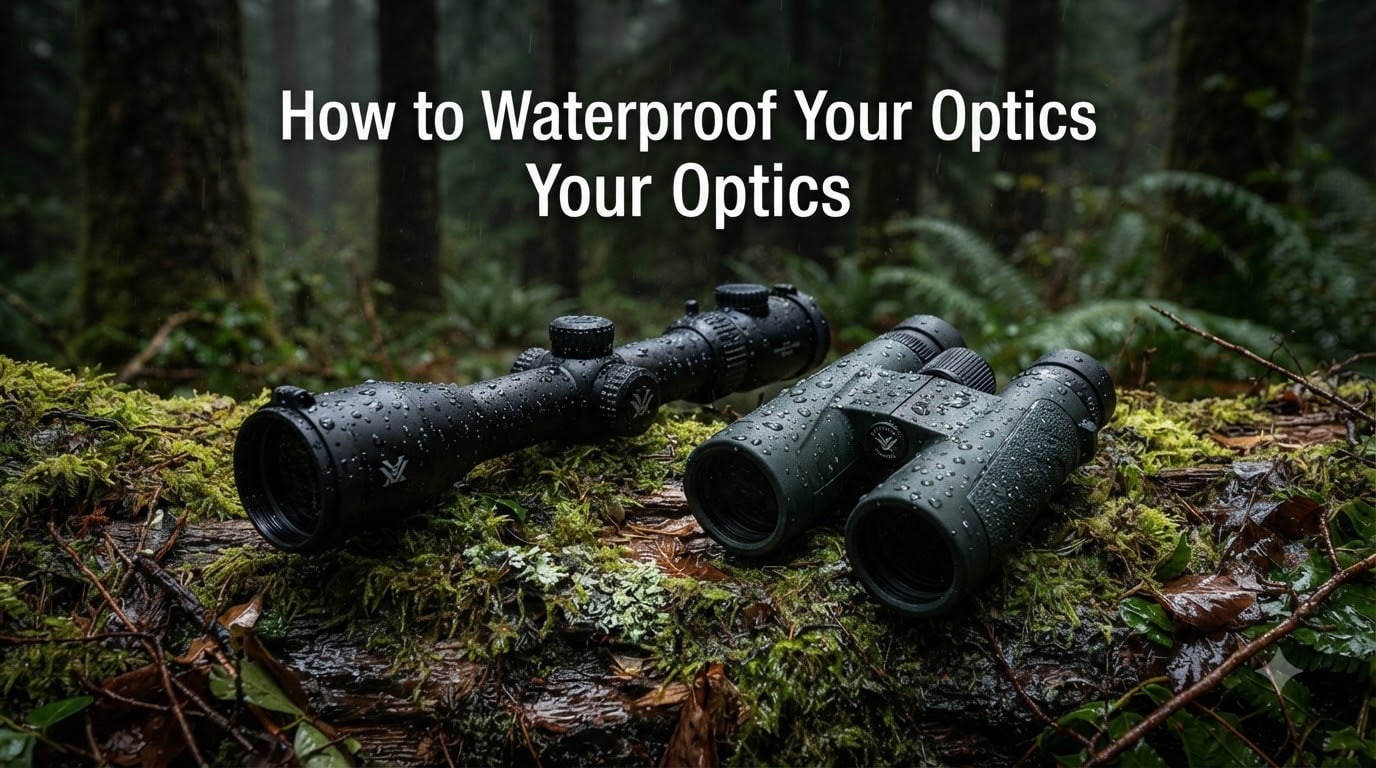
Rain does not care how expensive your scope is. I learned that the hard way on a November elk hunt when a $900 riflescope fogged from the inside and stayed that way for the rest of the season. If you have ever asked yourself how to waterproof your optics, the answer is layered, and most shooters only know one or two of the layers. After testing riflescopes, binoculars, and red dots in Pacific Northwest rain, Gulf Coast humidity, and a few accidental kayak dunkings, I have put together the field-tested playbook I wish I had back then.
This guide walks you through what actually makes optics waterproof, how to read an IPX rating, the covers and seals worth your money, and what to do when water gets in anyway. You will also get my emergency drying checklist for when you are stuck in the field without a workbench. Whether you shoot with waterproof binoculars or a sixty-year-old non-sealed scope, the principles below work the same way.
A truly waterproof optic is sealed against liquid water intrusion under more than just a sprinkle. Manufacturers achieve this with rubber O-ring gaskets at every joint, then purge the internal cavity with dry nitrogen or argon gas before sealing it for life. The gas pressure is slightly higher than atmospheric, so any microscopic leak pushes gas out instead of letting humid air seep in.
Fog proof is not the same thing as waterproof, even though the two often appear together. Fog proof means the interior cavity has no moisture to condense on cold glass. A scope can be fog proof but not waterproof if the seals fail and let liquid in. Conversely, a sealed optic that got knocked out of purge can hold water out for a while but still fog internally because humid air is trapped inside. Understanding that distinction matters when you read marketing copy or shop for a hunting optics upgrade.
Three construction features decide whether an optic keeps water out:
The sealed tube of a modern scope looks simple from outside, but inside it is a controlled environment. Knowing what each piece does helps you notice damage early and avoid voids that void the warranty.
Nitrogen purging replaces the room-temperature air inside the tube with dry nitrogen before the optic is sealed. Nitrogen is inert, so it does not react with lens coatings or anti-reflective surfaces. More importantly, the gas is injected at a pressure higher than atmospheric. That overpressure acts like a one-way valve, because any microscopic leak pushes nitrogen outward, blocking humid outside air from migrating in.
You will sometimes see argon instead of nitrogen. Argon is slightly denser, so it stays inside the tube marginally longer across temperature swings. For practical purposes, argon-purged and nitrogen-purged scopes behave the same in the field, and neither will fog from the inside if the seal holds.
Every seam, turret stem, hinge, and battery door needs a rubber gasket to keep water out. Even the best nitrogen purge is worthless if the O-rings are nicked, dried out, or coated in old grease. Manufacturers seal these with silicone or synthetic grease to extend service life and keep the rubber supple.
Common leak points on a riflescope or binocular are:
IPX ratings are the easiest way to compare how much water an optic is built to handle. The rating comes from the international IEC 60529 standard, and the X means the manufacturer did not test for solid-particle ingress, which scopes almost never advertise anyway. The number after IPX is what you care about. Here is how each rating translates to real field conditions:
Most hunting and shooting optics aim for IPX5 or IPX6. You will see IPX7 on SHTF optics marketed as dunk-proof, and IPX8 is reserved for serious types of binoculars built for marine use. If a manufacturer does not list an IPX rating, assume IPX0 and plan to bring your own rain protection.
Even fully waterproof optics need routine care to stay waterproof. Seals dry out, grease migrates, and coatings wear. A short checklist after every wet outing will add years to the life of your gear.
The first thirty minutes after a wet outing are when most damage happens. Water sits in the nooks around turrets and battery caps, and if you toss the optic into a warm vehicle, that moisture turns into vapor and migrates inward through micro-leaks.
Once a month, give each optic a slightly deeper service. This is also when you catch the small issues before they become foggy reticles or corroded battery contacts.
Manufacturer seals are the first line of defense, but covers and caps are the second line and they take the worst of the abuse. The right cover depends on how and where you use the optic.
Flip-up caps are spring-loaded polymer covers that snap closed when released. They are fast to use and stay out of the way when shooting, but they pop open on recoil from heavy magnum rifles and they let rain splash in through the hinge gap.
Bikini covers are elastic bands of neoprene or cordura that stretch across the tube and snap over the objective and ocular bells. They do not pop off, but they fail when stretched out, and rifle shooters report tension loss after one season of use.
Neoprene scope covers wrap the entire optic and tie off with a draw cord. They are bulky, slow to deploy, but they are the only cover type that consistently survives Alaskan downpours and Pacific Northwest tree-stand rain. For reflex sights and red dots, a neoprene cover is the only realistic option because exposed lenses fill with water instantly.
For bird watching binoculars, a quality tethered objective cap plus the included ocular cap is enough for most storms. For riflescopes on hunting rifles, neoprene covers paired with flip-up caps give you the best balance of speed and weather protection. For competition and target shooting, where speed matters more than weather, stick with rubber armored flip-ups and an umbrella in the staging area.
Sooner or later, water finds a way in. A dropped binocular in a river, a scope cap blown off in a storm, or a momentary lapse in judgment at a kayak launch all end the same way: an optic full of water. What you do in the first few hours determines whether you save it.
First, get the optic out of the water and remove every cap, battery, and cover. Open every port and let gravity do its work by setting the optic on a dry towel with the objective facing down. The reason for objective-down is simple: most O-rings and seals are designed to keep water out of the tube proper, so water that got in usually pools near the eyepiece or turret area. Drainage from that end comes first.
Do not use a hair dryer or any direct heat source. Hot air warps polymer housings, dries out O-ring grease, and can crack the bonding between lens elements. If you have access to a vehicle, point a vent at room temperature toward the open optic and let airflow do the work over several hours.
For moisture inside the tube that you cannot reach, toss in a few silica gel packets and seal the optic in a zip-top bag for 24 to 48 hours. Do not use rice. Rice dust gets into focus mechanisms and scratches lens coatings, and it is barely better than open air for pulling moisture from a sealed cavity. A proper silica canister from a camera dry cabinet works best.
Not every optic worth keeping is fully sealed. Older scopes, budget spotters, and most red dots leak. You cannot make them truly waterproof, but you can stretch their survivability in the field with a few low-cost tricks.
Electrical tape wrapped around the seam between objective bell and main tube keeps splashing rain out. It is not pretty and it leaves residue, but it works in an emergency and costs almost nothing. A thin layer of silicone grease on every threaded cap and on the inside of turret caps adds a partial gasket where none existed.
For the objective and ocular lenses, a sacrificial lens film cut from a camera UV filter offers cheap insurance. You screw the filter into the optic and lose a cheap filter instead of a coated objective when something scratches or hits the front element. Sacrificial films also keep driving rain from pooling on the lens.
Sometimes the best waterproofing is keeping water off the optic entirely. An umbrella clipped to a shooting stick or tripod keeps your spotting scope dry for hours. A truck bed cover or SUV hatch is a mobile blind during a storm. Hunters in tree stands use a pop-up blind as overhead cover. None of these are glamorous, but every one of them is recommended by real users on hunting forums because they work.
Water damage is not always obvious. A scope that fogs only on cold mornings, a binocular that shows tiny spider-web patterns inside the prism housing, and a rangefinder that gives inconsistent readings are all early warning signs.
Look for these telltales:
Light internal fog that responds to a silica bag can sometimes be saved. Fungal growth, etched coatings, and corroded electronics almost always mean replacement, because the optical surfaces are damaged at a molecular level. The cost of professional restoration usually matches a new entry-level optic, so weigh repair only for sentimental or high-end pieces. For most owners, prevention is dramatically cheaper than restoration.
Partial waterproofing is possible using silicone grease on threads, electrical tape over seams, and sacrificial UV filters on lenses. True purging requires factory-grade equipment, so proper internal waterproofing is not a realistic DIY job.
IPX5 or IPX6 covers heavy rain and wet brush, which is enough for most hunting. IPX7 is worth the upgrade for stream crossings, swamp work, or coastal hunting where a dunking is possible.
Remove all caps and batteries, set the optic objective-down on a dry towel in a warm, low-humidity room, and place silica gel packets inside the tube before sealing it in a zip-top bag for 24 to 48 hours. Avoid hair dryers and rice.
Not always. A scope that gets wet briefly and dries out within hours usually survives. Fog that lingers, fungal growth on lenses, or corroded battery contacts indicates permanent damage and replacement is usually the most cost-effective option.
A neoprene scope cover paired with quality flip-up caps gives the strongest defense in heavy rain. Bikini covers work for light drizzle but stretch out over time, and bare flip-up caps let splash water in through the hinge gap.
Waterproof optics come from a layered system, not a single feature. The internal purge and O-rings do the heavy lifting, IPX ratings tell you how much abuse the optic can take, and covers plus field habits handle the rest. If you are shopping for a new optic, prioritize IPX6 or IPX7 over flashy reticle features. If you already own an older non-sealed scope, the maintenance checklist and emergency drying steps above will keep it in the field for years.
The single biggest upgrade most shooters can make this year is a neoprene cover and a small silica gel canister in every hard case. Combined with fifteen minutes of post-rain maintenance, that routine protects more optics than any factory warranty. For a deeper dive on specific models worth your money, check our guide to waterproof binoculars and start with the IPX7-rated options if you live anywhere rain is a regular guest. Here is to a dry reticle and a clear sight picture in 2026 and every season after.