What Scope for a Deer Rifle? 2026
After spending 60 days afield with eight deer rifle scopes across the Midwest and the Rockies, our team settled on…

I learned the hard way that optics storage is not a “set and forget” task. After leaving a refractor in a damp garage for one humid summer, I pulled it out to find a milky bloom on the objective lens that no amount of cleaning would remove. Fungal spores had etched into the anti-reflective coating, and the glass was permanently damaged. That single mistake cost me a four-figure repair and pushed me to figure out, once and for all, how to store optics long term the right way.
Whether you own a Schmidt-Cassegrain, a pair of birding binoculars, a rifle scope, or a small Newtonian, the enemies are the same: humidity, temperature swings, dust, and neglect. This guide pulls together what I’ve picked up from years of field use, conversations with optical technicians, and reading every forum thread I could find on telescope and binocular preservation. I’ll walk you through the exact humidity thresholds, the post-session routine I now follow without fail, and how to pick a storage spot that won’t slowly destroy your investment.
Yes, binoculars go bad over time, but only when conditions work against them. A quality pair of nitrogen-purged, fog-proof binoculars stored in a climate-controlled closet can last 20-30 years with no optical degradation. The same pair stored in a damp garage may be ruined in 18 months. The difference is environmental, not the gear itself.
A well-cared-for telescope can serve a lifetime. Most quality refractors and Maksutovs from major manufacturers ship with 10-25 year warranties, and the optics themselves often outlast those warranties when properly stored. The lifespan of a telescope is more about how you treat it between sessions than how often you use it.
Long-term optics storage means anything longer than two weeks. Anything shorter falls under routine post-session care. Anything longer means you’re trusting the storage environment to do no harm for months at a time, and that’s where most optical damage happens.
The three categories of damage are fungus growth on lens coatings, delamination from thermal cycling, and micro-abrasion from settled dust. All three are preventable. None of them are reversible.
Humidity is the single biggest threat to stored optics, and the damage it causes is irreversible. Fungal spores are everywhere in the air, and they only need three things to colonize a lens surface: moisture, organic material, and warmth. Anti-reflective coatings are made of metal oxides and organic binders that fungi happily consume.
Temperature matters because rapid swings cause condensation. When you bring a cold telescope into a warm room, dew forms on every glass surface. Move it back to a cold garage and that moisture freezes into the threads and crevices. Over time, thermal cycling breaks down adhesives, shifts optical alignment, and creates the condensation that feeds fungal growth.
Dust is the most visible threat but the least destructive. A few particles on a lens surface will not meaningfully reduce image quality. Abrasive cleaning of dust is what causes damage. The goal of dust protection is to avoid having to clean in the first place.
Combine all three, and you get a worst-case scenario: warm air, high relative humidity, dust providing nutrients, and temperature swings delivering moisture to the lens surface. That is the environment that ruins optics, and it’s also the environment of an unheated garage or basement in many climates.
The safe humidity level for telescope and binocular storage is below 60% relative humidity, with the sweet spot sitting around 40-50% RH. Below 40% is excellent but rarely sustainable without active dehumidification. Above 60% RH and fungal spores start colonizing lens coatings within weeks. Above 70% RH, colonization can begin in days.
Fungal damage starts as a faint misty spot, often mistaken for a smudge. As the fungus matures, it develops a web-like structure that etches into the coating. By the time you can see it clearly, the lens surface is permanently damaged. I cannot stress this enough: once fungus etches into an anti-reflective coating, that section of the coating is gone for good.
Active dehumidification is the most reliable method. A small electric dehidifier running in a closed storage room can hold RH at 45% indefinitely. For a closet or cabinet-sized space, desiccant dehumidifiers work without electricity but need periodic recharging.
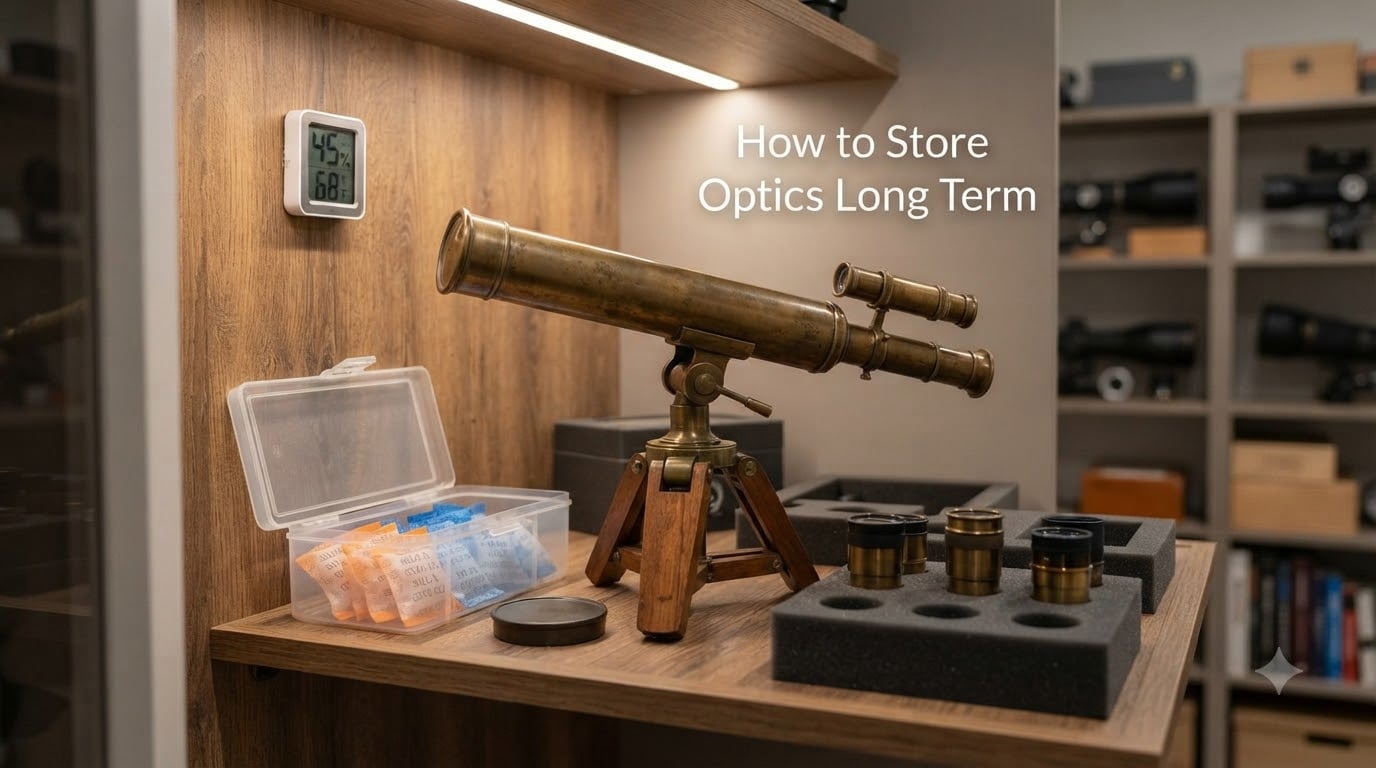
Silica gel packs are useful inside sealed cases and small storage boxes. I keep four large reusable silica gel canisters in my binocular case. The question of whether you need silica gel packs depends on your storage environment: if your room RH stays below 50% year-round, silica is belt-and-suspenders. If your storage area runs 60% RH or higher in summer, silica gel is essential inside any sealed container.
A hygrometer is non-negotiable for serious storage. I keep a digital hygrometer in every storage location. The unit cost is under $15 and it tells you whether your desiccants are working, whether your dehumidifier is keeping up, and whether you have a hidden moisture problem before it destroys $2,000 of optics.
Silica gel changes color when saturated. Indicating silica turns from blue to pink (or orange to green, depending on chemistry) as it absorbs water. Saturated silica gel can be recharged in a 250°F oven for 2-3 hours, or in a microwave on low for 90-second bursts. I mark the recharge date on each canister with a paint pen so I never lose track.
Optics tolerate stable cold better than they tolerate temperature swings. A telescope stored at a constant 35°F is generally safer than one stored in a garage that swings from 50°F to 90°F across a week. The damage isn’t from the cold itself but from the cycling that drives condensation in and out of the optical tube.
Thermal cycling breaks down adhesives used in lens cells and mirror mounts. It also shifts the focuser draw tube as metals expand and contract at different rates. After enough cycles, you can develop focus drift, shifted collimation, or even cracked cemented doublets in refractors.
For long-term storage, ideal conditions are stable temperatures between 50°F and 75°F. Avoid unheated spaces that swing more than 30°F between day and night, and avoid any storage location where the optics experience direct sunlight through a window. UV exposure degrades rubber eyecups, focusing knobs, and certain adhesives even when the glass itself stays cool.
If your only option is a garage or basement, insulate the storage area or wrap the optic in a thermal blanket to slow the cycling rate. A telescope sitting inside an insulated cabinet inside an unheated garage will experience far less thermal stress than one sitting on an open shelf.
Putting optics away wet is the single most common storage mistake. Even if you didn’t see rain or condensation, ambient humidity settles on every surface during a session. Skip the drying step, and you store optics in a thin film of moisture that feeds fungal spores.
Here is the procedure I run every time I bring optics inside, no exceptions.
Bring the optic inside with all dust caps and covers in place. Let it sit in its case for one to two hours to reach room temperature. Opening caps on a cold optic in a warm room causes immediate condensation on the inner lens surfaces.
Use a clean microfiber cloth to wipe moisture from the tube, focuser, and any rubber armor. Pay attention to the focus knob and the area around the eyepiece holder, where water tends to pool.
After the optic is at room temperature, remove the front dust cap and visually inspect the objective. Allow 30-60 minutes of air-drying with the cap off, ideally in a low-humidity room. A small desk fan on low speed directed across (not at) the lens speeds the process.
Eyepieces should never go straight back into a sealed case. Wipe each one down, then leave them out on a dry cloth for an hour before storing. I keep a dedicated eyepiece tray with slotted foam inserts that hold each eyepiece vertically so air circulates around them.
Place fresh or recharged silica gel canisters inside the case before closing it. If your case has foam inserts, replace them every 3-5 years as foam breaks down and traps moisture.
If your binoculars got soaked, the recovery procedure is more aggressive. Shake out visible water, leave the caps off, and store them in a sealed container with a large silica gel desiccant for 24-48 hours. Don’t use a hair dryer or oven. Heat damages anti-reflective coatings and seals. If water penetrated the prism housing, take the binoculars to a service center rather than trying to disassemble them yourself.
The best place to store a telescope long term is a climate-controlled interior room with stable temperature, low humidity, and protection from direct sunlight. A spare bedroom closet, a hallway cabinet, or a dedicated dry storage room all work well. The closer you can match the ideal 50-75°F, 40-50% RH range, the longer your optics will last.
Whether you can store a telescope in the garage depends on your climate. In dry, mild climates (such as the American Southwest), an insulated garage is acceptable. In humid or four-season climates, a garage exposes optics to the exact humidity swings and temperature cycling that destroy them.
Basements are usually worse than garages. Below-grade spaces hold humidity even when the house above is dry, and small water leaks go unnoticed for months. If you must use a basement, add a dehumidifier and a hygrometer before storing anything valuable.
Attics are the worst common storage location. Attics swing from below freezing in winter to 130°F+ in summer, and they trap moisture from the rooms below. The only time an attic makes sense is for a rarely-used optic in a sealed, climate-controlled cabinet.
Different telescope designs have different vulnerabilities. Storing them with their specific weak points in mind prevents the most common long-term damage for each design.
Store refractors vertically or horizontally, capped on both ends. The objective lens is the most expensive component, and storing the scope pointed downward lets dust settle away from the optic rather than onto it. If you must store horizontally, leave the front cap off and let the rear cap breathe until the optic has fully equalized.
Refractors are particularly sensitive to thermal cycling because the cemented doublet or triplet in the objective can crack from differential expansion. Avoid unheated garages if you own an expensive apochromat.
Newtonians should be stored capped, with the front opening sealed against dust infiltration. The primary and secondary mirrors are aluminum-coated, and dust on the primary rarely affects image quality enough to justify cleaning. Store the tube horizontally on its dovetail or in its original box.
If you store a Newtonian in a damp area, expect the mirror coatings to oxidize within 2-5 years. The result is a noticeable drop in reflectivity and dimmer images. Recoating is possible but expensive.
Schmidt-Cassegrain Telescopes (SCTs) and Maksutovs have a corrector plate at the front that seals the optical tube. Store them with both caps on, ideally in their original foam-lined case. The corrector plate is the most vulnerable component, and a single scratch requires an expensive replacement.
For long-term SCT storage, leave the visual back off the rear cell so the interior can equalize with ambient humidity. This prevents the sealed tube from slowly building up internal moisture.
Dobsonians present a storage challenge because of their size. The tube assembly stores horizontally on its rocker box or in a separate location. Cover the open top of the rocker box to keep dust out of the bearings, and cover the open end of the tube. The Teflon pads on Dobsonian bearings attract dust, and a dirty bearing ruins the smooth motion that makes Dobsonians a joy to use.
Eyepieces are some of the most sensitive optics you own, and they’re often stored worse than the telescope itself. Each eyepiece should live in its own protective case or in a foam-lined eyepiece tray, stored vertically with the eye lens facing up. Stacking eyepieces on top of each other invites scratches on the eye lens and lets dust settle into the field stop.
Anti-reflective coatings on eyepieces are thinner than those on telescope objectives and more vulnerable to fungus. If your telescope eyepieces live in a high-humidity environment, expect fungal bloom on the coatings within a year. Store them in a sealed container with silica gel and a hygrometer.
Any optic with a battery needs the battery removed before long-term storage. Alkaline batteries leak within 2-5 years, and the corrosive electrolyte destroys circuit boards and contacts. Lithium batteries last longer but still leak eventually. Pull every battery, store it separately, and check the contacts for corrosion before reinstalling.
Rangefinders, red dot sights, and DSLR lenses all benefit from the same humidity-controlled storage as telescopes. Treat them as one category of valuable precision optics, and apply the same 40-50% RH target.
Mice and rats love the cardboard cases that ship with most telescopes and binoculars. Rodents chew through foam, nest in eyepiece trays, and destroy optics with their droppings. If your storage area is in a garage, basement, or shed, store optics in hard plastic cases or metal cabinets rather than cardboard. Set traps in the storage area and check them monthly.
I have lost count of the forum threads I’ve read where someone returned to a stored telescope to find a mouse had nested in the focuser draw tube. The fix is prevention: a metal cabinet, a sealed plastic case, or a storage area that’s clearly rodent-proof.
Yes, binoculars can go bad over time, but only when stored in poor conditions. Quality nitrogen-purged binoculars stored at 40-50% relative humidity and stable room temperature can last 20-30 years with no optical degradation. Storing them in damp or temperature-cycling environments leads to fungal growth on lens coatings, delamination, and corroding prisms, often within 1-3 years.
The safe humidity level for telescope storage is below 60% relative humidity, with 40-50% RH as the ideal target. Above 60% RH, fungal spores start colonizing anti-reflective lens coatings within weeks. Use a digital hygrometer to verify your storage area, and add silica gel or a dehumidifier if humidity creeps above 50%.
It depends on your climate. In dry, mild climates (such as the American Southwest), an insulated garage is acceptable if humidity stays below 60% RH. In humid or four-season climates, garage storage exposes optics to temperature swings of 40+ degrees and humidity spikes that damage coatings, shift collimation, and feed fungal growth. A climate-controlled interior closet is always the better choice.
Silica gel packs are recommended for any sealed storage case, and required if your storage area runs above 50% relative humidity. Indicating silica gel that changes color when saturated is the most useful type. Recharge saturated silica in a 250°F oven for 2-3 hours, or in a microwave on low in 90-second bursts. Replace silica gel canisters every 2-3 years as the absorbent material degrades.
A well-maintained telescope can last a lifetime and often outlives its original owner. Quality refractors, Maksutovs, and Newtonians from major manufacturers routinely serve 30+ years of regular use. The limiting factor is almost always storage conditions and lens coating degradation, not mechanical wear. With proper humidity control and dust protection, telescope lifespan is essentially unlimited.
Here is the storage checklist I run before any optic goes into long-term storage. Print it out and tape it inside your storage cabinet.
Learning how to store optics long term is mostly learning to respect humidity and temperature swings. The single biggest improvement you can make is adding a digital hygrometer to your storage area. Once you see what your environment actually does, the right combination of silica gel, dehumidification, and case choice becomes obvious.
If you take one thing away from this guide, let it be the 60% rule. Keep relative humidity below 60%, ideally below 50%, and your optics will outlive the next decade. Skip that step, and no amount of cleaning or recollimation will undo the fungus that grows on coatings. Use 2026 as the year you finally get your storage under control, and your telescope and binoculars will thank you for the next 20 years of use.