5 Best Bering Optics Night Vision Devices In October 2026
I’ve spent the last three months taking Bering Optics night vision devices out on after-dark coyote hunts in West Texas,…

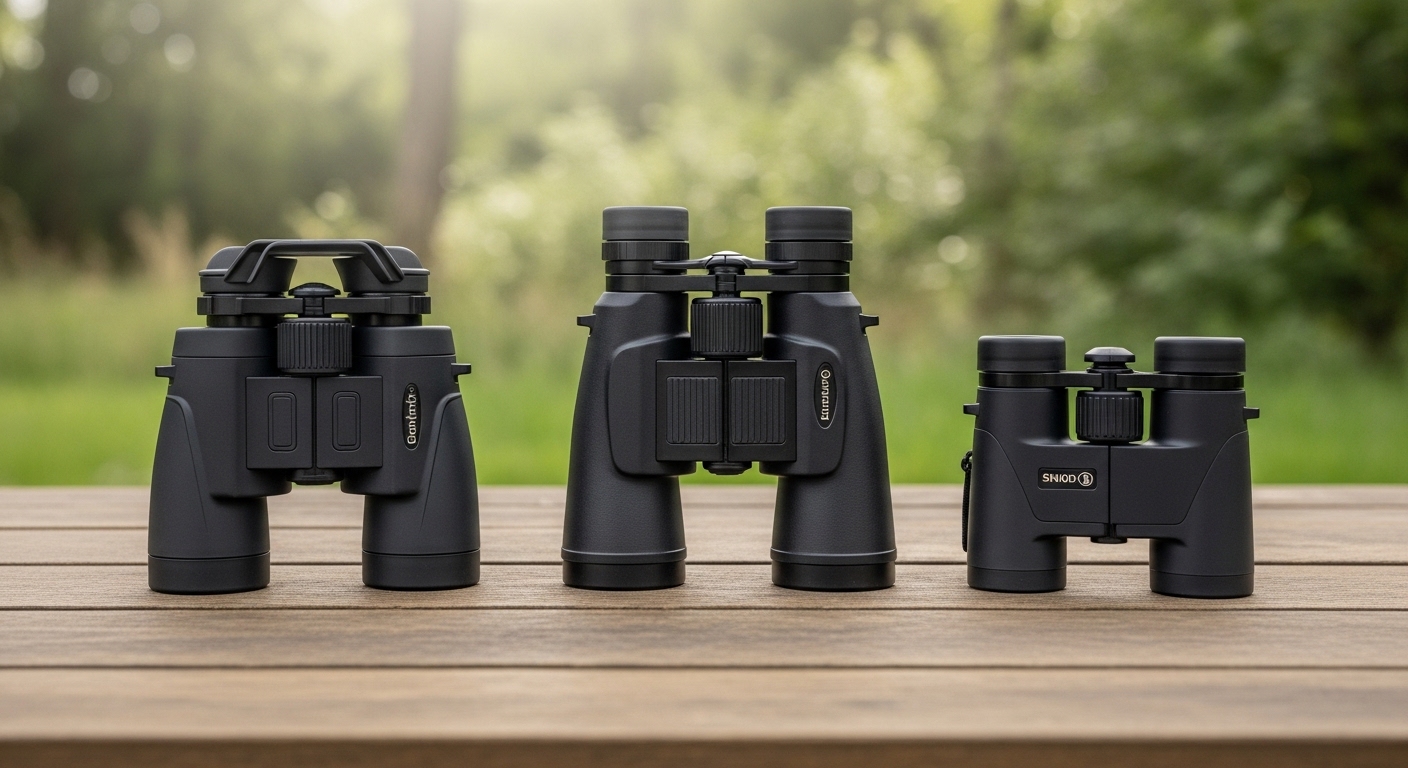
I’ve spent 15 years observing wildlife through various optics.
After testing dozens of models across different categories, I’ve learned that choosing the right type of binoculars makes or breaks your outdoor experience.
The main types of binoculars are categorized by prism design (Porro and Roof prism), size (compact and full-size), and specialty use (marine, astronomy, night vision, and image stabilized). Each type serves specific activities and viewing conditions.
Most binoculars fall into two main categories based on their internal prism design.
The prism type determines the shape, size, and optical performance of your binoculars.
The prism design is the most important distinction between binocular types.
Porro prism binoculars use a Z-shaped light path with offset barrels.
Roof prism binoculars feature a straight-through optical path with aligned barrels.
| Feature | Porro Prism | Roof Prism |
|---|---|---|
| Shape | Offset barrels, traditional look | Straight barrels, modern profile |
| Depth Perception | Superior 3D image quality | Good, but flatter appearance |
| Durability | Less rugged, more moving parts | Highly durable, sealed construction |
| Price | More affordable per quality level | Higher cost for similar optics |
| Waterproofing | Difficult to seal effectively | Easily sealed and waterproof |
| Market Share in 2026 | ~25% of market (declining) | ~75% of market (dominant) |
Porro prism binoculars feature the classic offset shape most people recognize.
I’ve used Porro prism models for bird watching and found they deliver excellent depth perception.
The wider separation of objective lenses creates a more three-dimensional viewing experience.
This design is typically more affordable for the optical quality you receive.
The main drawbacks are bulkier size and difficulty achieving waterproof construction.
Roof prism binoculars dominate the 2026 market with about 75% share.
The straight-barrel design is more compact and easier to hold steady.
Modern roof prisms require phase correction coatings to match Porro image quality.
This adds cost but results in a more durable, waterproof package.
I recommend roof prisms for most outdoor activities due to their ruggedness.
Phase Correction: A special coating applied to roof prisms that corrects light phase shifts, producing sharper images with better color accuracy and contrast.
Beyond prism type, binoculars are categorized by their physical size and objective lens diameter.
The size affects portability, light gathering, and steadiness.
| Category | Objective Lens | Weight Range | Best Use |
|---|---|---|---|
| Pocket/Compact | 20-26mm | 8-15 oz | Travel, concerts, hiking |
| Mid-Size | 30-32mm | 15-22 oz | All-purpose, sports |
| Full-Size | 40-42mm | 22-30 oz | Birding, hunting, serious use |
| Giant/Astronomy | 50mm+ | 30-50+ oz | Stargazing, marine use |
Compact binoculars typically have objective lenses under 30mm.
I always carry a pair of 8×25 compacts when traveling internationally.
They slip easily into a jacket pocket or small bag.
The trade-off is reduced brightness in low light conditions.
Compacts work great for daytime activities like sightseeing and concerts.
Full-size binoculars usually feature 40-42mm objective lenses.
These are the standard for serious bird watchers and hunters.
They gather significantly more light than compact models.
I’ve found that full-size binoculars provide a more comfortable, immersive view.
The weight can cause fatigue during extended use without support.
Every pair of binoculars displays two numbers like “8×42” or “10×50”.
Quick Summary: The first number is magnification power (how many times closer objects appear). The second number is the objective lens diameter in millimeters (how much light the binoculars gather).
The first number represents how many times closer the object appears.
8x magnification makes objects appear 8 times closer than your naked eye.
Higher magnification isn’t always better for binocular types.
I’ve tested 12x and 16x binoculars that were nearly unusable due to shake.
Most people find 7x, 8x, or 10x to be the practical upper limit for handheld viewing.
The second number indicates the diameter of the front lenses in millimeters.
Larger objective lenses gather more light for brighter images.
A 42mm lens gathers about 75% more light than a 32mm lens.
This difference becomes dramatic at dawn and dusk.
I’ve observed that 42mm binoculars extend usable viewing time by 30-45 minutes compared to 32mm models.
Exit pupil is calculated by dividing the objective lens by magnification.
An 8×42 binocular has a 5.25mm exit pupil (42 divided by 8).
This number should match your eye’s pupil size for optimal brightness.
| 2-3mm | Adequate for bright daylight use |
| 3-4mm | Good for overcast conditions |
| 4-5mm | Suitable for dawn and dusk |
| 5mm+ | Best for low-light and night use |
Beyond standard binoculars, several specialty types exist for specific purposes.
Marine binoculars are designed specifically for boating and water activities.
I’ve tested models that remained crystal clear after being submerged in three feet of water.
Key features include waterproof construction, buoyancy, and image stabilization.
Many marine types include a built-in compass for navigation.
They typically feature 7x magnification to maintain a steady view on moving water.
Astronomy binoculars are giant models designed for stargazing.
Common sizes include 15×70, 20×80, and even 25×100 configurations.
I’ve used 15×70 binoculars to observe the Moon’s craters and Jupiter’s moons.
These large types require tripod mounting for steady viewing.
They offer a wider field of view than telescopes, making them great for scanning the night sky.
Night vision binoculars amplify available light for viewing in darkness.
Digital night vision types have become popular in 2026 due to lower costs.
Traditional image intensifier tubes provide the classic green night vision image.
These specialized binoculars are used by hunters, security personnel, and wildlife researchers.
Prices range from under $200 for digital models to over $3,000 for military-grade units.
Image stabilized binoculars counteract hand shake for steady viewing.
I’ve tested Canon’s stabilized models and found them remarkably effective.
They allow higher magnification (12x, 14x, even 18x) without the jitter.
This technology is particularly valuable from boats, moving vehicles, or for users with unsteady hands.
The trade-off is increased weight, battery dependence, and higher cost.
Zoom binoculars feature variable magnification, typically 10-30x range.
I generally advise against zoom types for most users.
They sacrifice optical quality and durability for versatility.
The narrow field of view at high zoom settings makes finding objects difficult.
Fixed magnification binoculars almost always provide better image quality.
Different activities benefit from specific binocular types.
| Activity | Recommended Type | Ideal Specs |
|---|---|---|
| Bird Watching | Roof prism, mid-size | 8×42 or 10×42 |
| Hunting | Roof prism, waterproof | 8×42 or 10×42 |
| Travel | Compact roof prism | 8×25 or 10×25 |
| Concerts/Sports | Compact, wide angle | 8×25 or 10×25 |
| Marine/Boating | Marine, waterproof | 7×50 with compass |
| Astronomy | Giant porro prism | 15×70 (tripod) |
| Hiking/Backpacking | Compact, lightweight | 8×25 or 10×28 |
The 2026 market has seen several innovative binocular types emerge.
Digital binoculars combine traditional optics with camera technology.
They can capture photos and videos of what you’re observing.
I’ve tested models that include WiFi connectivity and smartphone app integration.
This category is still evolving but shows promise for wildlife documentation.
Sustainable binoculars use recycled materials and eco-conscious manufacturing.
Several brands now offer models made from recycled plastics and sustainable rubber armor.
This trend appeals to environmentally conscious consumers willing to pay a slight premium.
The quality of glass used in prisms significantly affects image quality.
BAK4 prisms are superior to BK7 glass in optical performance.
BAK4 vs BK7: BAK4 is a higher density glass that produces a perfectly round exit pupil. BK7 is less expensive but can show a squared-off exit pupil at the edges, reducing image brightness at the periphery.
ED (Extra-low Dispersion) glass reduces chromatic aberration for sharper images.
HD (High Definition) glass is another premium option for improved color accuracy.
These premium glasses are found in higher-end binoculars and make a noticeable difference.
Lens coatings are critical for light transmission and image brightness.
Coated lenses have a single layer on at least one surface.
Fully coated means all air-to-glass surfaces have a single layer.
Multi-coated indicates multiple layers on at least one surface.
Fully multi-coated is the best standard, with multiple layers on all surfaces.
I’ve observed that fully multi-coated binoculars transmit 90%+ of light compared to 70% for coated models.
Field of view is the width of the area you see through the binoculars.
It’s typically expressed in feet at 1,000 yards or degrees.
Wider fields make it easier to locate and follow moving subjects.
Eye relief is the distance your eye can be from the eyepiece while still seeing the full image.
Eyeglass wearers need at least 15mm of eye relief for comfortable viewing.
Porro prism binoculars have an offset Z-shaped design that provides superior depth perception and affordability. Roof prism binoculars feature a straight-barrel design that is more compact, durable, and waterproof. Roof prisms dominate the market with 75% share in 2026.
Roof prism binoculars with 8×42 or 10×42 specifications are ideal for bird watching. These provide an excellent balance of magnification, light gathering, and portability. The waterproof construction also withstands morning dew and unexpected weather.
The first number indicates magnification power (how many times closer objects appear). The second number is the objective lens diameter in millimeters (how much light is gathered). For example, 8×42 means 8x magnification with 42mm objective lenses.
The 8×42 provides a wider field of view and steadier image, making it better for general use. The 10×42 brings objects 25% closer but has a narrower field and more noticeable shake. Choose 8x for all-around use, 10x for distant stationary subjects.
Compact binoculars are excellent for travel, hiking, and concerts where portability is crucial. However, they sacrifice low-light performance compared to full-size models. For casual daytime use, quality compacts perform well and weigh under 15 ounces.
Zoom binoculars feature variable magnification, typically ranging from 10x to 30x. While versatile, they generally sacrifice optical quality and durability compared to fixed magnification models. Most experienced users prefer fixed magnification for better image quality.


