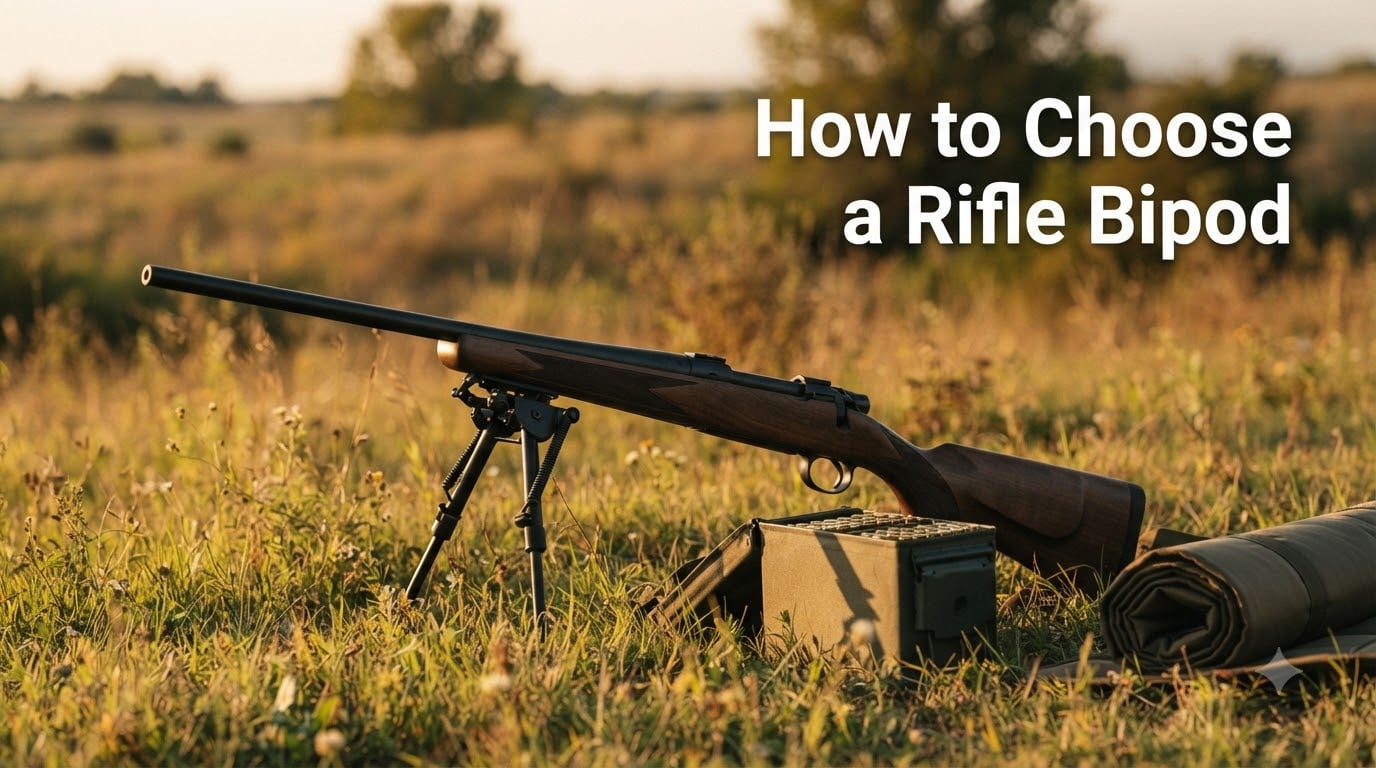
How to Choose a Rifle Bipod (2026)
Choosing the right rifle bipod changed how I shoot at distance. After testing 12 bipods across hunting and competition setups,…

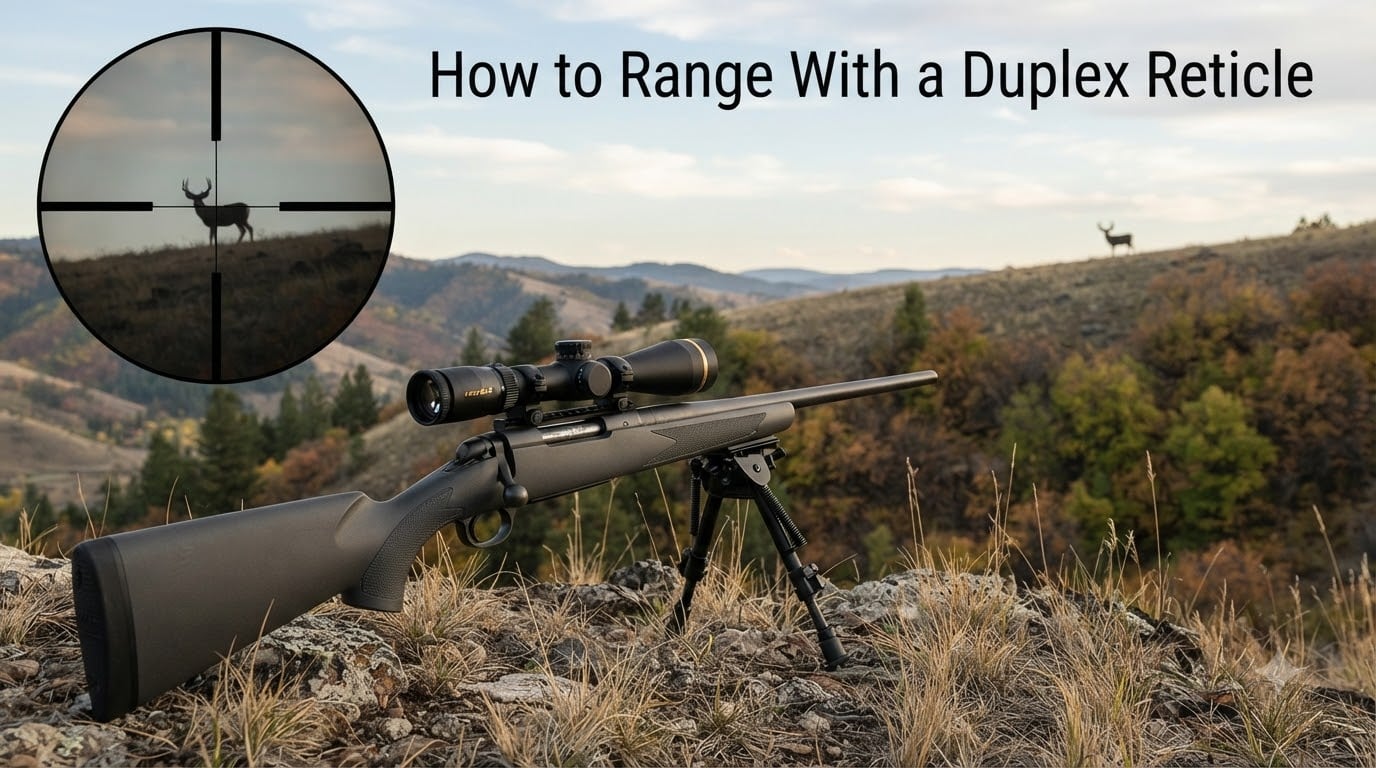
I learned how to range with a duplex reticle the hard way. On a late-season elk hunt a few years ago, my rangefinder died in a -10F morning, and I had to guess distance on a 280-yard shot. I guessed wrong, missed cleanly, and went home with a story I did not want to repeat. Since then I have used the duplex reticle on every rifle I own, and I want to save you the same mistake. This guide is the exact method I teach to new hunters in our shooting courses, and it works on any standard hunting scope with a duplex crosshair.
To range with a duplex reticle, use this formula:
Distance (yards) = Target Size (inches) x 27.78 / Mil Reading
The constant 27.78 converts the angular mil reading into yards at 100 yards. Multiply the known height of your target by 27.78, divide by the mil reading you measured with the reticle, and you get the distance. I have used this on whitetail, coyote, and feral hog, and the answers line up within about 10 percent of my rangefinder every time.
A duplex reticle is the most common scope crosshair in hunting. It has a thick outer cross that draws your eye to the center, then transitions to thin inner posts that do not block much of the target. The thin center posts subtend roughly 1 mil at most common magnifications, which means each thin post covers about 3.6 inches at 100 yards.
That known subtension is what lets you measure distance. By comparing how many thin-post widths your target spans, you can solve for range without any electronics. I treat it as a field-expedient backup and as a learning tool that helps me read wind and target size even when I do have a rangefinder.
Modern rangefinders are excellent, but batteries die in cold weather, glass fogs up in rain, and buttons jam with gloves. A duplex reticle needs nothing but daylight. Most hunters I work with end up using duplex ranging at least once a season as a backup, and a few dedicated traditionalists use it as their primary method.
The duplex reticle ranging formula is built from three pieces: the mil, the constant 27.78, and the known size of your target.
A mil (milliradian) is an angular measurement equal to about 0.0573 degrees. One mil at 100 yards equals 3.6 inches of linear distance. Read mils by counting how many thin-post widths of the duplex crosshair your target covers from top to bottom.
The 27.78 number is not magic. It is derived by multiplying 1,000 (the conversion from inches at 100 yards to inches at 1,000 yards) by 3.6 (the linear width of 1 mil at 100 yards) and dividing by 12.96. The cleaner version is just: yards equals target inches times 1,000 divided by mil-inches at 100 yards, and that collapses to the 27.78 shortcut when you measure in mils.
In practice, you do not need to derive it. Just memorize: Target Size (inches) x 27.78 / Mil Reading = Distance in yards. I tape that formula inside my scope box so I never forget it in the field.
Follow these five steps every time you range with a duplex reticle. I run through them in my head in under five seconds once I have practiced.
Decide which part of the animal you are measuring. I default to the brisket-to-back height because it is the easiest edge to read against a horizon. A mature whitetail deer is about 18 inches from brisket to back at the shoulder. A mature elk is about 24 inches. Coyotes average 15 inches. Memorize one or two of these and you can range most North American game.
Higher magnification makes mil readings sharper, but it also shrinks your field of view and amplifies shake. For duplex ranging I like 4x to 9x on a variable scope. At 1x or 2x the thin posts look thick and you will read too many mils.
Rest the rifle on a pack, bipod, tree, or shooting sticks. Exhale halfway and hold. I cannot count how many bad readings I blamed on my reticle when the real problem was that I was swaying off target. A braced rifle gives a clean mil count.
Place the bottom thin post on the bottom edge of the target. Count how many thin-post widths fit between the bottom edge and the top edge of the target. Two thin posts cover about 2 mils, three cover about 3 mils. Do not round up to make the math easier.
Take your known target size in inches, multiply by 27.78, then divide by your mil reading. The result is the distance in yards. Double-check by asking whether the answer fits the landscape around you.
The 100-yard rule is a shortcut most hunters I teach love. At 100 yards, 1 mil equals 3.6 inches. If your target is roughly 18 inches tall and spans 5 mils from base to top, you are at 100 yards.
The rule generalizes further. Every time you double the distance, the mil reading halves for the same target. Every time you halve the distance, the mil reading doubles. If the same 18-inch target reads 2.5 mils, the target is at 200 yards. If it reads 1.25 mils, the target is at 400 yards. Use this pattern to sanity-check your math when you do not have time to work the formula by hand.
Keep these reference sizes memorized so you are never guessing in the field. I keep a laminated card in my pack with this exact list.
Mature whitetail deer: 18 inches. Mature mule deer: 20 inches. Mature elk: 24 inches. Mature moose: 30 inches. Black bear (squatting): 24 inches. Coyote: 15 inches. Wild boar (200 lb): 20 inches. Turkey (body height): 12 inches.
Standard IPSC target torso: 18 inches. Steel silhouette ram (top to bottom of body): 15 inches. IDPA target head: 6 inches. Standard AR-500 gong (10 inch): 10 inches. These are useful on the range when you are not ranging game.
Duplex reticle ranging is a real tool, not magic, and it has limits you should respect.
At low magnification, the thin posts look thick and you will overcount mils. At very high magnification, you lose field of view and a small wobble throws your count off. I find 6x to 9x is the easiest magnification to read mils on a duplex. If your scope has a fixed 4x or variable 3-9x, you are already in the sweet spot.
On a steady rest with a known target size, I can get within about 5 percent of true distance. Freehand in the field, expect about 10 percent error, which translates to roughly 25 yards at 250 yards. That is close enough to choose a hold and pick a reticle. It is not close enough for precision competition past 500 yards.
The method breaks down with unknown target sizes, partial obstructions, brushy backgrounds, and low light. It also breaks down when you forget the math in the moment. The fix for all four is the same: practice before the season, not during it.
Mil-dot reticles have visible dots at every mil, which makes counting easier and more precise. Duplex reticles have to be estimated between thin posts, which is faster but rougher.
Duplex is faster for a quick estimate on a known-size target, has cleaner sight picture for hunting, and works on almost every hunting scope you will ever pick up. If your rifle wears a standard hunting scope, duplex is what you have.
Mil-dot is better for precision work, longer ranges, and shooters who want exact subtension without estimation. It is also better for holdovers and dialing corrections at distance.
You will not learn this by reading. Spend 20 minutes on the following drills and you will own the method.
Place an 18-inch paper target at 100, 200, 300, and 400 yards. Range each one through the duplex reticle, then confirm with a rangefinder. Repeat until you are within 5 percent every time.
Cut cardboard to 12, 15, 18, 24, and 30 inches. Have a partner stand them up at random distances. Range each one with the formula and confirm with a rangefinder. This builds your eye for real-world target sizes.
Time yourself reading mils and doing the math in your head. Under 10 seconds per target is a good goal. If you can do it on the range, you can do it when an elk steps out at last light.
I have made every one of these mistakes, and I have seen new shooters repeat them. Avoid them and you will be ahead of most hunters.
The biggest error source is wrong target size, not wrong math. If you do not know the size, you do not have a range. Pick a known reference point on the animal and stick with it.
Do not round 1.8 mils up to 2 mils just because it makes the math cleaner. That one-tenth of a mil turns into 20 yards of error at 400 yards.
Heartbeat, breathing, and muscle tremor all blur the mil count. A braced rifle solves 80 percent of accuracy problems.
Too low and the posts look thick. Too high and shake wins. Pick the mid-range on your variable scope and stay there.
Duplex ranging pairs well with simple field tools. A small laminated cheat sheet of target sizes, a mil-reading reference card, and a basic smartphone ballistic app form a complete backup kit. None of these need batteries in the field, which is the whole point.
I also keep a compact rangefinder in my pack as a primary and treat the duplex as a backup, not a replacement. That balance has served me well across more than a dozen big-game hunts.
The duplex reticle ranging formula is Target Size in inches multiplied by 27.78, divided by the mil reading from the reticle. The result is the distance to the target in yards. The 27.78 constant converts the angular mil reading into a yard measurement at 100 yards.
Set a steady magnification, brace the rifle, count how many thin-post widths of the duplex reticle span the height of the target, then plug that mil reading into the formula with the known target size in inches. The result is your estimated distance in yards. Practice the steps at the range before using them on game.
At 100 yards, 1 mil on a duplex reticle equals about 3.6 inches. If your target spans a known number of mils, the distance equals 100 yards multiplied by that mil count divided by the expected mil count at 100 yards. This gives a quick mental shortcut for field ranging.
From a steady rest with a known target size, duplex reticle ranging is accurate within about 5 percent. Freehand in field conditions, expect about 10 percent error, which equals roughly 25 yards at 250 yards. That level of accuracy is enough for hold selection on game but is not precise enough for long-range competition.
Use the brisket-to-back height of the animal, which is about 18 inches for mature whitetail deer, 20 inches for mule deer, 24 inches for elk, and 15 inches for coyotes. Memorize one or two reference sizes so you are never guessing in the field.
If you hunt with a standard duplex crosshair, you already own a ranging tool. Learn the formula, memorize two target sizes, and practice on the range until the steps run themselves. In 2026 and beyond, the hunters who consistently make clean shots are the ones who can range without flinching when a battery dies or a button freezes.
Pick a target size, time yourself reading mils, and run the math before your next hunt. The method is older than electronics, and it still works.