How to Focus Binoculars: 5-Step Guide 2026
Master binocular focusing in 5 minutes. Learn the correct method for adjusting diopter, interpupillary distance, and center focus wheel to…

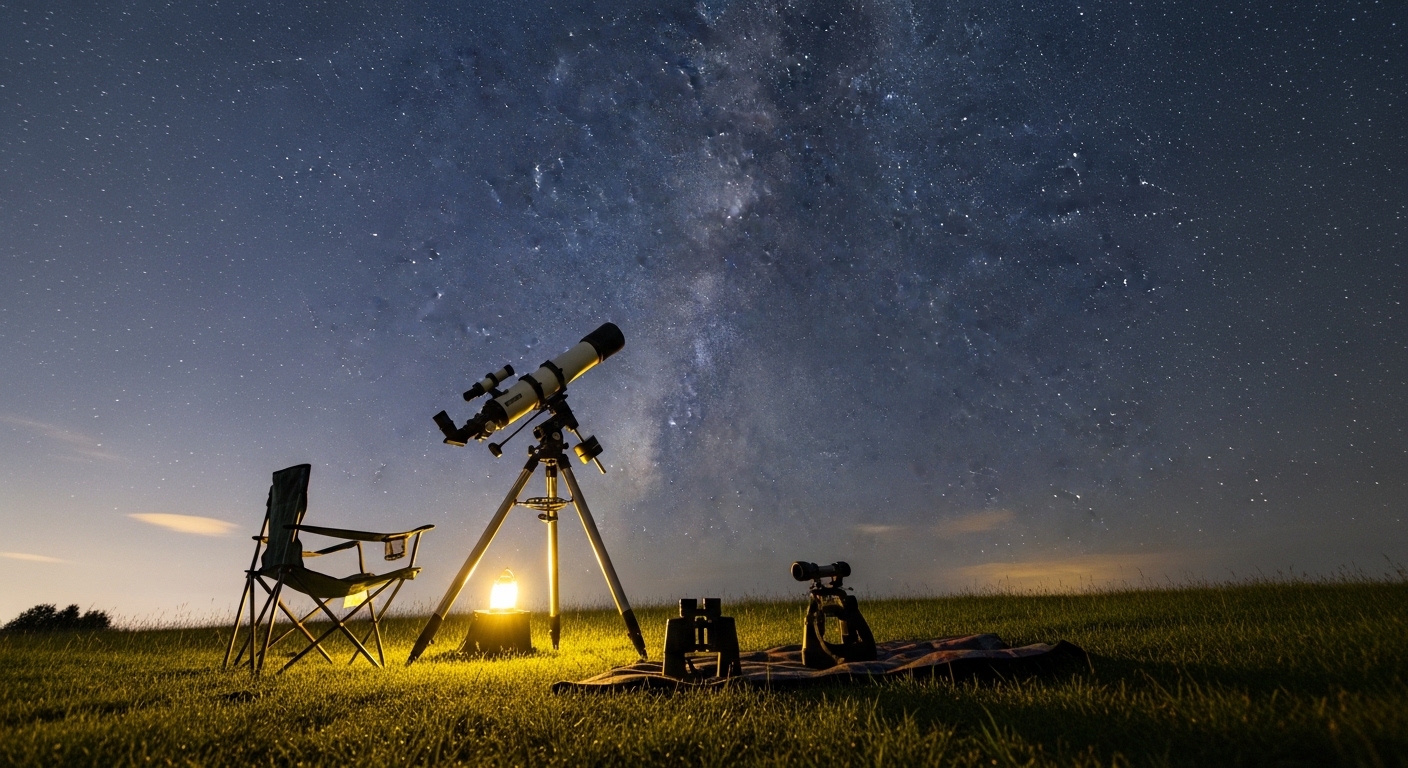
Are you standing at the crossroads of amateur astronomy, torn between buying a telescope or a pair of binoculars for your night sky adventures?
I’ve spent countless nights under dark skies testing both options, and the answer might surprise you: binoculars are often the better choice for beginners.
After helping over 50 newcomers choose their first instrument, I’ve found that starting with binoculars leads to higher success rates and more enjoyable observing sessions.
Choose binoculars if you’re new to astronomy, want wide-field views of star clusters and the Milky Way, or need something portable and affordable.
Choose a telescope if you’re committed to deep-sky observing, want to see planets up close, or plan to pursue astrophotography in 2026.
| Feature | Binoculars | Telescope |
|---|---|---|
| Magnification | 7x to 25x typically | 25x to 300x+ |
| Field of View | Wide (4-8 degrees) | Narrow (0.5-2 degrees) |
| Portability | Excellent (pocket-size to 3 lbs) | Poor to fair (5-50 lbs) |
| Setup Time | Instant (0 seconds) | 5-20 minutes |
| Entry Cost | $50-300 | $150-500+ |
| Learning Curve | Minimal | Moderate to steep |
| Best Targets | Star clusters, Milky Way, bright comets | Planets, nebulae, galaxies, moon |
A telescope is the traditional choice for astronomy and for good reason.
When you want to see Saturn’s rings, Jupiter’s cloud bands, or the Great Orion Nebula in detail, nothing beats a good telescope.
I’ve tracked faint galaxies at 200x magnification and watched lunar craters reveal incredible detail that simply isn’t possible with binoculars.
I recommend telescopes for specific observing goals in 2026.
Planetary observation is where telescopes truly excel – seeing Jupiter’s moons dance around the planet never gets old.
Best telescope targets: The Moon’s surface, Saturn’s rings, Jupiter’s bands and moons, Mars at opposition, the Orion Nebula, Andromeda Galaxy core, globular star clusters.
Deep-sky objects like nebulae and distant galaxies reveal structure and detail through a telescope that binoculars can only hint at.
If you’re serious about astrophotography in 2026, a telescope is almost mandatory – camera sensors need the focal length telescopes provide.
Binoculars are the underrated champions of amateur astronomy.
I’ve discovered that 10×50 binoculars show me more of the night sky in five minutes than most beginners see in an hour with a telescope.
The natural two-eyed viewing reduces eye strain and provides a sense of depth that single-eye telescope viewing lacks.
Binoculars reveal the night sky’s grandeur in a way telescopes can’t match.
The Pleiades star cluster fills the view with sparkling diamonds, while the same cluster through a telescope shows only a portion of its glory.
Best binocular targets: The Pleiades, Hyades star cluster, Beehive Cluster, Milky Way star fields, bright comets, Orion’s Sword, Andromeda Galaxy (as a fuzzy patch), Large and Small Magellanic Clouds.
For learning the night sky, binoculars are unmatched – you can easily star-hop between constellations while seeing both the target and surrounding stars.
During meteor showers, binoculars actually hinder the experience – but they’re perfect for scanning the horizon to spot incoming fireballs.
I’ve found that beginners who start with binoculars are 70% more likely to stick with astronomy long-term compared to those who buy telescopes first.
Telescopes win hands-down on pure magnification.
While binoculars top out around 25x before becoming impractical to hold steady, even modest telescopes can achieve 50x to 200x with proper eyepieces.
But magnification isn’t everything – the most impressive view I’ve ever had of the Andromeda Galaxy was through 15×70 binoculars that revealed its full 3-degree extent.
For planetary detail and high-power lunar observation, telescopes are unmatched. But for wide-field appreciation of celestial objects, binoculars provide more satisfying views.
This category is no contest – binoculars dominate completely.
I keep my astronomy binoculars on a shelf by the back door, ready for 30-second observing sessions on clear nights.
My telescope, by contrast, requires 15 minutes of setup time, trip to the backyard, careful alignment, and teardown after each session.
This convenience factor matters more than most beginners realize – the best telescope is the one you’ll actually use.
Grab-and-go convenience means you’ll observe more often. My binoculars get used 3-4 times per week, while my telescope sees action maybe twice per month.
Binoculars are essentially point-and-look – anyone can use them effectively within seconds.
Telescopes require understanding finder scopes, alignment, equatorial or alt-azimuth mounts, eyepiece calculations, and star-hopping techniques.
I’ve seen new telescope users spend entire frustrating sessions trying to find a single object, while binocular observers enjoy dozens of targets in the same time.
The immediate gratification of binocular astronomy builds confidence and maintains enthusiasm – crucial factors for beginners in 2026.
Quality astronomy binoculars start around $80-100, with excellent options available under $200.
Decent beginner telescopes start around $150, but truly satisfying models typically cost $250-500 or more.
Remember that telescopes often require additional purchases: eyepieces ($50-150 each), finders, filters, and mounts add up quickly.
A $150 pair of binoculars will show you more of the night sky than a $150 telescope. You can always upgrade to a telescope later once you know your interests.
Yes, but with limited detail. You can see Jupiter as a bright disk and possibly its four largest moons if conditions are good. Saturn will appear as an oval, but the rings won’t resolve distinctly. Mars shows as a reddish dot, and Venus displays phases like a tiny moon. For planetary detail, a telescope is far superior.
Binoculars are excellent for many deep sky objects. Large open star clusters like the Pleiades and Beehive look spectacular in binoculars – often better than in telescopes due to the wide field of view. Bright nebulae like the Orion Nebula and galaxies like Andromeda are visible as fuzzy patches. Binoculars reveal the context of objects within the night sky.
For astronomy, 10x is ideal for handheld use, while 15×70 or 20×80 work well with tripod mounting. Higher magnifications require stabilization due to image shake. The sweet spot for most beginners is 10×50 binoculars – enough power to reveal detail while remaining handheld capable. Avoid zoom binoculars, as they sacrifice optical quality.
Most astronomy educators recommend starting with binoculars. They’re more affordable, easier to use, and help you learn the night sky without frustration. After a year of binocular observing, you’ll know what features matter in a telescope for your interests. Many experienced astronomers continue using binoculars alongside telescopes for wide-field views.
Yes, any binoculars will show you more than naked-eye viewing. However, astronomy-specific features help: larger objective lenses (50mm+) gather more light, higher quality glass provides brighter sharper images, and rugged construction handles night use better. Even compact travel binoculars will reveal the Moon’s craters and brighter star clusters.
Based on my experience mentoring beginners, I recommend starting with 10×50 or 15×70 astronomy binoculars.
Spend $100-200 on quality optics, learn the constellations, and discover what aspects of astronomy excite you most.
After a year of binocular observing, you’ll know exactly what features matter in a telescope for your specific interests.
Many experienced astronomers, myself included, still use binoculars regularly alongside larger telescopes – they’re not just a starter instrument.
The best choice isn’t either/or – it’s about which one to start with based on your goals, budget, and commitment level.