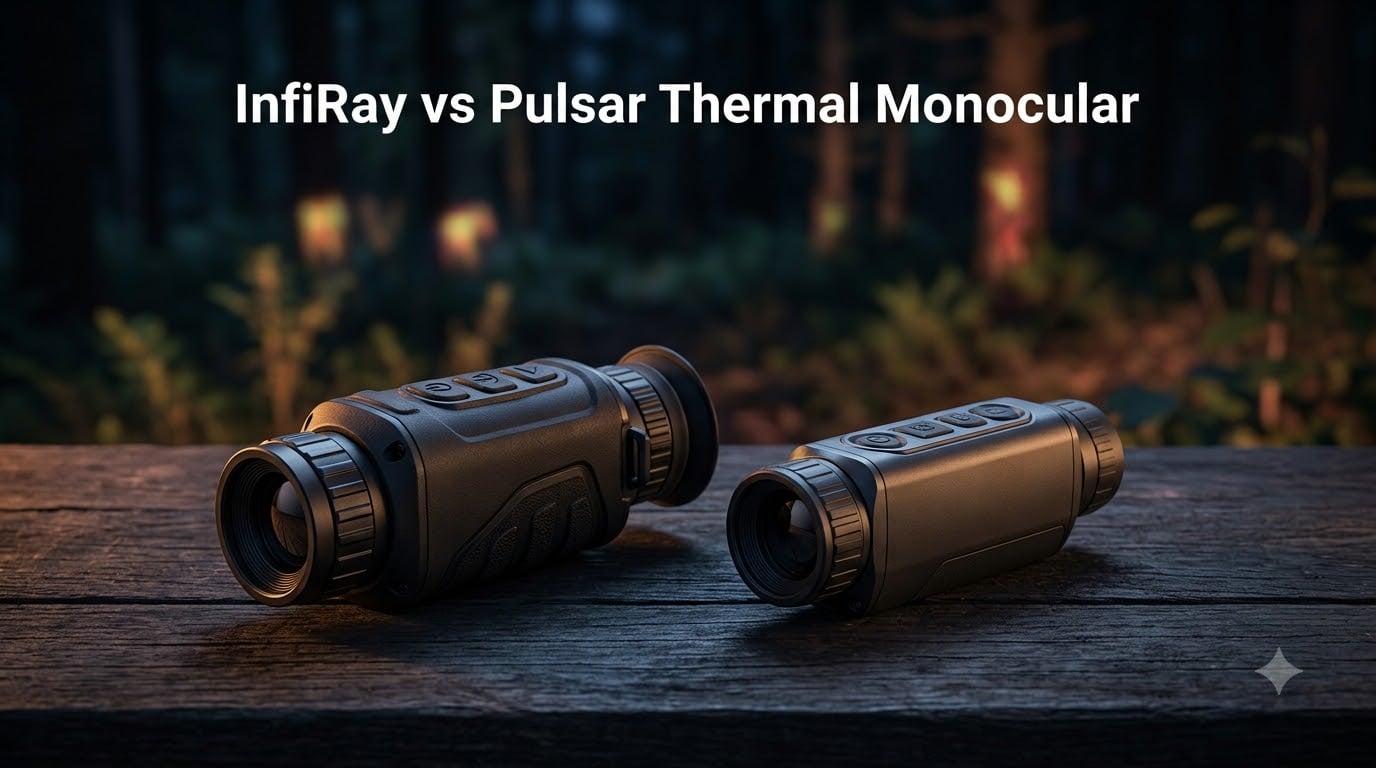
InfiRay vs Pulsar Thermal Monocular (October 2026)
If you’ve spent any time on thermal hunting forums, you’ve seen the same debate play out again and again: InfiRay…

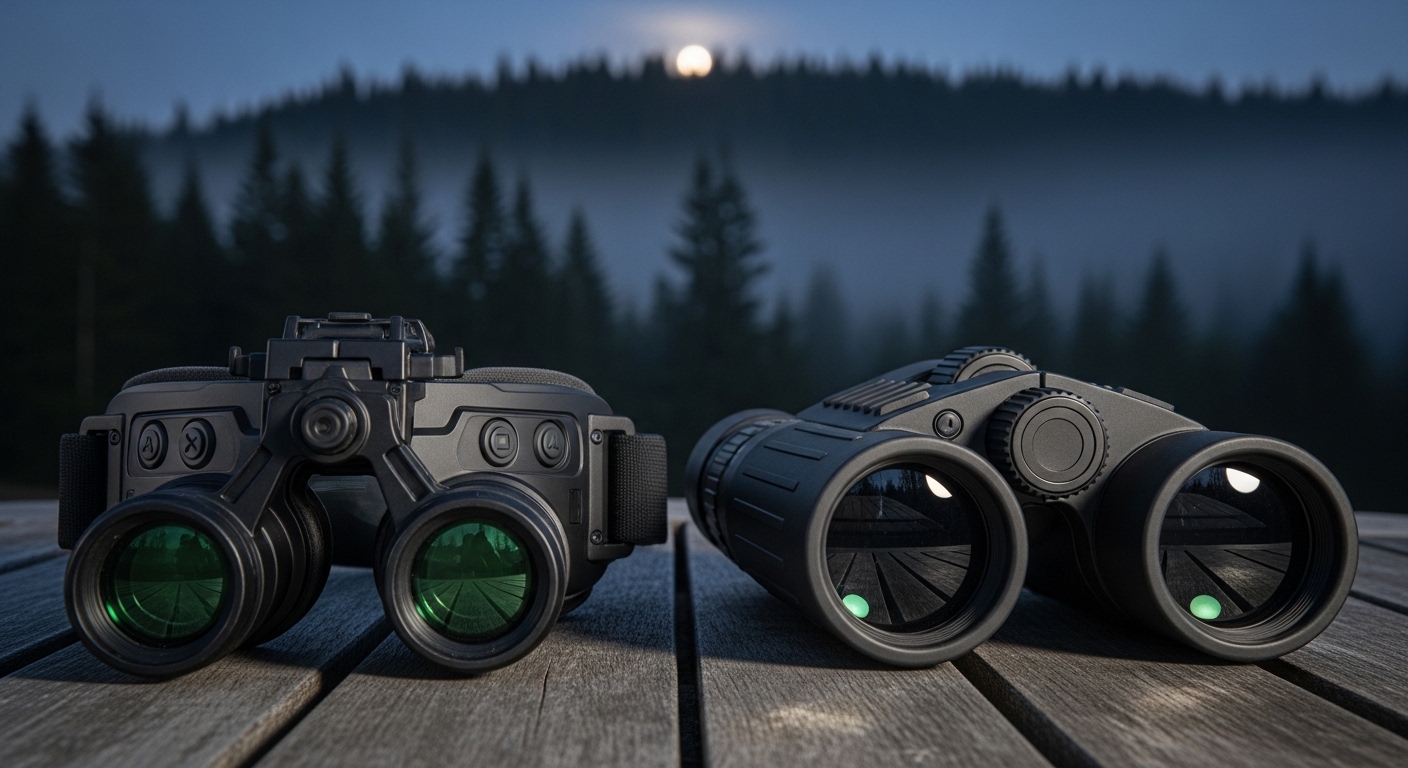
Choosing between night vision goggles and binoculars can make or break your nighttime activity. After three years of testing across hunting seasons, security operations, and wildlife observation projects, I’ve seen people make the wrong choice and regret it. The wrong device leaves you frustrated with limited capability or unnecessary weight and cost.
Night vision goggles provide hands-free operation with 1x magnification for tactical mobility and close-range work. Night vision binoculars deliver superior image quality with higher magnification for detailed long-range observation. Choose goggles for active movement and binoculars for stationary surveillance.
The technology behind these devices has evolved significantly in recent years. Digital night vision has democratized access to nighttime viewing capabilities, while traditional image intensifier tubes continue to push performance boundaries. Understanding the fundamental differences between goggles and binoculars helps you match the right tool to your specific mission.
This comprehensive comparison examines every critical factor: magnification, field of view, depth perception, weight, ergonomics, weather performance, battery life, and power management. We’ll explore both traditional analog systems and modern digital alternatives to help you make an informed decision based on real-world performance.
Whether you’re hunting predator populations at dawn, conducting security patrols, observing wildlife behavior, or navigating unfamiliar terrain after dark, the right night vision device transforms your capabilities. Let’s dive into the details.
Magnification: The measure of how much closer an object appears compared to viewing with the naked eye. Night vision goggles use 1x magnification (no zoom), while binoculars typically offer 3x, 5x, or higher magnification.
The fundamental difference comes down to magnification and how you use the device. Goggles sit on your face or helmet with 1x magnification, keeping your hands free while maintaining depth perception and situational awareness. Binoculars are handheld devices that magnify distant objects but sacrifice mobility and situational awareness. Understanding how night vision technology works helps explain why this magnification difference matters so much.
In my experience, this single factor determines 90% of buying decisions. If you need to move, handle equipment, or navigate terrain while using night vision, goggles are the only viable option. If you’re stationary — watching a food plot, monitoring a perimeter, or observing wildlife from a fixed position — binoculars provide superior image quality and range.
Field of View (FOV): The width of the visible area you can see through the device at a given distance. Wider FOV provides better situational awareness and depth perception.
Field of view plays a critical role in this comparison. Goggles typically offer a 40-degree field of view, allowing you to see your surroundings and move naturally. Binoculars with higher magnification have narrower FOV — sometimes under 20 degrees — which can make disorientation a problem when moving. This tunnel vision effect is one of the most common complaints I hear from new night vision users who chose the wrong format.
Another key difference is how each device handles depth perception. Dual-tube goggles provide true stereoscopic vision because each eye sees a slightly different image. Your brain combines these images to create depth perception similar to natural daylight vision. Binoculars also offer stereoscopic vision, but the higher magnification can distort depth perception at closer ranges, making distance judgment tricky when you’re new to using magnified night vision.
Reddit’s r/NightVision community offers a helpful distinction: “binoculars” typically refer to dual optical tubes regardless of mounting, while “goggles” describe any head-mountable night vision device. This terminology matters when shopping — some “goggles” are actually single-tube designs that lack true depth perception. Understanding these differences before you buy prevents frustration later.
Quick Summary: Night vision goggles excel at hands-free operation, making them ideal for tactical situations, hunting while moving, and any scenario requiring mobility.
Night vision goggles mount to your head or helmet, leaving both hands free for weapons, equipment, or navigation. This hands-free capability is why military units, law enforcement teams, and serious hunters overwhelmingly choose goggles for operations requiring movement. The ability to maintain your night vision while performing other tasks creates a tactical advantage that no handheld device can match.
During hunting season, I’ve found goggles indispensable when stalking game or navigating to stands in darkness. The ability to see my surroundings while carrying a bow or rifle cannot be overstated. However, when sitting in a stand for hours, I often wish for the increased magnification and comfort of binoculars. The right choice ultimately depends on whether your priority is mobility or magnification.
Quick Summary: Night vision binoculars prioritize image quality and magnification, making them superior for stationary observation, surveillance, and wildlife viewing.
Night vision binoculars are handheld devices designed primarily for stationary observation. The higher magnification brings distant objects into clear view, making them ideal for surveillance, wildlife observation, and scouting game from a fixed position. When you don’t need to move, binoculars deliver optical performance that goggles simply cannot match.
For stationary surveillance or wildlife observation, binoculars offer a significantly better viewing experience. I’ve used binoculars to watch deer herds from 300 yards away, identifying individual animals and assessing their behavior in detail that would be impossible with 1x goggles. The magnification and image quality reveal details that remain invisible to goggle users, making binoculars the clear choice when mobility isn’t required.
Modern night vision devices fall into two categories: traditional analog systems using image intensifier tubes, and digital systems using CMOS sensors and digital processing. Understanding this technology distinction helps you choose between performance characteristics and features that match your specific needs.
Analog night vision relies on image intensifier tubes that amplify available light through a vacuum tube. Photons strike a photocathode, converting to electrons which are multiplied and then converted back to light on a phosphor screen. This technology provides exceptional sensitivity and virtually zero processing lag. The image appears in real-time with no delay between movement and what you see. Gen 2+ and Gen 3 analog systems offer the highest performance available today, with exceptional low-light sensitivity and clarity.
Digital night vision uses CMOS sensors similar to those in digital cameras, converting light to electrical signals that are processed and displayed on an LCD or OLED screen. This technology has improved dramatically in recent years, making digital options increasingly viable for serious applications. Digital systems offer advantages like daytime compatibility (they won’t be damaged by bright light), video recording capabilities, and often electronic zoom features.
The refresh rate represents a critical difference between these technologies. High-quality digital night vision now offers refresh rates of 60Hz or higher, minimizing motion blur during rapid movement. Budget digital devices may operate at 30Hz or lower, creating noticeable lag and blur when you’re moving quickly. This motion blur can be disorienting and problematic for tactical applications where you need to track moving targets or navigate while on the move.
Analog systems have virtually zero processing delay — what you see happens in real-time. Digital systems inherently have some processing latency, though premium digital options have reduced this to imperceptible levels for most users. When evaluating digital night vision, always check the refresh rate specification and look for user reviews that mention motion performance.
Digital night vision also offers features that analog cannot match. Many digital devices include built-in recording capabilities, allowing you to capture still images or video of what you’re observing. Some offer Wi-Fi connectivity for smartphone integration, letting you view and record remotely. Firmware updates can improve performance over time, something impossible with analog tubes. These smart features make digital options attractive for users who value versatility and recording capabilities.
Weight distribution and ergonomics play a crucial role in night vision device selection, especially for extended use. The physical demands of head-mounted versus handheld systems create very different fatigue profiles that can significantly impact your experience in the field.
Night vision goggles concentrate weight on your head and neck. Most dual-tube systems weigh between 450-900 grams (1-2 pounds) without the mount or helmet. While this might sound manageable, that weight sits inches from your face, creating leverage that multiplies the effective strain on your neck muscles. Extended wear — especially during active movement — can cause significant neck fatigue. The weight distribution matters enormously: well-balanced goggles with the weight close to your face cause less strain than front-heavy designs.
Helmet choice significantly affects comfort. A lightweight ballistic helmet might weigh 1-1.5 kg (2.2-3.3 lbs) on its own. Adding 500+ grams of night vision goggles plus a counterweight at the rear means you’re carrying 2+ kg on your head for hours. This cumulative weight becomes exhausting during long operations. Quality mounting systems with proper adjustment and counterweighting are essential for comfort, but they add complexity and cost.
Night vision binoculars present different ergonomic challenges. Most weigh between 600g and 1.5 kg (1.3-3.3 lbs), similar to goggles but handheld rather than head-mounted. This weight is supported by your arms and shoulders rather than your neck. For short observation sessions, handheld binoculars feel comfortable and natural. However, arm fatigue sets in after 30-60 minutes of continuous use, especially if you’re holding the device steady for detailed observation.
The advantage of binocular ergonomics is that you can lower the device periodically to rest your arms. You’re not locked into the weight being constantly attached to your body. This on-demand usage pattern means you can observe for hours overall with intermittent breaks, whereas goggles are constantly attached and exerting continuous strain.
For applications requiring both movement and observation, some users carry both: goggles for movement with the option to switch to binoculars for stationary observation periods. This hybrid approach maximizes the strengths of each format while managing fatigue through strategic use patterns.
Real-world night vision use often happens in challenging environmental conditions. Rain, fog, humidity, and temperature extremes can dramatically affect performance. Understanding how weather impacts different night vision formats helps you choose equipment that will perform reliably when conditions turn difficult.
Waterproof ratings matter significantly for night vision devices. Most professional-grade equipment carries IP67 or IPX7 ratings, meaning they can withstand immersion in water to a depth of 1 meter for 30 minutes. This level of protection is essential for hunting, maritime operations, or any use where rain or water exposure is likely. Budget devices often lack proper sealing, making them vulnerable to moisture damage that can destroy sensitive electronics or fog internal optics.
Fog performance varies between technologies. Digital night vision often handles fog better than analog because the digital processing can enhance contrast in difficult conditions. However, all night vision devices struggle in heavy fog because the water droplets scatter infrared light just as they scatter visible light. Your detection range will decrease in fog regardless of technology, though higher-quality systems maintain better performance than budget options.
Rain presents different challenges. Light rain typically has minimal impact on performance, though water on the objective lens can create distortions. Heavy rain can scatter infrared illumination and reduce effective range. For goggles users, rain on the eyepieces can be distracting and may require periodic wiping. Binocular users can more easily shield the objective lenses with their body or cover the device between observation periods.
Temperature extremes affect all night vision technology. Image intensifier tubes perform best in moderate temperatures. Extreme cold can reduce tube performance temporarily, though this effect is usually reversible when the device warms up. Digital systems may experience battery drain in cold temperatures, and LCD displays can become sluggish or unresponsive until warmed. Heat generally affects night vision less than cold, but extreme temperatures can stress seals and potentially cause fogging inside the device if moisture has penetrated the housing.
Internal fogging occurs when temperature changes cause condensation inside the device. Quality night vision equipment is nitrogen-purged and sealed to prevent this. Budget devices often lack this protection, making them vulnerable to internal fogging that renders them temporarily or permanently useless. For serious use in variable conditions, proper sealing and purging are essential features.
| Feature | Night Vision Goggles | Night Vision Binoculars |
|---|---|---|
| Magnification | 1x (no zoom) | 3x to 8x typical |
| Field of View | 40-45 degrees | 15-30 degrees |
| Operation | Hands-free, head-mounted | Handheld |
| Depth Perception | Excellent (dual-tube) | Good (but distorted at range) |
| Mobility | Excellent for moving | Poor while in use |
| Detection Range | 100-200 yards typical | 300-600+ yards possible |
| Weight Range | 450-900g (plus mount) | 600g-1.5kg |
| Battery Runtime | 8-50 hours typical | 12-60 hours typical |
| Weather Rating | IP67 on professional models | IP67 on professional models |
| Comfort (Extended) | Head/neck fatigue | Arm fatigue |
| Entry Price | $300-800 (digital) | $300-600 (digital) |
| Professional Price | $3,000-12,000 | $2,500-8,000 |
| Ideal Use | Active, tactical operations | Stationary observation |
Choosing between goggles and binoculars doesn’t have to be complicated. Follow this simple framework based on how you plan to use night vision. The right choice becomes clear when you focus on your primary activity rather than getting distracted by feature lists.
Ask yourself: will I be moving or stationary while using night vision? This single question determines the right choice 90% of the time. Be honest about your actual use patterns, not what you imagine you might do someday.
Choose Night Vision Goggles if:
Choose Night Vision Binoculars if:
Night Vision Generations: Night vision devices are categorized by generation. Gen 1 is basic and affordable. Gen 2+ offers professional-grade performance. Gen 3 represents military-grade technology with the best performance but highest cost and export restrictions. Understanding generation differences is crucial for making an informed purchase decision.
Digital night vision offers an entry point around $300-800 for both goggles and binoculars. These devices use CMOS sensors instead of image intensifier tubes, providing adequate performance for casual use and daytime compatibility. Digital options have improved dramatically and now offer compelling value for users who don’t require military-grade performance.
For serious applications, Gen 2+ systems start around $2,000-3,000. These professional-grade devices use image intensifier tubes with significantly better low-light performance than Gen 1. Most dedicated night vision users consider Gen 2+ the minimum for serious work. The performance jump from Gen 1 to Gen 2+ is substantial and justifies the price difference for most users.
Gen 3 devices range from $3,000 to over $10,000. These military-grade systems offer the best available performance with exceptional sensitivity and clarity. At these price points, binoculars generally cost less than comparable goggles, making them the more budget-friendly option for equivalent performance. However, export restrictions (ITAR) limit availability of Gen 3 technology to U.S. buyers and prohibit international sales without State Department approval.
Remember that generation matters more than format for most performance metrics. A Gen 2+ set of binoculars will outperform Gen 1 goggles in every meaningful way despite the format difference. Invest in the best generation you can afford, then choose the format that matches your mobility needs.
High-end night vision falls under ITAR (International Traffic in Arms Regulations) in the United States. Gen 3 devices cannot be exported without State Department approval, and some countries completely prohibit civilian night vision ownership. These export restrictions are serious — manufacturers who violate ITAR face severe penalties, so they’re very careful about compliance.
Before making any purchase, verify your local laws regarding night vision possession and use. Some states have additional restrictions beyond federal regulations. International buyers face additional challenges — most Gen 3 devices simply cannot be shipped outside the United States, and Gen 2+ devices may require export licenses. Digital night vision typically avoids these export restrictions, making it the only practical option for many international buyers.
Hunting regulations also matter. Some jurisdictions restrict night vision use for hunting, especially for certain game species or during specific seasons. Check your local wildlife agency regulations before using night vision afield. Violations can result in fines, license suspension, or worse.
Beyond choosing between goggles and binoculars, several practical considerations affect your long-term satisfaction with night vision equipment. These factors often get overlooked during the excitement of purchase but become critically important during actual use.
Night vision devices require power to operate, and battery management becomes a critical consideration for extended use. Goggles typically use AA or CR123 batteries, with runtime ranging from 8 to 50 hours depending on technology and brightness settings. Digital goggles often have shorter battery life than analog models due to the power requirements of the display and processing electronics. Binoculars often have similar power requirements but may offer longer runtime due to simpler design and the ability to use larger battery compartments.
Battery type matters for field use. CR123A batteries offer excellent energy density but are expensive and can be hard to find in remote locations. AA batteries are universally available but may require more frequent changes. Rechargeable options are increasingly common, especially in digital devices, but require planning for charging in the field. Some advanced systems offer external battery packs that extend runtime significantly — these add bulk but provide marathon operation capability for extended missions.
Power management features can make a big difference. Auto-shutoff preserves battery life when you accidentally leave the device on. Brightness adjustment lets you balance image quality against power consumption — lower brightness extends runtime at the cost of image clarity. Some digital devices offer power-saving modes that reduce refresh rate or processing to extend battery life when you need maximum runtime.
I always recommend carrying spare batteries and testing your device before any critical use. Digital night vision typically offers shorter battery life than traditional image intensifier systems, though rechargeable options are becoming more common. Cold temperatures dramatically reduce battery performance — plan for 30-50% less runtime in freezing conditions. Always store batteries close to your body to keep them warm in cold weather, and consider using lithium batteries which perform better in extreme temperatures than alkaline.
Professional night vision equipment is built to withstand harsh conditions, but build quality varies dramatically across price points. Look for waterproof or water-resistant ratings, shock resistance, and quality construction. Military-spec devices offer the best durability but come at premium prices. The difference between a budget device that fails after one season and professional equipment that lasts years becomes obvious in harsh conditions.
Waterproofing matters for any outdoor use. IP67 rating means the device can withstand immersion in 1 meter of water for 30 minutes — this is the minimum standard for serious field use. IPX7 offers the same immersion protection without the dust protection rating. Devices without proper sealing may work fine in light rain but can fail catastrophically if dropped in water or used in heavy rain.
Shock resistance is especially important for head-mounted goggles. The device will bounce and jolt during normal use — if you’re running, riding in vehicles, or moving actively, your night vision equipment experiences significant shock. Quality construction with proper internal mounting and shock absorption prevents damage from this normal use. Budget devices may fail under conditions that professional equipment handles routinely.
After dropping a pair of digital goggles during a hunt and watching them fail, I learned that durability matters. Professional-grade equipment costs more but provides reliability when you need it most. Night vision often gets used in critical situations — hunting, security, tactical operations — where equipment failure is unacceptable. The investment in quality construction pays dividends in reliability and longevity.
Night vision devices require proper care to maintain performance and longevity. Different maintenance requirements apply to analog versus digital systems. Understanding these needs helps you protect your investment and ensure reliable performance when you need it.
Lens care is fundamental for all night vision devices. Clean lenses with appropriate optics cleaning supplies — microfiber cloth and lens cleaning solution designed for coated optics. Avoid abrasive materials or household cleaners that can damage lens coatings. Keep lens caps on when not in use, and store devices in protective cases to prevent accidental scratches or impacts.
Image intensifier tubes in analog systems require special care. Never expose an active tube to bright light — this can damage the photocathode and permanently degrade performance. Most modern tubes have automatic bright light protection (auto-gating), but this is a safety feature, not an invitation to carelessness. Turn off the device before exposing it to bright light, and never point it at the sun or bright artificial light sources while powered on.
Digital systems have fewer restrictions but still require proper care. CMOS sensors are generally immune to bright light damage, but LCD displays can be affected. Avoid leaving digital devices with displays exposed to direct sunlight for extended periods — this can damage the screen. The electronics in digital systems are vulnerable to moisture, making waterproof ratings even more important than for analog devices.
Storage affects longevity. Store night vision devices in a cool, dry place away from direct sunlight. Remove batteries during long-term storage to prevent corrosion and leakage. Use desiccant packets in storage cases to control moisture, especially in humid climates. For expensive image intensifier devices, consider professional storage solutions with climate control.
Tube lifespan concerns many analog night vision buyers. Quality Gen 2+ and Gen 3 tubes typically last 5,000-10,000 hours of use before performance degrades significantly. For most users, this means years of service. Digital systems have finite lifespans too — electronics eventually fail, and displays can degrade — but replacement is often easier and cheaper than replacing an image intensifier tube.
Professional servicing is available for high-end equipment. Manufacturers can replace image intensifier tubes, repair electronics, and recalibrate devices. This service is expensive but can extend the life of premium equipment. Budget devices are generally not serviceable — when they fail, you replace rather than repair. This is an important consideration when calculating total cost of ownership.
Neither device is universally better. Night vision goggles excel at hands-free tactical mobility with 1x magnification for close-range operations. Night vision binoculars provide superior image quality and higher magnification for detailed long-range observation. Choose goggles for active movement and binoculars for stationary surveillance.
Navy SEALs typically use dual-tube night vision goggles like the GPNVG-18 (Ground Panoramic Night Vision Goggles) or PVS-31 systems mounted on helmets for hands-free tactical operations. These provide stereoscopic vision and 1x magnification for close-quarters combat and maritime operations.
Night vision isn’t illegal for civilian ownership in most countries, but export is restricted. High-end night vision (Gen 3+) falls under ITAR (International Traffic in Arms Regulations) in the US, prohibiting export without State Department approval. Some countries restrict civilian possession entirely. Always check local laws before purchasing.
While night vision binoculars are designed for terrestrial use, they can enhance viewing of bright celestial objects. However, traditional astronomical binoculars or telescopes with larger apertures are far superior for planet and stargazing. Night vision binoculars lack the optical quality needed for detailed astronomical observation.
Traditional night vision requires some ambient light to function. In complete darkness, you’ll need an infrared illuminator, which projects invisible IR light that the night vision device can detect. Most night vision systems include built-in IR illuminators for use in zero-light conditions. Digital night vision also typically includes IR illumination capabilities.
Detection range depends on the generation and environmental conditions. Entry-level digital goggles typically detect human-sized figures out to 50-100 yards. Gen 2+ systems extend this to 200-300 yards. Gen 3 military-grade goggles can detect targets at 500+ yards under optimal conditions. Identification ranges are typically half of detection ranges.
Night vision goggles vs binoculars represents a fundamental choice between mobility and magnification. By understanding your primary use case, budget constraints, and environmental requirements, you can select the format that will serve you best in the field.