8 Best Binocular Tripod Adapters (September 2026)
I still remember the morning my hands started shaking so badly I could not focus on a bull elk at…


Learning how to focus binoculars properly transforms your outdoor experience from frustrating to exceptional. Many people lift their binoculars, squint through them, twist the focus wheel randomly, and eventually give up with a headache. The problem isn’t the equipment, it’s the technique most people were never taught.
The correct focusing method takes about two minutes to learn and will give you razor-sharp images through both eyes. I’ve watched hundreds of students master this technique, and the difference in their viewing experience is remarkable. Once you understand the dual-focus system and follow the proper steps, blurry images and eye strain become things of the past.
To focus binoculars properly, adjust the interpupillary distance first, set eye cups for your vision needs, focus your left eye with the center wheel, then calibrate the right eye diopter. Once set, only use the center focus wheel for distance adjustments.
Statistics show that approximately 70% of people have some difference in vision between their left and right eyes. Without proper diopter adjustment, these viewers never achieve truly sharp images through both eyes simultaneously. Understanding how to focus binoculars correctly solves this problem for good.
Most binoculars use a dual-focus system designed to accommodate vision differences between your eyes. This system consists of a central focus wheel that adjusts both barrels simultaneously, plus a diopter adjustment on one eyepiece that fine-tunes for individual eye differences. For more details on understanding binocular magnification, check out our comprehensive guide.
Diopter: A measurement of lens refractive power. On binoculars, the diopter adjustment compensates for vision differences between your eyes, typically allowing plus or minus 2 to 4 diopters of correction.
The center focus wheel moves the internal lenses forward or backward to focus on objects at different distances. This is what you’ll use most often in the field. The diopter, however, is set once and then left alone, making it the most misunderstood and overlooked adjustment on binoculars.
Two main focus systems exist on binoculars. Center focus is most common, using a single wheel with a separate diopter adjustment. Individual focus binoculars require focusing each eyepiece separately, these are typically marine or astronomy models where you view objects at consistent distances. Fixed focus binoculars require no adjustment at all but have limited effective range.
Proper focusing begins before you even look through the lenses. Three critical adjustments determine whether you’ll see a clear, full image: interpupillary distance, eye cup position, and neck strap setup. Getting these right first prevents frustration later.
Interpupillary Distance (IPD): The distance between the centers of your pupils, typically 58-72mm in adults. Binoculars must be adjusted to match your specific IPD or you’ll see double images or dark circles in your field of view.
Hold the binoculars up to your eyes and look at a distant object. Notice if you see two overlapping circles instead of one complete image. Use the central hinge to bend the barrels inward or outward until the circles merge into a single, perfectly round field of view.
I mark my IPD setting with a small piece of tape when I find the sweet spot. This saves time in the field and prevents accidental adjustments. Your IPD is constant, so once set, you rarely need to change it unless someone else uses your binoculars. Many experienced birders do the same for quick setup.
Eye cups control the distance between your eyes and the lenses. This adjustment matters more than most people realize and directly affects your ability to see the full field of view without blacked-out areas.
If you wear eyeglasses, twist the eye cups down to their lowest position. This allows your glasses to get closer to the lenses, maximizing your field of view. Binoculars designed for eyeglass wearers have longer eye relief, typically 15-20mm, which prevents the blacked-out edges that plague many glasses-wearing users.
Without glasses, twist the eye cups up. This blocks peripheral light and positions your eyes at the optimal distance from the lenses. Some binoculars have adjustable eye cups with intermediate positions, find what feels comfortable and maintains a full field of view.
Proper neck strap positioning prevents bounce and fatigue during extended use. Adjust the strap so the binoculars sit at chest level when hanging, not bouncing against your stomach or hips. This position allows you to quickly lift them to your eyes without fumbling.
For serious birding or hunting, consider a binocular harness instead of a standard neck strap. Harnesses distribute weight across your shoulders and back, eliminating neck strain completely. They also keep binoculars more stable during movement, preventing accidental diopter adjustments from bouncing.
If you’re learning how to focus binoculars for the first time, follow this quick checklist before heading into the field. Spending five minutes now saves frustration later and ensures you’re ready when action happens.
First-Time Setup Checklist:
This is the core technique that most manufacturers including Nikon, Vortex, and Bushnell recommend. I’ve refined these instructions after teaching them to hundreds of students, adding clarifications that address common confusion points. The key is focusing each eye separately, then using only the center wheel for ongoing adjustments.
Quick Summary: Focus your non-dominant eye first using the center wheel, then adjust the diopter for your dominant eye without touching the center wheel. Once calibrated, use only the center wheel for all distance adjustments.
Pick an object with fine detail at least 50 yards away. A sign with text, tree branches, or architectural details work well. Avoid blank walls or uniform surfaces, these make it impossible to achieve precise focus. The more contrast and detail in your target, the easier it is to find the sharp focus point.
Cover the right objective lens (the large front lens) with the lens cap. Don’t close your right eye, keeping it open but covered maintains natural eye position and prevents squinting. Using the lens cap instead of your hand is a trick I learned from birding guides, it’s faster and more reliable.
Looking through only the left barrel, slowly turn the center focus wheel until the image is perfectly sharp. Take your time, this step sets the baseline for all future focusing. Turn the wheel slowly and watch for the moment when details become crisp and clear.
When the image snaps into focus, you’ll know it. Experienced users call this the “snap to focus” moment, where slight adjustments in either direction make the image obviously worse. Once you find this sweet spot, stop and leave the focus wheel exactly where it is.
Now move the lens cap to the left objective lens, covering it completely. Look through only the right barrel and locate the diopter adjustment. This is the critical step most people miss, yet it’s essential for sharp images through both eyes.
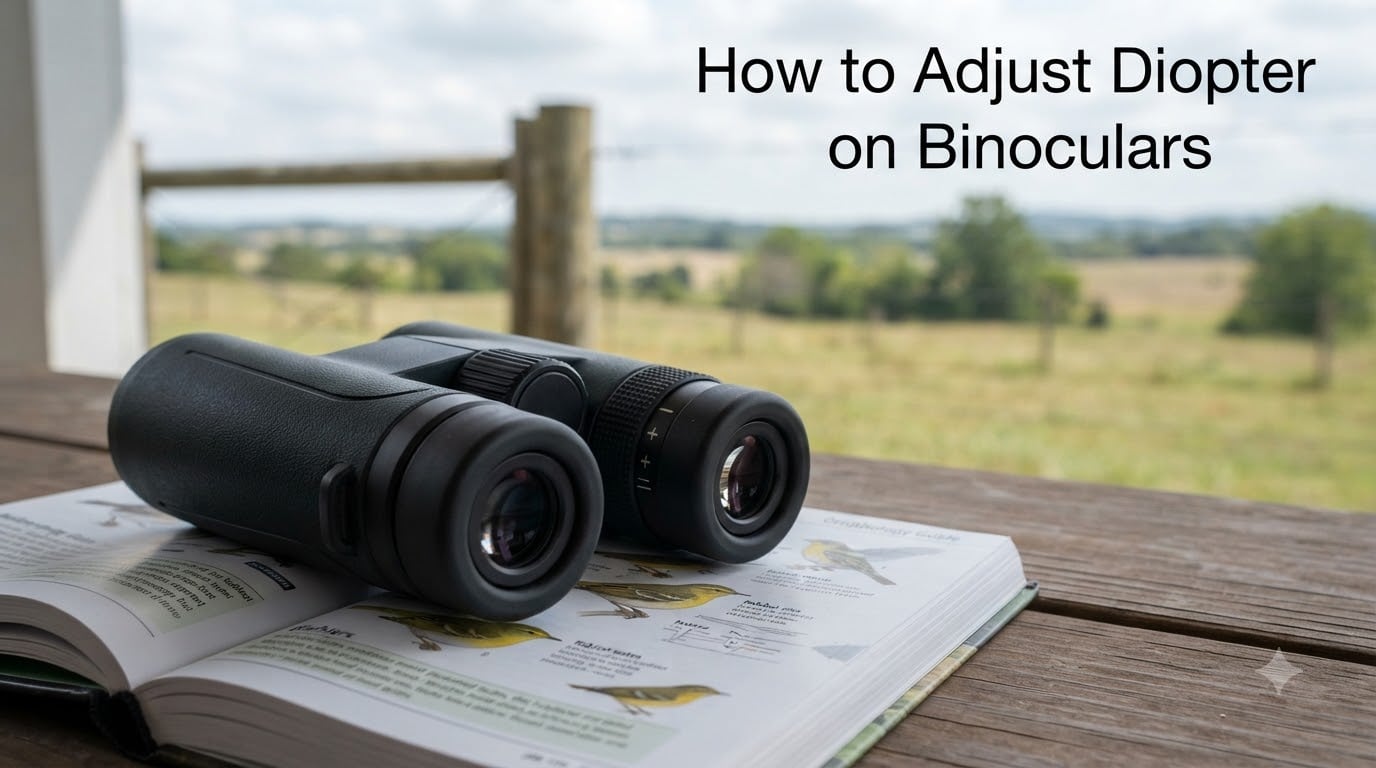
On most binoculars, the diopter is a ring on the right eyepiece, sometimes marked with plus and minus indicators. Some models place it on the left, and a few integrate it into the center focus wheel with a locking mechanism. Check your manual if you’re unsure.
Turn the diopter adjustment until the image is sharp. Do not touch the center focus wheel during this step, only adjust the diopter. This is where most people make mistakes, reaching for the focus wheel out of habit. The center wheel must stay exactly where you left it in Step 2.
With both objective lenses uncovered, look through the binoculars with both eyes. The image should appear sharp and comfortable. If it’s not quite right, fine-tune using only the center focus wheel. Never touch the diopter again unless it gets bumped or someone else uses your binoculars.
At this point, your diopter is calibrated to your eyes. Make a mental note of its position, or mark it with a small dot of paint or nail polish. This reference point saves time if the diopter gets bumped accidentally. Forum users consistently report this simple tip prevents frustration in the field.
Find objects at various distances, from close focus to infinity. Practice adjusting only the center focus wheel to switch between targets quickly. Notice how your diopter setting remains correct regardless of distance. This is why setting the diopter once is so important.
I recommend spending 10 minutes practicing this in your backyard before heading into the field. Building muscle memory now means faster, more reliable focusing when you spot that rare bird or need to track game. Experienced birders practice regularly to maintain their skills.
Pro Tip: If your binoculars have a diopter lock, engage it after finding your perfect setting. This prevents accidental adjustment during transport or rough handling in the field. Higher-end models often include this feature specifically for this reason.
Different activities demand different focusing strategies. After years of field use across various applications, I’ve developed specific techniques that work best for each situation. The right approach makes all the difference in success and enjoyment.
Birding requires quick refocusing as birds move between perches at varying distances. Set your diopter carefully before heading out, then practice rapid focus adjustments. Keep your focus wheel between thumb and forefinger while scanning for birds.
Use the scanning technique: focus on the horizon first, then pan slowly across your field of view. When you spot movement, quickly adjust focus to that distance without taking the binoculars from your eyes. This technique, recommended by All About Birds, helps you find and identify birds faster.
I focus on a stationary object at the distance I expect to see birds, then make only minor adjustments as needed. When scanning, I keep the focus wheel accessible, ready to adjust instantly when a bird appears at a different distance.
Hunting binoculars often get bumped and jostled, which can shift your diopter setting. Before your hunt, recheck your diopter calibration and consider marking it more permanently. Hunting forums consistently emphasize this precaution to avoid frustration in the field.
For glassing at dawn or dusk, focus on the highest contrast edge you can find, typically the horizon line or tree branches against the sky. Your eyes struggle with focus in low light, so give yourself extra time and trust your initial snap-to-focus moment.
Astronomical viewing presents unique focusing challenges. Stars don’t provide the edge detail that terrestrial objects do, making precise focus difficult. For more on binoculars vs telescopes for stargazing, see our detailed comparison.
Experienced astronomers on Cloudy Nights forums recommend focusing on the moon first, if visible. If not, find a bright star and slightly defocus in both directions, then settle on the midpoint where the star appears smallest and brightest. This technique helps overcome the lack of edge detail.
Some users create a Bahtinov mask, a simple device that creates diffraction patterns to aid precise focusing. This tool is especially helpful for beginners learning to focus on stars. Others recommend relaxing your eyes to infinity focus, then adjusting the binoculars to match.
When viewing sports, most action happens at a relatively consistent distance. Focus once on that distance range and leave it alone. Constant refocusing causes eye fatigue and you’ll miss the action while fiddling with the wheel.
For stadiums and arenas, focus on the section where you expect most action to occur. Make minor adjustments only when play shifts significantly closer or farther. This approach keeps you ready for the big moments without constant refocusing.
Sometimes binoculars simply won’t achieve sharp focus. Based on my experience repairing and testing optics, here are the most common problems and their solutions. Most issues are fixable with simple adjustments.
| Problem | Likely Cause | Solution |
|---|---|---|
| One eye always blurry | Incorrect diopter setting | Readjust diopter following Step 3 |
| Double vision | IPD not matched to your eyes | Adjust barrel width until single image |
| Black edges in view | Eye cups in wrong position | Adjust for glasses vs no glasses |
| Can’t achieve sharp focus | Internal misalignment or damage | Professional repair needed |
| Focus wheel stuck | Dirt, debris, or temperature issue | Clean around wheel, check for ice |
| Image soft at edges | Normal for some binoculars | Focus using center 70% of view |
If your binoculars won’t hold focus, the focus wheel tension may be loose. Some models allow you to adjust this tension, check your manual. Temperature changes can also cause temporary focus drift, allow your binoculars to acclimate for 15-20 minutes when moving between extreme temperatures.
If you’ve tried everything and still can’t achieve sharp focus, internal misalignment or prism damage may be the culprit. This typically happens after dropping the binoculars or rough transport. Professional repair is usually required, though for inexpensive models, replacement may be more cost-effective.
Sometimes the diopter adjustment range isn’t sufficient for your vision needs. Most binoculars provide plus or minus 2 to 4 diopters of correction, which works for most people. If your prescription exceeds this range, you may need to wear glasses while using binoculars.
Forum users frequently ask about this limitation. The solution depends on your specific situation. If you have mild to moderate vision differences, the binocular’s diopter should suffice. For extreme differences or complex prescriptions, wearing glasses becomes necessary. This is especially true for astigmatism, which cannot be corrected by diopter adjustment alone.
Persistent headaches when using binoculars usually indicate improper diopter adjustment or IPD mismatch. Your eyes strain to merge slightly different images, causing fatigue. Recheck your diopter following the steps above, and verify your IPD setting by ensuring you see one perfectly circular image.
Using binoculars with glasses requires specific adjustments for optimal viewing. This is a major search intent identified in research, with many users asking how to focus binoculars with glasses. The key is understanding when glasses are necessary and when diopter adjustment alone will suffice.
If you have astigmatism, you should wear your glasses when using binoculars. Diopter adjustment cannot correct astigmatism, which affects how light enters your eye in multiple directions. Even mild astigmatism (1-2 diopters) typically requires glasses for sharp images through binoculars.
For simple nearsightedness or farsightedness, you can often use the diopter adjustment instead of glasses. The diopter compensates for spherical vision differences between your eyes, effectively replacing your glasses for binocular use. Many users prefer this approach as it eliminates glasses-related vignetting.
Modern binoculars feature twist-up eye cups designed to work with or without glasses. Twist them down fully when wearing glasses to maximize your field of view. Look for models with longer eye relief (15mm+) if you wear glasses, as this prevents blacked-out edges.
Proper maintenance keeps your binoculars focusing smoothly for years. I’ve seen well-cared-for optics perform perfectly after decades of use, while neglected ones fail within months. Simple care habits extend the life of your focus mechanism significantly.
Dirt on your lenses degrades image quality and makes focusing difficult. Clean lenses properly using air to blow away loose dust, then a soft brush for remaining particles. Only use lens cleaner and microfiber cloth for smudges, wiping in circular motion from center to edge.
Never use household glass cleaner or paper towels, these can damage lens coatings. A single scratch won’t affect focus much, but accumulated damage over time will noticeably degrade your view. Proper cleaning technique prevents this gradual degradation.
The focus wheel is the most vulnerable part of the focusing system. Store binoculars with lens caps on and in a case when not in use. If the focus wheel feels gritty or stiff, don’t force it, dirt may have entered the mechanism.
For minor debris, some compressed air around the focus wheel may help. If problems persist, professional service is safer than DIY repairs on precision optics. Many brands like Nikon offer repair services that can restore smooth operation.
Sometimes the diopter adjustment becomes stuck, often due to hardened grease or dirt accumulation. Forum users on BirdForum recommend applying a small amount of rubbing alcohol around the diopter ring to dissolve hardened grease. Let it sit for a few minutes, then gently try to turn the ring.
If this doesn’t work, avoid excessive force that could damage the mechanism. Professional service may be required for stubborn cases. Prevention is better than cure, so protect your diopter from dirt and moisture during storage and transport.
Store binoculars in a dry, temperature-stable environment. Moisture can cause internal fogging and mold growth that permanently affects optical quality. Silica gel packets in your storage case help control humidity and prevent moisture-related damage.
Never leave binoculars in a hot car or direct sunlight. Extreme temperatures can damage lubricants in the focus mechanism and cause glue failures in prism assemblies. Temperature changes can also cause temporary focus issues, so allow binoculars to acclimate before use.
Focus your non-dominant eye first, which is typically the left eye for most people. Cover the right lens, use the center focus wheel to sharpen the left eye view, then adjust the diopter for your right eye without touching the center wheel. This method is recommended by all major binocular manufacturers.
The diopter is an adjustment ring on one eyepiece that compensates for vision differences between your left and right eyes. It allows you to calibrate binoculars to your specific vision needs, typically providing plus or minus 2 to 4 diopters of correction. Set it once and use only the center focus wheel for ongoing adjustments.
When properly focused, you should see a single, circular image with sharp detail throughout the center 70% of the view. The image should snap into focus clearly, and slight adjustments either way should make it obviously worse. No eye strain or double vision should occur. If one eye remains blurry, readjust the diopter.
It depends on your vision correction. If you have astigmatism, always wear your glasses as diopter adjustment cannot correct astigmatism. For simple near or farsightedness, you can use the diopter adjustment instead of glasses. Most modern binoculars have twist-up eye cups designed to work with or without glasses.
This usually means your diopter adjustment is incorrect for your eyes. Cover each eye and check which one appears blurry, then readjust the diopter following the calibration steps. This issue is extremely common and easily fixed once you understand the diopter function. Approximately 70% of people have vision differences between eyes requiring diopter adjustment.
Once your diopter is set correctly, it should remain accurate for your eyes indefinitely. However, vision changes gradually over time, so recheck every few years. Always recalibrate if someone else has used your binoculars or after the diopter has been accidentally adjusted. Marking your diopter setting helps prevent accidental changes.
The two main adjustments are the center focus wheel and the diopter. The center focus wheel adjusts both barrels simultaneously for distance and is used regularly in the field. The diopter adjusts one eyepiece individually to compensate for vision differences between your eyes and is set once during initial calibration.
Yes, people with astigmatism can use binoculars, but they should wear their glasses. Diopter adjustment cannot correct astigmatism as it affects how light enters your eye in multiple directions. Even mild astigmatism (1-2 diopters) typically requires glasses for sharp images through binoculars. Look for models with longer eye relief if you wear glasses.
If your binoculars won’t focus, check the basics first: verify IPD is adjusted for a single circular image, ensure eye cups are positioned correctly for glasses or no glasses, and confirm the diopter is calibrated to your eyes. If these are correct and focus is still impossible, internal misalignment or damage may require professional repair.
Learning how to focus binoculars is a simple skill that pays dividends every time you use them. By following the 5-step method and taking time for proper setup, you’ll enjoy sharp, comfortable viewing through both eyes. Remember to set your diopter once and use only the center focus wheel for ongoing adjustments.
Whether you’re bird watching, hunting, stargazing, or enjoying sports events, proper focusing technique makes all the difference. Take the time to practice these steps, mark your diopter setting, and keep your binoculars well-maintained. With these habits, your binoculars will provide crisp, clear views for years to come.