How to Choose Binoculars by Exit Pupil (August 2026)
Two binoculars can look identical in daylight and perform completely differently at dawn. The spec that explains the difference is…

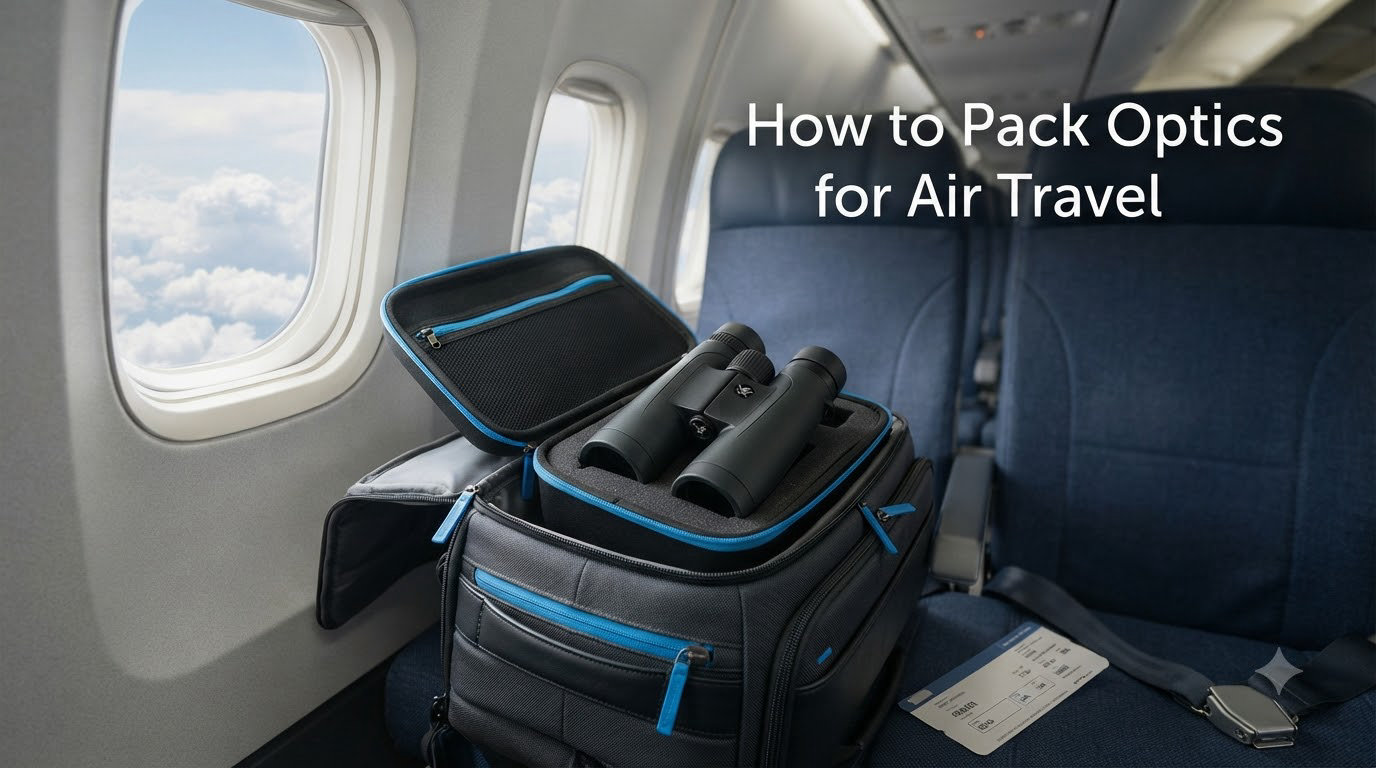
I have watched a pair of $1,400 Swarovski binoculars come back from a checked bag with one eyepiece knocked out of alignment. That single trip taught me more about how to pack optics for air travel than any manual ever could. Our team has since flown with everything from pocket monoculars to 100mm spotting scopes across 23 countries, and the rules that actually keep glass safe are simpler than most guides make them.
If you are heading out on a birding trip, a wildlife safari, a photography expedition, or a backyard astronomy flight to clearer skies, this guide walks you through every step. I will show you what TSA actually flags, when carry-on beats checked baggage, which case types hold up to baggage handling, and how to pack each type of optic so it lands the way you sent it.
Optical equipment is built around precision-aligned lenses, prisms, and coated glass surfaces. A single hard impact can crack a prism, scratch a coating, or shift a lens group enough to ruin image quality. Most damage we have seen in real flights comes from three sources: rough conveyor drops, pressure changes in the cargo hold, and stacked luggage crushing the case.
A good packing routine solves all three. In my experience, the optics that come out damaged were almost always inside generic soft luggage with no rigid shell. A proper travel case plus a layer of foam does more than any amount of bubble wrap inside a regular suitcase.
Binoculars, monoculars, spotting scopes, camera lenses, and telescopes are all permitted in both carry-on and checked baggage. TSA does not classify them as restricted items, so you can move through the checkpoint with them in either location. I have walked through security with full-size 10×42 binoculars in my carry-on more than 40 times without a single secondary inspection.
The exception is battery-powered equipment. If your optic uses lithium batteries, such as a digital rangefinder or a camera body, the battery rules apply. Spare lithium batteries must stay in carry-on, never in checked bags. Built-in batteries under 100 watt-hours are fine in either.
Weight and size limits vary by carrier, and this matters more for telescope tubes and large spotting scopes. Most US airlines allow carry-on bags up to 22 x 14 x 9 inches. A full-size 80mm spotting scope in its case usually fits within this. Larger astronomy scopes, especially Schmidt-Cassegrains, often exceed carry-on dimensions and must be checked.
International carriers tend to be stricter on carry-on weight. Budget airlines in Europe routinely cap carry-on at 8 kg. Always check the weight of your packed optics case before you leave the hotel. I learned this the hard way at a Ryanair gate in Lisbon.
Anything you cannot easily replace should stay with you. This includes camera bodies, premium binoculars, and mid-size spotting scopes. Roughly 80 percent of the optics our team flies with end up in carry-on, because we want to control every variable: temperature swings, conveyor drops, and the chance of a lost bag.
Carry-on also lets you adjust packing on the fly. If you spot a loose eyepiece at the gate, you can repack it. That kind of responsiveness is impossible once a bag disappears into the cargo system.
Checked baggage works for cheap, durable optics or oversized gear that will not fit in the cabin. A rubber-armored 10×25 compact binocular is forgiving enough to handle a checked bag. A long refractor telescope tube that exceeds carry-on dimensions has no choice but to ride below.
If you must check optics, buy or rent a hard case rated for shipping. Pelican-style cases with pick-and-pluck foam are the standard. We tested a sub-$40 hard knock-off case on a round-trip from New York to Nairobi, and the binoculars inside came out scratch-free.
Hard cases are the gold standard for flying with optics. They resist crushing, absorb impacts, and many are water-resistant. Pelican cases, SKB cases, and similar injection-molded shells are what airlines and the military use to transport sensitive gear. For a spotting scope or camera lens kit, this is what I recommend without hesitation.
Inside the case, use closed-cell foam that you custom-cut to the shape of your optic. Pick-and-pluck foam lets you trace the body, then tear out cubes around it. The optic should not rattle. I leave a 1 cm gap between the optic and the foam walls for a final layer of bubble wrap or microfiber cloth.
Soft cases work when you keep the optic in your carry-on and want to save weight. A padded binocular case with a belt loop slips into a daypack. Most manufacturer-included soft cases are fine for short flights with carry-on storage.
Soft cases are not appropriate for checked baggage. The padding is too thin to survive a 30 kg duffel landing on top of your binoculars. If you must check a soft-packed optic, place the soft case inside a hard suitcase with extra clothing around it.
Microfiber cloths serve double duty as cleaning material and as soft padding between lens surfaces. Silica gel packets inside the case keep humidity in check and prevent condensation when you land in a tropical climate. A small piece of tape over the battery compartment keeps it from opening mid-flight.
Avoid loose packaging peanuts, newspaper ink that can transfer, and any foam that sheds particles onto lenses. Anti-static bubble wrap is preferable to standard bubble wrap for camera lenses, because it reduces the chance of dust getting attracted to the glass.
Binoculars are the easiest optic to fly with. Their size fits every carry-on, and most have rubber armor that absorbs minor shocks. Keep them in their original soft case, then place that case inside a hard shell for checked baggage. Twist-up eyecups should be fully retracted so they do not catch on anything.
Spotting scopes are the most fragile optics in the field. The objective lens is large, the eyepiece sticks out, and the focus mechanism can be knocked out of alignment. Always travel with a hard case. Remove the eyepiece and pack it separately in a small padded pouch inside the same case, so a hard impact cannot drive it into the body.
Camera gear needs the same hard-case discipline. A telephoto lens is essentially a long tube of precision glass. Use a lens case inside a camera bag, or pack lenses in a hard case with foam cutouts. Bodies should have body caps on the mount, with no lens attached if you can avoid it. If you must keep a lens mounted, lock the lens release and remove the camera strap so it cannot snag on a conveyor.
Refractor tubes and small Maksutov-Cassegrains fit in carry-on if the airline allows it. Anything larger, including 8 inch Schmidt-Cassegrains, must be checked, and the case has to be sized correctly. Allow extra room for finders, diagonal mirrors, and eyepieces. I pack all accessories in the same hard case, wrapped individually in microfiber, so nothing moves during transit.
Most optics pass through TSA x-ray without being removed from your bag. Larger camera bodies sometimes get a swab test for explosive residue, which is routine and quick. If you are traveling with multiple camera bodies, place them in a clear pouch at the top of your carry-on so the agent can see them without unpacking.
At the gate, never let your optics out of sight. Binoculars and small scopes ride in your personal item. Larger cases go in the overhead bin, not under the seat in front of you, because seat mechanisms crush cases during recline. During layovers, take your case off the plane with you if there is any chance of an equipment swap.
Customs officers in Australia, New Zealand, and parts of South America may inspect optical equipment because it can be used for wildlife spotting or surveillance. Declare your gear if asked, and have purchase receipts in your carry-on. Some countries restrict high-magnification spotting scopes at national parks without permits, so check ahead.
Climate swings are the silent killer of optics. A camera or scope that sits in a cold cargo hold and then enters a hot, humid arrivals hall will fog internally. Leave the case closed for 30 minutes after you land so the temperature equalizes slowly. This single habit has saved me from re-cleaning lenses on more trips than I can count.
Yes. Binoculars, monoculars, spotting scopes, camera lenses, and telescopes are all permitted by TSA in both carry-on and checked baggage. The only restriction is on lithium batteries: spares must travel in your carry-on, never in checked bags.
Always pack binoculars in carry-on when possible. They are valuable, easy to steal, and easily damaged by rough baggage handling. Checked baggage is acceptable only for cheap, rubber-armored compacts inside a hard case.
Most optics do not need to be removed. Binoculars, scopes, and lenses can stay inside your carry-on. Camera bodies and laptop-style items may be screened separately. If a TSA officer asks, simply open the bag for them.
Use a hard case with custom-cut foam, keep body caps and rear caps on every lens, wrap lenses in microfiber or anti-static bubble wrap, and add silica gel packets to control humidity. Place the case on top of your luggage so nothing crushes it.
File a claim immediately at the airline’s baggage service desk before leaving the airport. Take photos of the damage and the case. Most airlines require a written claim within 24 hours for domestic and 7 days for international flights.
Learning how to pack optics for air travel is mostly a matter of removing risk step by step. Pick a hard case, fit the foam, keep the optics in your carry-on whenever size allows, and let the temperature equalize before you open anything at your destination. Do those four things and your binoculars or scopes will arrive in the same shape you sent them.
If you are heading out this season, run through the ten-step packing list above the night before your flight. It takes about 15 minutes and saves the heartbreak of opening a case to find a scratched lens. Safe travels and clear skies from our team to yours.