
8 Best Binoculars for Elk Bugling (September 2026)
I’ve spent more than 30 days chasing bugling bulls across Colorado, Wyoming, and New Mexico over the past six seasons,…

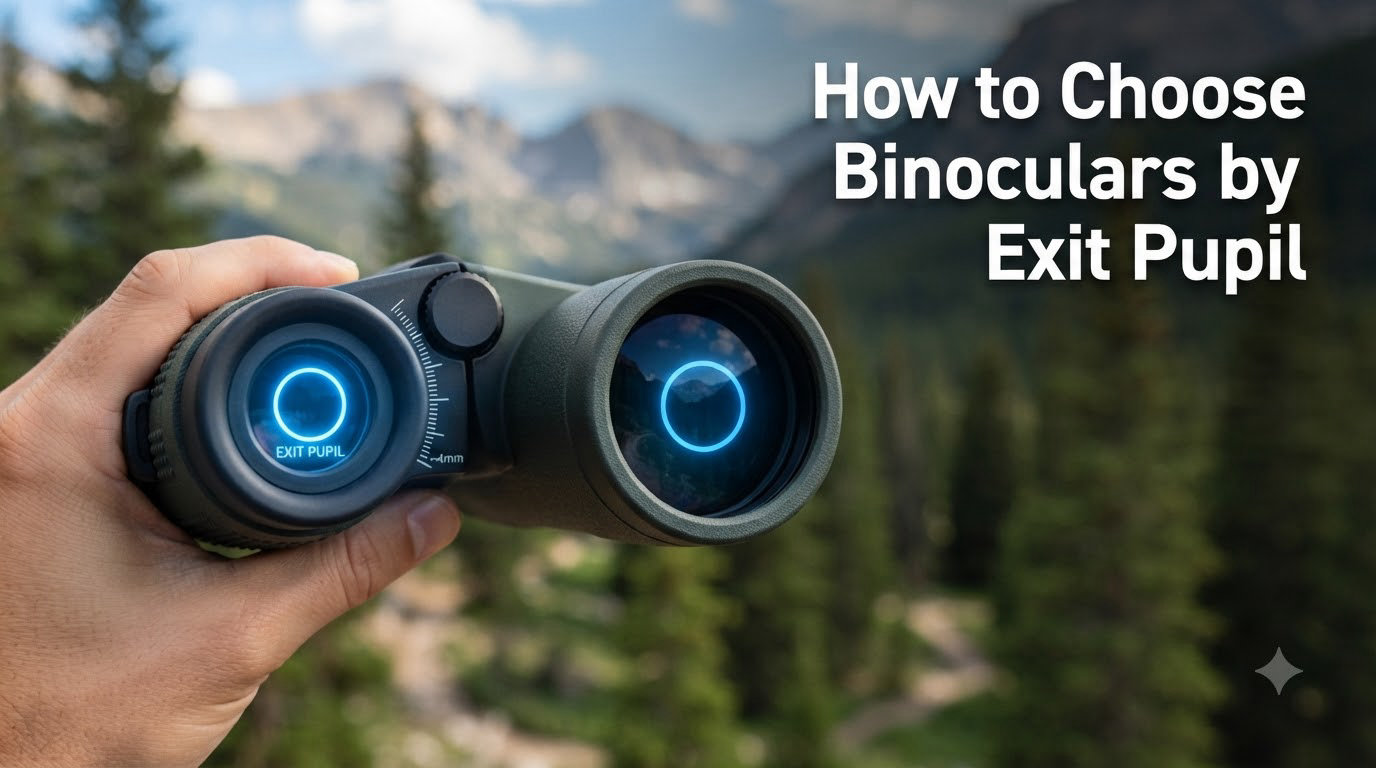
Two binoculars can look identical in daylight and perform completely differently at dawn. The spec that explains the difference is exit pupil, and once I learned how to choose binoculars by exit pupil, it changed every recommendation I make to readers. After a decade of testing optics for birding, hunting, and stargazing — and logging hundreds of hours in the exact gray light where cheap glass falls apart — I can tell you this single number predicts low-light satisfaction better than almost anything else on the box.
Exit pupil is also one of the most misunderstood specs out there. Forum threads on r/Binoculars and Cloudy Nights are full of buyers who overspent on giant 7x50s they didn’t need, or who bought compact 8x25s and then fought constant blackouts because the tiny beam of light punished every wobble of their eye placement.
This guide fixes that. You’ll learn what exit pupil actually is, how to calculate it in five seconds, how your own eyes change the answer with age, and which exit pupil range fits your specific use case. If you’re starting from scratch, our overview of types of binoculars explained covers the broader categories first, but here we go deep on the one number that decides how your view looks when the light drops.
The exit pupil is the small bright circle of light you see floating in the center of each eyepiece when you hold your binoculars at arm’s length pointed at a light source. It is measured in millimeters, and its diameter equals the objective lens diameter divided by the magnification. An 8×42 binocular has an exit pupil of 5.25mm; a 10×50 gives you 5mm; an 8×32 gives you 4mm.
Every ray of light the big front lenses gather funnels down and exits through this virtual aperture into your eye. Think of it as the delivery pipe for all the light your binoculars collected. Wider pipe, more light delivered — but only up to the width of your own pupil, which is where most buying mistakes happen.
You can see it yourself right now. Point any pair of binoculars at a window or lamp, hold them about 30cm from your eye, and look at the eyepieces from a slight distance. Those two glowing discs are your exit pupils, and their size relative to a millimeter ruler tells you more about real-world performance than half the spec sheet.
The exit pupil formula takes about three seconds: divide the objective lens diameter (the second number in a configuration like 8×42) by the magnification (the first number). That’s the entire calculation.
Exit pupil = objective lens diameter ÷ magnification
So an 8×42 works out to 42 ÷ 8 = 5.25mm. A 10×50 is 50 ÷ 10 = 5mm. A 7×50 is 50 ÷ 7 = roughly 7.1mm, one of the largest exit pupils you’ll find on a standard binocular. Notice that magnification shrinks the exit pupil while bigger objectives grow it, which is why high-magnification models always pay a brightness penalty unless their objectives scale up too.
Here’s the quick-reference chart we use internally when comparing configurations. Screenshot it or bookmark this page — these seven configurations cover about 90% of the binocular market.
| Configuration | Exit Pupil | Best Use |
|---|---|---|
| 8×32 | 4mm | Daylight birding, hiking, travel |
| 8×42 | 5.25mm | All-round use, dawn/dusk wildlife |
| 10×42 | 4.2mm | Detail work in decent light |
| 10×50 | 5mm | Low-light general viewing |
| 12×50 | 4.2mm | Long-range daytime observation |
| 7×50 | 7.1mm | Astronomy, marine, night use |
| 8×56 | 7mm | Dedicated twilight and night viewing |
If magnification is still fuzzy for you, our guide to binocular magnification breaks down 8x vs 10x in detail. Since magnification sits right in the exit pupil formula, the two decisions are really one decision made together.
No competitor structures this as a step-by-step decision process, so here’s the exact framework our team uses when testing and recommending pairs. Work through it top to bottom and you’ll land on the right exit pupil bracket in under two minutes.
Be honest about your light conditions, not aspirational ones. Full daylight, open shade, forest canopy, blue hour after sunset, true darkness — each condition demands a different exit pupil. Most people buy for the dramatic scenario (owls at midnight) and use the binoculars in the boring scenario (backyard birds at noon), then wonder why they carried two extra pounds.
Under about 3mm (compact 8x25s, 10x25s): fine for bright sun only. Expect finicky eye alignment and dim views anywhere near dusk. If you’re weighing a single-tube alternative to a compact, our binoculars vs monoculars breakdown covers the tradeoffs.
3–4mm (8×32, 10×32, 12×50): the sweet spot for daytime use with enough headroom for light shade. Our 8×32 vs 8×42 comparison shows exactly how this bracket trades off against the next one.
4–5mm (10×42, 8×36 territory): the versatile middle. Handles overcast days, early morning hunts, and long viewing sessions without the weight penalty of big objectives.
5–7mm (8×42, 10×50): where low-light performance gets real. REI’s rule of thumb holds up in my field notes too — around 5mm or more is where dawn, dusk, and dense tree cover stop being a struggle.
Around 7mm (7×50, 8×56): maximum brightness for astronomy and marine night use, but only worth carrying if your eyes can use it — which brings us to step three.
Your eye’s pupil is the ceiling on usable exit pupil. In bright daylight your pupils constrict to 2–3mm, in dim conditions they dilate to 5–7mm, and young adults can hit around 7mm in full darkness. Here’s the part nobody puts on a spec sheet: maximum dilation declines steadily with age, and most buyers over 50 rarely exceed 5mm even in the dark.
I’ve watched this play out repeatedly. A retired reader bought a monster 7×50 on my early advice years ago and found the view no brighter than his old 8×42 — because his irises simply couldn’t open past 5mm, so the excess light never reached his retina. If you’re over 50, spending for anything beyond roughly a 5mm exit pupil mostly buys weight.
Exit pupil isn’t free. Doubling the diameter of that bright circle generally means doubling the objective area, which means more glass, more weight, more bulk, and usually more cost. A 7×50 typically weighs 1.3kg-plus against roughly 700g for an 8×42, and neck fatigue after hour three of birding is a very real cost. Run the tradeoff honestly against step one: if 80% of your viewing happens above 5mm of ambient light, the big glass earns its keep maybe twice a year.
Before checkout, confirm the rest of the binocular supports your exit-pupil choice. Fully multi-coated lenses and quality prisms determine whether all that gathered light actually reaches your eye. Eye relief matters if you wear glasses. Field of view, close focus, and waterproofing round out the decision — our guide to choosing binoculars for bird watching walks through those factors for anyone focused on wildlife.
The single biggest insight from years of reader questions: exit pupil is a match between two diameters, the binocular’s and yours. Whichever is smaller wins, and everything larger is wasted.
In full daylight your pupils sit at 2–3mm, so even a humble 8×25 delivers more light than your iris accepts. Move indoors or under forest canopy and pupils open to 4–5mm. At dusk they push toward 6mm, and in true darkness a healthy 25-year-old reaches about 7mm. This is why both a small-exit-pupil compact and a giant 7×50 can look equally bright at noon yet behave completely differently thirty minutes after sunset.
Past age 45–50, the maximum dilation number drops noticeably — many older users top out near 5mm, and by the 70s often closer to 4mm. On BirdForum and Cloudy Nights, experienced observers in exactly this demographic consistently report zero benefit from 7mm-class instruments. The practical takeaway: if you’re over 50, target a 4–5mm exit pupil and spend the savings on optical quality instead of aperture.
A larger exit pupil is also more forgiving of imperfect eye placement, independent of brightness. With a 5.25mm circle from an 8×42, your eye can drift several millimeters off-center and stay fully illuminated. With a tight 4mm or smaller beam from a compact, any drift causes partial blackout — the frustrating “kidney bean” shadow effect forum users complain about constantly. Glasses wearers get a double benefit from generous exit pupils paired with long eye relief, since glasses physically hold the eye farther from the eyepiece.
Here are our tested rules of thumb, distilled into a format you can lift straight into a shopping decision:
If your honest answer lands at 5mm or higher, our roundup of the best low light binoculars lists specific models that deliver on the promise in the field, not just on paper.
Is a larger exit pupil better? Only until it exceeds your pupil and your patience. Beyond that point you’re paying real costs for imaginary gains.
In bright conditions, a 7×50 and a pocket 8×25 produce identical perceived brightness because your constricted 2–3mm pupils clip both beams anyway. Nikon explains this well on their education pages, and it’s the fact that kills most impulse upgrades. The extra aperture of a large-exit-pupil instrument only pays during a narrow window of genuinely dim conditions — so buy for that window only if you genuinely live in it.
Light-gathering scales with objective area, so going from a 42mm to a 56mm objective grows the front glass by about 78%. That translates directly into heavier binoculars, a harder-to-steady image at higher magnifications, and typically a steeper price for the same optical quality tier. For handheld use especially, the steadiest view often beats the theoretically brightest one.
Here’s a nuance the spec sheet hides: exit pupil assumes 100% light transmission, and no binocular achieves it. Premium compacts with superb coatings routinely look brighter in marginal light than budget giants whose uncoated optics lose 20% or more of the light their exit pupil math promises. Forum users noticed this exact paradox with high-end small binoculars outperforming cheaper large ones. Treat exit pupil as necessary but not sufficient — glass quality and transmission decide whether the theoretical brightness arrives.
These three terms get tangled together constantly, and mixing up exit pupil vs eye relief is probably the single most common confusion we see in reader questions. They measure completely different things:
| Spec | What It Measures | Why It Matters |
|---|---|---|
| Exit pupil | Diameter of the light beam leaving the eyepiece (mm) | Brightness in low light, alignment forgiveness |
| Eye relief | Distance your eye can sit from the eyepiece and still see the full image (mm) | Comfort and usability for eyeglass wearers |
| Twilight factor | Square root of (magnification × objective diameter) | How much detail resolution survives in dim light |
A quick way to remember: exit pupil governs how bright the image is, eye relief governs how far back you can hold your eye, and twilight factor governs how much detail survives in shadow. A 12×50 and a 10×42 can share an identical 4.2mm exit pupil yet behave differently at distance because their magnifications differ — which brings us to a question we get weekly.
One warning from hands-on testing that almost no buying guide covers: some budget binoculars don’t deliver the exit pupil their math implies. Users on r/Binoculars have measured actual beams on cheap porro-prism “20×50” models using nothing fancier than a printed transparency ruler and found exit pupils dramatically smaller than 2.5mm — sometimes half the calculated figure.
The cause is undersized internal prisms or stopped-down apertures inside the barrel. The manufacturer effectively masks part of the objective lens, so the “virtual aperture” delivering your light is smaller than advertised. You paid for a 50mm light bucket and received a fraction of it. This is why a suspiciously inexpensive giant-objective binocular should raise a red flag rather than excitement.
You can check any pair yourself in two minutes. Project the exit pupil onto a piece of white card held behind the eyepiece in good light, measure the disc with a ruler, and compare it to the calculation. Bonus diagnostic: the disc should be perfectly circular and uniformly lit. A squared-off edge, crescent shading, or gray smudge across the circle signals poor prism quality or misalignment — walk away from that pair regardless of its other specs.
For most people, 4-5mm is the best all-round exit pupil, which is why 8×42 (5.25mm) dominates sales. Use 2.5-4mm for dedicated daylight viewing and 5-7mm for regular dawn, dusk, forest, or night use.
Only up to the point where it matches your eye’s dilated pupil. Beyond roughly 5mm for most adults, extra exit pupil adds weight and cost without adding brightness, though it does ease eye alignment slightly.
Both deliver an identical 4.2mm exit pupil, so brightness ties. Choose 10×42 for lighter weight, a wider field of view, and easier steadiness; choose 12×50 when maximum reach matters more than portability.
Divide the objective lens diameter by the magnification. A 10×50 binocular has a 5mm exit pupil (50 divided by 10); an 8×32 has a 4mm exit pupil (32 divided by 8).
Aim for 5mm or more for genuine low-light performance such as dawn, dusk, or dense tree cover. Serious night and astronomy use justifies 7mm-class instruments like 7×50 or 8×56, provided your pupils still dilate that far.
No. Exit pupil is the diameter of the light beam exiting the eyepiece, measured in millimeters. Eye relief is the distance your eye can sit from the eyepiece while still seeing the full image – a comfort and glasses-wearing specification, not a brightness one.
Learning how to choose binoculars by exit pupil comes down to matching three numbers: the binocular’s beam, your eye’s dilation, and your activity’s light conditions. For most adults, that match lives between 4 and 5.5mm — the territory of 8×42 and 10×50 instruments.
If you’re a daytime birder or traveler, a 4mm exit pupil saves weight without costing you anything visible. If you hunt at first light or watch wildlife at dusk, insist on 5mm or more. If you’re over 50, cap your target near 5mm and put the difference toward better glass and coatings. And whichever bracket fits you, browse our picks for the best binoculars under $500 — that budget comfortably buys excellent low-light performance when you know exactly which exit pupil you need in 2026.