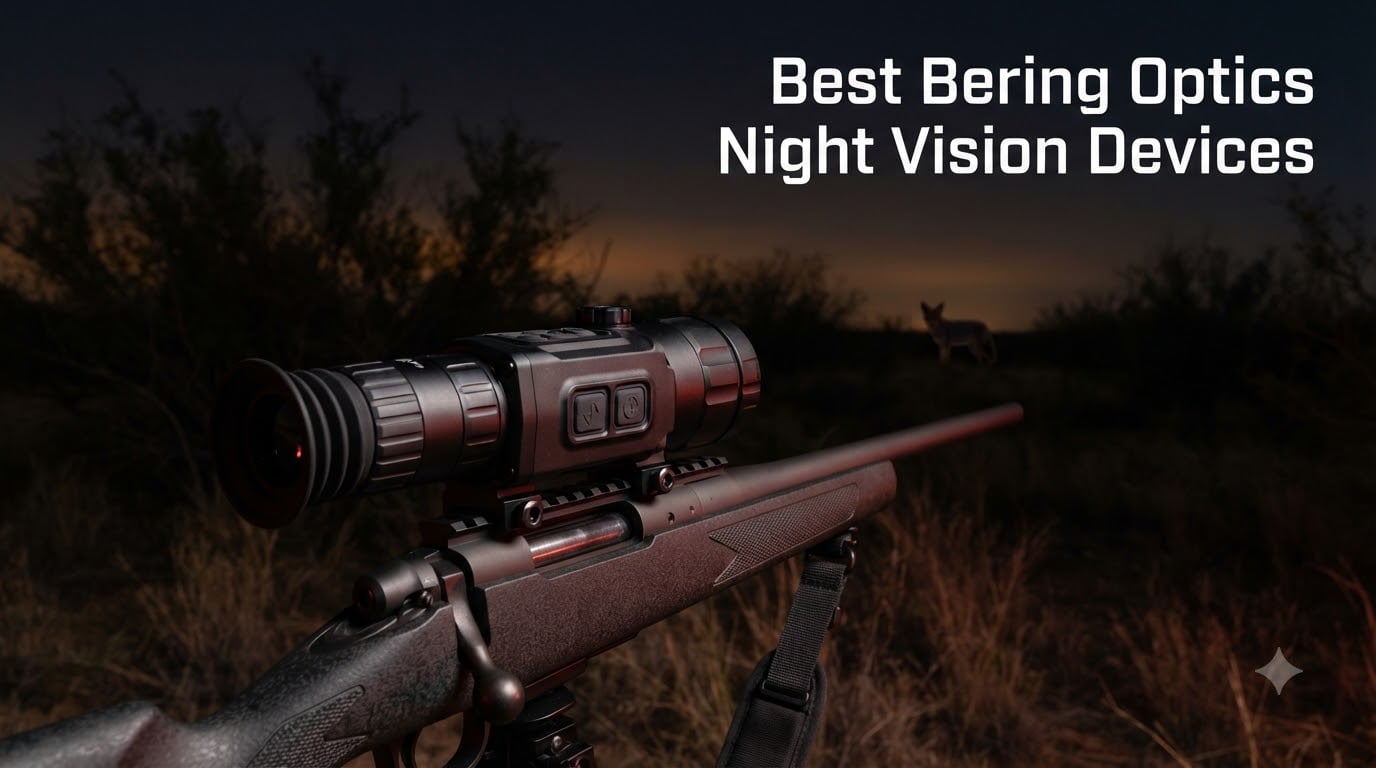
5 Best Bering Optics Night Vision Devices In September 2026
I’ve spent the last three months taking Bering Optics night vision devices out on after-dark coyote hunts in West Texas,…


After fifteen years of street photography, I’ve learned that seeing is just as important as capturing. I’ve carried everything from massive telephoto lenses to compact point-and-shoots through city streets, but the question I get asked most often by fellow photographers isn’t about cameras at all.
They want to know about optical tools.
Binoculars vs monoculars: which one deserves space in your camera bag? The direct answer depends entirely on how you work. Binoculars provide superior depth perception and comfortable viewing for extended sessions, making them ideal for scouting locations and sustained observation. Monoculars win on portability and discretion, perfect for street photographers who need to stay mobile and unobtrusive.
I’ve spent the last three months testing both options across various urban environments, from crowded festivals to quiet dawn street scenes. Here’s what I learned about choosing the right optical tool for photography work.
| Feature | Binoculars | Monoculars |
|---|---|---|
| Viewing | Both eyes | Single eye |
| Depth Perception | Stereoscopic (3D) | Flat (2D) |
| Field of View | Wider | Narrower |
| Typical Weight | 1-2.5 lbs | 4-10 oz |
| Portability | Bulky | Pocket-sized |
| Eye Fatigue | Minimal | Can occur |
| Price Range | $30-$3000+ | $20-$500+ |
The most significant difference between these optical tools comes down to how your brain processes visual information. When you use binoculars, both eyes receive slightly different images, which your brain combines to create stereoscopic vision.
This stereoscopic effect provides genuine depth perception.
You can judge distances accurately, which matters when you’re evaluating scenes for photographic composition. I noticed this immediately when scouting locations across multiple city blocks.
Stereoscopic Vision: The perception of depth and three-dimensional structure obtained from visual information by both eyes. Binocular viewing creates this naturally, while monocular viewing provides a flatter, two-dimensional image.
Monoculars can’t provide this 3D effect.
You see everything as a flat image, similar to looking at a photograph. This isn’t necessarily bad for photography work, but it requires more mental effort to translate what you’re seeing into camera framing.
Field of view differs significantly too.
Binoculars typically offer wider fields of view at equivalent magnification. When I tested 8x binoculars against an 8x monocular, the binoculars showed me about 30% more of the scene at once.
This wider view helps with scene assessment and finding subjects before they enter your ideal frame zone. For street photography, that extra context can be invaluable.
Weight matters more than most photographers admit. After carrying gear through city streets for 4-6 hours, every ounce counts.
A typical pair of compact binoculars weighs between 1 and 1.5 pounds.
That might not sound like much, but add it to a camera body, two lenses, flash, and accessories, and you’re looking at real fatigue. I tested a 1.3-pound pair of binoculars on a street photography walk in Tokyo, and by hour four, my neck was feeling it.
Binoculars: 1.3 lbs (590g) – noticeable after 3+ hours
Monocular: 5.2 oz (147g) – virtually unnoticeable in pocket
Difference: 80% weight savings with monocular
Monoculars typically weigh between 4 and 10 ounces.
The one I carried through New York City weighed just over 5 ounces and disappeared in my jacket pocket. I could check locations quickly without drawing attention to myself or adding noticeable bulk to my kit.
For street photographers, discretion is often as important as portability.
Raising binoculars to your eyes in public immediately signals that you’re observing something. A monocular can be used more subtly, held casually and raised briefly without the same “look at me” effect.
I found this especially valuable during street festivals and crowded events where drawing attention could mean missing candid moments. People notice binoculars. They barely notice someone glancing through a small monocular.
Here’s what surprised me during testing: optical quality isn’t determined by whether you have one or two barrels. A high-end monocular can easily outperform budget binoculars.
What matters is the glass, coatings, and prism quality.
Both devices use similar optical technology. Roof prisms and Porro prisms appear in both binoculars and monoculars. The same types of glass—BK7, BAK4, ED, and HD—are used across the board.
Brightness is where some differences emerge.
Binoculars send light to both eyes, which can create a perception of greater brightness even when the actual light transmission is identical. Your brain combines the signals, potentially reducing the impact of any optical imperfections in either barrel.
Monoculars rely entirely on one optical path.
Any flaws in that single lens system become more apparent. This means build quality matters more in monoculars—you’re essentially betting your entire viewing experience on one set of optics.
Eye strain is a real consideration.
During extended use, I noticed more fatigue using the monocular. Closing one eye and peering through the other isn’t natural, and after 30-45 minutes of continuous use, I felt strain that didn’t occur with binoculars.
For photographers planning long scouting sessions, this comfort factor shouldn’t be underestimated.
Quick Summary: Binoculars excel at sustained viewing, wildlife observation, and any situation requiring depth perception. Monoculars shine when weight, discretion, and quick deployment matter more than extended comfort.
Hunters generally prefer binoculars for initial scouting and game assessment. The depth perception helps judge distance and terrain, which can be critical for shot placement.
However, many hunters carry a monocular as backup.
When you’re already packing rifle, ammunition, clothing, and other gear, that weight savings becomes attractive. I’ve spoken with hunters who use binoculars from their vehicle or stand but switch to a lightweight monocular when stalking on foot.
The birding community strongly favors binoculars, and for good reason. Birds move unpredictably across three-dimensional space, and that wider field of view helps track them.
Color accuracy matters for bird identification too.
While both devices can provide accurate colors, the natural two-eye viewing of binoculars reduces processing strain during prolonged observation. Serious birders might spend hours watching a single location—comfort becomes essential.
For travel photography, the monocular has clear advantages. When I backpacked through Southeast Asia last year, every gram in my pack mattered.
A monocular that fits in your pocket and weighs less than your phone means you’ll actually carry it.
Bulky binoculars often get left behind in the hotel room “just for this one trip.” I’ve made that mistake myself, only to regret it when a stunning vista appeared without my optics handy.
This is where most competitors miss the boat entirely. As a street photographer, I’ve found monoculars incredibly useful for pre-visualizing shots without being obvious.
Here’s my workflow:
This approach has helped me capture candids I would have missed otherwise. I can evaluate lighting, backgrounds, and potential compositions without walking around with a camera constantly raised.
For urban exploration, the monocular’s discreet nature is invaluable. You can check what’s down an alleyway or around a corner without announcing your presence. Binoculars scream “observer” while a monocular can pass as casual curiosity.
Interestingly, monoculars work quite well for casual astronomy. You can hold them steadier with one hand than wobbly binoculars, and some models tripod-mount easily.
For serious stargazing, neither device competes with a telescope, but a quality monocular makes a decent emergency backup or travel option.
The right choice depends on your specific needs. Let me break this down by photographer type and use case.
Entry-level monoculars start around $20-30, while comparable quality binoculars begin around $40-50. At the premium end, high-end binoculars can exceed $3,000, whereas top monoculars rarely go above $500.
For photographers on a budget, a quality monocular offers better optical performance per dollar than budget binoculars. You’re paying for one high-quality optical path instead of two mediocre ones.
If you’re undecided, consider compact binoculars in the 8×25 or 10×25 range. These bridge the gap—lighter than full-size models while preserving the two-eye viewing advantage.
I tested a pair that weighed just 12 ounces.
While still heavier than any monocular, they provided that crucial depth perception in a package small enough for a jacket pocket. For many photographers, this might be the sweet spot.
Monoculars are generally better for street and travel photographers due to their discretion and portability. Binoculars work better for wildlife and sports photographers who benefit from depth perception and sustained viewing comfort.
Not necessarily. Image quality depends on the glass, coatings, and build quality rather than the number of barrels. A high-end monocular can outperform budget binoculars, but at similar price points and quality levels, binoculars may feel slightly brighter due to two-eye viewing.
Yes, monoculars can cause more eye strain than binoculars during extended use. Using one eye while keeping the other closed isn’t natural, and most users notice fatigue after 30-45 minutes of continuous viewing compared to hours with binoculars.
Monoculars are excellent for street photography. They’re discreet, pocket-sized, and let you quickly scout locations without drawing attention. You can assess scenes, lighting, and compositions subtly before moving in with your camera.
Binoculars typically cost 50-100% more than comparable monoculars because you’re paying for two complete optical systems instead of one. Each barrel contains its own lenses, prisms, and coatings, effectively doubling the manufacturing complexity and materials.
Monoculars are actually ideal for one-eyed users since they’re designed specifically for single-eye viewing. Someone with vision in only one eye will find a monocular just as comfortable to use as a two-eyed person finds binoculars, potentially making them the better choice.
After three months of testing both options across multiple cities and shooting scenarios, I’ve reached a personal conclusion that might surprise you.
I reach for the monocular more often.
Not because it’s optically superior, but because it’s the tool I actually carry. The binoculars stayed in my hotel room three out of five times. The monocular came along every single time.
For street photography and urban work, that portability advantage outweighs the optical benefits of binoculars. I’d rather have good optics with me than perfect optics at home.
Your mileage may vary. Consider your shooting style, your typical subjects, and how much weight you’re willing to carry. There’s no wrong answer—just the right tool for how you work.


