How to Choose a Birdhouse (August 2026)
When I put up my first birdhouse fifteen years ago, it was a flimsy pine box from a garden center…

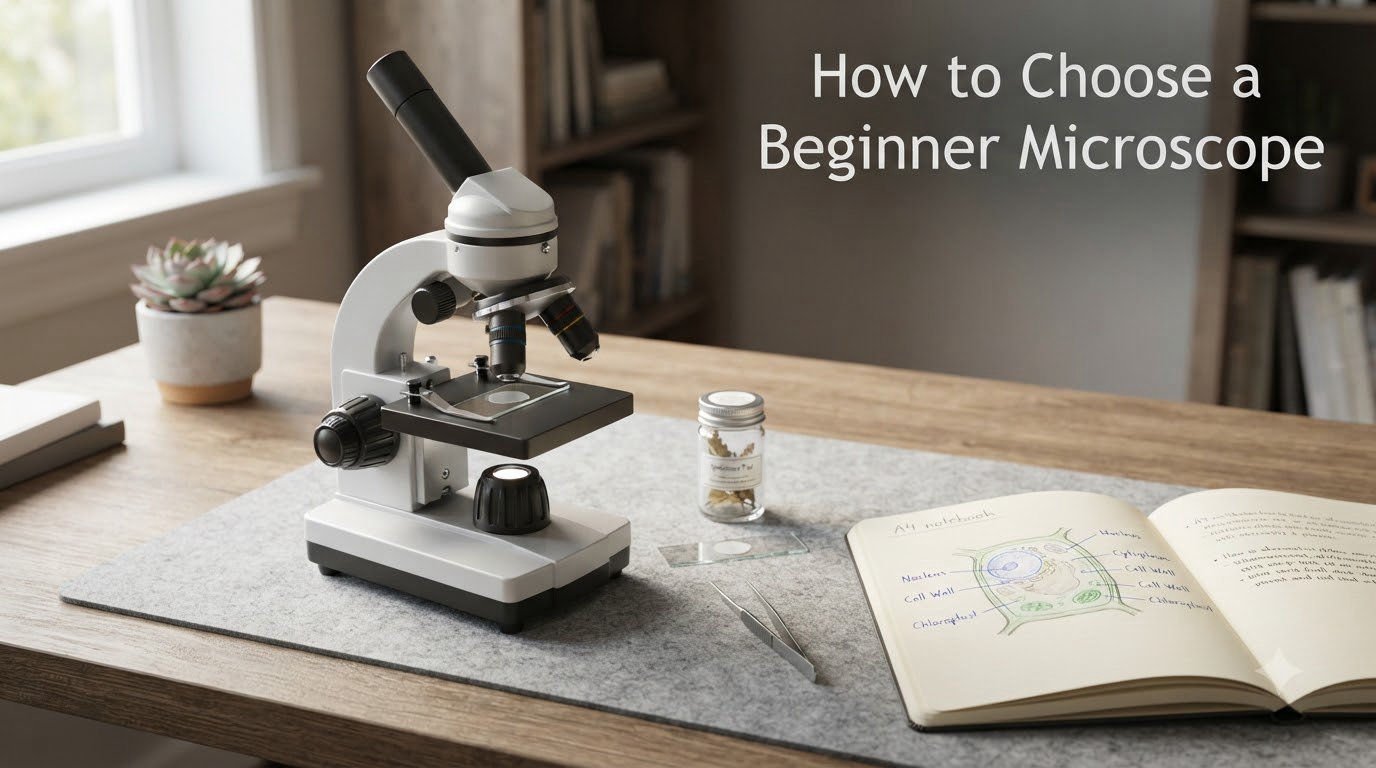
I remember the first time I peered through a real microscope at a high school pond water sample and saw a paramecium zip across the field of view. That single moment hooked me on microscopy for life. Yet when I went to buy my first scope a few years later, I nearly walked out with a 2000x plastic “toy” that would have ruined the experience.
Choosing a beginner microscope in 2026 is less about finding the cheapest model with the highest magnification number and more about matching the instrument to what you actually want to see. Our team has spent months comparing scopes, reading hundreds of Reddit threads in r/microscopy, and interviewing amateur microscopists to build this guide. Whether you are a parent buying for a curious 10-year-old, a student starting a biology class, or an adult picking up a new hobby, this walkthrough will help you choose a beginner microscope that you will still enjoy a year from now.
If you are weighing a digital option instead, our best digital microscope roundup covers the modern camera-based alternatives. Otherwise, read on for the full framework.
The single biggest decision when choosing a beginner microscope is whether you need a compound or a stereo microscope. Get this wrong and the rest of the spec sheet does not matter.
A compound microscope uses multiple lenses to magnify thin, light-transmitting samples like cells, pond scum, blood smears, or prepared tissue slides. Light shines up from below through the slide and into the objective lenses. These are the classic “school” microscopes and the right choice for biology, medicine, and anythin.
A stereo microscope (also called a dissecting microscope) gives you a 3D view of opaque objects at lower magnification. Think coins, insects, circuit boards, rocks, or watch parts. Light falls onto the sample from above, and you view it from above as well. If your samples are solid and three-dimensional, stereo is the right starting point.
Our full head-to-head breakdown lives in our Compound vs Stereo Microscope guide. Here is the quick comparison:
| Feature | Compound Microscope | Stereo Microscope |
|---|---|---|
| Typical magnification | 40x to 1000x | 10x to 80x |
| Sample type | Thin, transparent slides | Solid, 3D objects |
| Light path | From below (transmitted) | From above (reflected) |
| Image type | 2D, high detail | 3D, lower detail |
| Best for beginners | Biology students, hobbyists exploring cells | Coin collectors, insect fans, soldering, dissection prep |
| Approximate entry cost | Mid-tier and up | Often lower |
Still unsure? Most true beginners do best by starting with a compound microscope, since biology curricula and most “first samples” (pond water, onion skin, cheek cells) live there. Stereo scopes are excellent second instruments or specialized first buys for specific hobbies.
Marketing loves to slap huge magnification numbers on beginner microscopes. “2000x power!” screams the box. Here is the truth: usable magnification, optical quality, and resolution matter far more than the headline number.
Most compound beginner microscopes ship with three or four objective lenses on a rotating turret, paired with a 10x eyepiece. The total magnification equals objective power times eyepiece power.
| Objective | With 10x Eyepiece | What You Can See |
|---|---|---|
| 4x (scanning) | 40x | Whole insects, large organisms, slide overview |
| 10x (low power) | 100x | Pond critters, plant cells, fabric weave |
| 40x (high power) | 400x | Bacteria (large species), cell detail, blood cells |
| 100x (oil immersion) | 1000x | Small bacteria, fine cellular detail, requires immersion oil |
For 90 percent of beginner work, the 4x, 10x, and 40x objectives cover everything you need. The 100x oil immersion lens is exciting but rarely used without proper technique and slide preparation. A scope claiming “2000x” usually means a cheap 20x eyepiece stacked on a 100x objective, and the resulting image is blurry and dim rather than detailed.
If you specifically want to see bacteria, a quality 1000x compound microscope with an Abbe condenser and proper slide staining is what you need. We will cover condenser quality next.
Once you have decided between compound and stereo, these are the build features that tell you whether you are looking at a serious instrument or a plastic disappointment.
An iris diaphragm sits below the stage and lets you control the cone of light hitting the specimen. An Abbe condenser sits above the diaphragm and focuses that light. Together they control contrast and resolution, especially at 400x and above. A beginner microscope without these is like buying a camera without a lens. Skip it.
A mechanical stage has X and Y knobs that move the slide smoothly in tiny increments. At 400x, even a slight bump with your finger sends the specimen flying out of view. A mechanical stage is one of the most appreciated features by every beginner I have watched struggle without one.
Achromatic objectives correct for color fringing. They are the minimum standard for serious beginner work. Plan objectives are even better (flat field) and common on mid-tier scopes. Avoid microscopes that do not specify the objective type at all.
DIN compatibility means the objectives are 45mm and fit a standard thread. This lets you upgrade or swap lenses later without replacing the whole microscope. It is the single best long-term value feature a beginner microscope can have.
Metal gears and frames hold alignment far better than plastic. Optical alignment matters: if the internal prism shifts, your image degrades. A solid metal body will stay aligned for decades; a plastic body often drifts within months.
Coarse focus brings the image into rough view. Fine focus sharpens it. At 400x and above, fine focus is essential. Make sure the beginner microscope you choose has both knobs and that they turn smoothly without slipping.
The light source matters more than most beginners realize. There are three common options in 2026:
LED illumination is the modern default for beginner microscopes. It runs cool, lasts roughly 50,000 hours, and uses very little power. Many LED scopes are cordless and rechargeable, which is great for field use or kids. For most beginners, LED is the best choice.
Halogen illumination produces a warmer, slightly more natural light that some experienced microscopists prefer for stained slides. It runs hotter, has a shorter bulb life, and is increasingly rare in new beginner scopes.
Tungsten or fluorescent lighting is older technology you will mostly see on vintage or used microscopes. They still work but tend to run hot and dim over time.
If you are buying new, choose LED. If you are buying a used scope, a halogen or tungsten system is fine as long as the bulb is replaceable and cheap.
Different users need different beginner microscopes. Here is the framework I share with friends and family.
A simple stereo microscope at 10x to 40x works best. Young kids struggle with the thin slides a compound scope requires, and they usually want to look at real-world objects (bugs, leaves, sand). Pick something durable, plastic-acceptable, and easy to focus.
A binocular compound microscope with 4x, 10x, and 40x objectives, a mechanical stage, and LED lighting is the sweet spot. This is the classic “B120-class” instrument that countless biology teachers recommend.
Skip the toy section. Look for a trinocular compound microscope if you ever want to add a camera, or a stereo microscope with a boom stand if your interests run toward dissection or electronics.
Buy once. A mid-tier binocular compound microscope with an Abbe condenser, mechanical stage, achromatic objectives, and lifetime warranty will serve multiple children over many years. The cost spread across a decade of use is tiny.
The r/microscopy community has been collecting beginner mistakes for over a decade. Here are the ones that come up again and again.
Mistake 1: chasing magnification. Anything over 1000x on a beginner scope is marketing noise. Focus on optical quality instead.
Mistake 2: skipping the mechanical stage. Trying to nudge a slide by hand at 400x is genuinely frustrating. The mechanical stage is the upgrade beginners thank themselves for the most.
Mistake 3: buying a monocular scope. Using one eye for extended viewing causes headaches and eye strain. Binocular heads cost a little more and are worth every cent.
Mistake 4: ignoring the warranty. A lifetime warranty on optical components signals a manufacturer who trusts their build quality. Five-year warranties are common on mid-tier scopes. Anything shorter is a red flag.
Mistake 5: forgetting slides and accessories. A microscope without prepared slides, blank slides, and cover slips is a paperweight. Budget for a starter accessory kit on day one.
Mistake 6: trusting unknown Amazon listings. The compound microscope market has many lookalike brands with similar specs and very different build quality. Stick with established names or buy from sellers with strong return policies.
This is the section I wish someone had handed me before my first purchase. Use it as your final filter.
Entry tier scopes sit at the bottom of the market. They work for casual curiosity and very young kids, but the optics and mechanical parts are basic. Expect plastic components and limited upgrade paths.
Mid tier is where serious beginners should land. This includes binocular compound microscopes with Abbe condensers, mechanical stages, achromatic objectives, and DIN compatibility. The optical quality is genuinely good and the scopes last decades.
Pro tier scopes add plan objectives, trinocular heads, Kohler illumination, and phase contrast. They are overkill for a true beginner unless you have specific advanced goals.
A used Olympus, Nikon, or Leica from a university surplus sale can outperform many new mid-tier scopes at half the price. The trade-off is no warranty, possibly missing accessories, and the need to inspect before buying. If you have a local microscopy club, ask before shopping.
New beginner microscopes come with warranties, fresh slides, and the satisfaction of unboxing. For most first-time buyers, new is the safer path.
Brands like AmScope, Omano, Swift, and Celestron dominate the beginner and mid-tier compound market. They have established parts supply, working warranties, and large user communities online. Vintage Nikon, Olympus, and Leica are excellent in the used market.
Even the best-reviewed beginner microscope can arrive with a problem. A 30-day return policy from a reputable seller is your safety net. Amazon listings from major brands usually qualify.
DIN-standard objectives, a standard 23mm eyepiece tube, and a standard filter set mean you can add accessories later without buying a new scope. This single decision can double the useful life of your first microscope.
A starter accessory kit with prepared slides, blank slides, cover slips, immersion oil, lens wipes, and a slide storage box costs less than you would think. Skip it and your new scope sits unused for weeks while you wait for parts to arrive.
For readers ready to go beyond beginner scopes, our guide to advanced microscope configurations covers the next step up.
A good basic microscope for beginners is a binocular compound microscope with 4x, 10x, and 40x achromatic objectives, a mechanical stage, an Abbe condenser with iris diaphragm, and LED illumination. Look for DIN-standard objectives so you can upgrade later, and choose a brand with at least a five-year warranty. This setup handles pond water, plant cells, blood smears, and prepared slides without frustration.
The numbers refer to the objective lens magnification, multiplied by the eyepiece (usually 10x) to give total magnification. The 4x objective gives 40x total and is best for scanning whole slides and large organisms. The 10x objective gives 100x total and is the everyday workhorse for pond critters, plant cells, and fabric detail. The 40x objective gives 400x total and reveals bacteria, blood cells, and fine cellular structures. A 100x oil immersion objective giving 1000x is reserved for advanced work.
Yes, a 1000x compound microscope can see larger bacteria such as Bacillus, Bacillus subtilis, and many rod-shaped species, especially when slides are properly stained. Smaller bacteria like Mycoplasma still cannot be resolved by light microscopy at all. To actually see bacteria clearly at 1000x you need an Abbe condenser, proper Köhler-style illumination, immersion oil, and stained prepared slides rather than wet mounts.
Buy a compound microscope first if you want to explore biology: pond water, cells, prepared slides, and stained specimens. Buy a stereo microscope first if you are mainly interested in coins, insects, rocks, soldering, watchmaking, or 3D objects. Many hobbyists eventually own both. If your budget covers only one and you have no specific hobby focus, a mid-tier compound microscope with mechanical stage is the safer first choice.
LED is better for almost every beginner in 2026. It runs cool, lasts around 50,000 hours, uses little power, and allows many scopes to run cordlessly on rechargeable batteries. Halogen produces a warmer light that some experienced microscopists prefer for stained slides, but it runs hot, has shorter bulb life, and is increasingly rare in new beginner microscopes. Choose LED unless you are buying a quality used halogen scope at a good price.
Buy new if you want a warranty, fresh accessories, and the security of a return policy. Buy used if you have the knowledge to inspect the optics and want significantly better build quality for the same money. Vintage Olympus, Nikon, and Leica compound microscopes from university surplus often outperform new mid-tier scopes at half the cost. Inspect used scopes for smooth focus, clean optics, working illumination, and a mechanical stage before paying.
If you want a beginner microscope that will still earn its place on your desk in 2026, start with a binocular compound microscope with achromatic 4x, 10x, and 40x objectives, a mechanical stage, an Abbe condenser with iris diaphragm, and LED lighting. Choose a brand with a solid warranty and DIN-standard objectives so you can grow into it.
Once you know whether biology or 3D inspection is your real interest, invest in the matching tier and add a small accessory kit on day one. Your microscope will reward you for years.