8 Best Binocular Tripod Adapters (September 2026)
I still remember the morning my hands started shaking so badly I could not focus on a bull elk at…

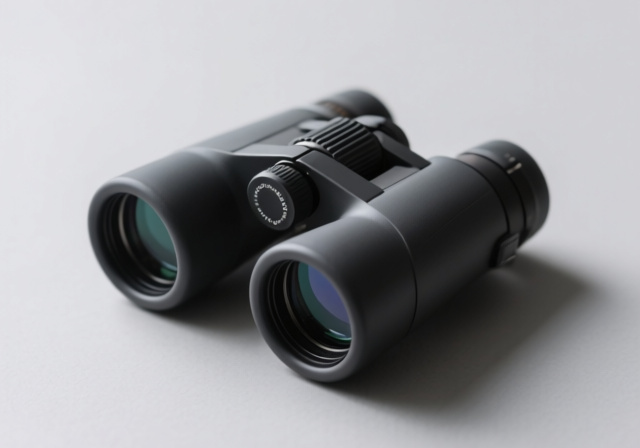
Understanding binocular features shouldn’t require an engineering degree. After years of testing optics across different activities, I’ve learned that most technical jargon serves one purpose: matching specifications to your specific needs.
>The key binocular features that determine real-world performance include magnification power, objective lens diameter, field of view, lens and prism coatings, eye relief, and waterproof construction. Each specification affects how the binoculars perform in specific situations—from bright daylight birding to dawn hunting expeditions.Quick Answer: For most users, 8×42 binoculars offer the best balance of magnification, brightness, and field of view. Prioritize fully multi-coated optics, waterproof construction, and at least 15mm of eye relief if you wear glasses.
This guide breaks down every binocular feature you’ll encounter, explaining what each specification means in plain language and how it translates to real-world performance.
Every pair of binoculars displays two numbers like 8×42 or 10×25.
These aren’t random codes—they tell you exactly how the binoculars will perform in the field.
Quick Summary: The first number is magnification power (how many times closer objects appear). The second number is objective lens diameter in millimeters (how much light enters). Larger second numbers mean brighter images but heavier binoculars.
Magnification seems straightforward—higher numbers bring things closer.
But there’s a catch I learned the hard way while tracking birds through dense forest.
Higher magnification narrows your field of view and amplifies every tiny hand movement. I tested 10x and 12x binoculars alongside 8x models, and the shake at 10x made tracking moving birds nearly impossible without a tripod.
| Magnification | Best For | Tradeoffs |
|---|---|---|
| 6x-8x | Birding, general use, sports | Wider field of view, less shake |
| 10x | Hunting, long-distance viewing | Narrower view, more noticeable shake |
| 12x+ | Stable viewing only (tripod) | Very narrow, requires stabilization |
Choosing the right magnification depends on your primary activity and how steady you can hold the binoculars.
This comparison shows what each magnification level delivers in real-world use.
| Magnification | Field of View | Exit Pupil (8×42) | Shake Factor | Best Use Cases |
|---|---|---|---|---|
| 6x | Very wide (450+ ft) | 5.25mm (42mm lens) | Minimal | Woodland birding, sports |
| 7x | Wide (400-450 ft) | 6mm (42mm lens) | Low | Marine use, general wildlife |
| 8x | Wide (350-400 ft) | 5.25mm (42mm lens) | Low | All-purpose birding, hunting |
| 10x | Moderate (300-350 ft) | 4.2mm (42mm lens) | Moderate | Open country hunting, distant viewing |
| 12x | Narrow (250-300 ft) | 3.5mm (42mm lens) | High | Stationary viewing with tripod |
Most experienced users recommend starting with 8x magnification unless you have a specific reason to go higher.
The difference between 8x and 10x might seem small on paper, but in the field, 8x is significantly easier to hold steady and find your subject quickly.
You’ll encounter various binocular number combinations beyond the standard 8×42 format.
Understanding these less common configurations helps you avoid marketing hype and choose the right tool for your needs.
What does 30×60 mean? The 30×60 designation means 30x magnification with 60mm objective lenses. However, these specifications are often exaggerated on inexpensive models. Realistically, most 30×60 binoculars deliver closer to 10-15x magnification with significant optical compromises including narrow field of view and poor image quality.
The 30×60 format is commonly marketed as “high power” binoculars at budget price points.
While the numbers look impressive on paper, these models typically suffer from poor optical quality, difficulty holding steady, anddim images despite the large objective lenses.
The comparison between 10×25 and 30×60 binoculars often confuses new buyers.
| Specification | 10×25 Binoculars | 30×60 Binoculars (Typical) |
|---|---|---|
| Magnification | Genuine 10x | Often exaggerated (actual 10-15x) |
| Exit Pupil | 2.5mm | 2mm (60mm divided by 30x) |
| Field of View | 280-320 feet | Very narrow (150-200 feet) |
| Low Light | Poor (small exit pupil) | Poor despite large lenses |
| Stability | Moderate shake | Severe shake at claimed magnification |
| Best For | Daylight travel, sports | Novelty use, not recommended |
For serious use, quality 10×25 binoculars will outperform typical 30×60 models in every category except pure magnification marketing claims.
Objective Lens Diameter: The size of the front lenses measured in millimeters. Larger lenses gather more light, producing brighter images especially in dim conditions.
The second number (42mm, 32mm, 50mm) tells you the diameter of the front lenses.
Larger lenses capture more light.
This matters most at dawn and dusk—the golden hours when wildlife is most active.
I’ve compared 8×25 compacts against 8×42 full-size binoculars at sunset. The difference is dramatic—25mm lenses produce a dim, muddy image when 42mm lenses still deliver clear, bright views.
But bigger lenses mean heavier binoculars. That 50mm pair that seems fine in the store becomes a neck anchor after four hours on the trail.
The comparison between 12×50 and 10×42 binoculars represents a common dilemma for hunters and wildlife observers.
| Factor | 12×50 Binoculars | 10×42 Binoculars |
|---|---|---|
| Magnification | 12x (closer view) | 10x (slightly less) |
| Exit Pupil | 4.2mm | 4.2mm (same brightness) |
| Field of View | Narrower (~260 ft) | Wider (~300 ft) |
| Weight | Heavier (30-35 oz) | Moderate (25-28 oz) |
| Steadiness | More noticeable shake | Easier to hold steady |
| Best For | Stable long-distance viewing | Most hunting and wildlife use |
For most users, 10×42 binoculars offer better practical performance.
The 2x magnification difference between 10x and 12x is less significant than the increased shake and narrower field of view. Unless you have exceptionally steady hands or use a tripod, 10×42 will deliver more satisfying views in the field.
However, if you primarily glass from a stationary position—treestand, blind, or vehicle mount—the 12×50 configuration can provide that extra magnification when it matters most.
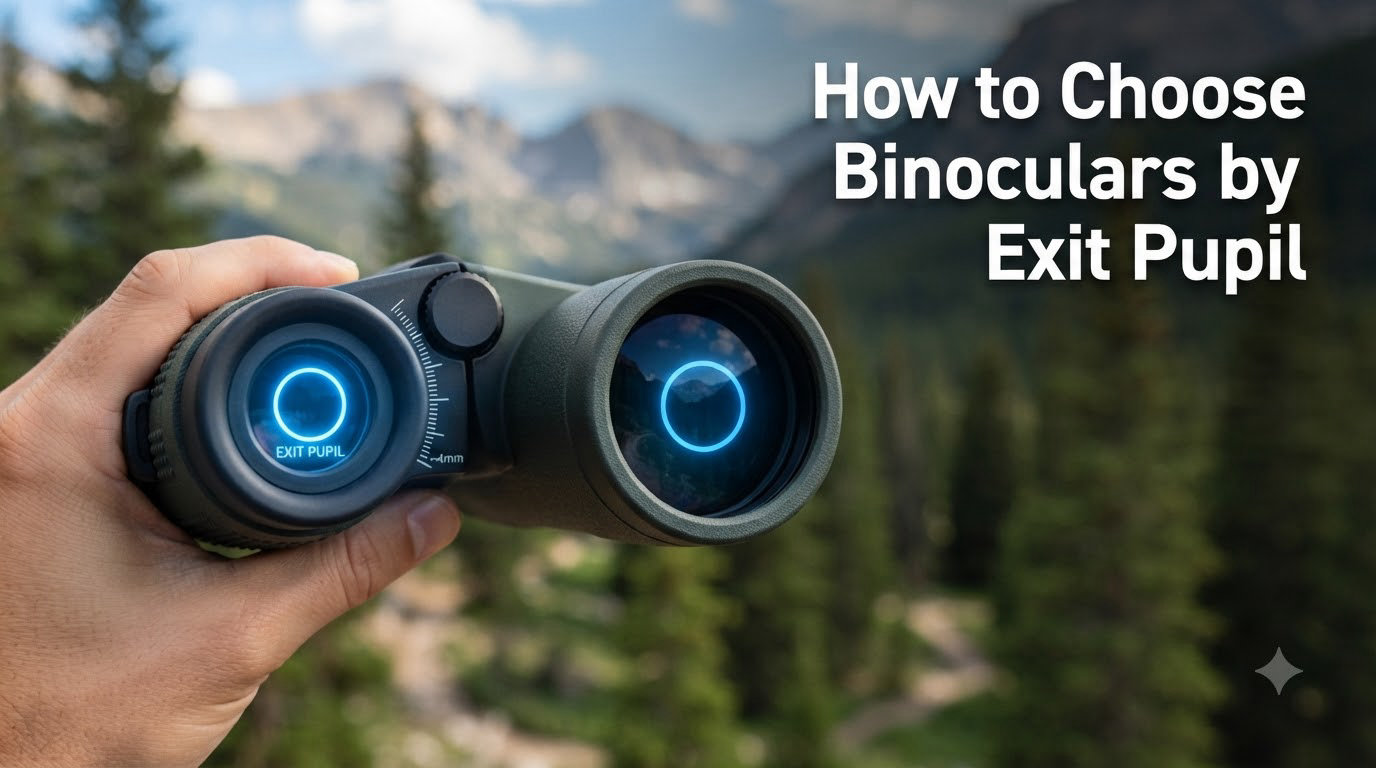
Exit pupil is a hidden specification that determines low-light performance.
Calculate it by dividing the objective lens diameter by magnification.
Exit Pupil: The diameter of the light beam exiting the eyepiece. Calculated as objective lens diameter divided by magnification (42mm divided by 8x = 5.25mm exit pupil). Larger exit pupils deliver brighter images in low light.
An 8×42 binocular has a 5.25mm exit pupil. A 10×25 compact has only 2.5mm.
Why does this matter?
Your pupil dilates to about 2-3mm in bright sunlight but can reach 5-7mm in darkness. If the exit pupil is smaller than your dilated pupil, the image appears dim.
For daylight use, 2-3mm exit pupil works fine. For dawn and dusk viewing, look for 4mm or larger.
Twilight factor is another calculation that predicts low-light performance.
Multiply magnification by objective lens diameter, then find the square root.
An 8×42 has a twilight factor of about 18. A 10×50 scores about 22.
Higher numbers indicate better performance in dim conditions—but only if you can hold the binoculars steady enough to benefit.
Beyond the basic numbers, optical quality separates good binoculars from great ones.
These features determine image clarity, color accuracy, and overall viewing comfort.
What is field of view? Field of view is the width of the area you can see through binoculars at 1000 yards, typically expressed in feet. A wider field of view (350-400+ feet) makes it easier to find and track moving subjects like birds or athletes.
Field of view determines how much of the scene you see at once.
It’s usually measured in feet at 1000 yards.
A wider field of view makes finding and following subjects much easier—especially birds that fly erratically or athletes moving across a field.
I’ve missed countless bird identifications because narrow binoculars made it impossible to keep the bird in frame as it moved between branches.
Lower magnification typically delivers wider fields of view. That’s another reason 8x often beats 10x for bird watching.
Every lens surface reflects some light away from your eyes.
Without coatings, you lose light and contrast with every air-to-glass surface.
| Coating Type | Light Transmission | What It Means |
|---|---|---|
| Coated | ~70% | Single layer on some surfaces |
| Fully Coated | ~80% | Single layer on all air surfaces |
| Multi-Coated | ~85% | Multiple layers on some surfaces |
| Fully Multi-Coated | 90-95%+ | Multiple layers on all surfaces |
Fully Multi-Coated: All air-to-glass surfaces have multiple anti-reflective coating layers. This is the minimum standard for quality binoculars, maximizing light transmission and reducing glare.
Good binoculars should be fully multi-coated.
Anything less compromises brightness and introduces internal reflections that degrade image quality.
Roof vs. Porro Prisms: Roof prisms use a straight, compact design ideal for durability and portability. Porro prisms have an offset shape that delivers better depth perception and often lower cost, but are bulkier. Quality roof prisms require phase correction coatings to match porro optical performance.
All binoculars use prisms to flip the inverted image right-side up.
The prism design affects the shape, size, and optical quality of your binoculars.
Roof prisms create a straight, streamlined barrel.
They’re more compact, easier to seal against moisture, and generally more durable.
However, roof prisms split light into two paths that must reunite perfectly. Without special coatings, this causes slight phase shifts that reduce resolution and contrast.
Phase Correction: Special coatings applied to roof prisms that correct phase shifts caused by light splitting, ensuring maximum resolution and contrast. Essential for quality roof prism binoculars.
Porro prisms create that classic offset binocular shape.
They deliver excellent depth perception and often provide better optical quality per dollar.
The offset design can be more awkward to pack and typically requires more complex internal construction.
As you move up in price, manufacturers add premium glass and coatings.
ED (Extra-Low Dispersion) Glass: Special glass that minimizes chromatic aberration—color fringing around high-contrast subjects. ED glass delivers sharper images with more accurate colors, especially noticeable in bright conditions.
Chromatic aberration shows up as purple or green fringing around high-contrast edges.
ED glass virtually eliminates this problem.
I notice the difference most when watching white birds against dark backgrounds or reading text at a distance.
Dielectric coatings reflect 99%+ of light off prism surfaces.
This maximizes brightness and contrast compared to uncoated or silver-coated prisms.
Combined with phase correction, dielectric coatings help roof prism binoculars match or exceed porro prism optical quality.
Optical quality means nothing if the binoculars can’t handle real-world use.
Physical features determine comfort, durability, and usability in the field.
Do you need waterproof binoculars? Yes, for serious outdoor use. Waterproof binoculars are O-ring sealed and nitrogen-purged to prevent internal fogging. Non-waterproof binoculars can develop internal moisture from temperature changes, permanently damaging optics.
Waterproofing protects against rain and accidental submersion.
Fog proofing prevents internal condensation when moving between temperature extremes.
Quality binoculars achieve both through O-ring seals and nitrogen purging.
I’ve had non-waterproof binoculars fog internally on cold mornings, rendering them useless until the moisture eventually cleared—if it ever did.
Nitrogen Purged: The process of replacing air inside binoculars with dry nitrogen gas. This prevents internal fogging caused by temperature changes and inhibits fungal growth on optical surfaces.
Eye relief is the distance your eyes can be from the eyepiece while still seeing the full field of view.
If you wear glasses, this specification matters immensely.
Binoculars for glasses wearers: Look for 16-18mm+ of eye relief if you wear eyeglasses. Twist-up eyecups are essential—they retract to accommodate glasses while extending for non-glasses users. Testing binoculars with your glasses is crucial before purchasing, as eye relief claims vary by manufacturer.
Most eyeglass wearers need at least 15-17mm of eye relief.
Anything less and you’ll struggle to see the complete image, constantly adjusting and losing your subject.
Insufficient eye relief causes vignetting—dark edges around your view that make it impossible to see the full field of view.
Twist-up eyecups let you adjust eye relief by extending or retracting the eyecup.
They’re essential for accommodating both eyeglass wearers and non-wearers comfortably.
Quality eyecups have multiple stopping positions, letting you find the perfect eye relief whether you wear glasses, contacts, or no correction at all.
Cheap binoculars often have fixed or fold-down rubber eyecups that don’t provide precise adjustment.
Astigmatism presents unique challenges for binocular users.
The condition causes irregular curvature of the eye’s cornea or lens, resulting in blurred or distorted vision at all distances.
Binoculars don’t correct astigmatism—that requires glasses or contact lenses.
Astigmatism and Binoculars: If you have astigmatism, you must wear your glasses when using binoculars to see clearly. Look for models with 17mm+ eye relief and quality twist-up eyecups. The diopter adjustment on binoculars only corrects differences between your eyes, not astigmatism itself.
The diopter adjustment on binoculars compensates for differences between your two eyes.
It does not correct astigmatism—that requires proper prescription eyewear.
If you have astigmatism, wear your glasses when using binoculars and prioritize adequate eye relief to avoid vignetting.
Some users with mild astigmatism report that high-quality optics with good edge-to-edge sharpness minimize the perceived distortion.
However, for moderate to severe astigmatism, proper corrective eyewear is essential for clear viewing through any binoculars.
Close focus is the minimum distance at which binoculars can focus sharply.
Most binoculars focus down to 10-15 feet.
Quality models, especially those designed for birding, often focus as close as 5-6 feet.
This matters more than you might think.
Close focus lets you observe butterflies, dragonflies, and flowers—not just distant subjects. For insect and macro enthusiasts, it’s a game-changing feature.
| Category | Typical Size | Weight Range | Best For |
|---|---|---|---|
| Full-Size | 42mm+ objective | 25-35 oz | Low light, stationary viewing |
| Mid-Size | 30-32mm objective | 18-25 oz | All-around balance |
| Compact | 25-28mm objective | 12-18 oz | Travel, backpacking |
| 20-25mm objective | 8-12 oz | Always-carry convenience |
After carrying full-size binoculars on 8-hour birding expeditions, I learned that weight matters.
Your neck will feel every ounce above 25 ounces by day’s end.
The focus wheel should be smooth and responsive.
Cheap binoculars often have stiff, gritty focus mechanisms that make precise adjustment frustrating.
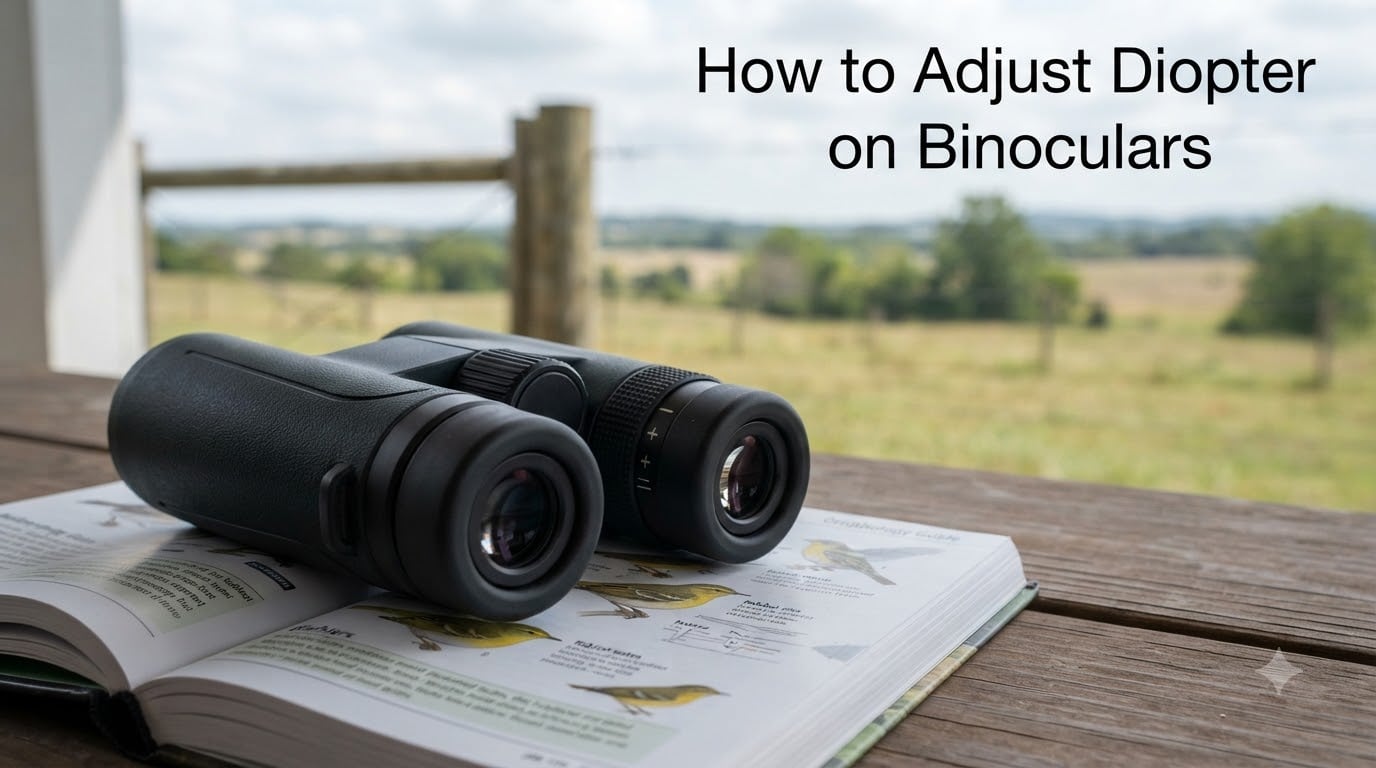
Diopter adjustment compensates for vision differences between your eyes.
Usually located on the right eyepiece, it lets you fine-tune one eye independently for a perfectly merged image.
Different activities demand different feature priorities.
Here’s what matters most for common uses:
| Use Case | Ideal Specs | Priority Features |
|---|---|---|
| Bird Watching | 8×42 or 8×32 | Wide field of view, close focus, color accuracy |
| Hunting | 8×42 or 10×42 | Low light performance, durability, waterproof |
| Travel | 8×25 or 10×25 | Compact size, lightweight, waterproof |
| Stargazing | 10×50 or 15×70 | Large exit pupil, steady platform needed |
| Sports/Concerts | 8x or 10x compact | Portability, venue restrictions, quick focus |
| Marine/Boating | 7×50 | Steady image, waterproof, compass built-in |
Birding demands wide field of view for tracking flying birds and excellent close focus for nearby subjects.
Color accuracy matters for identifying subtle plumage differences.
Most birders prefer 8x magnification over 10x for the wider view and easier hand-holding.
Hunters need low-light performance for dawn and dusk activity.
Larger objective lenses (42-50mm) and quality coatings matter more than maximum magnification.
Durability and waterproof construction are non-negotiable for harsh field conditions.
Every ounce matters when you’re traveling light.
Compact 8×25 or 10×25 models balance magnification with portability.
Waterproof construction protects against unexpected weather and humidity changes.
As street photographers, we often think in terms of camera lenses and focal lengths.
But binoculars offer unique advantages for urban observation.
Compact binoculars let you scout locations from a distance without drawing attention.
You can observe how light changes throughout the day across a city block without disrupting the scene.
For street photography, prioritize compact size, quick focus, and a wide field of view.
8×25 or 8×32 models offer the right balance of portability and performance for urban use.
Binocular technology continues evolving beyond traditional optics.
Image-stabilized binoculars use gyroscopes or vari-angle prisms to counteract hand shake.
They’re expensive but invaluable for higher magnifications (10x and above) or use from moving platforms like boats.
Digital binoculars combine traditional optics with cameras, GPS, and app connectivity.
You can capture images, record observations, and share data instantly.
While still evolving, these features appeal to tech-savvy users who want to document their sightings.
Some hunting binoculars include laser rangefinders for precise distance measurement.
They’re specialized tools but invaluable for hunters and long-range shooters who need exact distances.
The first number is magnification power (how many times closer objects appear). The second number is the objective lens diameter in millimeters. For example, 8×42 means 8x magnification with 42mm front lenses. Larger objective lenses gather more light for brighter images, especially in low light conditions.
Exit pupil is the diameter of the light beam leaving the eyepiece, calculated by dividing objective lens diameter by magnification. An 8×42 binocular has a 5.25mm exit pupil. For daylight use, 2-3mm is sufficient. For dawn and dusk viewing, look for 4mm or larger to match your dilated pupil size.
A good field of view for general use is 300-400 feet at 1000 yards. Wider fields (350+) make finding and tracking subjects easier, especially moving targets like birds or athletes. Higher magnification typically narrows the field of view, which is why 8x binoculars often work better than 10x for dynamic subjects.
Roof prisms use a straight, compact design that’s durable and portable. Porro prisms have an offset shape offering better depth perception and often lower cost. Quality roof prisms require phase correction coatings to match porro optical quality. Roof prisms dominate the modern market due to their streamlined design.
Eye relief is the distance your eyes can be from the eyepiece while seeing the full field of view. Eyeglass wearers typically need 15-17mm or more of eye relief. Twist-up eyecups let you adjust the eye relief, accommodating both glasses and non-glasses users. Insufficient eye relief causes vignetting (dark edges) when wearing glasses.
Yes, for serious outdoor use. Waterproof binoculars are O-ring sealed and nitrogen-purged to prevent internal fogging and moisture damage. Non-waterproof models can develop internal condensation from temperature changes, potentially ruining the optics. Waterproofing is essential for birding, hunting, marine use, and any activity where weather exposure is possible.
For most users, 10×42 binoculars are the better choice. They offer a wider field of view (about 300 feet vs 260 feet), are easier to hold steady, and weigh less. While 12×50 provides slightly more magnification, the increased shake and narrower view often outweigh the benefits unless you primarily glass from a stationary position with tripod support.
The 30×60 designation means 30x magnification with 60mm objective lenses. However, these specifications are often exaggerated on inexpensive models. Most 30×60 binoculars actually deliver closer to 10-15x magnification with poor optical quality, narrow field of view, and difficulty holding steady. Serious users are better served by standard configurations like 8×42 or 10×42.
Yes, people with astigmatism can use binoculars, but they must wear their glasses to see clearly. Binoculars don’t correct astigmatism—only prescription eyewear can. If you have astigmatism, prioritize binoculars with 17mm+ eye relief and quality twist-up eyecups to accommodate your glasses while avoiding vignetting.
Quality 10×25 binoculars outperform typical 30×60 models in every practical category. While 30×60 claims higher magnification, these specifications are often exaggerated. Genuine 10×25 binoculars provide better optical quality, wider field of view, and more reliable performance. For serious use, standard configurations like 8×25 or 10×25 from reputable manufacturers are recommended over 30×60 models.