
How to Choose a Birdhouse (August 2026)
When I put up my first birdhouse fifteen years ago, it was a flimsy pine box from a garden center…

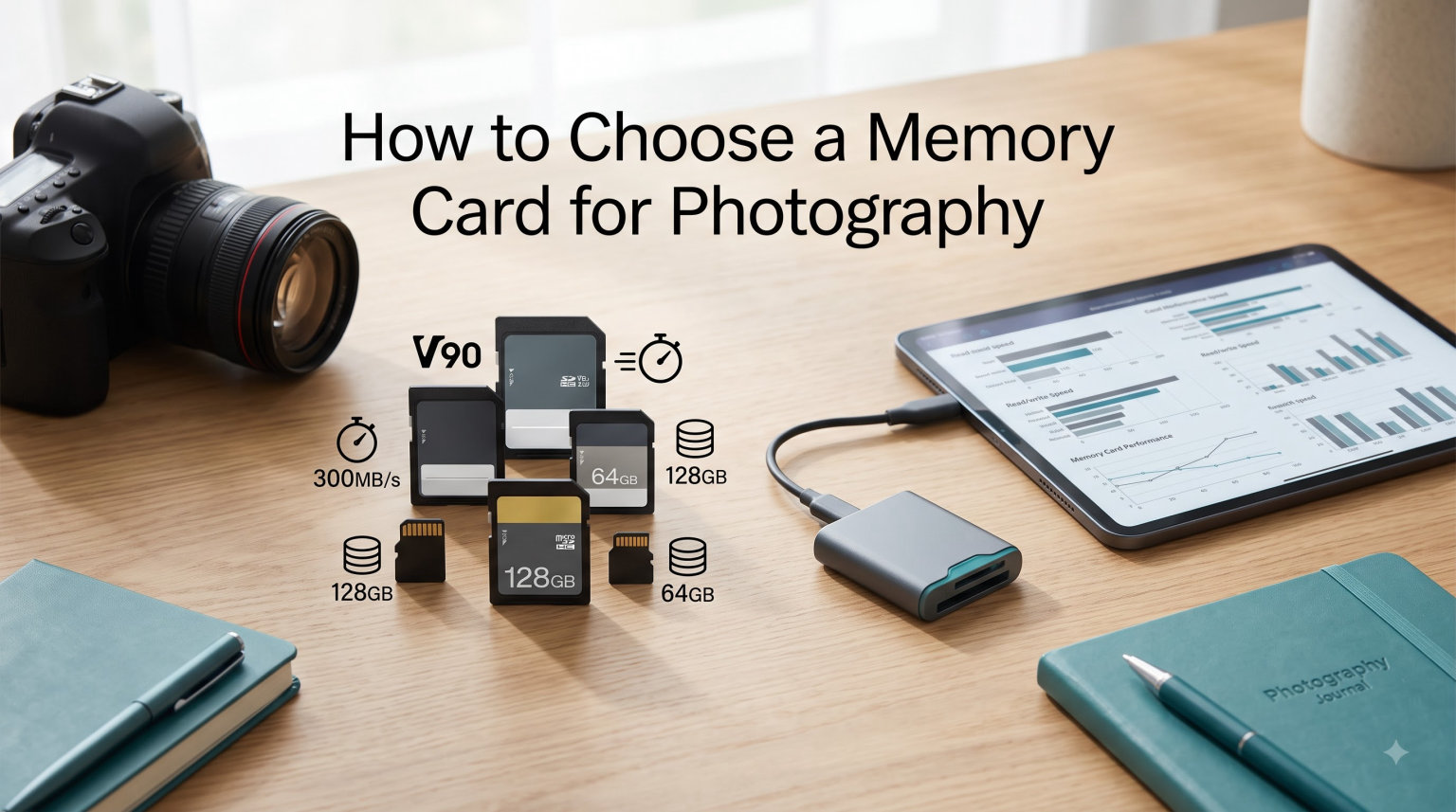
I have shot on everything from cheap no-name SD cards that corrupted a full day of shooting to V90 workhorses that have survived five years of rain, airport X-rays, and street sessions in three continents. Learning how to choose a memory card for photography comes down to four things: matching the format to your camera’s slot, picking a sustained write speed your shooting style demands, sizing capacity to your workflow, and buying a genuine card from a brand you can trust. Get those four right and the label alphabet soup stops mattering.
This 2026 guide walks you through each decision in order, with the same framework our team uses when testing cards for our best memory cards for photography roundup. By the end you will know exactly what memory card do I need for my camera has as its answer — and why the biggest number on the box is usually the least important one.
The best memory card is one your camera’s slot fully supports, fast enough to clear your buffer during bursts and record your video bitrate without dropping frames, big enough for a full shoot, and bought genuine from an authorized retailer. Compatibility beats speed, speed beats capacity, and brand trust beats price every time.
Here is the whole decision compressed into six steps:
Before comparing speeds or prices, confirm what your camera physically accepts. Every card purchase fails at this step or succeeds at it. Open your camera’s manual (or the manufacturer’s spec page) and look for the “storage media” line.
The full-size SD card family dominates photography. The original SD standard tops out at 2GB, SDHC spans 4GB to 32GB, and SDXC covers anything above 32GB — currently up to 2TB on paper. Any camera made in the last decade accepts SDXC, which is what you should buy: a 64GB or larger SDXC card costs barely more than a 32GB SDHC card today.
One physical note: UHS-II cards carry an extra row of pins on the back. They fit any SD slot, but a UHS-I-only camera simply ignores the second row and runs the card at slower UHS-I speeds. You lose nothing except money you did not need to spend, which is why matching the bus standard matters more than the card itself.
Yes, with an adapter — but I recommend against it for serious work. microSD cards were engineered for phones and action cameras, and even flagship models rarely sustain write speeds comparable to a full-size UHS-II card. Adapters add another failure point, and forum threads are full of corrupted-shoot stories that trace back to an adapter contact problem. Keep microSD for drones, action cams, and phones; use full-size cards in your main body.
CFexpress uses the PCIe/NVMe interface borrowed from computer SSDs, which is why these cards hit read speeds past 1,700 MB/s. Type B cards are the size of a matchbox and appear in Nikon Z8/Z9 bodies and Canon R5/R5 Mark II slots. Type A cards are the size of an SD card and live in Sony a7 IV, a7R V, and FX3 dual slots alongside SD.
If your professional body takes CFexpress, budget for it — these cards cost several times more per gigabyte than SD. Our team ranked the current options in our guide to the best CFexpress cards for professional cameras.
Older DSLRs still run CompactFlash, and Nikon’s first-generation Z bodies (Z6, Z7) use XQD. Both formats are fading from production, so if you shoot one of these bodies, buy quality stock now while it exists. A DSLR-versus-mirrorless comparison like our DSLR vs mirrorless camera differences guide covers how slot types differ across systems in more depth.
A card label looks like a math problem, but each symbol answers one question: how fast is the guaranteed minimum write speed? That word minimum is the key. These ratings promise a floor the card will never drop below, not a peak it occasionally touches.
The three symbol families, oldest to newest:
A Class 10 card and a U1 card and a V10 card all guarantee the same 10 MB/s. When you see both symbols on one label, they are describing the same card to different standards — read the highest one and ignore the rest. Here is what each rating tier handles comfortably:
For anyone asking what speed SD card do I need for 4K video: a true V30 card covers 4K at 30fps on most cameras, step up to V60 for 4K/60 or 6K recording, and reserve V90 for 8K or heavily compressed All-I codecs. Your camera manual lists the minimum card class required for each video mode — treat that number as a floor, not a target.
Bus speed is the highway between your camera and the card, separate from the speed ratings above. UHS-I tops out around 104 MB/s theoretical throughput; UHS-II adds a second pin row and raises the ceiling to about 312 MB/s. A V90 card only delivers its rated 90 MB/s through a UHS-II bus — pair it with a UHS-I body and the bus becomes the bottleneck.
Is UHS-II better than UHS-I? Technically yes, practically it depends. If you shoot bursts longer than ten frames or record high-bitrate video, UHS-II pays for itself in buffer recovery time. If you shoot single frames or short clips, a quality UHS-I card does the identical job for less money.
Manufacturers print the biggest number in bold, and it is almost always the read speed — how fast the card empties into a computer. Read speed affects your editing import times. Write speed affects whether you get the shot. Guess which one matters more in the field?
When you fire a burst, images queue in the camera’s buffer memory and drain to the card at its sustained write speed. The math is unforgiving: a 45MP body producing 60MB uncompressed RAW files writes roughly two files per second onto a V30 card. Shoot a 20fps sports sequence and the buffer locks up after about 10 to 15 frames, leaving you staring at a busy indicator while the action continues. The same body with a V90 card keeps draining fast enough to shoot nearly twice as long before lockup.
This is exactly why we test sustained write performance rather than trusting the front-of-box numbers. Peak speeds sell cards; sustained speeds make photographs.
Capacity depends entirely on your file sizes. A 24MP JPEG runs about 8-12MB, a 45MP uncompressed RAW file can exceed 60MB, and 4K video at 150Mbps consumes roughly a gigabyte per minute. Here is what common card sizes realistically hold using typical file sizes:
So how many photos can a 64GB memory card hold? Roughly 2,000 to 2,500 large RAW files or 6,000-plus JPEGs — plenty for a day of casual shooting. My rule after a decade of this: buy 128GB as your baseline size, because the price difference over 64GB is trivial and it saves mid-shoot swaps. Beginners picking up one of the starter camera kits for beginners can start with a single 64GB card and upgrade when they move to RAW workflows.
Verdict first: for any shoot you get paid for, carry multiple smaller cards rather than one large one. Wedding photographers on Reddit’s r/photography put this well — a failing 256GB card can take the entire wedding down with it, while a failing 64GB card costs you one segment of the day.
The trade-off is convenience. Rotating cards means more swapping and more things to keep track of. For personal travel and street work, one 128GB card plus one spare in your pocket is a reasonable middle ground. For paid events, I rotate 64GB cards and never let a single card hold more than one major session segment.
Storage does not stop at the card, either. Cards fail, bags get stolen, hotels burn. Pair your card rotation with a solid offload-and-backup routine, and consider dedicated protection like the fireproof memory card storage options we tested for irreplaceable work.
Which memory card brands can I trust? Six names come up consistently across professional forums and our own failure testing: SanDisk, Lexar, Samsung, Sony, Kingston, and ProGrade Digital. All six back their cards with substantial warranties — several with limited lifetime coverage — and their controllers handle error correction far better than generic NAND.
Counterfeits are the real enemy. Community post-mortems consistently find that most card failures trace back to fake cards bought from third-party marketplace sellers, where a scammer flashes a 16GB chip to report 512GB and sells it at a too-good-to-be-true price. Everything written past the real capacity silently corrupts.
Your defense is boring and effective:
Mainstream cards from the trusted brands share most environmental protections: IPX7-level waterproofing, shock resistance from significant drops, operating ranges from below freezing to desert heat, and X-ray tolerance for airport security. These ratings cost nothing extra on reputable cards, so treat them as standard equipment.
Ruggedized lines like Sony Tough go further with monolithic construction and bend-proof shells. They earn their premium for photographers who shoot in surf, sandstorms, or sub-zero conditions. Everyone else can spend that difference on a second card instead — redundancy protects data better than armor.
A 64GB or 128GB SDXC UHS-I card with a V30 or U3 rating handles JPEG shooting, basic RAW, and Full HD or light 4K video. Expect to pay modestly for a SanDisk Extreme-class or Lexar Professional card. Skip anything cheaper than the established brands — a corrupted first year of photos teaches the wrong lesson.
Once you shoot RAW regularly or split time between stills and 4K video, move to V60 UHS-II cards. The extra sustained speed clears buffers between bursts and keeps 4K/60 recording safe. Two 128GB cards — one in each slot of a mirrorless body, set to simultaneous recording — give you real-time backup without thinking about it.
Paid work demands V90 UHS-II SD cards or CFexpress matched to your body’s bus, plus dual-slot simultaneous recording wherever possible. Rotate multiple smaller cards across the day, offload twice daily, and never erase a card until the job is delivered and backed up in two places. This is where the price-per-gigabyte premium on top-tier cards earns itself back the first time a buffer clears in three seconds instead of fifteen.
Street work has its own rhythm: rapid sequences, hundreds of frames per session, and frequent card swaps in the field. Our team runs two 128GB V60 cards per body — one in the camera, one in a pocket holder — so a swap takes five seconds mid-walk. Discreet single-card workflows beat fumbling with pouches when you are working a scene. And because street photography often happens in rain, dust, and pocket-heat conditions, the environmental ratings stop being marketing fluff and start being insurance. If your style leans toward long bursts of moving subjects, borrow the professionals’ V90 habit; if you shoot deliberate single frames, V30 leaves budget for a spare body battery instead.
No choosing guide is complete without the worst-case protocol, because panic makes corruption permanent. The moment a card errors out or files vanish:
In my experience, cards that “die” mid-shoot usually surrender 80-95% of their files to recovery software — provided nobody formatted or kept writing to them first.
Class 10 guarantees a minimum sustained write speed of 10 MB/s, the original SD Association speed rating. It is sufficient for JPEG stills and Full HD video, but modern cameras benefit from newer U3 or V30-rated cards that guarantee 30 MB/s for RAW bursts and 4K recording.
Yes, technically. UHS-II adds a second row of pins and raises theoretical throughput from about 104 MB/s to 312 MB/s. It is worth the premium for long bursts and high-bitrate video; casual shooters shooting single frames get little practical benefit and can save money with quality UHS-I cards.
You can, using a microSD-to-SD adapter that most cameras accept. However, microSD cards generally sustain lower write speeds than full-size cards, and adapters add an extra failure point. Use microSD for drones and action cams; choose full-size SD cards for your main camera.
A 64GB card holds approximately 6,400 JPEG photos at 24MP (about 10MB each) or roughly 1,300 large RAW files at 45MP (about 50MB each). Video capacity runs about 85 minutes of 4K footage at 100 Mbps.
For paid or irreplaceable work, buy several smaller cards. A failing 256GB card can lose an entire event, while rotating 64GB cards caps potential loss to one segment of the day. One larger card is acceptable for casual shooting where total loss would be painful but survivable.
A V30 card (30 MB/s sustained) handles 4K at 30fps on most cameras. Step up to V60 for 4K at 60fps or 6K recording, and V90 for 8K or high-bitrate All-I codecs. Always meet or exceed the minimum card class listed in your camera manual for each video mode.
SanDisk, Lexar, Samsung, Sony, Kingston, and ProGrade Digital are the consistently recommended brands across professional communities and independent testing. Buy from authorized retailers such as Bu0026amp;H, Adorama, or Best Buy — counterfeit cards from third-party marketplace sellers cause most reported card failures.
Learning how to choose a memory card for photography is really learning one habit: match the card to the camera first, then to the workload, then to the wallet. A genuine V30-or-better SDXC card from a trusted brand covers most shooters; enthusiasts gain from V60 UHS-II, and professionals should never compromise on sustained write speed or redundancy. Once you know your specs, browse our tested picks for the best memory cards for photography and put the framework to work before your next shoot.