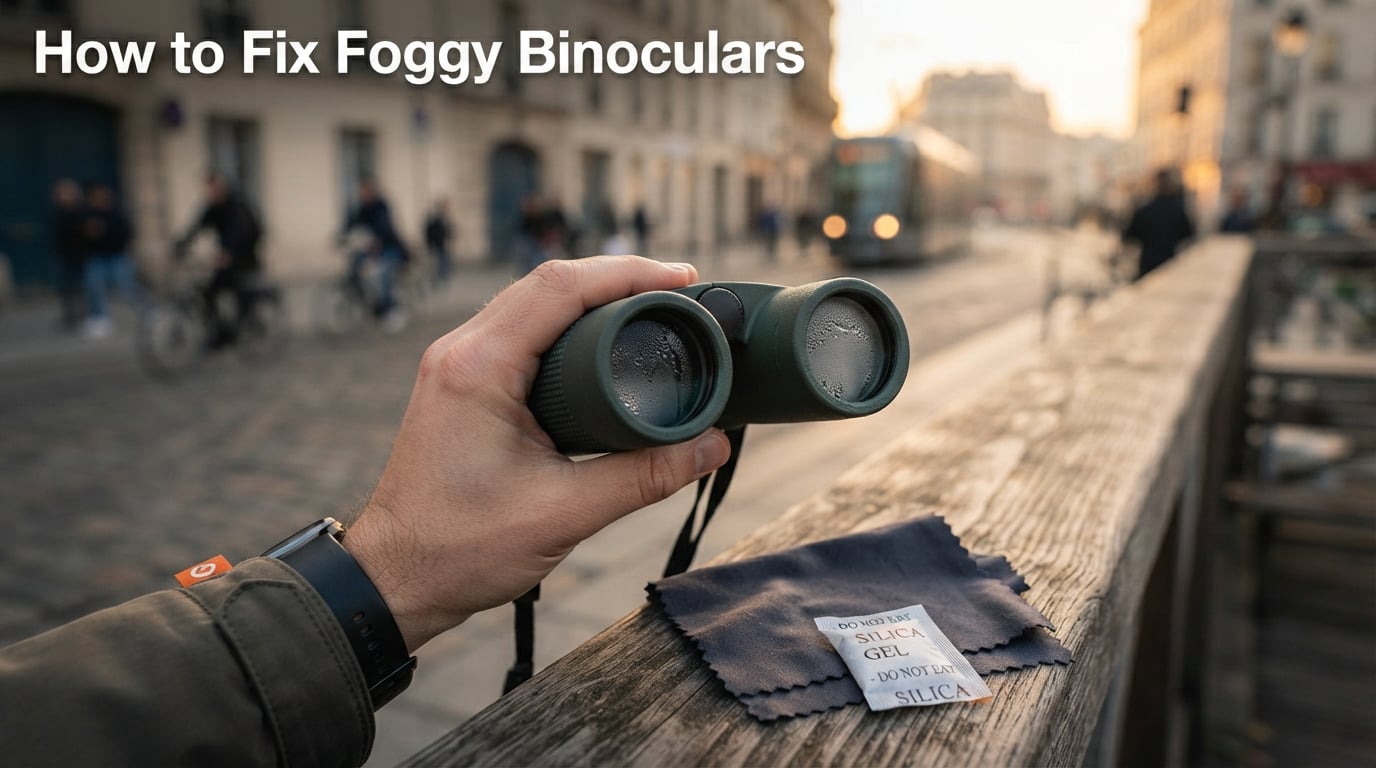
How to Fix Foggy Binoculars 2026
I learned how to fix foggy binoculars the hard way on a 4 a.m. street shoot in Hanoi, when steam…

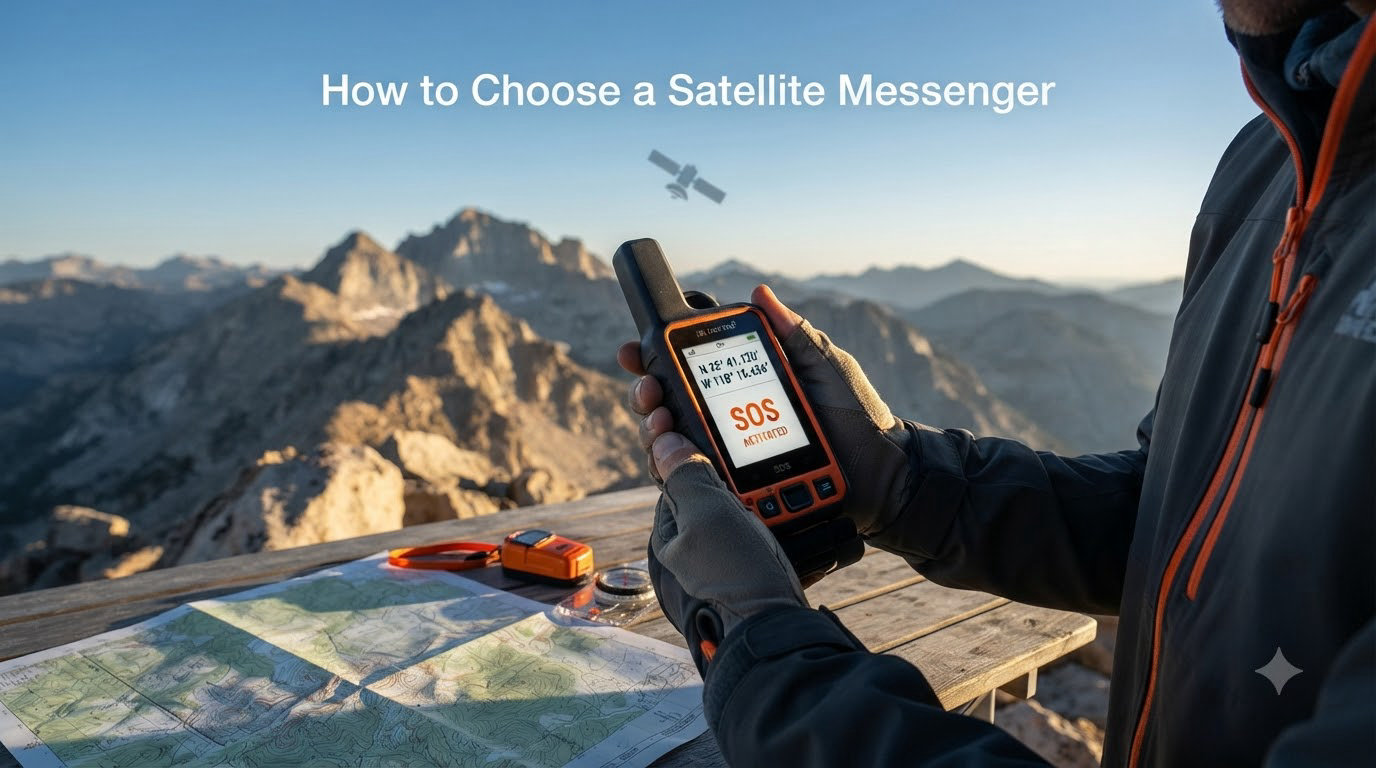
Choosing the right satellite communicator used to feel simple: pick a Garmin inReach, activate a plan, and hit the trail. After spending the last several seasons testing a dozen different satellite messengers across the Sierra Nevada, the Wind River Range, and a two-week section of the Pacific Crest Trail, I can tell you the decision has gotten far more interesting.
New subscription tiers, photo messaging, mesh networking, and budget options now sit alongside the old guard, and the differences actually matter. This guide on how to choose a satellite messenger walks you through everything I wish I had known before buying my first device, so you can skip the trial-and-error and pick something that fits your trips, your terrain, and your wallet.
A satellite messenger is a handheld device that uses orbiting satellite networks to send and receive text messages, share GPS coordinates, and trigger SOS emergency signals from anywhere on Earth, independent of cellular coverage.
Cell phones fail in the backcountry for one simple reason: there are no towers. A satellite messenger solves that by talking directly to satellites hundreds of miles above you. When you press send, the message hops to a satellite, then to a ground station, then to whoever you designated as your contact. The same chain works in reverse for incoming messages, which is why two-way messaging has become so valuable compared to older one-way SPOT-style trackers.
You need one if your adventures take you past the edge of cell coverage. That includes thru-hiking the PCT or AT, hunting in remote public lands, mountaineering in the Cascades, sailing offshore, or skiing outside ski patrol boundaries. Even on short day hikes in canyon country, where your phone shows one bar and then drops, a messenger keeps a working safety net in your pack.
Backcountry safety statistics back this up. Search-and-rescue teams report that faster SOS alerts with confirmed coordinates dramatically shorten response times. The Garmin-supported IERCC (International Emergency Response Coordination Center) alone reports coordinating thousands of rescues each year. The real question is not whether you need one; it is which type fits the way you actually travel.
Each device contains a small antenna, a GPS receiver, and a modem tuned to a specific satellite frequency. When you send a message, the device locks onto satellites, encodes the message into a brief data packet, and beams it up.
From there, the packet travels to a ground station, hits the carrier’s server, and is routed to your contact via SMS or email. Replies come back the same way. The whole trip usually takes 15 to 60 seconds when you have a clear view of the sky.
Two networks dominate: Iridium, with 66 cross-linked satellites providing true global coverage including the poles, and Globalstar, with a smaller constellation that works well in the lower 48 but struggles at high latitudes or over open ocean. Understanding which network your device rides on matters more than most buyers realize.
If any of these describe you, a satellite messenger belongs in your pack. Solo backpackers who travel far from trailheads. Thru-hikers on routes like the PCT, AT, or CDT. Hunters in Wyoming, Montana, or Alaska where there is no service for days. Mountaineers tackling glaciated or remote objectives. Sailors on offshore passages. Backcountry skiers and snowboarders going outside resort boundaries. Off-grid guides running trips for clients. And anyone whose family has asked them to “check in” from the trail.
You do not need one if your outdoor time stays within a few miles of your car on well-trafficked trails with reliable cell coverage. But for most people reading this, the answer is some version of yes.
Before we get into networks and subscription tiers, you need to pick a device category. Each serves a different profile, and confusing them is the most common buying mistake I see.
Satellite messengers are the most popular middle ground. They send short text messages, share your location, and trigger an SOS. They have small antennas, long battery life, and monthly plans starting low.
Satellite phones are full two-way voice devices with dedicated phone numbers. They cost more upfront and charge higher subscription fees, but you can actually call someone and have a conversation.
Personal locator beacons (PLBs) are one-way emergency devices. You press the button, a 406 MHz distress signal goes to the government-run Cospas-Sarsat system, and search-and-rescue gets your coordinates. There is no monthly fee and no ability to send “I am fine” check-ins.
A standalone messenger has its own screen and keyboard. You can type messages, read incoming replies, and trigger the SOS without touching your phone.
Examples include the Garmin inReach Mini 2, Garmin inReach Messenger Plus, and SPOT X. The advantage is reliability: if your phone dies, gets wet, or loses Bluetooth connection, your messenger still works. The disadvantage is typing speed on tiny buttons and slightly higher weight.
Smartphone-paired devices like the ZOLEO or the new wave of mini messengers rely on an app for typing, mapping, and message management. The hardware is small, light, and often cheaper.
The catch is dependence on your phone for anything beyond the bare SOS. If your battery dies on day six, you lose the messaging experience until you recharge. For weekend trips, this is fine. For long trips, carry a backup battery bank.
PLBs such as the ACR ResQLink or Ocean Signal rescueME send a one-way distress signal to the Cospas-Sarsat satellite system. No subscription, no monthly fee, no two-way messaging.
You press the button, the international SAR infrastructure picks it up, and they send help. PLBs are unbeatable for lifetime cost of ownership: buy once, register with NOAA, and the device works for 5 to 10 years on a single battery. The downside is no check-ins, no weather, no reassurance messages to family.
Satellite phones like the Iridium 9555 or Inmarsat IsatPhone 2 give you a real phone number and voice calling.
They are heavy, expensive, and require significant subscription fees. Most backpackers and weekend adventurers do not need one. They make sense for expedition leaders, journalists in conflict zones, offshore sailors on long passages, and remote workers who genuinely need voice.
The network underneath your device shapes coverage, latency, and reliability more than any other specification. Here is how the three main options stack up.
Iridium operates 66 low-Earth-orbit satellites in a cross-linked mesh. It is the only network with true pole-to-pole coverage, including the Arctic, Antarctic, and mid-ocean routes. Most premium messengers ride Iridium.
Globalstar uses a smaller constellation of low-Earth-orbit satellites that works well in populated landmasses but has weaker coverage over open ocean and at extreme latitudes.
Cospas-Sarsat is a separate, government-run system that listens for 406 MHz distress signals from PLBs and EPIRBs. It is free, global, and reserved for emergencies only.
Iridium gives you the widest coverage of any commercial satellite network. Whether you are on Denali, in the Brooks Range, sailing the Drake Passage, or trekking in Patagonia, an Iridium-based messenger will send and receive.
Tradeoffs: messages can take 30 to 60 seconds to send because the satellites are constantly moving. Devices ride the network via Short Burst Data (SBD) or the newer Iridium Messaging Transport (IMT), which supports larger payloads like photos.
Globalstar covers most of North America, Europe, Australia, and parts of South America well. It struggles in polar regions and over open ocean.
Devices on Globalstar, including older SPOT messengers and the Bivystick, tend to send messages faster when coverage is available, but the holes are real. If your adventures stay within the lower 48 and you want lower subscription costs, Globalstar is a reasonable choice.
Cospas-Sarsat is the gold standard for emergencies. The system uses a separate set of satellites in higher orbits, dedicated to picking up 406 MHz distress beacons. When you trigger a registered PLB, the signal goes to a government dispatch center and then to local SAR teams.
It is free, global, and does not require any subscription. It does not allow check-ins or non-emergency messaging.
Match the network to where you go. If you travel anywhere remote or off-grid on the planet, lean Iridium. If your trips stay in the contiguous US, lower Canada, and Western Europe, Globalstar is acceptable and saves money. If all you want is a one-button rescue device, a Cospas-Sarsat PLB is the simplest answer.
Once you know the device type and network, you compare features. Here are the six that matter most.
Two-way messaging lets you send and receive text. That is the single biggest upgrade over older one-way trackers, because you can confirm rescues, get weather updates, and reassure family.
The SOS button is universal. Press it, and the device routes an emergency alert through the carrier’s response center (Garmin’s IERCC for inReach, for example). Response coordinators then dispatch local SAR based on your registered profile.
Look for devices with a dedicated, protected SOS button. Some messenger apps let you trigger SOS from the phone app, which is faster but introduces one more failure point.
Most messengers log a breadcrumb track at a fixed interval (every 10 minutes by default). Your family can follow along on a web map. Track intervals of 2 to 10 minutes are common; finer tracking drains battery faster but gives a smoother map.
Location sharing also works the other direction. Some devices let contacts ping you for a one-time coordinate, useful for trip reports.
Premium messengers offer on-demand weather forecasts for your current location. Garmin inReach devices pull forecasts from a partner service based on your plan.
This is one of the most underrated features. Knowing a storm front is rolling in 36 hours before it hits can change a trip plan entirely.
Battery life varies wildly by usage. A messenger in standby with 10-minute tracking lasts 14 to 30 days on most devices. Sending a handful of messages a day cuts that to 5 to 7 days. Heavy use with frequent messages, Bluetooth pairing, and live tracking can drop it to 2 to 4 days.
For trips longer than a week, carry a small power bank or solar panel and turn the device off when you do not need it.
Look for an IPX7 rating or higher. That means the device survives immersion in 1 meter of water for 30 minutes, which covers rain, river crossings, and accidental drops.
Some devices add MIL-STD-810 ratings for shock, vibration, and temperature. Backcountry gear takes a beating. A device that survives being dropped on granite is worth the premium.
Standalone messengers with physical buttons are reliable but slow to type on. Smartphone-paired devices are faster to type and offer richer mapping, but they need the phone app to be functional.
Try both before you buy if possible. Some people love dedicated buttons. Others would rather use their phone keyboard for everything except SOS.
Subscriptions are where the sticker shock happens. The device price is just the entry fee. Plan costs, activation fees, and annual commitments add up fast.
Most Iridium-based messengers use tiered monthly plans. The lowest tier lets you send a small number of messages and disables tracking. The mid-tier adds tracking and unlimited preset messages. The top tier unlocks unlimited custom messages, weather, and photo sharing.
Annual plans typically save 10 to 20 percent compared to monthly. Some carriers offer seasonal suspends if you only use the device a few months per year.
Entry tier (typically the lowest monthly option): unlimited preset messages, limited custom messages, basic tracking. Mid tier: more custom messages, weather forecasts, longer tracking intervals. Top tier: unlimited custom messages, photo and voice messages, premium weather, and full IMT support on capable devices.
If you only need check-ins and SOS, the entry tier works. If you want weather and conversation, budget for the mid or top tier.
Most carriers charge a one-time activation fee on top of the device price. Some offer free activation with annual plans. Some also require a minimum commitment of 12 months; others allow month-to-month flexibility at a higher rate.
Read the fine print. The cheapest monthly plan may require an annual commitment that costs more than the next tier up.
If you only want a safety net and do not care about check-ins, a PLB is the most cost-effective answer. Buy once, register with your country’s beacon registry (NOAA in the US), and the device works for years on its internal battery.
Subscription-free messengers also exist in the smartphone-paired category. They use your phone’s satellite connection (on supported phones) or a pay-per-message model. The convenience factor is lower but the cost is more transparent.
Run the math before you buy. A mid-tier subscription plan on an Iridium messenger over five years easily exceeds the device purchase price.
Compare that to a PLB at a higher upfront price but zero ongoing cost. Over a five-year horizon, the PLB is often cheaper if you only want emergencies. Over a ten-year horizon, the PLB wins by a wide margin.
Use this framework to narrow down options in under ten minutes.
Ask yourself one question: what kind of trip stresses my communication the most? Solo backpacking in cell-dead zones? Group trips where check-ins matter? International travel where networks differ? Hunting trips where stealth is required? Your answer drives the rest.
Day trips and weekend overnights: any device works, including budget options.
Week-long trips: prioritize battery life and the ability to recharge on the go.
Multi-week thru-hikes: prioritize standalone operation, Iridium coverage, and a power plan.
Lower 48 only: Globalstar is acceptable and cheaper.
High latitudes, polar regions, or open ocean: Iridium only.
Emergency-only needs: any PLB on Cospas-Sarsat.
Decide which features you will actually use. Two-way messaging, weather forecasts, and tracking are the most popular. Photo and voice messaging are nice-to-haves that bump subscription costs to the top tier.
No device is indestructible. Carry a backup battery bank, know how to trigger SOS from the device alone (without your phone), and tell someone your trip plan before you leave.
Match your adventure to the device profile that fits best.
Go with an Iridium-based standalone messenger on a mid or top-tier plan. You want reliable two-way messaging, weather forecasts, and tracking that family can follow. Battery management matters; pair the device with a 10,000 mAh power bank.
A smartphone-paired communicator on an entry or mid-tier plan works fine. You are within reach of help if something goes wrong, and the cost is lower.
Pick a rugged standalone messenger with an IPX7 rating or higher. Cold temperatures cut battery life, so keep the device close to your body when possible. Iridium is the only network that consistently works above the tree line in places like Patagonia or the Alaska Range.
Many hunting zones sit in coverage gaps. A standalone messenger with reliable SOS and check-in capability gives your family peace of mind. Hunting groups often pick devices with longer battery life and simple preset messages.
Iridium is mandatory for most international and offshore use. Globalstar coverage drops off sharply in many regions outside North America. If you sail offshore, a dedicated satellite phone or an EPIRB is worth considering alongside a messenger.
Before you finalize the purchase, run through these insider tips.
Buy direct from the manufacturer or an authorized reseller. Grey-market imports sometimes lack warranty support or come with regional SIMs that do not work with your home country’s plans.
Satellite messengers are not navigation devices. Pair yours with offline topographic maps on your phone (Gaia GPS, Caltopo, or OnX Backcountry) and a battery bank sized to your trip length.
Send a test message from your driveway before every trip. Confirm your subscription is active, your emergency contacts are correct, and your tracking interval is set the way you want.
The SOS button is for true emergencies. For non-emergency help, like a sprained ankle that needs a slower pickup, use two-way messaging to coordinate. Tell your contact what is going on and what you need.
A satellite messenger is a handheld device that uses satellite networks to send and receive text messages, share GPS coordinates, and trigger SOS emergency signals from anywhere on Earth, independent of cellular coverage.
Satellite messengers communicate with orbiting satellites, typically the Iridium or Globalstar networks, to relay messages and GPS coordinates to ground stations, which then route them to your recipients or emergency response centers.
You need one if your trips take you past the edge of cell coverage for an extended period, including thru-hiking, backpacking, hunting, mountaineering, offshore sailing, or any solo travel in remote terrain.
Personal locator beacons (PLBs) send one-way SOS signals on the Cospas-Sarsat system without any subscription. Subscription-free messengers also exist for occasional or pay-per-message use, though they offer fewer features.
Iridium offers true global coverage including the poles and open ocean, while Globalstar works well across the lower 48 and Western Europe but has weaker coverage at high latitudes. Pick based on where you travel.
Picking the right satellite messenger in 2026 comes down to three honest questions: where do you go, how long are you gone, and how much ongoing cost can you sustain. If you answered the polar regions or long thru-hikes, an Iridium-based standalone messenger on a mid-tier plan is the safest bet. If your trips stay in the lower 48 and you only need a safety net, a subscription-free PLB delivers unbeatable long-term value. If you want a balance of features and cost, a smartphone-paired device on a flexible month-to-month plan is hard to beat.
The most important step is the next one: pick the device that fits your adventures, activate the plan, send a test message from your driveway, and pack it on your next trip. The peace of mind alone is worth the setup time.