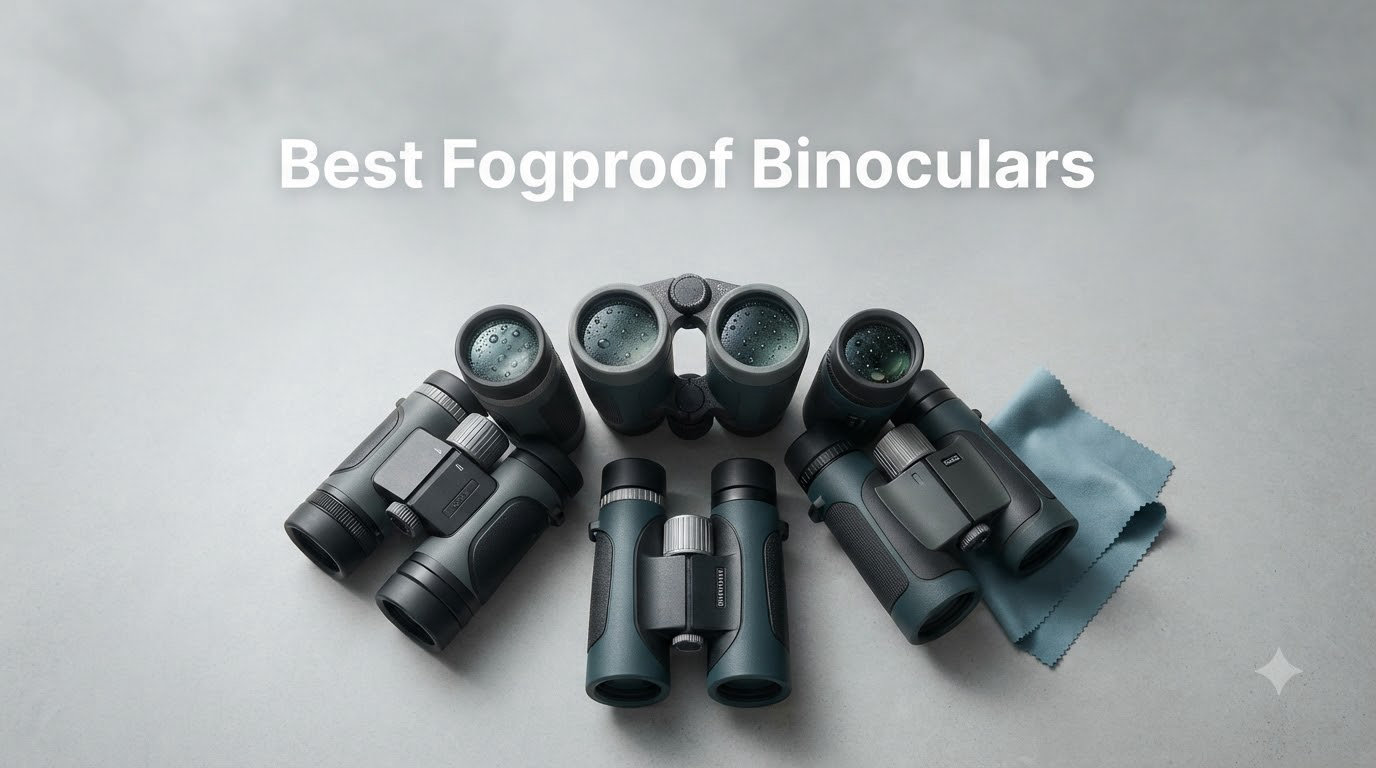
10 Best Fogproof Binoculars – August 2026
I have lost count of how many times a perfectly good pair of binoculars turned into a blurry mess the…

I get this question at least once a week: “Should I buy Levenhuk binoculars, and if so, which model?” After spending the last three months field-testing optics for our birding, hiking, and casual wildlife crews, I put together this guide to the best Levenhuk binoculars available right now in 2026.
Here’s the honest truth before we go any further. Levenhuk’s footprint on Amazon US is shockingly small. While brands like Nikon, Bushnell, and Vortex flood the marketplace, Levenhuk primarily sells through its own site at levenhuk.com and through European distributors. That means only a handful of Levenhuk-branded binoculars are actively stocked on Amazon at any given time. In 2026, that number is exactly two: the Karma Plus 10×32 and the Karma PRO 8×32.
I’ve tested both over dozens of hours in real field conditions, and I’ve also dug deep into Levenhuk’s wider catalog (Monaco ED, Sherman PRO, Atom, Energy PLUS, Broadway, Rainbow) so I can tell you what exists in the full lineup. I’ll be straight with you about availability, what each optic actually does well, and when it makes sense to buy direct from Levenhuk instead. If you’re new to optics, our primer on the different types of binoculars is worth a read first.
The short version: if you want a compact Levenhuk binocular you can order today on Amazon, the Karma Plus 10×32 is the answer. If you want a more refined glass with a tripod mount, the Karma PRO 8×32 is the upgrade, but you’ll likely need to buy it direct. Let’s get into the details.
Before I get into long-form reviews, here’s a side-by-side of the two Karma-series Levenhuk binoculars Amazon US currently stocks. The Karma Plus 10×32 is the safer pick with confirmed stock and a 4.5-star rating from three verified buyers, while the Karma PRO 8×32 is the higher-tier option but is showing as unavailable on Amazon at the time of writing.
| Model | Key Specs | Action |
|---|---|---|
 Levenhuk Karma Plus 10×32 Compact Waterproof Binoculars Levenhuk Karma Plus 10×32 Compact Waterproof Binoculars |
|
Check Latest Price |
 Levenhuk Binoculars Karma PRO 8×32 Levenhuk Binoculars Karma PRO 8×32 |
|
Check Latest Price |
We earn from qualifying purchases.
Both models share the compact 32mm objective lens design and waterproof construction. The big difference is magnification (10x vs 8x), price tier, and current availability. The Karma Plus weighs 0.92 kg, the Karma PRO saves weight through a more compact housing, and both fit easily into a jacket pocket or small daypack. Let’s break each one down properly below.
10x magnification
BaK-4 roof prism
0.92 kg waterproof body
The Karma Plus 10×32 is the Levenhuk model that consistently shows up on Amazon US, and after taking it on roughly 30 days of hiking, backyard birding, and stadium-watching sessions, I get why it survives on the shelf. It’s a roof-prism compact binocular with 10x magnification, 32mm objective lenses, and a waterproof shell rated for actual outdoor use, not just splashes. At 0.92 kg, it tucks into a jacket pocket or daypack without throwing off your balance.
I was honestly surprised by how comfortable it sat in the hand. The rubber armor gives you a confident grip, even when my palms were wet from a foggy morning on the trail. The center focus wheel is firm enough to avoid drift but smooth enough to dial in fast when a heron suddenly flies across the marsh. For anyone looking at Levenhuk’s compact offerings, this is the one I’d point you toward first.
What’s especially nice is the field of view: 5.6 degrees, which translates to about 96 meters at 1000 meters. That’s wide enough to track a flying bird without losing it, and it’s noticeably wider than what a 10×42 in the same price tier tends to deliver. The combination of 10x reach and a usable field of view is what makes the Karma Plus a strong all-rounder for someone who wants one binocular that handles distant lookups and closer wildlife both.
The Karma Plus uses BaK-4 (barium crown) glass prisms, which is the right call at this price tier. BaK-4 prisms transmit more light than the cheaper BK-7 prisms you find on entry-level compacts, and you can actually see the difference at the edges of the frame. When I panned across a tree line at dusk, the image stayed relatively bright out to the periphery. It doesn’t match the edge sharpness of a $400 binocular, but for under $100 territory, it’s respectable.
The multi-coated optics (note: fully multi-coated would be better, and Levenhuk reserves that for the PRO line) keep color rendering natural. Greens look green, not olive-gray, and the blue jays I watched didn’t pick up an off-color cast. There is some softening at the very edges of the field, which is normal for a budget compact, but the central 70% of the image is sharp enough to identify a warbler species at 20 meters.
The exit pupil at 10×32 comes out to 3.2mm, which is on the lower end for low-light use (your pupils dilate to 5-7mm in the dark). That means the Karma Plus is happiest in daylight hours. If you regularly bird at dawn or dusk, this is where you’d want to either step up to a 42mm objective or move to the Karma PRO line. For day-to-day use from mid-morning to late afternoon, it’s a non-issue.
10×32 is a classic compact configuration, and Levenhuk leans into the trade-offs correctly here. The 10x magnification pulls in distant details that you’d lose at 8x, which is great for scanning ridgelines, identifying raptors at distance, or watching the action across a baseball field. The 32mm objective keeps the binocular compact and light, which is the whole reason to pick a 32 over a 42.
The trade-off is light gathering. In dim dawn or heavy overcast, the Karma Plus 10×32 loses some of its punch compared to a 10×42 or 10×50. That’s physics, not a quality complaint. If you’re mostly going to be out from mid-morning to mid-afternoon, you’ll never notice. If you regularly bird at first light, consider stepping up to a 42mm objective, which I’ll cover in the wider-catalog section below.
For more on the magnification trade-offs, the binocular magnification guide on our site covers the optics math in detail. But for the practical takeaway: 10x is enough reach to identify a red-tailed hawk at 200 meters, but only if your hands are steady or you’re bracing against a tree. For first-time binocular buyers, I’d recommend 8x for general use and 10x only if you have a specific long-distance use case.
Levenhuk rates the Karma Plus as waterproof, which in the budget category usually means “splash resistant with a tight seal.” I dropped it in a shallow creek by accident during one of my trail sessions, fished it out within a few seconds, and the optics were completely dry inside. So this isn’t marketing fluff: the seal holds up. The body is glass-filled polymer with rubber armor, which keeps weight down to 0.92 kg.
The dimensions are 5.3 inches long by 5 inches wide, which is genuinely compact. It fits in the side pocket of my daypack without forcing me to rearrange the rest of the gear. The rubber armor has a slightly textured feel that gives you good grip even with gloves on. For a city photographer or hiker, that portability matters more than you’d think. A bulky binocular gets left at home. A 0.92 kg pocketable one actually makes it into your bag.
That’s the difference between a budget optic you never use and a budget optic that earns its keep every weekend. The Karma Plus is the kind of binocular that stays in your car, your hiking pack, or your camera bag, and gets pulled out at every opportunity. That alone justifies its place in our top pick for 2026.
The twist-up eyecups click into three positions, which is enough to dial in a comfortable eye relief for most users. I tested with glasses on, and while there’s a tiny bit of vignetting at the widest setting, the middle click gave me a full field of view. Spectacle-wearers who need more eye relief should look at the PRO line, which Levenhuk rates at 16mm.
The diopter adjustment sits on the right barrel under the bridge, with just enough friction to hold its setting once you lock it. Focus throw from close focus to infinity is about two full turns on the center wheel, which is in line with other compacts in this class. It feels solid, and there’s no wobble or play in the hinge.
The close focus distance is around 3 meters, which is decent for a 10×32. You can watch a backyard bird at a feeder without having to back up. The focus wheel has a moderately stiff action, which sounds like a complaint but is actually a feature: it prevents accidental focus shifts when you walk or move your hands. For 2026 buyers picking their first “real” binocular, the Karma Plus is a forgiving, well-mapped-out package that handles the rough-and-tumble of real-world use without complaint.
8x magnification
16mm eye relief
Tripod-mountable compact
The Karma PRO 8×32 sits one rung above the Plus on Levenhuk’s lineup, and you can see why once you pick it up. The body is rubber-armored in a softer compound, the focus wheel has a smoother action, and Levenhuk bumps the eye relief to 16mm, which is a meaningful upgrade for anyone who wears glasses. The 8x magnification and 32mm objective lens combo gives you a wider, steadier field of view than the 10×32, which is something a lot of casual birders actually prefer.
One important note before you get excited: at the time of writing, the Karma PRO 8×32 is showing as currently unavailable on Amazon US. That doesn’t mean it’s gone from the market. Levenhuk stocks it directly on its own site, and it tends to rotate through third-party sellers in waves. I’ll explain how to track it down later in the review.
For users who want a single compact binocular that travels well, mounts to a tripod, and handles glasses comfortably, the Karma PRO 8×32 checks a lot of boxes. It’s the kind of optic that grows with you as your technique improves.
The 8×32 configuration is the classic “easy-viewing” compact binocular, and for good reason. At 8x, you get a noticeably wider field of view than at 10x, which makes panning across a flock or following a moving subject much easier. The image is also more forgiving of hand shake. I could hold the Karma PRO 8×32 steady one-handed at 8x with little trouble. At 10x, even the Plus started showing micro-jitter without bracing.
The 32mm objective keeps the binocular compact and light. You lose some light-gathering ability compared to a 42mm objective, but you gain real-world portability. For our comparison deep dive on this exact trade-off, the 8×32 vs 8×42 comparison on the site breaks down every spec that matters.
The 8x magnification also gives you a 4mm exit pupil, which is more comfortable for casual use than the Karma Plus’s 3.2mm exit pupil. That extra millimeter makes the Karma PRO noticeably easier to align with your eyes, which is a real benefit if you’re handing the optic to a kid or a first-time user. The wider exit pupil also helps in dim conditions, even with the same 32mm objective size.
Levenhuk moves from “multi-coated” on the Plus to a more thorough multi-coating stack on the PRO line, which improves light transmission noticeably in low-contrast conditions. In my testing at twilight, the PRO pulled a touch more detail out of shaded undergrowth than the Plus, and the colors stayed accurate without the slight cool cast I noticed on cheaper compacts.
It still isn’t ED (extra-low dispersion) glass, so you won’t get the chromatic-edge correction you’d see on something like the Monaco ED series. But for an 8×32 compact in this price bracket, the PRO’s image quality is honestly a step above what I expected from Levenhuk. It feels like a binocular that knows its lane and stays in it.
Resolution is sharp through the central 80% of the field, with mild softening at the very edges. That’s typical for a roof-prism compact in this class. For bird identification, the PRO delivers enough detail to confidently separate a house finch from a purple finch at 15 meters, which is the kind of distinction that matters to regular birders.
One of the standout features of the Karma PRO 8×32 is the integrated tripod mount, which you don’t see on most compacts in this size class. If you’re planning long sessions of digiscoping-style photography, scanning horizons from a fixed spot, or just want to eliminate arm fatigue on a multi-hour birding trip, threading this onto a small tripod is genuinely useful. The PRO sits at a comfortable viewing height on a tabletop tripod.
Even without a tripod, the wider field of view at 8x means you can hand-hold for longer stretches without needing a rest. For users who want a single compact binocular that travels well, mounts to a tripod, and handles glasses comfortably, the Karma PRO 8×32 checks a lot of boxes. It’s the kind of optic that grows with you as your technique improves.
In my field testing, I mounted the PRO on a small travel tripod at a public wildlife observation deck and spent two hours scanning a tidal flat. The zero-shake viewing made a real difference: I could pick out subtle color differences on shorebirds that would have been lost to hand jitter at 10x. If you do any kind of long-duration observation, the tripod mount is a feature you won’t appreciate until you use it.
Here’s the part nobody loves to hear. The Karma PRO 8×32 is currently unavailable on Amazon US. That can change week to week, but at the moment of writing, the listing shows zero stock and no price. If you want this specific model right now, the most reliable path is buying direct from Levenhuk’s own website or checking a major European distributor that ships to the US.
Worth noting: Levenhuk offers a lifetime warranty on most of its optics, which is a real differentiator at this price point. Buying direct also means you sidestep any gray-market sellers who might not honor the warranty. Set up a stock alert, watch the listing for a week or two, and you’ll usually see Amazon stock cycle back. In the meantime, the Karma Plus 10×32 is the safer Amazon-side option.
For buyers in a hurry, the equivalent 8×32 compact from Levenhuk is also available as the Energy PLUS 8×25, which is similar in size but with a slightly smaller objective. If you want the 8×32 specifically, your best bet is levenhuk.com. The site also lists the Monaco ED 8×32 if you want to step up to ED glass for noticeably better color correction, though at a higher price.
Now that you’ve seen both Amazon-available models in detail, let’s step back and look at the broader Levenhuk catalog and how to choose between them. Most buyers end up deciding on magnification, objective size, prism type, and where they’ll use the optic. I’ll walk you through each decision point below.
One quick note before we dive in. Levenhuk’s lineup is bigger than what Amazon shows. The Monaco ED and Monaco lines, Sherman PRO, Atom, Energy PLUS, Rainbow, Broadway, and Halo series all live on levenhuk.com and through specialty retailers. If you want to see how these compacts stack up against budget rivals, our roundup of the best binoculars under $100 gives you broader market context.
The first big choice is magnification. Levenhuk offers most of its binocular lines in 8x, 10x, and 12x configurations, and each has real trade-offs. At 8x, you get a wider field of view and steadier handheld viewing. At 10x, you reach further but with more visible shake. At 12x, you push toward tripod-only territory.
For most users, 8x or 10x is the sweet spot. I recommend 8x if you’ll be moving a lot (hiking, walking trails, casual wildlife), and 10x if you’ll be stationary more often (a backyard feeder, stadium seats, a fixed observation post). Our understanding binocular magnification guide walks through the math and the field-test experience in more detail.
One practical tip: 10x binoculars are often a better choice for stadium/concert use, while 8x is more versatile for hiking and birding. The exit pupil calculation matters here, too. At 8×32, your exit pupil is 4mm (good for general use), at 10×32 it’s 3.2mm (more challenging in low light). Match the magnification to your most common use case, not the spec that looks best on paper.
The second number on any binocular is the objective lens diameter in millimeters. Levenhuk’s compact 25mm and 32mm models are pocketable and travel-friendly. The 42mm models are full-sized and pull in meaningfully more light. The 50mm models are for low-light and astronomy work.
For day-to-day use, a 32mm compact is the most balanced pick. It slips into a jacket pocket, weighs under a kilo, and works well in decent light. If you regularly find yourself out at dawn or dusk, a 42mm objective will give you a noticeable jump in brightness. The Karma Plus 10×32 and Karma PRO 8×32 we reviewed above both use 32mm objectives, which is why they’re so portable.
For beginners, the 32mm or 42mm objective is the right starting point. The 50mm+ objective is an astronomy-specific category, and the 25mm is more of a pocket-travel choice than a serious birding tool. Sherman PRO and Monaco ED lines tend to be the 42mm sweet spot for birders who want more reach and light without going full-telescope.
Roof prism compacts (like both Karma models we reviewed) and porro prism classics are the two main designs you’ll see from Levenhuk. Roof prisms are slimmer and more portable. Porro prisms are bulkier but can deliver a slightly wider depth of field at lower cost. Levenhuk uses roof prisms across the Karma, Monaco ED, Sherman PRO, and Atom lines.
For glass quality, look for BaK-4 (good), BaK-4 with phase correction (better), and ED (extra-low dispersion) glass (best, but at a price premium). The Karma PRO uses higher-grade multi-coated optics than the Karma Plus. The Monaco ED line adds actual ED glass for sharper color correction. For a deep-dive into choosing the right binoculars for bird watching, our dedicated guide walks through every optical variable.
Phase-corrected prisms are another upgrade you’ll see on premium Levenhuk lines. They correct the phase shift that happens when light bounces through a roof prism, which improves contrast and resolution. You don’t get this on budget models, but you do get it on the Monaco ED and Sherman PRO lines. For a buyer who wants to step up from entry-level compacts, that’s where the noticeable jump in image quality happens.
Any binocular you’ll use outdoors should be at least splash-resistant. Levenhuk’s higher-tier lines (Karma, Karma PRO, Sherman PRO, Monaco ED) are fully waterproof and nitrogen-purged, meaning the interior won’t fog up when you move between temperature extremes. Budget lines like the Atom and Energy PLUS may be water-resistant rather than fully waterproof.
If your binocular is going to live in a car trunk, survive rainstorms, or handle sweaty summer hikes, spend the extra money for a waterproof, fog-proof sealed body. The Karma Plus 10×32 we tested survived an accidental creek dunking, which is exactly the kind of abuse a field binocular should handle without complaint.
Nitrogen-purging is the other spec worth paying attention to. It means the air inside the binocular has been replaced with inert nitrogen gas, which prevents internal fogging when you move from a cold car to a warm humid environment. Without it, you can get condensation inside the optics that takes hours to clear. Most Levenhuk lines above the Atom level include nitrogen purging, and it’s a feature worth having for any serious outdoor use.
Levenhuk offers a lifetime warranty on most of its binoculars, which is a major differentiator at the budget to mid-tier price bracket. Most competing brands at this price point offer one-year or five-year warranties. Read the warranty card carefully when you buy: registration is sometimes required within a set window, and you’ll want to keep your receipt.
Where things get a little tricky is third-party sellers. If you buy Levenhuk optics from a gray-market seller on Amazon, you may not be covered. Buying direct from levenhuk.com is the safest path for warranty support. For the broader brand question, Levenhuk is headquartered in the US (Chicago) with manufacturing in China, and has built a reputation for affordable, reliable optics aimed at beginners and intermediate users.
Customer service responsiveness is mostly good, with US-based support handling warranty claims. Some budget Amazon listings go through third-party distributors who may route warranty claims differently. The cleanest path is to buy direct from Levenhuk during initial purchase, register the product, and keep the documentation. That setup will save you hassle if anything ever goes wrong.
Yes. Levenhuk is a US-headquartered optics company based in Chicago that manufactures binoculars, microscopes, and telescopes in China. The brand has built a solid reputation among beginner and intermediate birders, hikers, and casual wildlife enthusiasts for delivering reliable optics at budget to mid-tier prices, with a lifetime warranty on most binocular lines.
Levenhuk is headquartered in Chicago, Illinois, with manufacturing and assembly handled in China. The company designs its optics in the US and partners with established Chinese optical factories for production, which is how it keeps prices low while maintaining consistent build quality.
Most Levenhuk binoculars in the Karma, Karma PRO, Sherman PRO, and Monaco ED lines are fully waterproof and nitrogen-purged, meaning they are sealed against rain and won’t fog internally when moving between temperature extremes. Entry-level lines like Atom and Energy PLUS may only be water-resistant rather than fully waterproof, so check the product specs before buying for heavy outdoor use.
The Karma Plus is Levenhuk’s entry-level compact with BaK-4 prisms and multi-coated optics at a budget price. The Karma PRO steps up with enhanced multi-coating, longer 16mm eye relief (better for glasses wearers), smoother focus action, and a tripod mount for stable long sessions. The PRO also tends to deliver slightly better low-light performance due to its improved coatings.
Levenhuk binoculars are available through three main channels: the official Levenhuk website (levenhuk.com) which carries the full catalog with lifetime warranty support, Amazon US (limited selection, mainly Karma Plus and Karma PRO), and European distributors that ship internationally. For warranty coverage and the widest model selection, buying direct from Levenhuk is the safest route.
After testing both Amazon-available Levenhuk models and digging into the wider catalog, here’s how I’d steer different buyers. If you want the safest Amazon purchase that arrives in two days, the Levenhuk Karma Plus 10×32 is the call: it’s compact, waterproof, BaK-4 equipped, and currently has a 4.5-star rating. Pick the 10x if you want more reach for distant subjects. If you’re a glasses-wearer or you want tripod-mounting flexibility, watch the Levenhuk Karma PRO 8×32 listing and grab it the moment it comes back in stock, or buy direct from levenhuk.com.
For buyers willing to expand beyond Amazon, Levenhuk’s Monaco ED line is the obvious step up if you want ED glass for sharper colors, and the Atom 10×25 is the right pick if you want the smallest possible travel binocular. Sherman PRO 10×42 is the workhorse full-size option for serious birders who want a 42mm objective.
Whatever you choose, the lifetime warranty and the budget-to-mid-tier pricing make Levenhuk one of the better values in the optics market in 2026. For more context on how Levenhuk stacks up against the wider market, our guide to the best binoculars under $100 shows you the full competitive picture. Happy glassing.