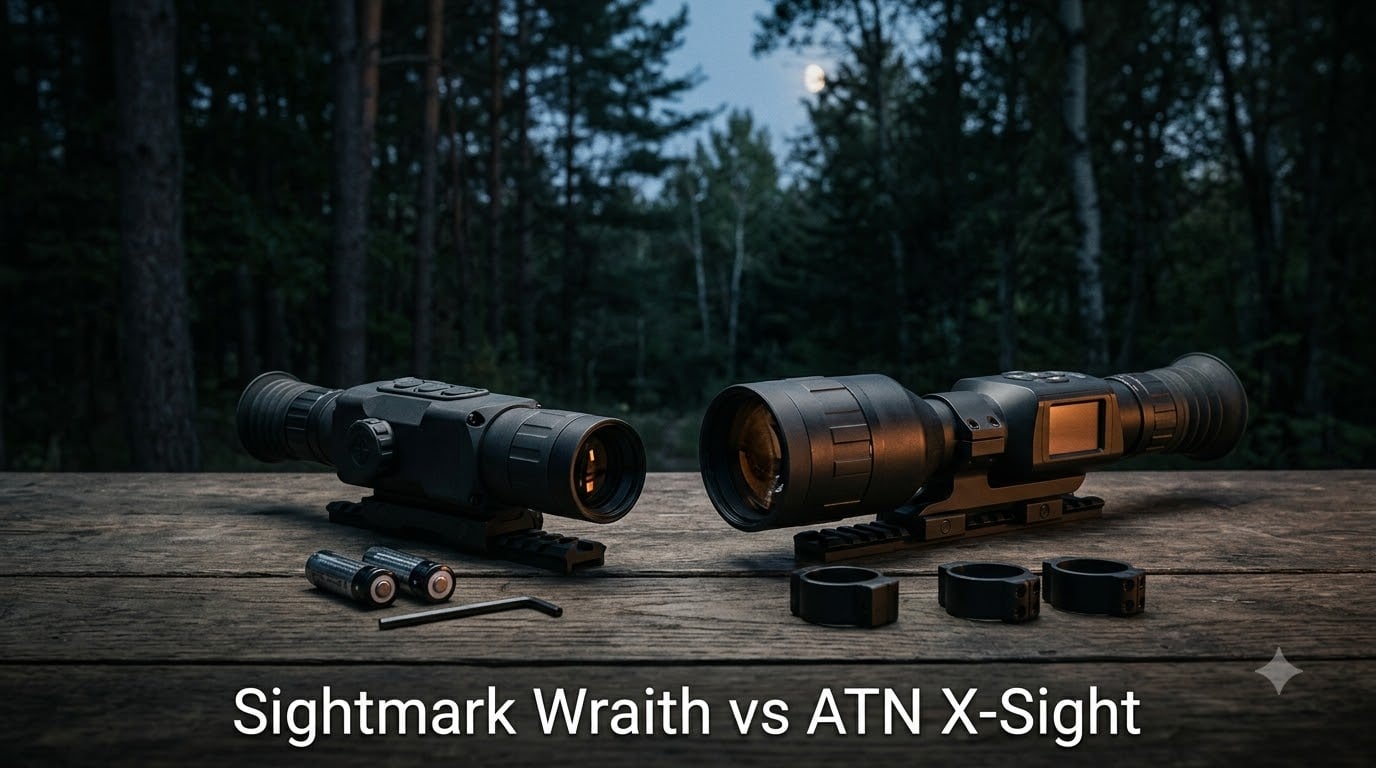
Sightmark Wraith vs ATN X-Sight (September 2026)
I spent the last three months running both the Sightmark Wraith 4K Mini and the ATN X-Sight 5 side-by-side on…


Night vision technology has evolved dramatically over the past 80 years, transforming from bulky military prototypes into sophisticated devices available to civilians. I’ve spent years testing night vision equipment across different generations, and the technology differences are profound.
Night vision generations classify image intensifier technology into tiers (Gen 1, 2, 3, and unofficially Gen 4) based on technological advancements in photocathodes, microchannel plates, and electronics, with each generation offering progressively better image clarity, range, and performance in low-light conditions.
Understanding these generations matters because the performance gap between them is massive. A Gen 1 device might show you a blurry shape at 50 yards, while Gen 3 can reveal facial features at 300 yards. The price difference reflects this: Gen 1 starts around $150, while Gen 3 can exceed $5,000.
I’ve tested devices from every generation across various conditions, from urban environments to deep wilderness. This hands-on experience has taught me that choosing the right generation depends entirely on your specific needs and budget.
There are three officially recognized night vision generations by the U.S. military: Gen 1, Gen 2, and Gen 3. Gen 0 exists historically, and Gen 4 appears as a marketing term but isn’t officially recognized.
The U.S. Army standardized these classifications to specify performance requirements for military procurement. Each generation represents a significant technological leap, not just incremental improvements.
Gen 0 technology from the Korean War era required massive infrared spotlights to function. The enemy could see you as clearly as you could see them. This limitation drove development of passive systems.
By 2026, the classification system includes unofficial designations like Gen 2+ and Gen 3+. These indicate improved performance within a generation but don’t represent entirely new technology.
Night vision devices work by amplifying available light through an image intensifier tube. Photons enter the objective lens, strike a photocathode converting them to electrons, which are multiplied by a microchannel plate (in Gen 2+), then hit a phosphor screen creating a visible green or black-and-white image.
Quick Summary: Image intensification is a multi-stage process. Light enters, converts to electrons, amplifies through the microchannel plate, and converts back to visible light on a phosphor screen. The entire process happens in nanoseconds.
The photocathode is where the magic happens. This specialized coating releases electrons when struck by photons. Gen 1 uses simple multi-alkali photocathodes, while Gen 3 employs gallium arsenide for superior sensitivity.
Gen 2 introduced the microchannel plate (MCP), a glass disc with millions of microscopic channels. Each channel acts as an electron multiplier, dramatically increasing amplification. This is why Gen 2 performs so much better than Gen 1.
Microchannel Plate (MCP): A component in Gen 2+ night vision devices containing millions of parallel glass channels that multiply electrons through secondary emission, providing 10,000x greater light amplification than Gen 1 technology.
The phosphor screen converts electrons back into visible light. Traditional green phosphor (P22) provides the classic night vision look. White phosphor offers better contrast and more natural appearance, becoming increasingly popular in 2026.
Generation 1 night vision is where most people start. I’ve used Gen 1 devices extensively, and they’re capable within their limitations. The technology dates back to the Vietnam War era, representing the first passive night vision systems.
Gen 1 devices use a simple image intensifier tube without a microchannel plate. Light amplification is achieved through cascading tubes or electron acceleration, resulting in significant geometric distortion around the edges of the image.
Key Characteristics:
The image quality is what you’d expect from 1960s technology. Significant edge distortion creates a fish-eye effect. Bright lights cause blooming that washes out much of the scene. In very dark conditions, you’ll need an IR illuminator.
That said, I’ve found Gen 1 perfectly adequate for backyard observation, checking property lines, and learning how night vision works. The experience taught me valuable lessons about what matters in night vision performance.
Gen 1 works well for casual users with limited budgets. If you want to observe wildlife in your backyard or check on your property at night, Gen 1 delivers acceptable performance.
However, I’ve seen many buyers disappointed when they expect Gen 1 to perform like military equipment. Managing expectations is crucial. Gen 1 is best for:
Generation 2 represents a massive leap forward. The introduction of the microchannel plate changed everything. I’ve tested dozens of Gen 2 devices, and they offer the best value for most users in 2026.
The microchannel plate provides tremendous light amplification without the cascading tubes of Gen 1. This means better image quality, less distortion, and significantly longer tube life. Gen 2 is where night vision becomes genuinely practical for serious use.
Performance Specifications:
Gen 2 devices perform well in most low-light conditions without requiring an IR illuminator. The image quality is dramatically better than Gen 1, with minimal distortion and clear detail recognition at distance.
I’ve used Gen 2 for hog hunting and predator control. The performance is consistently reliable. You can identify targets at 150-200 yards, which is more than adequate for most civilian applications.
Within the Gen 2 category, you’ll encounter Gen 2+ and Gen 2+ HD designations. These indicate improved photocathode sensitivity and better resolution. The difference is noticeable.
Gen 2+ typically uses advanced photocathode materials from European manufacturers like Photonis. These tubes can approach Gen 3 performance in some metrics, though they still use different technology.
For most users, Gen 2+ represents the practical ceiling. It offers excellent performance without the legal restrictions and high costs of Gen 3. The 5,000+ hour tube life means your device will last for years of regular use.
Generation 3 is where night vision technology reaches its peak. The gallium arsenide photocathode revolutionized performance when introduced in the 1980s. I’ve been fortunate to test Gen 3 devices, and the difference from Gen 2 is immediately obvious.
Gen 3 tubes use gallium arsenide (GaAs) photocathodes instead of the multi-alkali materials in Gen 2. GaAs is more efficient at converting photons to electrons, providing superior sensitivity across a wider light spectrum.
Key Gen 3 Specifications:
The image quality from Gen 3 is exceptional. Clean edge-to-edge clarity, minimal distortion, and excellent detail recognition. You can identify individuals, read signs, and detect objects at ranges exceeding 300 yards.
Gen 3 also includes an ion barrier film that protects the photocathode from damage. This film extends tube life but slightly reduces performance. Newer “filmless” variants remove this film for better sensitivity at the cost of some durability.
Autogated Power Supply: An advanced power system that rapidly cycles the tube on and off (thousands of times per second) to protect against sudden bright light damage while maintaining continuous image visibility. Essential for dynamic lighting conditions.
Autogating is a game-changer for Gen 3 devices. The power supply pulses the tube rapidly, preventing damage from sudden light sources like muzzle flashes or car headlights. Without autogating, a single bright light could permanently damage your $3,000+ tube.
Every Gen 3 device I’ve tested with autogating handled light transitions smoothly. The image briefly dims when encountering bright light, then recovers instantly. This protection is worth the premium for serious users.
Is there a Gen 4 night vision? The answer is complicated. Gen 4 is not officially recognized by the U.S. Army, though you’ll see it used in marketing materials. Here’s what actually happened.
In the late 1990s, the Army briefly recognized “Gen 4” as a designation for filmless, autogated tubes. These removed the ion barrier film from Gen 3 to improve signal-to-noise ratio. The performance was impressive.
However, the Army rescinded the Gen 4 designation in 2001. Testing revealed that filmless tubes had significantly reduced lifespan compared to standard Gen 3. The performance benefit didn’t justify the durability compromise for military applications.
Today, “Gen 4” in marketing typically refers to advanced Gen 3 variants with these features:
Technically, the devices marketed as Gen 4 perform similarly to unfilmed Gen 3 tubes. They offer slightly better signal-to-noise ratio and improved performance in extremely low light. However, the military prefers autogated Gen 3 with standard films for reliability.
For civilian buyers, the “Gen 4” designation is mostly marketing. You’re paying a premium for tubes that may have shorter lifespans. Standard Gen 3 autogated tubes offer the best balance of performance and durability in 2026.
The Bottom Line: Gen 4 is not an officially recognized night vision generation. The technology exists as advanced Gen 3 variants, but the military designation was rescinded due to durability concerns. When shopping, focus on Gen 3 autogated specifications rather than Gen 4 marketing.
Understanding the specifications helps you make informed decisions. Here’s a comprehensive comparison of the key differences between generations.
| Specification | Gen 1 | Gen 2 | Gen 3 |
|---|---|---|---|
| Technology | Cascading tubes | Microchannel plate | GaAs photocathode + MCP |
| Light Amplification | 1,000x | 20,000-30,000x | 50,000-100,000x |
| Resolution (lp/mm) | 30-45 | 45-64 | 64-81+ |
| Tube Life (hours) | 1,000-1,500 | 5,000-10,000 | 10,000-15,000+ |
| Effective Range | 75-100 yards | 200+ yards | 300+ yards |
| Geometric Distortion | Significant | Minimal | None |
| IR Illuminator Needed? | Usually | Sometimes | Rarely |
| Price Range | $150-$500 | $500-$3,500 | $2,500-$10,000+ |
| Export Status | Unrestricted | Mostly unrestricted | ITAR restricted |
Signal-to-noise ratio (SNR) measures image clarity. Higher SNR means cleaner images with less grain. Gen 1 typically has SNR below 10, while Gen 3 exceeds 20-25.
Resolution measured in line pairs per millimeter (lp/mm) indicates detail capability. Higher numbers mean more detail visible. Gen 1 offers 30-45 lp/mm, while premium Gen 3 exceeds 81 lp/mm.
Figure of Merit (FOM) is a performance metric calculated by multiplying resolution by SNR. Gen 2+ typically scores 1000-1600 FOM. Gen 3 with FOM above 1600-1800 may face export restrictions.
Figure of Merit (FOM): A calculated performance metric for night vision tubes: Resolution (lp/mm) x Signal-to-Noise Ratio. Higher FOM indicates better overall performance. Gen 3 tubes with FOM above 1600-1800 face export restrictions under ITAR regulations.
Traditional night vision displays images in green. This color choice wasn’t arbitrary: the human eye can distinguish more shades of green than any other color, and green phosphor is efficient and long-lasting.
In 2026, white phosphor technology has gained significant traction. White phosphor displays black-and-white images that many users find more natural. The contrast can be better for identifying objects and reading text.
I’ve used both extensively. White phosphor feels more like looking at a monochrome photograph. Green phosphor provides that classic night vision aesthetic but can cause more eye fatigue during extended use.
The choice between them is personal preference. Neither performs better technically. Price and availability are similar, so choose based on your own visual preference.
After testing equipment across all generations, I’ve developed clear recommendations based on use cases. The right choice depends on your specific needs and budget.
Choose Generation 1 if:
Choose Generation 2/2+ if:
Choose Generation 3 if:
For most people I’ve advised, Gen 2+ hits the sweet spot. The performance is excellent for hunting, security, and wildlife observation. The price remains accessible, and there are no legal restrictions on ownership or use.
Digital night vision uses CCD or CMOS sensors like digital cameras, converting light to digital signals displayed on an LCD screen. It’s fundamentally different from image intensification.
Digital systems work in total darkness because they’re sensitive to infrared. You’ll need an IR illuminator, but the technology can be very effective. Prices have dropped dramatically in 2026, with capable digital units under $200.
The main drawback is battery life. Digital systems consume power constantly, unlike intensifier tubes. You’ll get 4-8 hours from typical batteries versus 40+ hours from traditional night vision.
However, digital technology continues improving. High-end digital approaches Gen 2 performance at a fraction of the cost. For budget-conscious buyers, digital is worth considering.
Gen 3 night vision faces significant export restrictions under ITAR (International Traffic in Arms Regulations). The U.S. State Department controls export of Gen 3 devices, particularly those with high FOM scores.
For U.S. buyers, Gen 3 ownership is legal. However, you cannot export these devices without proper licensing. Taking your Gen 3 goggles abroad can result in serious legal consequences.
Gen 1 and most Gen 2 devices face minimal restrictions. You can buy, own, and transport these freely within the United States. Always check your local laws before purchasing.
Gen 4 is not officially recognized by the U.S. Army. The designation was briefly used in the late 1990s for filmless, autogated tubes but was rescinded in 2001 due to durability concerns. Today, “Gen 4” appears as a marketing term for advanced Gen 3 variants rather than a distinct generation.
Devices marketed as Gen 4 perform similarly to unfilmed Gen 3 tubes with slightly better signal-to-noise ratio. However, they may have shorter lifespans due to the removal of the ion barrier film. The military prefers autogated Gen 3 with standard films for reliability, making Gen 4 primarily a marketing distinction.
Gen 2 adds a microchannel plate (MCP) for electron amplification, providing 3x longer tube life (5,000 vs 1,500 hours), significantly longer range (200+ vs 75 yards), better resolution, and less geometric distortion. Gen 2 can also operate passively without requiring an IR illuminator in most conditions.
Tube lifespan varies by generation: Gen 1 lasts approximately 1,000-1,500 hours, Gen 2 provides 5,000-10,000 hours, and Gen 3 offers 10,000-15,000+ hours. Proper storage and use help maximize lifespan. Avoid exposing devices to bright daylight when powered on.
Autogating is a power supply technology that rapidly cycles the night vision tube on and off thousands of times per second. This protects the tube from damage caused by sudden bright light sources like muzzle flashes or car headlights while maintaining continuous visible image.
Filmless night vision removes the ion barrier film from Gen 3 tubes to improve signal-to-noise ratio and low-light performance. The tradeoff is potentially reduced tube lifespan. Most military-spec Gen 3 retains the ion barrier film for durability, while filmless variants appear in civilian markets.