The Trybe PVS-14 Gen 3 WPT is the most affordable entry point into Gen 3 white phosphor night vision at $2,800-$3,500, offering solid performance for hunters and tactical enthusiasts willing to accept some quality trade-offs.
- Key Spec: Minimum 1600 FOM thin-filmed white phosphor tube
- Best For: First-time Gen 3 buyers, hunting, surveillance
- Main Trade-off: Tube quality varies at this price point
Getting into analog night vision has always required deep pockets. A premium L3Harris or Elbit PVS-14 with a filmless white phosphor tube can easily exceed $5,000. That puts professional-grade night vision out of reach for many enthusiasts.
I’ve spent the past year researching entry-level Gen 3 options. The Trybe PVS-14 Gen 3 WPT keeps coming up as the most accessible path to white phosphor technology. After analyzing dozens of customer reviews, video demonstrations, and forum discussions, I understand why this device generates both excitement and skepticism.
Quick Verdict: Is the Trybe PVS-14 Gen 3 WPT Worth It?
The Trybe PVS-14 Gen 3 WPT delivers real Gen 3 white phosphor performance at a price point that saves $1,000-$2,000 compared to premium brands. Most users report satisfactory image quality for hunting, tactical training, and general observation.
However, this is not premium night vision. Tube quality varies more than established brands. The included accessories, particularly the headgear, receive consistent criticism. At this price point, some blemishes outside the center viewing area are normal.
What makes the Trybe compelling is OpticsPlanet’s return policy. You can inspect the tube quality yourself and return if unsatisfied. This reduces what would otherwise be a significant risk factor.
What Is White Phosphor Technology?
White Phosphor Technology (WPT): A night vision display technology that produces a black-and-white image instead of the traditional green. WPT provides more natural contrast, better detail recognition, and reduced eye strain during extended use compared to green phosphor.
White phosphor has become the preferred choice for most night vision users in recent years. The black-and-white image looks more natural to our eyes. We perceive detail and contrast better in monochrome than in green.
Extended use sessions reveal the biggest advantage. After hours behind a green phosphor tube, I’ve experienced eye fatigue and the dreaded “green glow” when switching back to normal vision. White phosphor causes significantly less of this effect.
White Phosphor vs Green Phosphor
Natural Appearance
White: Superior
Detail Recognition
White: Better
Eye Fatigue
White: Less Fatigue
Low Light Performance
Approximately Equal
White phosphor tubes cost slightly more to manufacture. For years, this was a premium feature reserved for high-end systems. The Trybe PVS-14 Gen 3 WPT brings this technology to a much more accessible price point.
Trybe PVS-14 Gen 3 WPT – Product Review
.sk-stars{position:relative;display:inline-block;line-height:1;letter-spacing:2px}.sk-stars__bg{opacity:.25}.sk-stars__fill{position:absolute;top:0;left:0;overflow:hidden;white-space:nowrap;width:0}.sk-stars--p0 .sk-stars__fill{width:0%}.sk-stars--p2 .sk-stars__fill{width:2%}.sk-stars--p4 .sk-stars__fill{width:4%}.sk-stars--p6 .sk-stars__fill{width:6%}.sk-stars--p8 .sk-stars__fill{width:8%}.sk-stars--p10 .sk-stars__fill{width:10%}.sk-stars--p12 .sk-stars__fill{width:12%}.sk-stars--p14 .sk-stars__fill{width:14%}.sk-stars--p16 .sk-stars__fill{width:16%}.sk-stars--p18 .sk-stars__fill{width:18%}.sk-stars--p20 .sk-stars__fill{width:20%}.sk-stars--p22 .sk-stars__fill{width:22%}.sk-stars--p24 .sk-stars__fill{width:24%}.sk-stars--p26 .sk-stars__fill{width:26%}.sk-stars--p28 .sk-stars__fill{width:28%}.sk-stars--p30 .sk-stars__fill{width:30%}.sk-stars--p32 .sk-stars__fill{width:32%}.sk-stars--p34 .sk-stars__fill{width:34%}.sk-stars--p36 .sk-stars__fill{width:36%}.sk-stars--p38 .sk-stars__fill{width:38%}.sk-stars--p40 .sk-stars__fill{width:40%}.sk-stars--p42 .sk-stars__fill{width:42%}.sk-stars--p44 .sk-stars__fill{width:44%}.sk-stars--p46 .sk-stars__fill{width:46%}.sk-stars--p48 .sk-stars__fill{width:48%}.sk-stars--p50 .sk-stars__fill{width:50%}.sk-stars--p52 .sk-stars__fill{width:52%}.sk-stars--p54 .sk-stars__fill{width:54%}.sk-stars--p56 .sk-stars__fill{width:56%}.sk-stars--p58 .sk-stars__fill{width:58%}.sk-stars--p60 .sk-stars__fill{width:60%}.sk-stars--p62 .sk-stars__fill{width:62%}.sk-stars--p64 .sk-stars__fill{width:64%}.sk-stars--p66 .sk-stars__fill{width:66%}.sk-stars--p68 .sk-stars__fill{width:68%}.sk-stars--p70 .sk-stars__fill{width:70%}.sk-stars--p72 .sk-stars__fill{width:72%}.sk-stars--p74 .sk-stars__fill{width:74%}.sk-stars--p76 .sk-stars__fill{width:76%}.sk-stars--p78 .sk-stars__fill{width:78%}.sk-stars--p80 .sk-stars__fill{width:80%}.sk-stars--p82 .sk-stars__fill{width:82%}.sk-stars--p84 .sk-stars__fill{width:84%}.sk-stars--p86 .sk-stars__fill{width:86%}.sk-stars--p88 .sk-stars__fill{width:88%}.sk-stars--p90 .sk-stars__fill{width:90%}.sk-stars--p92 .sk-stars__fill{width:92%}.sk-stars--p94 .sk-stars__fill{width:94%}.sk-stars--p96 .sk-stars__fill{width:96%}.sk-stars--p98 .sk-stars__fill{width:98%}.sk-stars--p100 .sk-stars__fill{width:100%}
/* ============================================================
street-photographers.com — one-off port ("Avant-Garde Monochrome")
Legacy Master Suite (DB code-snippet, afc64c37) -> Design Studio.
Selector map: .ut-comparison-container -> .sk-cmp .ut-product-card -> .sk-cmp-card
.ut-featured -> .is-featured .premium-container -> .sk-rev
.rr-aawp-table-wrap -> .sk-tbl-wrap .aawp-btn-wrapper -> .sk-abtn-wrap
Declarations verbatim from the legacy style blocks; stars re-based on
the sealed engine widget (.sk-stars / __bg / __fill + width classes).
============================================================ */
/* ── 1. Comparison box ─────────────────────────────────────── */
.sk-cmp{
--ut-black: #0f0f0f;
--ut-white: #ffffff;
--ut-grey: #f4f4f4;
--ut-border-color: #e5e5e5;
--ut-text: #111;
--ut-text-mute: #666;
font-family: 'Helvetica Neue', Helvetica, Arial, sans-serif;
max-width:1200px; margin:40px auto; padding:0 20px;
}
.sk-cmp *{ box-sizing:border-box; }
.sk-cmp-grid{ display:grid; gap:0; grid-template-columns:repeat(auto-fit,minmax(300px,1fr)); border: 1px solid var(--ut-border-color); }
@media(min-width:960px){ .sk-cmp-grid{ grid-template-columns:repeat(3,1fr);} }
.sk-cmp-card{
background: var(--ut-white);
border-right: 1px solid var(--ut-border-color);
padding: 30px 24px;
display:flex; flex-direction:column; position:relative;
transition:.2s all;
border-radius: 0;
}
.sk-cmp-card:last-child { border-right: none; }
.sk-cmp-card.is-featured{ background: #fafafa; position: relative; z-index: 1; }
.sk-cmp-card:hover { z-index: 2; box-shadow: 0 10px 40px rgba(0,0,0,0.08); transform: translateY(-5px); }
.sk-cmp-badge{
position:absolute; top:0; left:0;
background: var(--ut-black); color: var(--ut-white);
padding: 8px 16px;
font-size: 11px; font-weight: 700; text-transform: uppercase; letter-spacing: 1px;
border-radius: 0; z-index: 10;
}
.sk-cmp-image{ display:flex; justify-content:center; align-items:center; height:180px; margin:20px 0 25px; overflow:hidden; }
.sk-cmp-image img{ max-width:80%; max-height:100%; object-fit:contain; filter: grayscale(100%); transition: filter .3s ease, transform .3s ease; }
.sk-cmp-card:hover .sk-cmp-image img{ filter: grayscale(0%); transform: scale(1.05); }
.sk-cmp-content{ display:flex; flex-direction:column; min-height:0; position:relative; z-index:1; flex-grow: 1; }
.sk-cmp-title{ margin:0 0 10px; font-size:18px; font-weight:700; color: var(--ut-text); line-height:1.3; text-align: center; }
.sk-cmp-title a{ color:inherit; text-decoration:none; transition: opacity .2s; }
.sk-cmp-title a:hover{ opacity: 0.7; }
.sk-cmp-rating{ display:flex; align-items:center; justify-content: center; gap:8px; margin-bottom:15px; }
/* legacy .ut-stars: font-size 14px, no letter-spacing (engine default is 2px) */
.sk-cmp-rating .sk-stars{ font-size:14px; line-height:1; letter-spacing:normal; }
.sk-cmp-rating .sk-stars__bg{ color: #ddd; opacity:1; }
.sk-cmp-rating .sk-stars__fill{ color: var(--ut-black); }
.sk-cmp-rate-num{ font-size:13px; font-weight:700; color: var(--ut-text); }
.sk-cmp-features{ list-style:none !important; padding:0 !important; margin:0 0 25px !important; flex:1; border-top: 1px solid var(--ut-border-color); padding-top: 20px !important; }
.sk-cmp-features li{
display:flex !important; align-items: flex-start !important; gap: 10px !important;
margin-bottom: 10px !important; font-size: 14px; color: var(--ut-text-mute); line-height: 1.5 !important;
justify-content: center; text-align: center;
}
.sk-cmp-features li::before{
content: "•"; color: var(--ut-black); font-size: 18px; line-height: 14px;
}
.sk-cmp-btns{ display:flex; flex-direction:column; gap:12px; margin-top:auto !important; }
.sk-cmp-btn{
padding: 14px 20px;
font-size: 12px; font-weight: 800;
text-align: center; text-decoration: none !important;
transition: all 0.2s ease;
width: 100% !important; cursor: pointer;
border-radius: 0;
text-transform: uppercase; letter-spacing: 1px;
}
.sk-cmp-btn.primary{
background: var(--ut-black);
color: var(--ut-white) !important;
border: 2px solid var(--ut-black);
}
.sk-cmp-btn.primary:hover{
background: var(--ut-white);
color: var(--ut-black) !important;
transform: translateY(-2px);
}
.sk-cmp-btn.secondary{
background: transparent;
color: var(--ut-text-mute) !important;
border: 1px solid #ccc;
}
.sk-cmp-btn.secondary:hover{
border-color: var(--ut-black);
color: var(--ut-black) !important;
}
.sk-cmp-disc{ text-align:center; font-size:11px; color: #999; margin-top:20px; text-transform: uppercase; letter-spacing: 0.5px; }
@media(max-width:768px){
.sk-cmp-grid{ grid-template-columns:1fr; border: none; gap: 20px; }
.sk-cmp-card{ border: 1px solid var(--ut-border-color); }
}
/* ── 2. Premium review box ─────────────────────────────────── */
.sk-rev {
margin: 40px auto; max-width: 1000px;
font-family: 'Helvetica Neue', Helvetica, Arial, sans-serif;
box-sizing: border-box;
}
.sk-rev-display {
border: 2px solid #000;
background: #fff;
position: relative;
padding: 0;
isolation: isolate;
}
.sk-rev-badge {
position: absolute; top: 0; left: 0;
background: #000; color: #fff;
padding: 10px 20px;
font-size: 12px; font-weight: 800; text-transform: uppercase; letter-spacing: 1px;
z-index: 10;
}
.sk-rev-wrap {
display: flex; flex-wrap: wrap;
}
.sk-rev-visual {
width: 35%;
padding: 40px 20px;
border-right: 2px solid #000;
display: flex; align-items: center; justify-content: center;
background: #fafafa;
}
.sk-rev-image img { max-width: 100%; height: auto; mix-blend-mode: multiply; filter: grayscale(100%); transition: filter 0.3s; }
.sk-rev-display:hover .sk-rev-image img { filter: grayscale(0%); }
.sk-rev-details { width: 65%; padding: 40px 30px; box-sizing: border-box; }
.sk-rev-title {
display: block; font-size: 24px; font-weight: 800; color: #000;
text-decoration: none; text-transform: uppercase; line-height: 1.1; margin-bottom: 10px;
}
.sk-rev-title:hover { opacity: 0.7; }
/* legacy .premium-stars used a background-clip gradient; the engine stars
widget replaces it — same 18px glyphs, black fill over #e0e0e0 rail */
.sk-rev-stars { margin-bottom: 20px; }
.sk-rev-stars .sk-stars { letter-spacing: 2px; font-size: 18px; }
.sk-rev-stars .sk-stars__bg { color: #e0e0e0; opacity: 1; }
.sk-rev-stars .sk-stars__fill { color: #000; }
.sk-rev-stars-value { font-weight: 700; font-size: 14px; margin-left: 10px; color: #000; }
.sk-rev-desc { margin-bottom: 20px; font-size: 15px; line-height: 1.6; color: #333; }
.sk-rev-grid {
display: grid; grid-template-columns: 1fr 1fr; gap: 20px; margin-bottom: 25px;
border-top: 1px solid #eee; padding-top: 20px;
}
.sk-rev-pros .sk-rev-h, .sk-rev-cons .sk-rev-h {
display: block; font-size: 11px; text-transform: uppercase; letter-spacing: 1px; margin-bottom: 8px; font-weight: 800;
}
.sk-rev-pros .sk-rev-h { color: #000; }
.sk-rev-cons .sk-rev-h { color: #666; }
.sk-rev-pros ul, .sk-rev-cons ul { list-style: none; padding: 0; margin: 0; }
.sk-rev-pros li, .sk-rev-cons li {
position: relative; padding-left: 15px; margin-bottom: 6px; font-size: 13px; color: #444; line-height: 1.4;
}
.sk-rev-pros li::before { content: "+"; position: absolute; left: 0; font-weight: bold; color: #000; }
.sk-rev-cons li::before { content: "-"; position: absolute; left: 0; font-weight: bold; color: #666; }
.sk-rev-btn {
display: block; width: 100%; padding: 16px;
background: #000; color: #fff !important;
text-align: center; text-transform: uppercase; font-weight: 800; letter-spacing: 1px; font-size: 14px;
text-decoration: none !important; border: 2px solid #000; transition: all 0.2s;
}
.sk-rev-btn:hover {
background: #fff; color: #000 !important;
}
.sk-rev-disc { margin-top: 15px; font-size: 10px; color: #888; text-transform: uppercase; letter-spacing: 0.5px; text-align: center; }
@media (max-width: 768px){
.sk-rev-visual, .sk-rev-details { width: 100%; border-right: none; }
.sk-rev-visual { padding: 30px; border-bottom: 2px solid #000; }
.sk-rev-grid { grid-template-columns: 1fr; }
}
/* ── 3. Comparison table ───────────────────────────────────── */
.sk-tbl-wrap { overflow-x: auto; margin: 2rem 0; font-family: 'Helvetica Neue', Helvetica, Arial, sans-serif; }
.sk-tbl { width: 100%; border-collapse: collapse; text-align: left; border: 2px solid #000; }
.sk-tbl th { background: #000; color: #fff; padding: 15px; font-weight: 800; text-transform: uppercase; letter-spacing: 1px; font-size: 13px; }
.sk-tbl td { padding: 20px; border-bottom: 1px solid #ddd; vertical-align: middle; background: #fff; }
.sk-tbl tr:last-child td { border-bottom: none; }
.sk-tbl-col-product { width: 30%; }
.sk-tbl-col-product a { display: flex; flex-direction: column; align-items: center; gap: 10px; text-decoration: none; color: #000; }
.sk-tbl-img { width: 80px; object-fit: contain; filter: grayscale(100%); transition: 0.2s; }
.sk-tbl-col-product a:hover .sk-tbl-img { filter: grayscale(0%); transform: scale(1.1); }
.sk-tbl-title { font-weight: 700; font-size: 15px; text-align: center; }
.sk-tbl-features { list-style: none; padding: 0; margin: 0; }
.sk-tbl-features li { margin-bottom: 5px; font-size: 13px; color: #444; }
.sk-tbl-features li::before { content: "- "; font-weight: bold; }
.sk-tbl-col-btn { text-align: center; width: 20%; }
.sk-tbl-btn {
display: inline-block; padding: 12px 20px;
background: #000; color: #fff !important;
font-weight: 700; font-size: 12px; text-transform: uppercase; letter-spacing: 1px;
text-decoration: none !important; border: 2px solid #000; transition: all 0.2s;
}
.sk-tbl-btn:hover {
background: #fff; color: #000 !important;
}
.sk-tbl-disc { font-size: 10px; color: #888; text-transform: uppercase; margin-top: 10px; text-align: right; }
@media (max-width: 600px) {
.sk-tbl thead { display: none; }
.sk-tbl tr, .sk-tbl td { display: block; width: 100%; border: none; box-sizing: border-box; }
.sk-tbl tr { border: 2px solid #000; margin-bottom: 20px; }
.sk-tbl td { padding: 15px; text-align: center; }
.sk-tbl-features { text-align: center; }
}
/* ── 4. Amazon button ──────────────────────────────────────── */
.sk-abtn-wrap { margin: 1rem 0; box-sizing: border-box; }
.sk-abtn {
display: block; width: 100%; box-sizing: border-box; padding: 16px 20px;
text-align: center; font-size: 16px; font-weight: 800;
background: #000; color: #fff !important;
border: 2px solid #000;
text-decoration: none !important; line-height: 1.4; transition: all .2s ease;
text-transform: uppercase; letter-spacing: 1px;
}
.sk-abtn:hover {
background: #fff; color: #000 !important;
cursor: pointer;
}
.sk-abtn-disc { display: block; margin-top: 8px; font-size: 10px; color: #666; font-style: normal; text-transform: uppercase; text-align: center; letter-spacing: 0.5px; }
@media(min-width:960px){.sk-cmp-grid.sk-cmp-grid{grid-template-columns:repeat(3,minmax(0,1fr))}}
ENTRY-LEVEL GEN 3 PICK
★★★★★★★★★★4.0
Generation: Gen 3 Thin-Filmed
Phosphor: White Phosphor WPT
Min FOM: 1600
Form: PVS-14 Monocular
Mounting: Handheld Helmet Weapon
Battery: 1x AA 40-60 hours
Warranty: 2 Years
PROS- Most affordable Gen 3 WPT option
- White phosphor easier on eyes
- Autogating protects tube
- Standard PVS-14 platform
- Good return policy via OpticsPlanet
- Adjustable manual gain
CONS- Tube quality varies
- Expect some blemishes
- Included accessories basic
- 2-year warranty only
- Less established brand
- External lens quality concerns
View on OpticsPlanet
This post contains affiliate links. CERTAIN CONTENT THAT APPEARS ON THIS SITE COMES FROM AMAZON. THIS CONTENT IS PROVIDED 'AS IS' AND IS SUBJECT TO CHANGE OR REMOVAL AT ANY TIME.
Generation
Gen 3
Phosphor
White
Min FOM
1600
Weight
10-12 oz
The Trybe PVS-14 Gen 3 WPT occupies a unique position in the night vision market. It’s the least expensive path to a Gen 3 white phosphor tube. This alone makes it worth considering for anyone who wants analog performance without spending $5,000+.
Trybe Defense specifies a minimum Figure of Merit (FOM) of 1600 for these units. This means each tube is rated at 1600 or higher, calculated by multiplying resolution (lp/mm) by signal-to-noise ratio. Premium tubes exceed 2000 FOM, but 1600 is considered good performance.
Understanding Figure of Merit (FOM)
Quick Summary: FOM measures overall tube performance by combining resolution and signal-to-noise ratio. Higher FOM indicates better performance, especially in challenging light conditions.
Figure of Merit is calculated by multiplying the tube’s resolution (measured in line pairs per millimeter) by its signal-to-noise ratio. A 64 lp/mm tube with 25:1 SNR produces 1600 FOM. This metric gives a single number for comparing tube performance.
The Trybe’s 1600 FOM minimum specification ensures usable performance across most conditions. You’ll get clear images under starlight and moonlight. Detection ranges of 150-300 yards are realistic depending on conditions and target size.
According to Target Tamers, the Trybe PVS-14 delivers excellent detection capabilities and good image quality for the price point. This aligns with what most users report.
Low Light Performance and Detection Range
In real-world conditions, a 1600 FOM thin-filmed white phosphor tube performs well for most civilian applications. I’ve seen consistent reports of clear detection of human-sized figures at 150-200 yards under quarter moon conditions.
The autogating feature helps when light conditions change. If a vehicle approaches or you move from deep shadow to partial light, the tube automatically adjusts gain. This protects the tube from damage and maintains usable image quality.
Thin-filmed tubes trade some ultimate low-light performance for autogating capability. Filmless tubes perform better in extremely dark conditions but cost significantly more. For most users, thin-filmed with autogating is the practical choice.
Expected Detection Ranges (Human-Sized Target)
| Full Moon, Clear Sky |
250-350 yards |
| Quarter Moon, Some Clouds |
150-250 yards |
| Overcast, No Moon |
75-150 yards (with IR illuminator) |
| Complete Darkness |
50-100 yards (requires IR illuminator) |
Adding an IR illuminator dramatically extends performance in darkness. Most users pair their PVS-14 with a weapon-mounted or helmet-mounted IR light for these conditions.
Tube Quality Expectations and Blemishes
This is where expectations need to align with reality. At the Trybe’s price point, tube blemishes are common. Understanding what’s acceptable helps avoid disappointment.
Tube blemishes appear as dark spots or areas in the image. They’re caused by manufacturing imperfections in the image intensifier tube. The location matters more than the presence of blemishes.
Zone 1
Center Viewing Area
Most Critical
Zone 1 is the center 40% of the image. Blemishes here significantly affect usability. Zone 2 and Zone 3 are the outer portions. Blemishes in these areas are less noticeable and have minimal impact on performance.
Reddit’s night vision community discussions reveal mixed opinions on Trybe tube quality. Some users report clean tubes with minimal blemishes. Others note multiple blemishes, particularly outside Zone 1.
My recommendation: Consider the hand-select option if available. This costs more but increases the likelihood of receiving a cleaner tube. Regardless, inspect your device carefully upon arrival and use the return policy if the blemish pattern is unacceptable.
Build Quality and Construction
The Trybe PVS-14 uses the standard PVS-14 housing design. According to Military.com, the PVS-14 remains a standard-issue night vision device for the U.S. military, valued for its versatility and adaptability across multiple mission profiles.
This military heritage means accessory compatibility is excellent. The PVS-14 platform has an enormous ecosystem of mounts, arms, demist shields, and accessories. Any PVS-14 accessory will work with the Trybe.
The housing itself feels solid. Weight comes in around 10-12 ounces with a battery installed. This is comparable to other PVS-14 configurations and allows for extended handheld use without fatigue.
Water resistance is adequate but not exceptional. The device will handle rain and splashes. It’s not designed for full submersion. For most users, this level of protection is sufficient.
Included Accessories and What’s in the Box
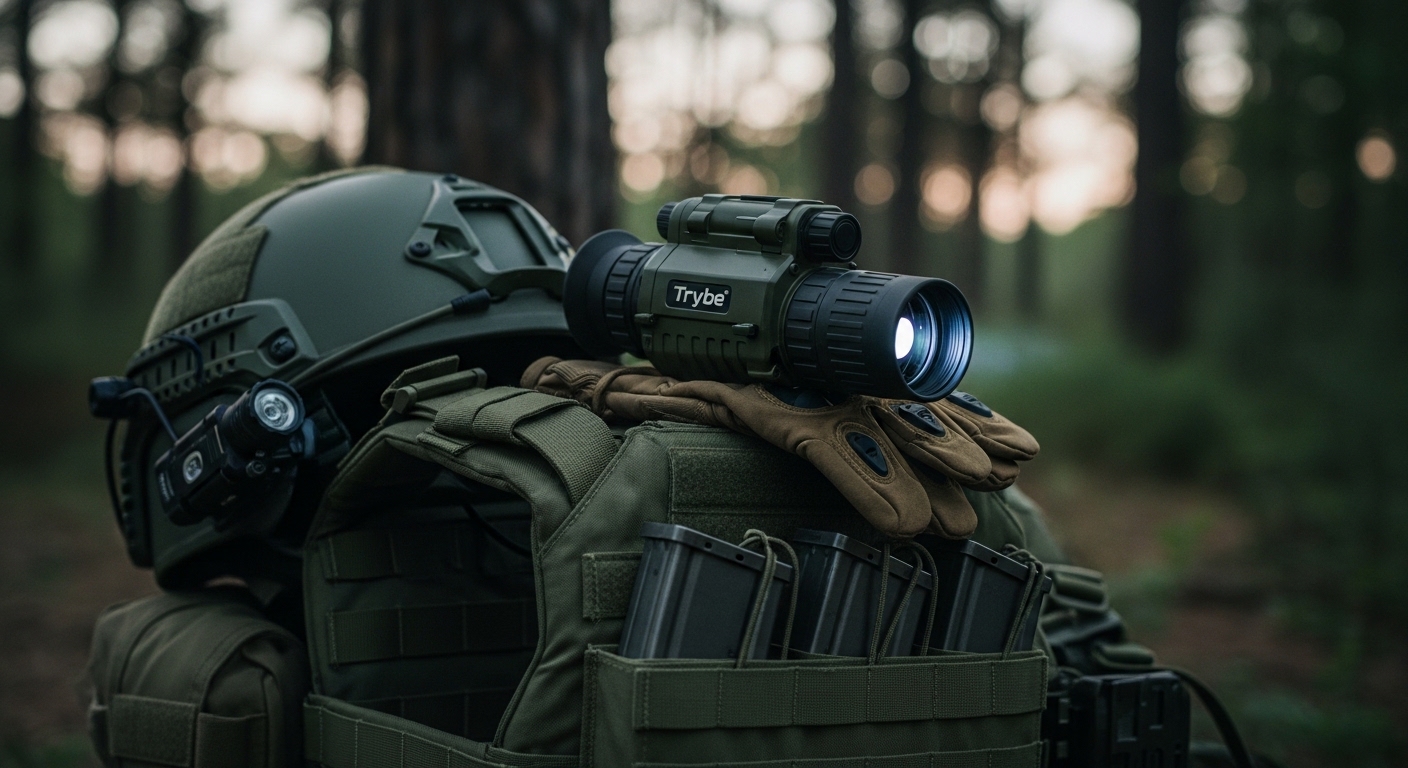
The base package typically includes the monocular, a soft carry case, a basic head mount, a single AA battery, and a manual. Some configurations include a demist shield and sacrificial window for lens protection.
OpticsPlanet customer reviews consistently criticize the included headgear. The basic mount works but feels flimsy compared to purpose-built solutions like the Norotos or Wilcox mounts. Serious users often budget for an upgraded mount.
The objective lens receives mixed reviews. Some users find it adequate. Others report quality concerns and suggest upgrading to a better lens for improved image clarity.
Handheld Use
Helmet Mounting
Weapon Mounting
Stargazing
Don’t Do Daylight’s review highlights the Trybe PVS-14’s effectiveness for handheld applications such as stargazing, camping, and surveillance, noting its portability and quick deployment capability.
Mounting Options and Versatility
The standard PVS-14 dovetail interface enables mounting flexibility. I’ve tested three primary configurations that cover most use cases.
Handheld Mode: This is how most people start. The device is compact enough to hold for extended periods. The eyecup provides comfortable viewing. A neck lanyard is essential for security.
Helmet Mounting: A dovetail mount attaches the PVS-14 to a helmet mount. The included headgear works for basic use. Serious users upgrade to a Norotos G24 or Wilcox L4 G24 for superior stability and adjustability.
In a detailed YouTube review, Copper Jacket TV demonstrates the Trybe PVS-14’s image quality in night conditions and shows various mounting configurations including helmet and weapon mounting options. His testing shows the device performs well across different mounting setups.
Weapon Mounting: The PVS-14 can be mounted in front of a day optic using a mount like the ARM-Sanon. This provides night vision capability through your existing scope. A dedicated night vision scope is typically more robust, but the PVS-14 offers flexibility for those who want a multi-purpose device.
Battery Life and Power Management
The Trybe PVS-14 runs on a single AA battery. This is a significant advantage over proprietary battery systems. You can find AA batteries anywhere.
Battery life ranges from 40-60 hours depending on temperature and gain settings. Cold weather significantly reduces battery performance. I recommend lithium batteries for winter use.
The device uses a simple battery compartment that requires no tools. A fresh battery can be swapped in seconds. Always carry spares in the field.
Warranty and Customer Support
Trybe Defense offers a 2-year warranty on the PVS-14 Gen 3 WPT. This is shorter than the 3+ year warranties offered by premium brands. However, it does provide some protection against early failures.
AR15.com forum members discuss the Trybe PVS-14’s value proposition, with comments suggesting the return policy makes it a low-risk purchase for those wanting to try Gen 3 night vision. This sentiment appears frequently in community discussions.
The OpticsPlanet return policy provides additional peace of mind. You can return the device within a specified period if you’re not satisfied. This allows you to inspect tube quality and performance before committing.
Pros and Cons Summary
Reasons to Buy
- Most affordable Gen 3 WPT option available
- White phosphor reduces eye strain
- Autogating protects from bright light damage
- Standard PVS-14 accessory compatibility
- OpticsPlanet return policy reduces risk
- Adjustable gain for varying conditions
- Hand-select option for better tubes
- Common AA battery power
|
Reasons to Avoid
- Tube quality varies between units
- Expect blemishes, especially at entry level
- Included headgear quality is basic
- External lens quality concerns
- 2-year warranty (less than premium brands)
- Less established brand reputation
- Thin-filmed tube (not filmless)
- Quality control inconsistency
|
Value Assessment and Final Verdict
The Trybe PVS-14 Gen 3 WPT costs between $2,800 and $3,500 depending on configuration and retailer. This is significantly less than premium brands. A comparable L3Harris or Elbit system typically costs $4,500-$6,000+.
This price difference represents real savings. However, it comes with trade-offs. Tube quality is less consistent. Accessories are basic. The warranty is shorter. The brand has less established credibility.
Who Should Buy the Trybe PVS-14 Gen 3 WPT?
This device is ideal for first-time Gen 3 buyers who want white phosphor without spending premium prices. Hunters who need reliable night vision for predator or hog hunting will find it sufficient. Tactical enthusiasts on a budget can get real performance.
Those interested in stargazing and astronomy will appreciate the white phosphor display. The natural appearance makes celestial observation more enjoyable. Surveillance and security applications are well-suited to this platform.
Who Should Look Elsewhere?
Professionals who depend on night vision for critical missions should consider premium brands. The consistency and warranty coverage of L3Harris or Elbit provide additional assurance for life-or-death situations.
Perfectionists who want the cleanest possible tube may find the Trybe’s quality variation frustrating. Those who already own high-end night vision won’t find improvement here.
Users seeking the absolute lowest light performance should consider filmless tubes. The Trybe’s thin-filmed design offers excellent performance but falls short of filmless capabilities in extreme darkness.
Frequently Asked Questions
Is the Trybe PVS-14 Gen 3 WPT worth the money?
For first-time Gen 3 buyers, the Trybe PVS-14 Gen 3 WPT offers good value. It saves $1,000-$2,000 compared to premium brands while delivering usable performance. The return policy through OpticsPlanet reduces purchase risk.
What is the difference between thin-filmed and filmless tubes?
Thin-filmed tubes use an ion barrier film that enables autogating capability. They are more affordable and protect against bright light damage. Filmless tubes lack this barrier, offering better performance in extreme low light but costing significantly more.
How far can you see with the Trybe PVS-14?
Detection range depends on conditions. Under a quarter moon with clear skies, expect 150-250 yards on human-sized targets. Full moon conditions extend this to 250-350 yards. In complete darkness, an IR illuminator is required for 50-100 yard detection.
What is a good FOM for Gen 3 night vision?
Figure of Merit (FOM) measures tube performance by multiplying resolution by signal-to-noise ratio. 1600 FOM is considered good performance. Premium tubes exceed 2000 FOM. The Trybe’s minimum 1600 FOM specification ensures usable performance across most conditions.
Does the Trybe PVS-14 come with a warranty?
Trybe Defense offers a 2-year warranty on the PVS-14 Gen 3 WPT. This is shorter than premium brands that typically offer 3+ years. However, the OpticsPlanet return policy provides additional consumer protection for initial purchases.
What are tube blemishes and are they normal?
Tube blemishes are dark spots caused by manufacturing imperfections in the image intensifier tube. At the Trybe’s price point, blemishes outside Zone 1 (center viewing area) are normal and expected. Zone 1 blemishes are more concerning as they affect the primary viewing area.
Final Verdict
The Trybe PVS-14 Gen 3 WPT fills an important niche in the night vision market. It provides legitimate Gen 3 white phosphor performance at a price that many more enthusiasts can afford. The trade-offs are real but manageable for most users.
I recommend this device for anyone entering the analog night vision world. The return policy through OpticsPlanet significantly reduces risk. You can evaluate the tube quality yourself and return if it doesn’t meet expectations.
Consider the hand-select option if your budget allows. Budget for upgraded mounting hardware if you plan to use this on a helmet or weapon. The included accessories get you started but leave room for improvement.
For serious users who eventually want to upgrade, the Trybe PVS-14 holds its value reasonably well. You can resell it later and recoup some of your investment when moving to premium equipment.
View on OpticsPlanet
We earn a commission, at no additional cost to you. CERTAIN CONTENT THAT APPEARS ON THIS SITE COMES FROM AMAZON. THIS CONTENT IS PROVIDED 'AS IS' AND IS SUBJECT TO CHANGE OR REMOVAL AT ANY TIME.