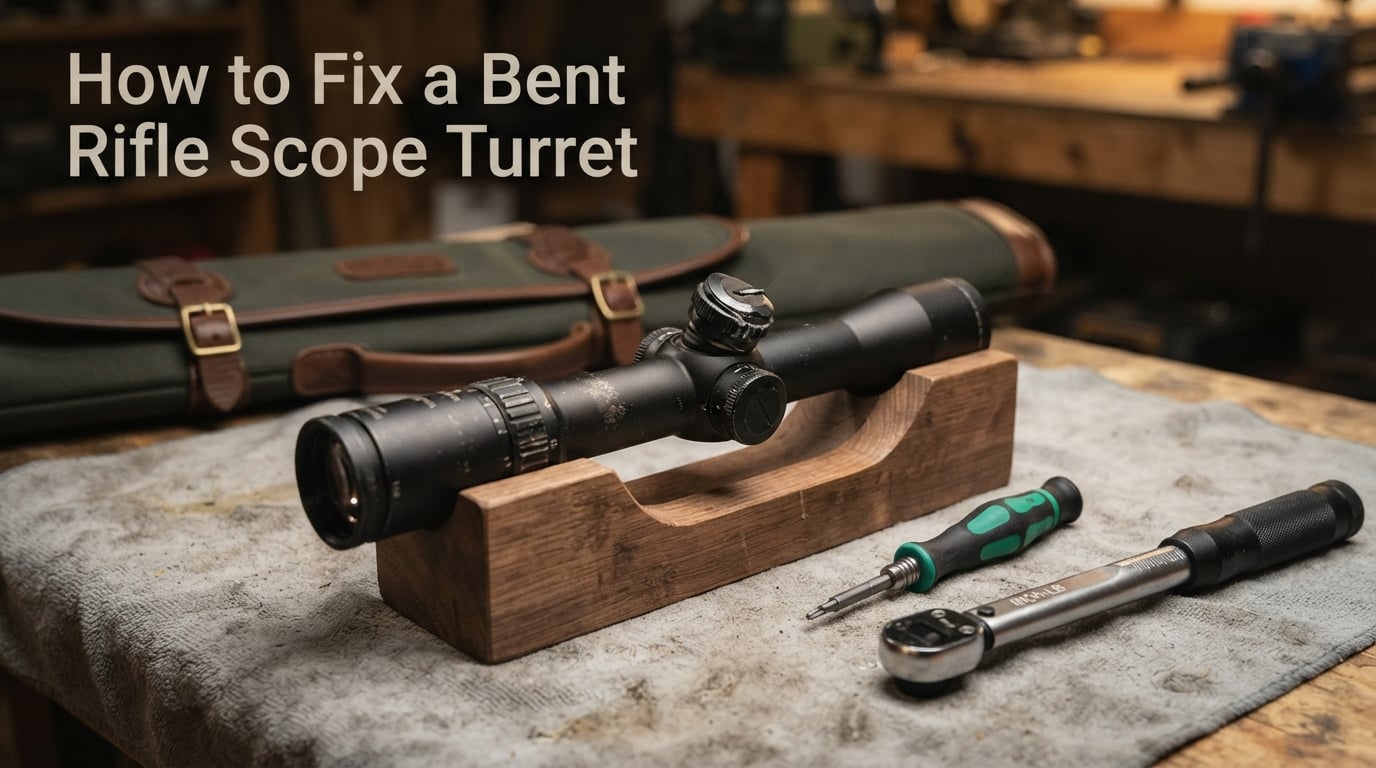
How to Fix a Bent Rifle Scope Turret 2026: DIY Guide
A bent rifle scope turret is one of the most frustrating problems a shooter can face. You mount your rifle,…


When I first started shooting, the terminology around rifle scopes felt like learning a foreign language. I’d hear experienced shooters talk about MOA adjustments, FFP reticles, and parallax errors while I stood there nodding politely. This rifle scope glossary is the resource I wish someone had handed me on day one.
Understanding scope terminology isn’t just about sounding knowledgeable at the range. These terms directly affect your accuracy, your shot placement, and your ability to make ethical kills when hunting. After spending 15 years behind various optics and helping dozens of new shooters get started, I’ve compiled this comprehensive glossary to help you skip the confusion I went through.
Rifle scopes have evolved significantly in 2026, with features like first focal plane reticles and ballistic turrets becoming standard. Whether you’re shopping for your first scope or trying to understand advanced long-range concepts, this glossary covers every term you’ll encounter.
A – Adjustable Objective | Airgun Scope
B – Ballistic Reticle | Ballistic Turret | BDC
C – Click Value | Coatings | Crosshair
D – Diopter | Dovetail | Duplex Reticle
E – Elevation | Exit Pupil | Eye Relief | Eyepiece
F – Fast Focus | Field of View | First Focal Plane | Fixed Power
H – Hold Over | Hold Off
I – Illuminated Reticle
K – Kentucky Windage
L – Light Gathering Power | Light Transmission
M – Magnification | Maximum Point Blank Zero | Mil | Mil Dot | Minute of Angle | Muzzle
N – None
O – Objective Lens | Ocular Lens
P – Parallax | Plex Reticle | Power
R – Reticle | Resolution | Reticle Focus
S – Second Focal Plane
T – Trajectory | Tube Diameter | Turret | Twilight Factor
V – Variable Power
W – Windage
Z – Zero | Zero Stop
Pronunciation: uh-JUST-uh-buhl ub-JEK-tiv
Definition: An objective lens that can be adjusted to focus on targets at different distances, typically used to eliminate parallax error at specific ranges.
An adjustable objective (AO) lets you focus the scope precisely for the distance you’re shooting. I’ve found this essential for varmint hunting where shots might range from 50 to 300 yards. The AO housing is usually on the front of the scope and moves the objective lens forward or backward.
See also: Parallax, Objective Lens
Definition: A scope designed specifically for air rifles, capable of withstanding the unique recoil impulse (often forward and backward) generated by spring-piston airguns.
Regular rifle scopes can fail when mounted on spring-piston airguns due to the unique double-recoil impulse. I learned this the hard way after destroying a decent scope on my Benjamin NP2. Airgun scopes have reinforced internal components to handle this stress.
Pronunciation: buh-LIS-tik RET-i-kuhl
Definition: A reticle with reference points (dots, lines, or bars) calibrated to compensate for bullet drop at specific distances.
Ballistic reticles allow you to hold over for different distances without dialing your turrets. The most popular versions use hash marks representing specific yardages. My experience with these reticles has been mixed—they work great if you know your exact ballistic data, but they require practice to use effectively under pressure.
See also: BDC, Hold Over, Trajectory
Definition: A custom elevation turret marked with yardage distances rather than MOA or MIL values, allowing quick adjustments to known ranges.
Ballistic turrets let you quickly dial to your target distance without doing mental math. After hunting with a standard MOA turret for years, switching to a ballistic turret cut my time-to-first-shot in half. The trade-off is they’re caliber-specific and load-specific.
See also: Turret, BDC, Elevation
Definition: A system of reference points in a reticle or marked on a turret that indicates holdover for specific distances to account for bullet drop.
BDC systems come in two forms: reticle-based (holdover points) and turret-based (yardage marks). Both rely on your specific ammunition performing as expected. I’ve found BDC turrets work well for hunters who consistently shoot the same ammo at known distances.
See also: Ballistic Reticle, Trajectory
Definition: The amount of adjustment made per click of a turret, typically expressed in MOA or MIL fractions.
Common click values are 1/4 MOA, 1/8 MOA, 0.1 MIL, or 0.05 MIL. Knowing your click value is essential for making precise adjustments. I’ve worked with scopes where four clicks moved the point of impact one inch at 100 yards (1/4 MOA) and others with finer 1/8 MOA adjustments for benchrest competition.
See also: Turret, MOA, Mil
Definition: Chemical treatments applied to lens surfaces to reduce light reflection, increase light transmission, and improve image clarity.
Coatings are one of the most misunderstood aspects of scopes. Single coating means one lens surface has coating. Fully coated means all air-to-glass surfaces are coated. Fully multi-coated means multiple layers on all surfaces—this is what you want. I’ve tested side-by-side scopes with and without quality coatings, and the difference in low-light performance is dramatic.
Coating quality hierarchy: Coated < Fully Coated < Multi-Coated < Fully Multi-Coated
Definition: The traditional reticle pattern featuring two fine lines crossing at the center, forming a plus sign (+) aiming point.
Crosshairs are the simplest reticle design and still widely used today. While modern reticles offer more features, sometimes simple is better. I prefer fine crosshairs for target shooting where precision matters more than rapid target acquisition.
See also: Reticle, Duplex Reticle
Pronunciation: DYE-uh-pter
Definition: An adjustment on the eyepiece that focuses the reticle to your eye, independent of target focus.
The diopter adjustment is often overlooked but critically important. It focuses the reticle itself, not the target. I always set my diopter at the start of each season by looking at a plain sky or wall and adjusting until the reticle is crisp. If you’re getting headaches or eye strain while shooting, check your diopter setting.
See also: Eyepiece, Reticle Focus
Pronunciation: DUHV-tayl
Definition: A mounting system featuring a wedge-shaped groove that mates with a corresponding base, commonly used for rimfire and airgun scopes.
Dovetail mounts come in two main styles: 11mm (standard rimfire) and 3/8-inch. While they’re lighter than Picatinny systems, I’ve found them less secure for heavy-recoil applications. For serious hunting or tactical use, I recommend upgrading to a Picatinny or Weaver system.
Definition: A reticle design with thick outer sections that taper to thin wires near the center, providing quick target acquisition while allowing precise aiming.
The Duplex is arguably the most popular hunting reticle of all time. The thick posts draw your eye to the center quickly, while the fine crosshair allows precise shot placement. After 20 years of hunting, I still default to a Duplex for most big-game applications.
See also: Reticle, Plex Reticle
Definition: The vertical adjustment on a rifle scope that moves the point of impact up or down to compensate for bullet drop at distance.
Elevation adjustments are almost always made with the top turret. When zeroing, remember the saying: “up for up, down for down.” Turning the elevation turret clockwise typically moves your point of impact up. I always verify zero at multiple distances to confirm my elevation adjustments are tracking correctly.
See also: Turret, Windage, Zero
Definition: The diameter of the light beam exiting the eyepiece, calculated by dividing the objective lens diameter by magnification.
Exit pupil determines how much light reaches your eye. A larger exit pupil (up to about 7mm) is better for low-light conditions. Your eye’s pupil dilates to about 7mm in darkness but only 2-3mm in bright daylight. This explains why a 10×50 scope (5mm exit pupil) works great in dawn/dusk conditions.
Formula: Objective Diameter xF7 Magnification = Exit Pupil
Examples:
See also: Objective Lens, Light Transmission
Definition: The distance from the ocular lens where your eye must be positioned to see the full field of view through the scope.
Eye relief is typically measured in inches. Most scopes offer 3-4 inches of eye relief, but hard-recoiling rifles require more. I learned this lesson the hard way when a .300 Winchester Magnum gave me a “scope bite” ring around my eyebrow. For magnum rifles, I now insist on at least 3.5 inches, preferably 4+.
Warning: Insufficient eye relief with heavy recoil can cause serious injury.
See also: Ocular Lens, Eyepiece
Definition: The rear end of the scope containing the ocular lens and diopter adjustment, where the shooter places their eye.
The eyepiece houses the lens that magnifies the focused image from the objective. Quality eyepieces have fast-focus mechanisms and generous eye boxes. I’ve found that a good eyepiece design makes the difference between a scope that’s pleasant to use and one that’s constantly frustrating.
See also: Ocular Lens, Diopter, Eye Relief
Definition: The combination of the eyepiece housing and ocular lens assembly at the rear of the scope.
These terms are often used interchangeably. The ocular is specifically the lens, while the eyepiece is the entire housing. Modern scopes integrate fast-focus eyepieces that allow quick reticle focusing without removing caps.
Definition: An eyepiece design with a prominent ring or collar that allows quick reticle focusing without removing dust caps.
Before fast-focus eyepieces became standard, you had to unscrew the eyepiece lock ring to focus the reticle. The modern fast-focus design is one of those quality-of-life improvements you quickly learn to appreciate. I use mine every time I head to the range.
See also: Diopter, Eyepiece
Definition: The width of the area visible through the scope at a specific distance, typically measured in feet at 100 yards.
Field of view decreases as magnification increases. This is why finding targets at high magnification can be challenging. I start on low power to locate game, then crank up the magnification for the shot. A typical 3-9x scope might offer 30-35 feet at 100 yards on 3x, but only 11-14 feet on 9x.
Rule of thumb: Lower magnification = wider field of view = easier to find targets
See also: Magnification
Definition: A reticle placement in front of the magnification lens, causing the reticle to grow and shrink proportionally with the target as magnification changes.
In an FFP scope, the reticle remains accurate at any magnification. If a mil-dot covers 4 inches at 100 yards on 4x, it still covers 4 inches at 100 yards on 16x (the dots just appear larger). This makes FFP ideal for long-range shooting where you might use the reticle for ranging and holdovers.
Trade-off: FFP reticles can become very fine at low magnification, making them difficult to see in low light.
See also: Second Focal Plane, Focal Plane
Definition: A scope with a single, non-adjustable magnification level, such as 4x or 6x.
Fixed power scopes are simpler, more durable, and often offer better optical quality per dollar. Many experienced hunters argue that a quality fixed 4x or 6x is all you really need for typical hunting ranges. I’ve used a fixed 6x for squirrel hunting and found it more than adequate for shots under 100 yards.
Advantages: Fewer moving parts, often lighter, typically less expensive
See also: Variable Power, Magnification
Definition: The location within the scope where the reticle is positioned, either before (first) or after (second) the magnification lens assembly.
The focal plane determines how your reticle behaves when you change magnification. First focal plane reticles scale with magnification; second focal plane reticles stay the same size. This choice affects how you use the reticle for ranging and holdovers.
See also: First Focal Plane, Second Focal Plane
Definition: Aiming above the intended point of impact to compensate for bullet drop at distance, without adjusting the scope’s elevation.
Hold over is used when you don’t have time to dial elevation or prefer to keep your zero set. Most ballistic reticles are designed for hold over. I’ve found hold over works well for hunting situations where shots present quickly and there’s no time to touch the turrets.
See also: Ballistic Reticle, Trajectory, Hold Off
Definition: Aiming into the wind (left or right of center) to compensate for wind drift without adjusting the scope’s windage.
Hold off is the horizontal equivalent of hold over. Instead of dialing for wind, you aim into the wind using the reticle’s horizontal references. This is essential for tactical and competitive shooting where conditions change rapidly. I’ve found hold off more practical than constant windage dialing in hunting scenarios too.
See also: Hold Over, Windage, Kentucky Windage
Definition: A reticle with built-in lighting (usually LED) to enhance visibility in low-light conditions.
Modern illuminated reticles often have adjustable brightness settings and can be turned off when not needed. I’ve found illumination particularly useful for dawn and dusk hunts when the reticle might otherwise wash out against a dark target. Battery life has improved dramatically in 2026, with many offering 1000+ hours.
Tip: Use the lowest brightness setting that’s visible—bright settings can cause glare and obscure your target.
See also: Reticle
Definition: The practice of estimating wind adjustment by aiming off-target without using precise reticle measurements or turret adjustments.
An old-school term that’s still relevant today. Kentucky windage refers to “guesstimating” your wind hold rather than using calculated adjustments. While not as precise as using a mil-based reticle, sometimes you have to trust your gut when the wind changes between shots.
See also: Hold Off, Windage
Definition: A scope’s ability to collect and transmit light to your eye, primarily determined by objective lens diameter and coating quality.
Light gathering is often oversimplified as just objective size, but coatings and glass quality are equally important. I’ve tested 50mm scopes that were outperformed by quality 44mm models with better coatings. Don’t assume bigger is always better—lens quality matters more than diameter.
See also: Light Transmission, Exit Pupil, Coatings
Definition: The percentage of light that passes through the scope to reach your eye, affected by glass quality, coatings, and lens count.
Premium scopes claim 90-95% light transmission, while budget scopes might only achieve 80-85%. The difference becomes obvious in low light. After hunting with both budget and premium optics, I can tell you that extra 10% transmission means seeing that last 10 minutes of legal shooting light.
Reality check: Your eye can’t detect differences smaller than about 3-5%. A 92% vs 95% transmission claim is mostly marketing.
See also: Light Gathering Power, Coatings
Definition: The degree to which a scope enlarges the target image, expressed as a number (e.g., 3x = 3 times larger than naked eye).
Scopes come in fixed power (single magnification) or variable power (range such as 3-9x). Variable scopes are described with two numbers like “3-9×40” meaning 3 to 9 power magnification with a 40mm objective. For most hunting applications, I recommend 3-9x or 4-12x as versatile ranges.
Choosing magnification:
See also: Fixed Power, Variable Power, Field of View
Definition: A zeroing method that maximizes the distance range where a bullet stays within a vital zone without holdover or adjustment.
MPBZ allows you to aim dead-center and hit within an acceptable area (typically a 6-8 inch vital zone) from close range to your maximum effective distance. For a typical deer rifle, this might mean a 250-yard zero that keeps you in the vitals from 0 to 300 yards. I’ve used this technique successfully for years of whitetail hunting.
See also: Zero, Trajectory
Definition: A unit of angular measurement equal to 1/1000th of a radian, approximately 3.6 inches at 100 yards (10cm at 100 meters).
Mils are increasingly popular in long-range shooting because they’re more intuitive than MOA for metric calculations. One mil equals 3.6 inches at 100 yards, or 36 inches at 1000 yards. If you need to adjust 18 inches at 500 yards, that’s exactly 1 mil—no complex math required.
Mil vs MOA comparison:
See also: Minute of Angle, Mil Dot Reticle
Definition: A reticle pattern with mil-based dot or hash mark spacing used for rangefinding, holdovers, and windage corrections.
The classic mil dot reticle places dots at 1 mil intervals. Modern versions often use hash marks instead of dots for better visibility. These reticles shine when paired with FFP scopes because the mil measurements remain accurate at any magnification. I’ve used mil dot reticles for everything from tactical competitions to calling shots on long-range coyotes.
See also: Mil, First Focal Plane, Ballistic Reticle
Pronunciation: MY-nut uv AN-guhl
Definition: A unit of angular measurement equal to 1/60th of a degree, approximately 1.047 inches at 100 yards (often rounded to 1 inch).
MOA is the traditional American measurement for rifle scope adjustments. One MOA equals roughly 1 inch at 100 yards, 2 inches at 200 yards, and so on. If you’re shooting 3 inches low at 300 yards, you need 1 MOA of elevation up (3 inches).
Common MOA adjustments:
See also: Mil, Click Value, Turret
Definition: The front end of the rifle barrel where the bullet exits.
While not a scope term per se, muzzle position is relevant when considering scope mounting and eye relief. The scope needs to be positioned so your eye is at the correct distance (eye relief) when the rifle is shouldered comfortably.
Definition: The front lens of the scope that gathers light and forms the initial image, with diameter determining light-gathering capability.
Objective lens diameter is the second number in scope specifications (e.g., the “40” in 3-9×40). Larger objectives gather more light but increase scope size and weight. For most hunting applications, I’ve found 40-50mm to be the sweet spot. Objectives larger than 50mm typically require extra-high mounting rings which can affect cheek weld.
Common sizes:
See also: Exit Pupil, Light Gathering Power
Definition: The rear lens of the scope that magnifies the focused image from the objective lens for your eye to see.
The ocular lens works with the eyepiece to provide the final magnified image. Quality ocular assemblies have multiple lens elements to correct aberrations and provide a clear image. When shopping for scopes, pay attention to eye relief specs which are determined by ocular design.
See also: Eyepiece, Eye Relief, Objective Lens
Pronunciation: PAR-uh-laks
Definition: The apparent movement of the reticle in relation to the target when the shooter’s eye position changes.
Parallax error occurs when the target image and reticle are on different focal planes. If your eye moves off-center, the reticle appears to shift across the target. At typical hunting distances (100-200 yards) with medium magnification, parallax isn’t usually an issue. But for precision work beyond 300 yards or at high magnification, parallax adjustment becomes essential.
Symptoms of parallax error: Point of impact shifts when you move your head behind the scope.
See also: Adjustable Objective, Side Focus
Definition: A proprietary reticle design featuring tapered posts similar to the Duplex pattern, used by various manufacturers with their own styling.
“Plex” has become a generic term for any Duplex-style reticle. Different brands have their own versions (German #4, Hunter, etc.) but they all share the same basic concept: thick outer posts for quick acquisition, thin center wires for precision.
See also: Duplex Reticle, Reticle
Definition: Another term for magnification, referring to how much larger the target appears through the scope.
Power is used interchangeably with magnification. You’ll see scopes described as “3-9 power” or “variable power scopes.” High power isn’t always better—too much magnification can make target acquisition difficult and magnify shooter movement.
See also: Magnification, Fixed Power, Variable Power
Pronunciation: RET-i-kuhl
Definition: The aiming reference pattern (crosshairs, dots, lines, or marks) visible within the scope that you align with your target.
The word “reticle” comes from the Latin “reticulum” meaning “little net.” Commonly called “crosshairs” regardless of actual pattern, reticles range from simple duplex designs to complex ballistic and milling reticles. The right reticle choice depends on your intended use—hunters typically prefer simple designs, while long-range shooters often benefit from ballistic or mil-dot reticles.
Common reticle types: Duplex, Mil Dot, BDC, Illuminated, FFP/SFP variations
Definition: A scope’s ability to reveal fine detail and separate closely spaced objects, determined by glass quality and optical design.
Resolution is what allows you to distinguish individual branches on a distant tree or see bullet holes at 200 yards. High-resolution scopes use premium glass and sophisticated coatings. In my experience, the difference between budget and premium glass becomes obvious when you’re trying to spot a partially concealed animal at dawn or dusk.
See also: Coatings, Light Transmission
Definition: The adjustment that sharpens the reticle’s appearance to your eye, independent of target focus.
Also called diopter adjustment, this focuses the reticle itself. A properly focused reticle should appear sharp and crisp. If you’re squinting or getting headaches, your reticle focus may be off. I adjust mine by looking at a blank sky or wall and turning the fast-focus ring until the reticle is sharp.
See also: Diopter, Fast Focus Eyepiece
Definition: A reticle placement behind the magnification lens, causing the reticle to remain constant in size regardless of magnification changes.
SFP is the traditional American scope design and remains the most common. The reticle stays the same size at 3x as it does at 9x. This means any holdover marks are only accurate at one specific magnification (usually marked on the power ring). I prefer SFP for most hunting because the reticle remains visible even at low magnification.
Key difference: In SFP scopes, reticle measurements are only accurate at one magnification setting.
See also: First Focal Plane, Focal Plane
Pronunciation: truh-JEK-tuh-ree
Definition: The curved path a bullet follows from muzzle to target due to gravity and air resistance.
Understanding trajectory is essential for long-range shooting. Bullets don’t fly straight—they arc downward. A typical deer rifle might be 3 inches high at 100 yards, dead-on at 200, and 12 inches low at 300. Ballistic reticles and turrets are designed to compensate for this predictable drop.
See also: Ballistic Reticle, BDC, Maximum Point Blank Zero
Definition: The diameter of the scope’s main tube, most commonly 1-inch or 30mm.
Standard tube diameter is 1 inch. Thirty-millimeter tubes are increasingly common and offer more internal adjustment range and potentially stronger construction. However, a 30mm tube doesn’t inherently gather more light—that’s determined by objective lens size. For most applications, either diameter works fine.
Common diameters:
Pronunciation: TUR-it
Definition: The knobs on a scope used to adjust windage (horizontal) and elevation (vertical), typically located on top and the side of the scope tube.
Turrets come in various styles from low-profile tactical knobs to large target-style turrets. Hunting scopes often have capped turrets to prevent accidental adjustments, while tactical and competition scopes often have exposed turrets with clear markings. I prefer capped turrets for hunting to protect my zero, but exposed turrets for range work.
See also: Click Value, Elevation, Windage, Zero Stop
Definition: A calculated number indicating a scope’s low-light performance, derived by multiplying the objective lens diameter by magnification and taking the square root.
Twilight factor attempts to quantify low-light capability in a single number. A 3-9×40 scope has a twilight factor of 19 (square root of 3×40). A 6×42 has a twilight factor of 20. While useful for comparisons, don’t rely on it alone—coating quality and glass type matter just as much.
Formula: Square Root of (Magnification x Objective Diameter)
See also: Light Transmission, Exit Pupil
Definition: A scope with adjustable magnification, expressed as a range such as 3-9x or 4-16x.
Variable power scopes offer versatility that fixed scopes can’t match. You can dial down for quick target acquisition or up for precise long-range shots. Modern variable scopes maintain good optical quality throughout their range. For 2026 hunting, a quality 3-9x or 4-12x variable will handle 95% of situations.
See also: Fixed Power, Magnification
Pronunciation: WIN-dij
Definition: The horizontal adjustment on a rifle scope that moves the point of impact left or right to compensate for wind drift or to align with the barrel.
Windage adjustments are typically made with the side turret. When zeroing, remember that shots to the left require adjustments to the right (turn the turret clockwise when viewed from the shooting position). For long-range shooting, windage can be the most challenging variable to master.
See also: Elevation, Turret, Hold Off, Kentucky Windage
Definition: The process of aligning the scope’s point of aim with the bullet’s point of impact at a specific distance.
Zeroing is the foundation of accurate shooting. Most hunters zero at 100 yards, though some prefer 200 yards for flat-shooting cartridges. The key is consistency—always zero at the same distance so you know exactly what your rifle will do. I verify my zero before every hunting season.
Zeroing steps:
See also: Elevation, Windage, Turret
Definition: A feature on elevation turrets that prevents adjustment below the zero point, providing a positive tactile stop at your established zero.
Zero stops allow you to dial elevation for long shots and return to a known zero by feel, even in the dark. This is invaluable for tactical and long-range competition shooting. While less critical for hunting, I’ve found zero stops convenient when practicing at longer ranges and returning to my hunting zero.
See also: Turret, Zero, Elevation
The basic parts of a rifle scope include: the objective lens (front lens that gathers light), the main tube (houses internal components), the eyepiece (rear lens you look through), turrets (adjustment knobs for windage and elevation), and the reticle (aiming reference). Understanding these components helps you make informed purchasing decisions and use your scope effectively.
MOA stands for Minute of Angle, which is an angular measurement equal to 1/60th of a degree. In practical terms, 1 MOA equals approximately 1 inch at 100 yards. This measurement is used for scope adjustments and accuracy specifications. A rifle shooting 1 MOA groups means it places shots within a 1-inch circle at 100 yards.
In a First Focal Plane (FFP) scope, the reticle is located before the magnification lens and scales with magnification. This means reticle measurements are accurate at any power. In a Second Focal Plane (SFP) scope, the reticle stays constant size and measurements are only accurate at one specific magnification. FFP is preferred for long-range shooting, while SFP works well for most hunting applications.
Eye relief is the distance from the ocular lens where your eye must be positioned to see the full field of view. Most scopes offer 3-4 inches of eye relief. Insufficient eye relief with heavy-recoiling rifles can cause the scope to hit your eyebrow, a painful experience known as scope bite. Magnum rifles typically require 3.5-4 inches of eye relief for safe shooting.
Parallax is the apparent movement of the reticle in relation to the target when your eye position changes. Parallax error occurs when the target and reticle are on different focal planes. It becomes noticeable at high magnification and longer distances (typically beyond 300 yards). Many scopes include parallax adjustment to eliminate this error for precision shooting.
For most hunting applications, a 40-50mm objective lens provides an excellent balance of light gathering and practical size. Larger objectives (50-56mm) gather more light for dawn/dusk hunting but require higher mounting rings. Smaller objectives (28-32mm) work well for rimfire and lightweight hunting rifles. Consider your shooting conditions and mounting requirements when choosing.
| Feature | First Focal Plane (FFP) | Second Focal Plane (SFP) |
|---|---|---|
| Reticle Size | Changes with magnification | Constant at all magnifications |
| Reticle Accuracy | Accurate at any magnification | Accurate at one magnification only |
| Low Visibility | Can be hard to see at low power | Always visible |
| Best For | Long-range, tactical, competition | Hunting, general shooting |
| Price | Generally more expensive | Typically less expensive |
| Measurement | MOA (Minute of Angle) | Mil (Milliradian) |
|---|---|---|
| Size at 100 yards | ~1.047 inches | 3.6 inches |
| Size at 1000 yards | ~10.47 inches | 36 inches |
| Common Click Values | 1/4, 1/8, 1/2 MOA | 0.1, 0.05 Mil |
| Primary Users | Hunters, American shooters | Tactical, long-range, metric users |
| Conversion | 1 MOA xF7 3.438 Mils | 1 Mil xF7 3.438 MOA |
This rifle scope glossary covers the essential terminology every shooter should know. As optics technology continues advancing in 2026, manufacturers introduce new terms and features, but the fundamentals remain consistent. Whether you’re a beginner looking for your first scope or an experienced shooter exploring long-range precision, understanding these terms will help you make informed decisions and get the most from your equipment.