8 Best Rifle Scope Bubble Levels (September 2026)
I lost a whitetail at 412 yards last fall because of something I couldn’t see through my scope. A subtle…

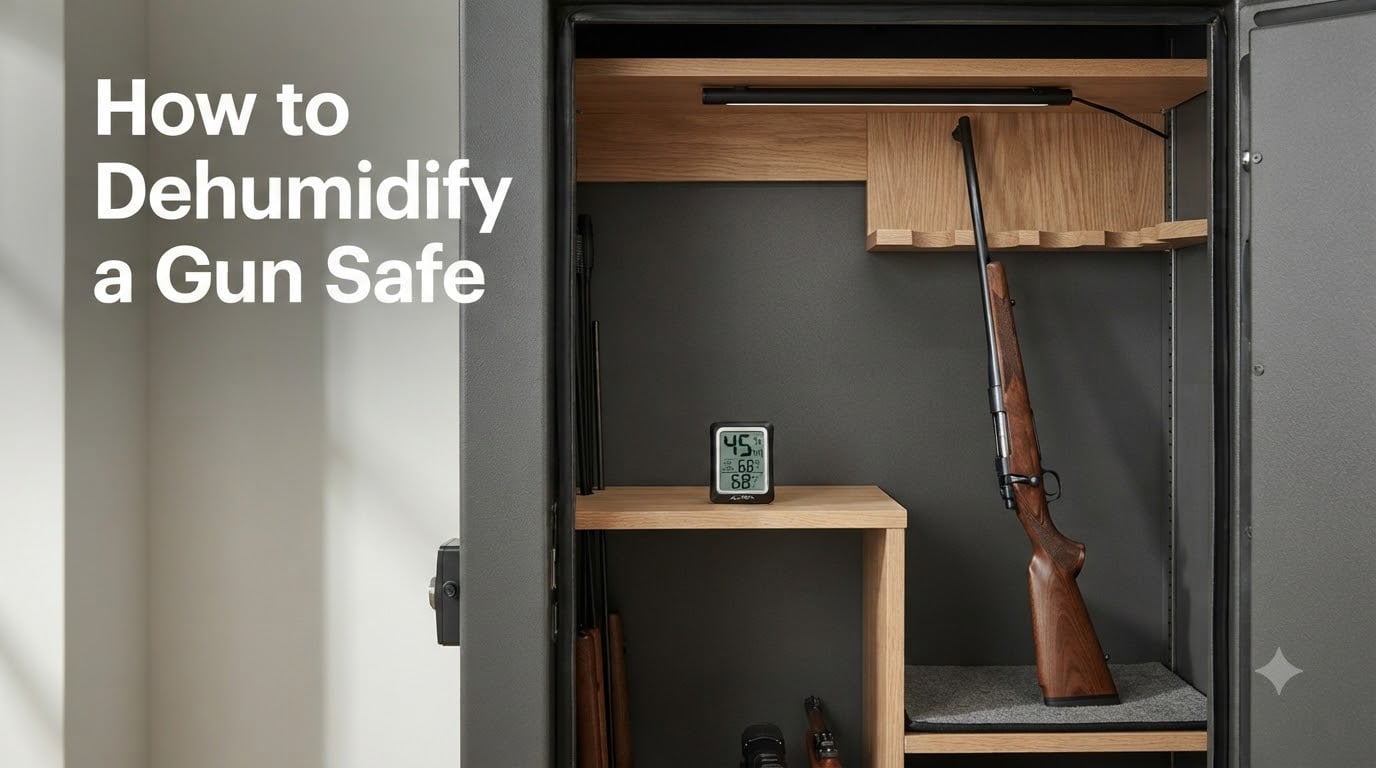
After two decades of storing firearms in basements, garages, and closets across three different climate zones, I can tell you exactly when rust shows up and how to stop it before it starts. The National Rifle Association recommends maintaining humidity inside a gun safe between 30% and 50% relative humidity (RH), at a temperature of 60 to 70 degrees Fahrenheit, and that single line is the foundation of every effective gun safe dehumidification setup. If you want to know how to dehumidify a gun safe the right way, you have to start with that range and work backward into the equipment and habits that keep you there.
I learned this the hard way. My first bolt-action developed a constellation of pin-prick rust spots after eight weeks in an unconditioned Tennessee basement one summer, and I have been chasing humidity numbers ever since. This guide walks through the methods I have actually used, the sizing rules that prevent overheating in small safes, and the maintenance routines that prevent surprise failures months later. By the end you will know which gun safe dehumidifier fits your safe, your climate, and your budget.
Can you put a dehumidifier in a gun safe? Yes. Purpose-built electric dehumidifier rods and rechargeable silica gel canisters are designed specifically for sealed gun safes and run cool enough to be safe around firearms, wood stocks, and ammunition.
Is 65% humidity too high for a gun safe? Yes. Anything above 60% RH significantly raises the risk of rust and corrosion on blued steel, stainless steel, and wood stocks, especially when the safe sits in a basement or garage.
The NRA-recommended range of 30% to 50% relative humidity at 60 to 70 degrees Fahrenheit is the gold standard for long-term firearm storage. This range sits comfortably below the threshold where condensation forms on cold steel and well above the dryness level that cracks wood stocks. Anything inside that band keeps your guns safe without drying out the wood or damaging ammunition primers.
Below 30% RH, wood stocks can dry out, glue joints weaken, and leather slings stiffen. Above 50% RH, the dew point climbs closer to room temperature, and any cold surface inside the safe (a barrel, a scope tube, a steel shelf) can start to sweat. The 60-70F range keeps that dew point margin wide enough that small temperature swings do not produce condensation.
Research from the firearms industry consistently shows that corrosion accelerates sharply once you cross 60% RH combined with temperatures above 75F. At 86F and 70% RH, surface rust can appear on carbon steel within four days. That is why sticking to 30-50% is not just a recommendation. It is the line between guns aging gracefully and guns aging into scrap.
Once humidity climbs past 60%, you enter the danger zone for blued and parkerized finishes, wood stocks, and even stainless steel under prolonged exposure. Moisture films form on metal, salt from skin oils attracts more moisture, and mold can begin to grow on leather, foam, and felt lining. If your hygrometer reads above 60% for more than a day or two, you need a stronger dehumidification setup immediately.
Most gun owners blame the safe for humidity problems, but the safe is not the cause. It is the symptom. A sealed gun safe actually traps whatever moisture enters the box, and three main sources contribute: condensation from temperature swings, ambient humidity in the surrounding room, and the moisture sealed inside the safe when you close the door.
When the air outside the safe cools at night, the steel walls cool faster than the air inside. Moisture inside the warm air condenses on those cold walls, exactly like a cold glass of water on a summer day. That water collects on the floor of the safe, wicks into foam lining, and starts the rust cycle.
This is especially bad in garages and basements where temperatures swing 20 to 30 degrees between day and night. The fix is warming the air inside the safe just enough to prevent that dew point from being reached, which is exactly what an electric dehumidifier rod does.
If you live in the Southeast, Gulf Coast, or upper Midwest, ambient humidity regularly sits above 60% for months at a time. Your heating and cooling system may keep the living space at 50% RH, but the basement or closet where the safe sits may run 10 to 20 points higher. Climate zone matters more than safe brand or safe size.
Forum users in Florida and Louisiana report rust spots appearing on stored firearms within weeks during summer. Users in Arizona and Nevada rarely see humidity issues at all. Geography is a major factor in sizing your dehumidification system.
Modern fireproof safes use tight gaskets and thick steel walls to keep fire out, but those same features trap moisture inside. Any humidity present when you close the door stays there, plus whatever enters through small seal leaks over time. A safe in a humid basement is essentially a slow-moisture incubator.
Electric dehumidifier rods are the most popular method for gun safe dehumidification, and for good reason. They are plug-and-play, maintenance-free, and run cool enough to leave in the safe 24/7. Brands like Goldenrod, Lockdown, and Browning dominate this category, and a quality rod will outlast the safe itself.
An electric dehumidifier rod is a low-wattage heating element, usually 12W to 80W depending on size, mounted horizontally near the top of the safe. It gently warms the air just enough to lower relative humidity and prevent condensation. There are no moving parts, no chemicals to replace, and no noise.
The rod does not actively pull water out of the air. Instead, it raises air temperature by a few degrees, which drops the relative humidity reading on your hygrometer. It is essentially a condensation prevention device, not a moisture extractor. That distinction matters for very humid climates where you may need a second method.
This is the question I get asked most, and the answer is not intuitive. A common Reddit complaint is, will a 12 inch Goldenrod cook my guns in a 12.73 cubic foot safe? The honest answer: a 12-inch rod is fine for any safe up to about 30 cubic feet. It will not cook your guns. It will warm the air by 2 to 4 degrees, which is well within safe storage parameters.
For larger safes above 30 cubic feet, step up to an 18-inch or 24-inch rod. For very large safes above 50 cubic feet, consider two rods mounted at opposite ends. The general rule of thumb: 1 inch of rod per 2 to 3 cubic feet of safe volume, with a minimum 12-inch rod for any safe.
Goldenrod is the original and still the most trusted, with a lifetime warranty and Made-in-USA construction. Lockdown offers similar performance with quick-connect brackets for easier mounting. Browning’s Ever Dry rod is a solid budget option. All three run on standard 110V outlets and consume less power than a nightlight.
Desiccant dehumidifiers physically absorb moisture from the air and store it inside silica gel beads or crystals. They require no electricity, run silent, and work in any safe. The tradeoff is they need periodic recharging once the beads saturate.
Silica gel is a porous form of silicon dioxide that traps water vapor in tiny internal pores. A single canister the size of a coffee can holds several hundred grams of beads and can absorb 30% to 40% of its weight in water before saturating. Once full, the beads either change color (orange to green, blue to pink) or stay silent, depending on the type.
Desiccant works best in smaller safes and as a backup to an electric rod in larger ones. In a sealed environment, a single canister can pull humidity down 5 to 10 points, which is often the difference between safe storage and rust season.
Most silica gel canisters recharge in a 225F oven for 2 to 4 hours. The beads dry out and are ready to use again. However, a real complaint from gun owners is that Hornady rechargeable units sometimes stop working after one or two recharge cycles, with crystals staying green and never drying out. If your canister fails, replacement is usually cheaper than warranty hassle.
Avoid the cheap disposable silica gel packets (the kind that ship with electronics). They work short-term but absorb very little moisture and are not worth the effort. Invest in a rechargeable canister with a color indicator.
Orange silica gel turns green when saturated. Blue silica gel (cobalt-chloride impregnated) turns pink when full. Some modern canisters use indicator cards that change color from blue to pink as moisture loads up. These give you a clear visual signal to recharge before humidity climbs too high.
Each method has strengths, weaknesses, and ideal use cases. The table below summarizes the main differences so you can pick the right combination for your safe.
Electric rods cost between $40 and $120 depending on length and brand, last for years with zero maintenance, and work continuously as long as the safe has power. Silica gel canisters cost between $15 and $50, require recharging every 4 to 8 weeks in humid climates, and run silently with no electricity needed. DIY methods like light bulbs, dry rice, and baking soda cost almost nothing but are inconsistent, sometimes unsafe, and rarely effective long-term.
For most gun owners, the best setup is an electric rod as the primary defense plus a silica gel canister as backup. That combination handles 95% of storage situations, from a 12 cubic foot Liberty safe in a dry basement to a 50 cubic foot Browning in a Gulf Coast garage.
Small safes under 20 cubic feet: a 12-inch electric rod plus one small silica gel canister. Medium safes 20 to 40 cubic feet: an 18-inch rod plus one or two canisters. Large safes above 40 cubic feet: a 24-inch rod plus two canisters, or two 18-inch rods plus one canister. If you store collectible or heirloom firearms, add a third canister as insurance.
Setting up gun safe dehumidification is a one-hour job if you have the right equipment. Follow this sequence and you will have a stable, monitored environment from day one.
Place a digital hygrometer inside your closed safe for 24 to 48 hours before adding any equipment. This baseline reading tells you how aggressive your dehumidification needs to be. If your safe already sits at 40% RH, a single silica gel canister may be enough. If it reads 70%, you need an electric rod plus canisters plus probably a room dehumidifier nearby.
Match the method to your safe size and climate. Small safe in dry climate: silica gel canister only. Small safe in humid climate: 12-inch electric rod plus canister. Medium safe in any climate: 18-inch rod plus canister. Large safe in humid climate: 24-inch rod plus two canisters, possibly a room dehumidifier in the surrounding space.
Mount the electric rod horizontally near the top of the safe, ideally above the firearms and out of the way of the door swing. Use the included mounting bracket or a simple zip tie. Place silica gel canisters on the floor or on a lower shelf, away from direct contact with wood stocks. Position the hygrometer at eye level near the door for easy reading without opening the safe.
Check the hygrometer reading once a week for the first month. After you confirm the system is holding 30-50% RH, monthly checks are enough. Recharge silica gel canisters when the color indicator changes (typically every 4 to 8 weeks in humid seasons, every 3 to 6 months in dry climates). Replace canisters that fail to recharge. Keep the safe door gasket clean and intact.
A hygrometer is the single most important tool in your gun safe. Without one, you are guessing. With one, you know exactly when your system is working and when it needs attention.
Mount the hygrometer at eye level near the safe door so you can read it without opening the door. Every time you open the door, you let in humid outside air, which temporarily spikes the reading. Place it on a shelf or use adhesive to mount it on the inside of the door. Avoid placing it directly under the electric rod, which will give a falsely high temperature reading.
Most cheap digital hygrometers are accurate to plus or minus 5% RH out of the box, which is too wide for gun safe use. Calibrate using the salt test: place the hygrometer in a sealed container with table salt and a few drops of water for 12 hours. The reading should stabilize at 75% RH. Adjust the unit’s calibration screw or offset to match.
Analog hygrometers can drift even more and should be replaced every few years. A calibrated digital unit costs $10 to $20 and is worth every penny.
Humidity is not constant throughout the year, and your dehumidification system may need to flex with the seasons. Basement and garage safes face the biggest swings and need the most attention.
Indoor winter humidity often drops below 30% once the furnace runs. Your safe may read 20% RH, which is too dry for wood stocks. In that case, scale back the electric rod (unplug it temporarily) or remove one silica gel canister to let humidity climb back into range. Wood stocks can crack below 25% RH, so monitor closely.
Summer is the dangerous season for most gun safes, especially in the Southeast. Outdoor humidity climbs above 70% and that moisture seeps into basements and garages. Add extra silica gel canisters in May, recharge them more frequently (every 3 to 4 weeks), and consider running a room dehumidifier in the basement if humidity stays above 60%.
DIY dehumidification methods have been around for decades and they work short-term. They are not reliable long-term, but they can buy you time in an emergency or stretch a tight budget.
A 40W incandescent light bulb left on inside the safe will warm the air enough to drop relative humidity by 10 to 15 points. It works for emergency situations like a flooded basement or a power outage. Dry rice and baking soda absorb small amounts of moisture and can help in a pinch, but they saturate quickly and need frequent replacement.
Do not leave a light bulb on unattended for long periods. Experienced gun owners report fire risk from bulbs touching foam lining or fabric. Do not rely on rice or baking soda as your only method. And do not seal the safe so tightly that you trap moisture inside. Some ventilation through the bolt holes or a desiccant port helps air circulation.
If you open your safe and find rust spots, do not panic. Light surface rust is removable at home with the right tools. Deep pitting requires professional attention.
For light surface rust on blued steel, use a brass brush, fine steel wool (0000 grade), or a dedicated rust remover like Birchwood Casey M-L-S or Hoppe’s Benchrest. Apply a thin coat of gun oil afterward to prevent recurrence. Check the humidity in your safe and adjust your dehumidification system to prevent it from happening again.
Deep rust pitting, rust under the scope mounts, or rust on stainless steel that has turned orange means the damage is structural. Stop using the firearm and take it to a gunsmith. Continuing to shoot a pitted barrel can be dangerous. A gunsmith can assess whether the gun can be saved or if it is scrap.
Once you have dealt with the rust, fix the humidity problem in your safe. A single rust event is a warning. A second event means your dehumidification system is not working.
Yes. Purpose-built electric dehumidifier rods and rechargeable silica gel canisters are specifically designed to run safely inside sealed gun safes, where they prevent rust and condensation on firearms, wood stocks, and ammunition.
Yes. Anything above 60% relative humidity significantly increases the risk of rust, corrosion, and mold on firearms and accessories, especially when the safe is located in a basement, garage, or unconditioned room.
The NRA-recommended ideal humidity level for a gun safe is between 30% and 50% relative humidity, at a temperature of 60 to 70 degrees Fahrenheit. This range prevents both condensation and wood-stock drying.
The best type depends on safe size and climate, but most gun owners use an electric dehumidifier rod as primary protection with a rechargeable silica gel canister as backup. This combination handles 95% of storage situations.
Common options include electric dehumidifier rods (Goldenrod, Lockdown, Browning), rechargeable silica gel canisters (Hornady, Eva Dry), color-changing desiccant packs, and a digital hygrometer to monitor the result.
Maintain humidity between 30% and 50% RH using an electric rod and silica gel canister, monitor with a calibrated hygrometer, store firearms with a thin coat of protective oil, and inspect them monthly during humid seasons.
Yes. 60% relative humidity is the upper limit for safe long-term firearm storage. Above this level, condensation risk rises sharply and rust can form on blued steel within days, particularly at temperatures above 75F.
The NRA recommends a stable temperature of 60 to 70 degrees Fahrenheit. This range keeps the dew point safely below ambient temperature and prevents both condensation on cold steel and excessive drying of wood stocks.
Learning how to dehumidify a gun safe is not complicated once you understand the targets: 30 to 50% relative humidity at 60 to 70 degrees Fahrenheit, monitored with a calibrated hygrometer. The equipment to get there is straightforward, and a quality setup costs less than a single gunsmith visit to repair rusted bores. If you live in a dry climate, a single silica gel canister may be all you need. If you live anywhere humid or store firearms in a basement or garage, pair an electric dehumidifier rod with a rechargeable canister and check the hygrometer weekly until you trust the system. Your firearms will outlive you if you keep them dry. Take the time to set this up properly in 2026, and your grandkids will thank you.