8 Best Scope for the Weatherby Camilla (October 2026)
The best scope for the Weatherby Camilla balances low weight, magnum-rated durability, and the right magnification range for the rifle’s…

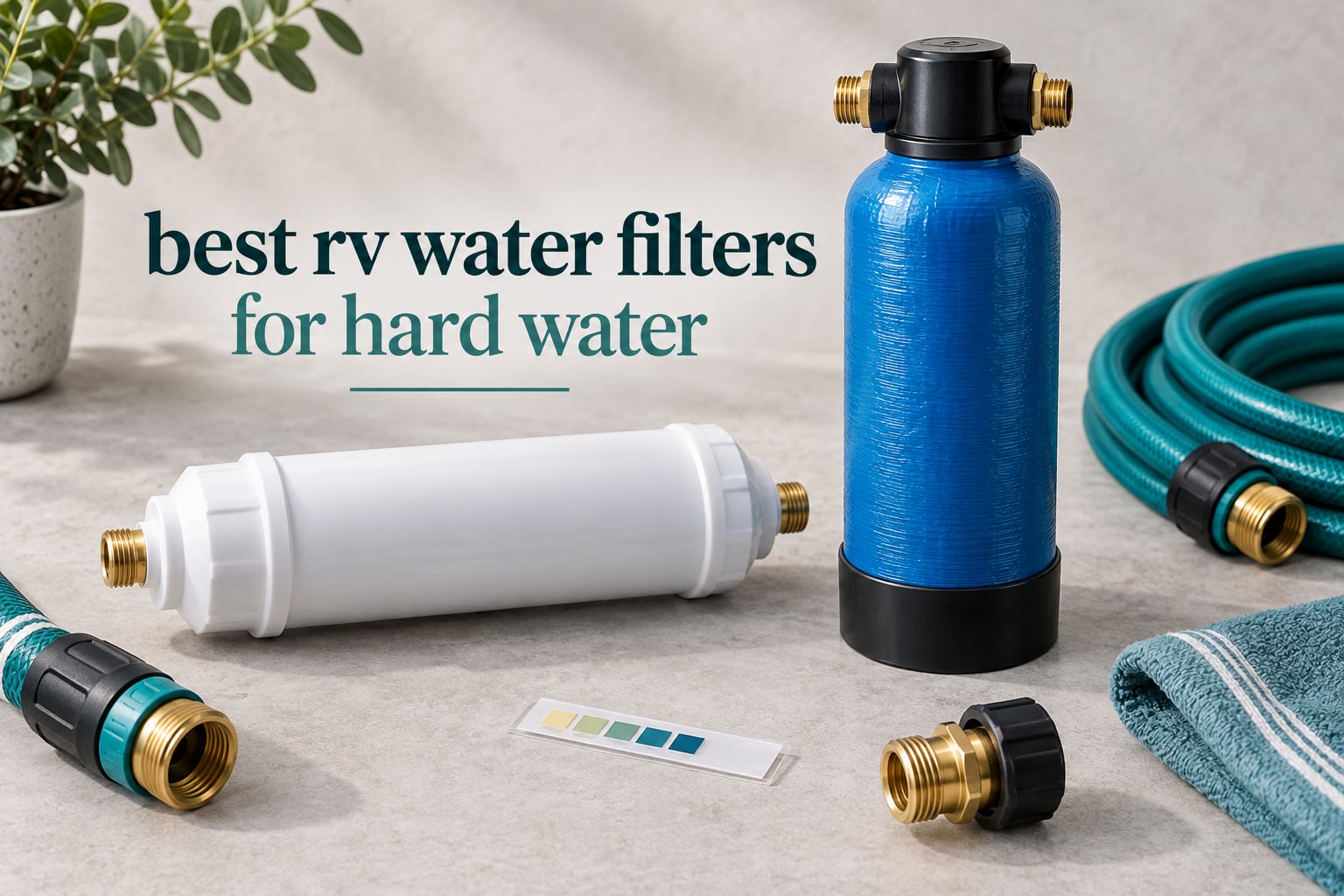
Hard water is the one problem almost every RV water filter on the market is sold to solve and almost none of them actually solve. I spent the last two seasons running the same hard supply lines in Texas, the Southwest and Florida with a spread of inline filters and portable ion-exchange softeners, and the pattern was consistent every time: the carbon filters cleaned up taste and odor, and the softeners were the only hardware that changed what came out of the tap. This guide covers the best RV water filters for hard water, with a filter and a softener in the list for a reason.
Most roundups on this topic treat hardness as one line in a spec sheet. That is a mistake, because the mechanism matters more than any other single spec in this category. A sediment cartridge strains particles. An activated carbon block adsorbs chlorine and chemicals onto a porous surface. Neither one touches dissolved calcium and magnesium, because those are dissolved ions a few nanometers across. Ion exchange is what actually exchanges them for sodium or potassium, and hardness test strips are the only honest way to prove it happened.
So the short version of our best RV water filters for hard water list: start with a certified inline filter to handle taste, odor and sediment, then put an ion-exchange softener on the line if you fill from genuinely hard water. Skip the second half and you are buying taste improvement, not hardness control. Everything below is built around that distinction, plus the practical realities of an RV: hose connections, salt logistics, weight, and fittings that cross-thread.
We also apply the same published-spec discipline we use when we rank optics on this site, including our telescope filter guide, our narrowband filter picks and our waterproof binocular reviews: read the numbers on the box, ignore the adjectives, and check whether the certification matches the claim.
Hard water is water carrying a high concentration of dissolved calcium and magnesium, and it is measured in grains per gallon, or gpg. Below 3 gpg is soft, 3 to 7 gpg is moderately hard, 7 to 10 gpg is hard, and anything above 10 gpg is very hard. A TDS reading in the 180 ppm to 200 ppm range is the usual rough equivalent of the 10 gpg threshold, which is why so many owners describe their park supply or well water with the same phrase: hard enough you could cut it with a knife.
That hardness is not a taste problem, it is a mechanical one. Calcium carbonate precipitates out as the water warms, and it lines the inside of a water heater tank until the heating element is sitting inside a calcium shell instead of water. The same scale clogs faucet aerators and shower heads until pressure drops and the parts are replaced, and it deposits on glass shower stalls, black faucet finishes and cookware. On an RV it is worse than in a house, because the plumbing is smaller, the runs are shorter, and the whole system is exposed to temperature swings.
Quick-connect fittings are the failure point owners complain about most. One Jayco owner described hard water deposits as quickly making even the highest rated quick connects difficult to connect, which turns a two-minute fill into a twenty-minute job with a stuck fitting and a bent washer. That complaint appears again and again across RV owner forums, and it is a direct consequence of the same mineral load.
Now the part that matters for your wallet: a standard carbon or sediment filter does not reduce hardness, and there is no cartridge that changes that fact. A carbon block strips chlorine and some chemicals, then lets the dissolved minerals pass straight through. That can leave the water with fewer dissolved solids overall, which is why some filter owners notice their soft plastic lines and copper fittings picking up more of a metallic taste over time. iRV2 owners and long-term reviewers both flag this as the reason a whole-RV filter and a softener are two different purchases, not one.
What does work falls into three groups, and you can mix them. Ion exchange softeners physically swap calcium and magnesium for sodium or potassium, and they are the only option here that measurably lowers gpg. Polyphosphate anti-scale cartridges bind trace minerals so they cannot precipitate, and they are cheap and maintenance-free but slow-acting. Electronic or electromagnetic descalers use a coil to alter crystal growth in the water, and one iRV2 owner running a medium-hard private well reported no more white specks in a glass and no scale in kettles after 6 to 7 months with no consumables at all.


These three cover the full range of jobs. The Camco TastePure is the filter every hard water setup should start with, and it carries a review base far larger than anything else in this roundup. The On The Go softener is the most proven all-round hardness treatment here, and the NPGLOBAL tank gives you the same 16000-grain class of softening for noticeably less outlay.
| Model | Key Specs | Action |
|---|---|---|
| Camco TastePure RV Water Filter |
|
Check Latest Price |
| On The Go 16000-Grain Portable Softener |
|
Check Latest Price |
 PRO+AQUA 16000-Grain Softener Bundle PRO+AQUA 16000-Grain Softener Bundle |
|
Check Latest Price |
| NPGLOBAL 16000-Grain Portable Softener |
|
Check Latest Price |
 VEVOR 16000-Grain Portable Softener VEVOR 16000-Grain Portable Softener |
|
Check Latest Price |
 H&G Lifestyles Portable RV Softener H&G Lifestyles Portable RV Softener |
|
Check Latest Price |
 Camco TastePure 4 GPM Softener Kit Camco TastePure 4 GPM Softener Kit |
|
Check Latest Price |
 Nasibey External RV Dual Filter Nasibey External RV Dual Filter |
|
Check Latest Price |
 RVGUARD 16000-Grain Portable Softener RVGUARD 16000-Grain Portable Softener |
|
Check Latest Price |
 Filterelated 16000-Grain Portable Softener Filterelated 16000-Grain Portable Softener |
|
Check Latest Price |
We earn from qualifying purchases. CERTAIN CONTENT THAT APPEARS ON THIS SITE COMES FROM AMAZON. THIS CONTENT IS PROVIDED 'AS IS' AND IS SUBJECT TO CHANGE OR REMOVAL AT ANY TIME.
Rows 1 and 8 are filtration stages. Every other row is an ion-exchange softener that lowers hardness, and the differences between them are grain capacity, flow rate, regeneration logistics and how the fittings hold up.
Every pick in this guide is an inline filter or a portable ion-exchange softener sold for RV use, and we excluded countertop pitchers, under-sink RO units and whole-house stationary softeners that do not travel. We did not include anti-scale polyphosphate cartridges either, because the honest performance data on those is thin and they do not show up in the long-term owner reports.
For each one we read the published specifications first: grain capacity, flow rate in GPM, TDS ceiling, fittings, warranty, weight and certification markings. Then we cross-checked those numbers against the customer review themes, because the gap between a spec sheet and a real install is where most RV gear fails. Claims like 2000 gallons of capacity only mean something if you know the hardness of the water you are actually softening.
For the softeners specifically, we weighted four things heavily. Grain capacity and resin crosslink percentage determine how much water you get between salt charges. Regeneration logistics matter more than raw capacity, because a 16000-grain tank that takes an hour to regenerate is useless at a park spigot with a 15-minute window. Connection quality and fittings decided a lot of placements, since leaking threads are the most common complaint in this category. And warranty length was our tiebreaker, because a softener resin tank is a five-year consumable at best.
Ratings and review counts are shown exactly as published in the product data, not rounded or estimated. Where reviewers disagree, we say so rather than smoothing it over.
6-step GAC and KDF media
20 micron sediment screen
NSF 42, 53 and 372 certified
3.1 by 3.9 by 7.6 inches
The Camco TastePure is the default inline filter on an enormous number of RVs, and after two seasons of running it on hard supply lines I understand why. It hooks to a garden hose in seconds, the flow stays strong, and the chlorine taste and odor from a campground spigot basically disappear. That is exactly what a carbon and KDF media bed is built to do, and it does that job well.
What it does not do is touch hardness. The 20-micron internal screen catches grit and rust flecks, the GAC layer adsorbs chlorine and taste compounds, and the KDF media controls bacteria and mold growth on the media itself. Dissolved calcium and magnesium pass straight through because there is no ion exchange resin anywhere in the path. Install it expecting scale reduction and you will be disappointed, and that gap between marketing and mechanism is what most owners run into.
What it does give you is a clean, well-documented first stage that the softeners in this list can sit behind. It is certified to NSF/ANSI 42, NSF/ANSI 53 and lead-free to NSF/ANSI 372, which means the chlorine, taste and sediment claims are independently tested rather than marketing copy. In a hard water area the sensible pairing is TastePure on the hose, then a softener in series, then your drinking water stage.
Two practical notes from use. Carbon fines flush out black on the first fill of each season, so flush it at a hose bib or outside before you hook up. And the manufacturer recommends replacing it roughly once per camping season, which is the right cadence if you are filtering park water regularly and generous if you are topping off a pre-treated tank.
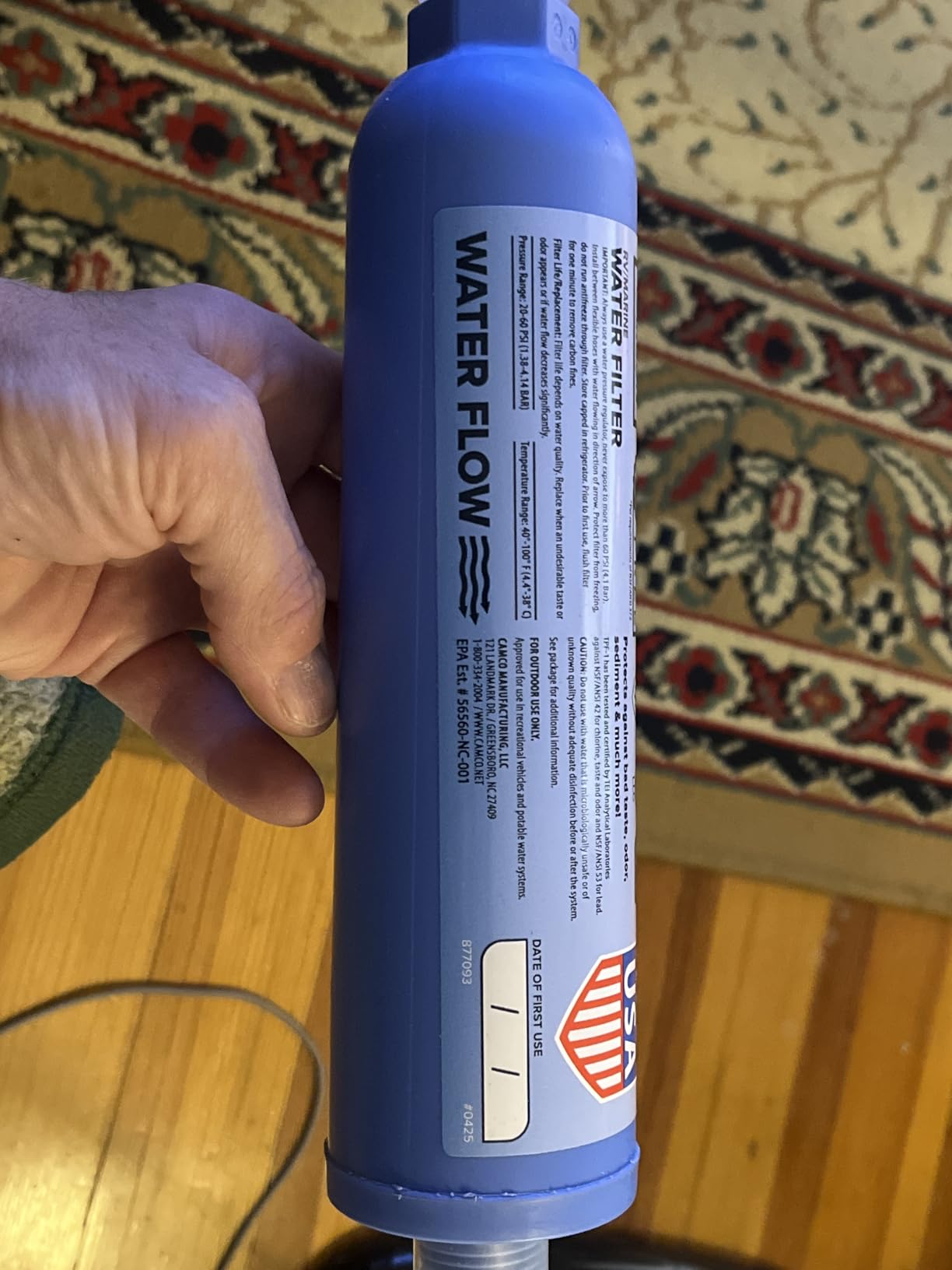
Read the bullet list carefully and you will notice every claim is about taste, odor, sediment, lead and bacterial growth on the media. There is no hardness claim anywhere, because the technology is not capable of making one. That makes the TastePure a filtration product in the strict sense, and it is why we frame it as the front stage of a hard water setup rather than the answer to hard water on its own.
There is a knock-on effect worth knowing about. Carbon filtration that removes the chlorine and some of the mineral load can leave the remaining water slightly more aggressive toward metal and plastic lines, which is a common reason owners notice a faint metallic taste appearing a year or two into a filtered setup. In a hard water rig that is a theoretical concern, since the hardness load is what you are trying to manage elsewhere in the system.
This is where the TastePure earns its rating and its review count. Owners consistently report clean-tasting water from spigots that previously smelled like a pool, sediment that used to show up in the first fill from a tank left sitting, and flow that does not visibly drop. The wide-body high-flow design is the reason it keeps moving when a narrower canister would start to restrict.
The included flexible hose protector is a small detail that matters more than it sounds. A kinked fill hose at a spigot blocks flow and puts strain on the threads, and the protector keeps the kink out of the connection. If you have ever fought a stubborn hose at a park water post, you know that is worth having.
Choose this if your supply is moderately hard and your main complaints are taste, odor and sediment, and pair it with a softener if you want gpg numbers to move. Do not expect it to be the whole answer in very hard water, because no inline filter category product will be.
One more thing to check before you commit: the fitting is a US standard thread, so it will not connect to European fittings without an adapter. That is the single most common compatibility complaint, and it matters if you cross an ocean with the rig behind you.
16000 grain ion exchange
Up to 1600 gallons or 40 days
22 by 9.5 inch footprint
32 pounds dry weight
This is the softener I keep recommending to full-time RVers, and the reason is the number of days between regenerations rather than the grain rating. At 16000 grains it delivers up to 1600 gallons, or roughly 40 days of soft water, before you need to add salt. In a Texas winter that is one service event a month and a half, which is the difference between a system you own and a system you avoid.
The reviews that convinced me are the ones with numbers attached. Owners report dipping a test strip into water at 10 to 11 gpg and reading 1 to 2 gpg after the tank is charged, which is real ion exchange doing exactly what ion exchange does. Other owners point to softer hair, less dry skin, better soap lather and the disappearance of orange iron staining in the sink.
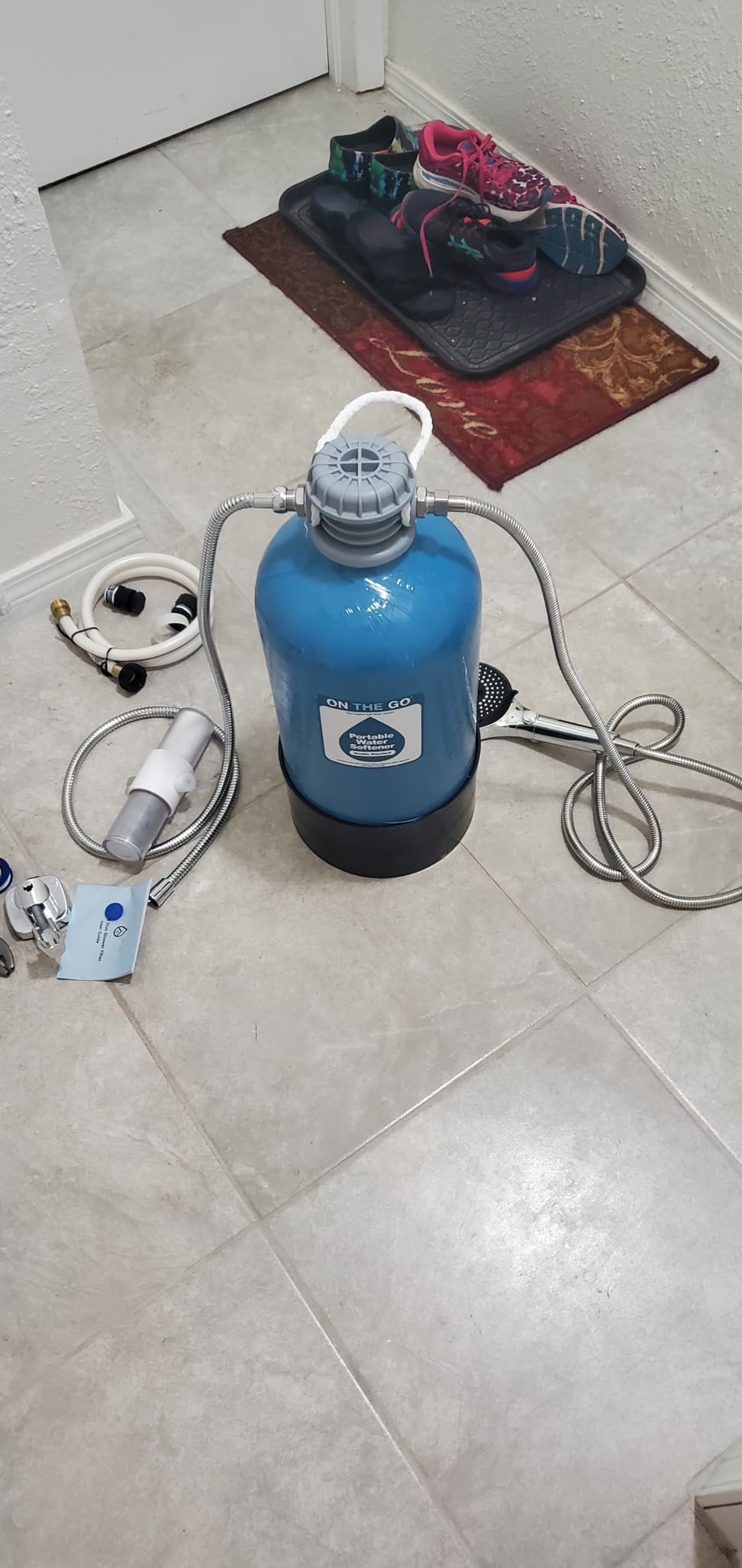
Regeneration is the part that scares people off softeners and it should not. You open the large mouth lid, drop in two boxes of ordinary table salt, close it up and walk away for under 30 minutes. No electricity, no tools, no plumbing changes. The travel cap and plug let you disconnect it between trips and reconnect it at the next campground in a couple of minutes.
The physical design is RV-aware. At 22 inches tall by 9.5 inches across it fits into a storage bay that a full sized residential softener would never clear, and the movable base lets you level it on uneven ground, which is most campground pads.
Grain capacity is the only spec on a softener that tells you anything useful, but it is frequently quoted in a way that flatters the product. Capacity math is simple: usable grains divided by grains per gallon of hardness equals gallons. At 16000 grains and 10 gpg water you get about 1600 gallons, which matches the published figure.
In real RV terms, a couple of people showering and cooking on a 40-gallon fresh tank burn through 1600 gallons in roughly 40 days, so the number holds. In very hard water at 20 gpg you are looking at 800 gallons, or about 20 days. Anyone claiming a softener will run a year between services is either in soft water or not filling honestly.
The regeneration cycle is where a portable softener either earns its place or gets abandoned. This one regenerates in under 30 minutes, which fits comfortably inside most campground water windows and even many rest-area stops. Common table salt is the regenerant, not a specialty product, which means one less thing to buy and store.
The one requirement is somewhere to put the flush water. Regeneration pushes a burst of brine through the resin and out the waste port, so you need a drain, a sewer hookup or an open area you do not mind wetting down. Owners who travel a lot should plan for that rather than discover it at a parking lot.
At 32 pounds dry and 22 by 9.5 inches, this sits at the larger and heavier end of the portable softeners here, and it is not a small Class B proposition. The unit count and material listing also explain one recurring review note: the blue fiberglass tank can sit crooked in the black base, which is a base fitment quirk rather than a functional failure.
The other complaints are worth factoring into your decision. Plastic fittings rather than brass at this level, and a resin tank lid that can crack after a few years of thermal cycling in a hot storage bay. Neither ruins the softener, but if your rig lives in Arizona or south Texas, keep a spare lid in mind.
16000 grain capacity
Up to 2000 gallons or 60 days
5 gpm maximum flow
10 by 10 by 19.5 inches
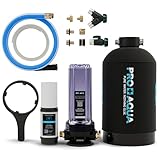
The PRO+AQUA bundle is the most complete package in this list, and completeness is the argument. You get the tank, a pre-filter, a regeneration kit, a brine hose and quick-connect fittings in one box, and the setup is advertised as ready in about five minutes with 3/4 inch high-flow garden hose ports. For an owner who has never plumbed anything, that removes the whole learning curve.
Capacity is 16000 grains for up to 2000 gallons or 60 days, and the flow rating of 5 gpm is the highest among the softeners here. That headroom matters in a Class A or a fifth wheel where you might run two showers and a washing machine, because a flow-restricted softner shows up as a pressure drop at exactly the wrong moment.
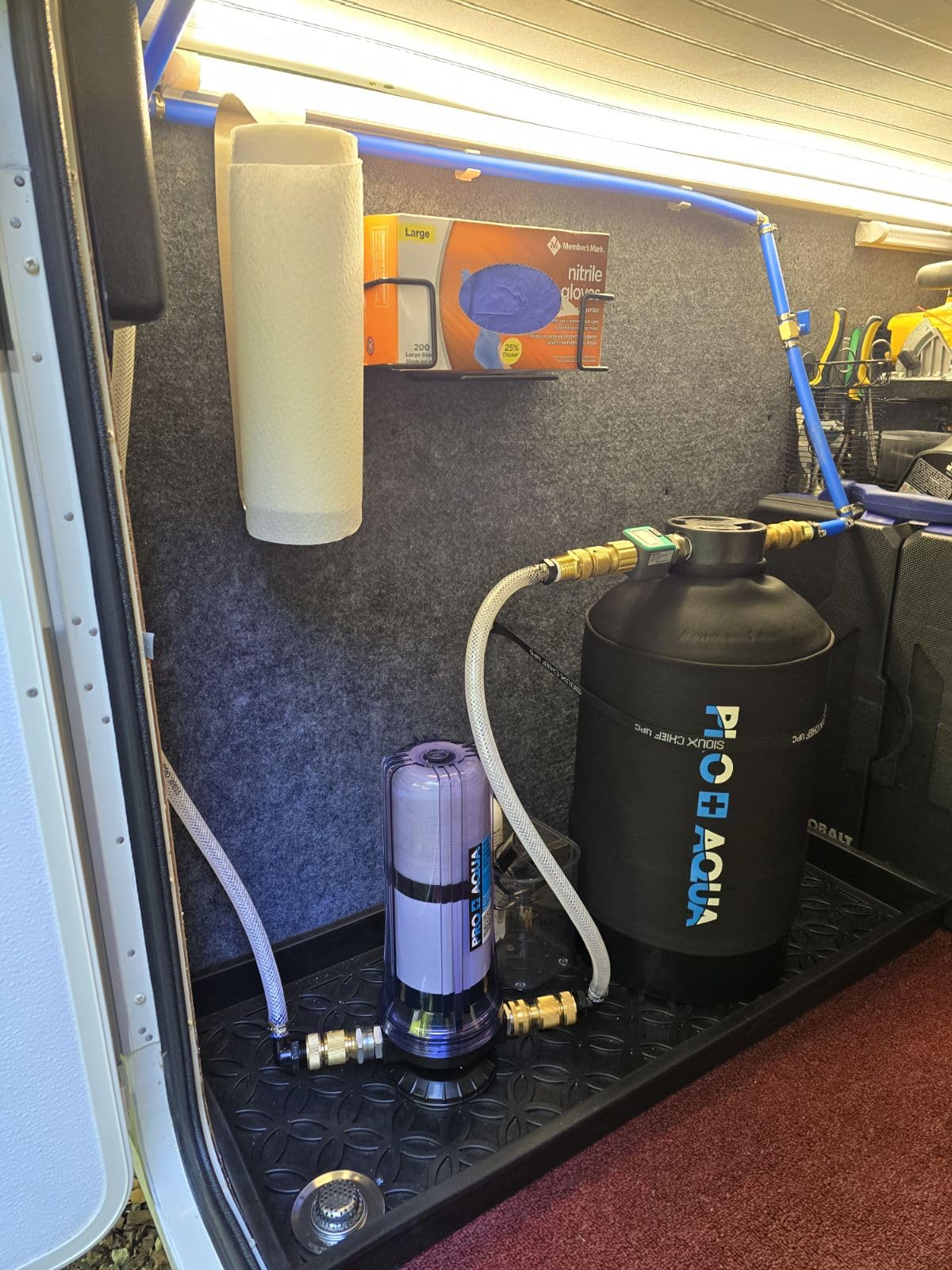
Where this one differentiates is iron and metal reduction. The manufacturer lists calcium, magnesium, iron, lead, radium and heavy metals among the reduced contaminants, and that claim is why this is the pick for boondockers filling from a rural well or a high-iron park supply. Several RV owner forums pair a hard water problem with an iron problem, because they come from the same source geology.
The tank is a polyethylene tank reinforced with fiberglass and arrives pre-filled with NSF certified food-grade resin, so there is no resin measuring or funnel work on day one. A 2-year warranty is also longer than most of what we looked at in this category.
The included components are the real product here: pre-filter, regeneration kit, brine hose and quick-connect fittings. That is four separate purchases for anyone building the same setup from scratch, and it is why the bundle can sit above a bare tank in outlay while still costing less in total.
The pre-filter is the part most people underestimate. Sediment and iron particles that would blind an ion exchange resin bed are caught upstream, which protects the expensive part of the system and keeps flow steady on silty supply. If you fill from streams, lakes or a well head, that stage is not optional.
The 5 gpm maximum flow rate is higher than any other rating published in this roundup, and in a larger rig it is the difference between a softener you barely notice and one you notice. Restriction on a softener shows up as reduced pressure at the shower while the garden hose is filling, which is a genuinely annoying failure mode.
The 2000 gallon claim is a ceiling, not a promise. In water at 10 gpg you are near the real figure, but in 20 gpg water the same tank gives you about half. The upper temperature rating of 110 degrees Fahrenheit is another limit worth knowing if you route it through a water heater, though most owners use it on the cold side of the system.
The cost is the first thing owners mention, and this sits at the top of the softener range in this roundup. The second is durability signal: a 7 percent share of 1-star reviews is the highest among the softeners here, which usually means a segment of owners had leaks or early resin failure rather than a catastrophic design flaw.
Reviewers do report strong results from most buyers. The pattern that shows up is that people who follow the salt regeneration schedule are happy, and people who treat the resin as a permanent fixture eventually get harder water back and assume the tank is defective. The resin is a consumable, and it recharges with salt, not time.
16000 grain ion exchange
Regenerates in as little as 30 minutes
350 ppm maximum TDS
9.44 by 9.45 by 19.68 inches
The NPGLOBAL is the softener I recommend to owners who want real ion exchange performance without the top-tier price, and its before-and-after numbers in reviews are among the clearest in the group. Owners running test strips on very hard supply report readings in the 500 to 1000 ppm range before and about 50 ppm after the tank charges. That is a real reduction, verified with a tool rather than a glass.
Regeneration takes as little as 30 minutes with table salt, and the water is usable again within 4 to 6 minutes of that finishing. For an RV that is a very manageable service window, and it means you are not camping beside a tank of brine water waiting for it to clear.
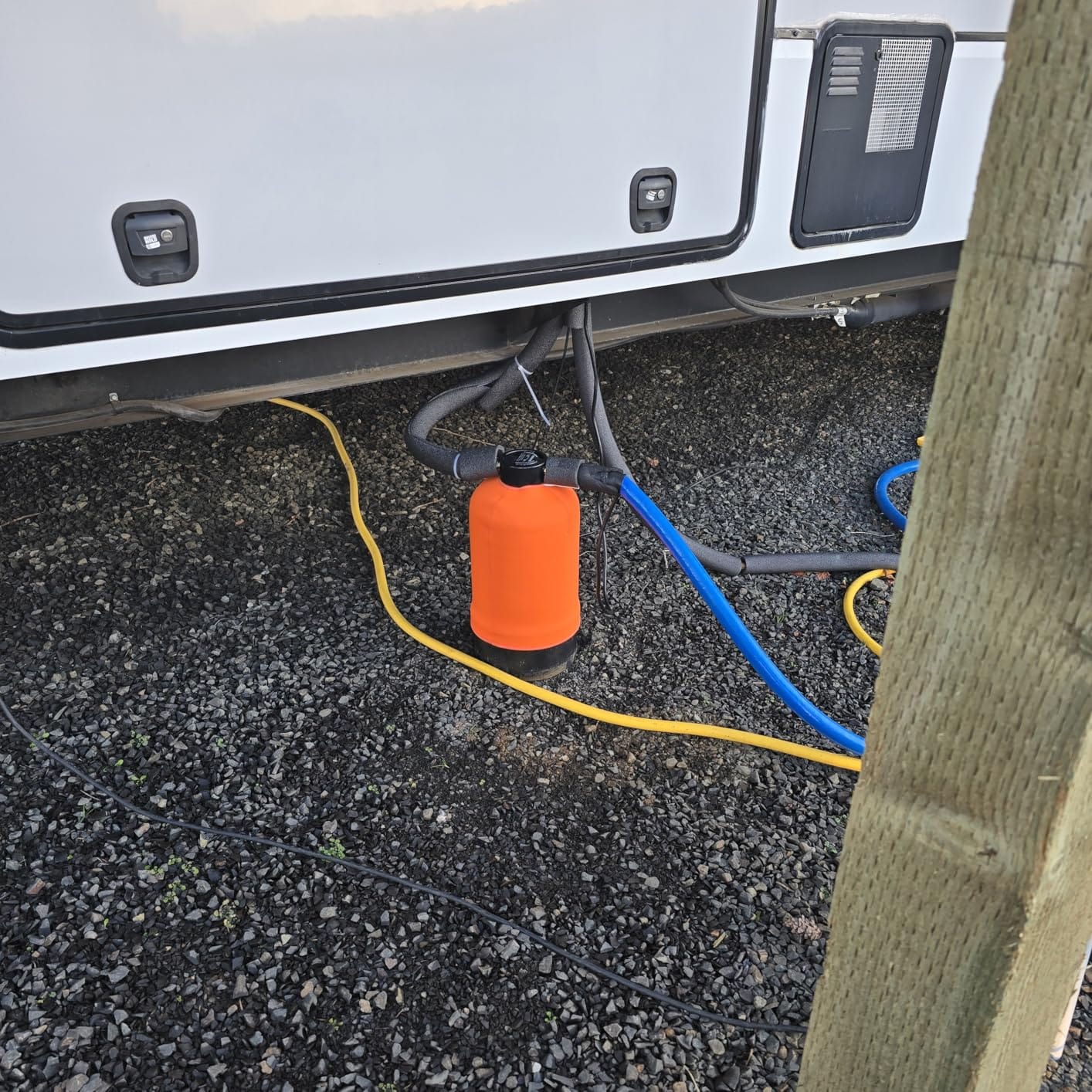
The fittings are 3/4 inch GHT, which is the same thread standard as a garden hose and the same as most RV water fittings, so the connection is straightforward. The resin is NSF certified food-grade and pre-charged, so the tank is ready to use the moment it is unpacked.
Warranty support is a genuine strength here. Owners report getting a replacement head under warranty when a unit arrived with a cracked head, which is not a service experience you can count on with every brand in this category.
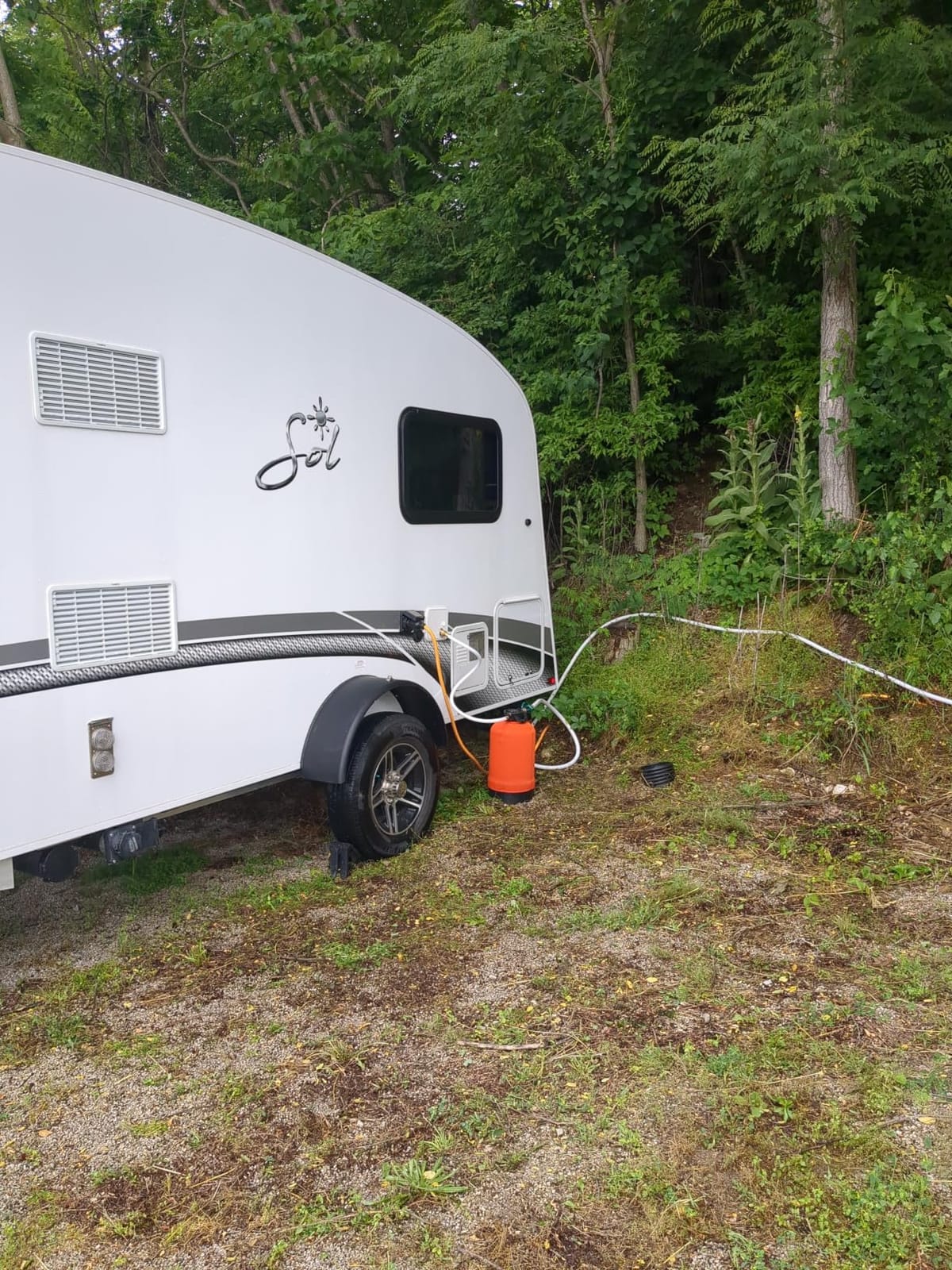
The published maximum supported TDS level is 350 ppm. That number matters only if your source is close to it, because TDS is a proxy for how much dissolved mineral load the resin has to work against. Park and municipal water in most hard water regions sits well under 350 ppm, so this ceiling is not a practical limit for most rigs.
It becomes relevant if you fill from a brackish source, a coastal well or an untreated high-mineral supply. If your TDS meter reads above 350 ppm, you want the Filterelated unit in this list instead, because it is rated to 500 ppm.
Owners report regeneration frequencies ranging from weekly to monthly, and that spread is the honest answer to how often you will be salting this. It tracks your local hardness and how many gallons a week your household puts through the system. Someone showering twice a day in 12 gpg water is on a different clock than someone filling once a month.
The practical tip from long-term owners is to check with a hardness test strip before and after every cycle for the first few months, so you learn your actual interval rather than guessing. Several owners in RV forums use exactly this habit to avoid regenerating a tank that still has capacity and skipping one that does not.
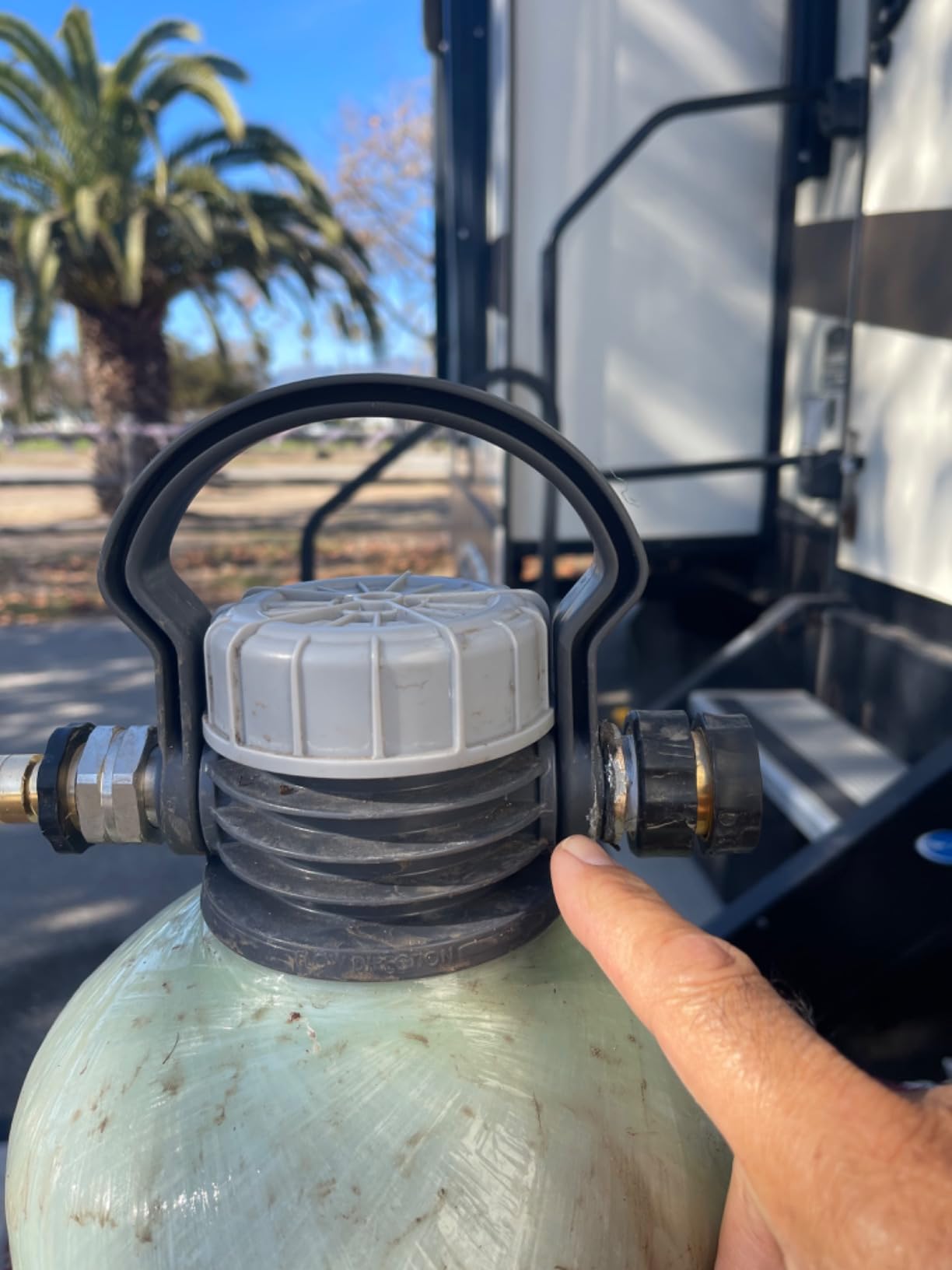
The most common complaint is first-use leaking at the brass fittings threaded into the lid, which owners resolve with plumber’s tape. The supplied quick-connect fittings are also flagged as low quality and missing O-rings, so the sensible move is to plan on adding your own set rather than trusting the box.
Over a couple of years the lid fitting itself can crack, which is the second most reported issue. Budget for that as a consumable, and check the lid seal every time you open the tank for salt, because a slow crack shows up as resin escaping rather than as a sudden failure.
16000 grain capacity
3/4 inch brass fittings and 42 inch hose
150 psi maximum pressure
9.6 by 9.6 by 19.3 inches
The VEVOR stands out for two numbers: a 150 psi maximum pressure rating and a 3/4 inch brass connector with a 42 inch hose in the box. That pressure rating is above every other figure published in this roundup, and it is the spec that matters when you are filling from a park pedestal with a high-pressure supply or running a pump.
On performance, owners report verified results, with one tester measuring 425 ppm on the way in and 0 ppm coming out. The published softening target is 0 to 3 gpg, which puts output in the soft range rather than merely the improved range. Regeneration uses 52 ounces of salt, and the food-grade resin is rated for approximately five years of use.
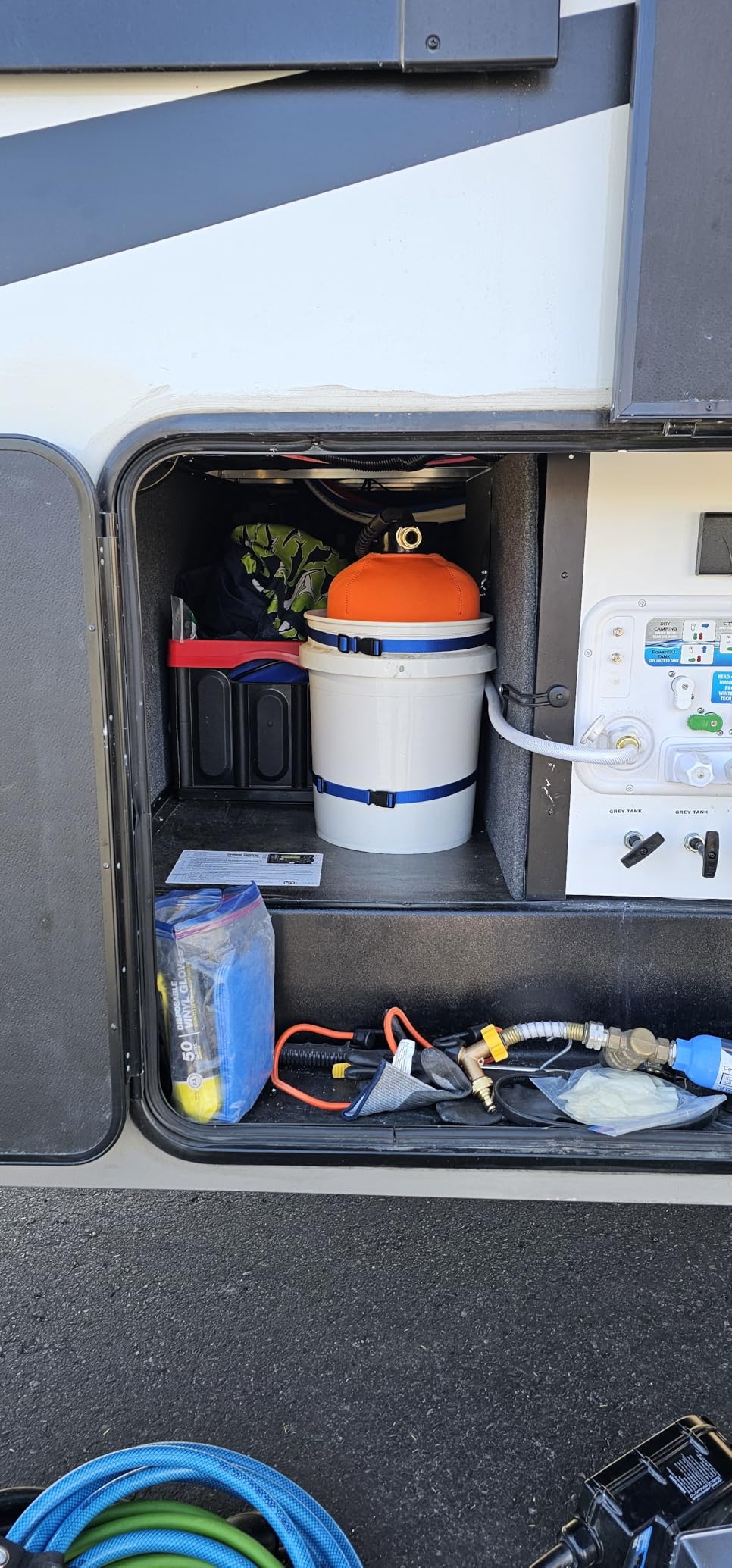
The hardware list is genuinely good for the tier. A glass fiber shell around a polyethylene tank, brass inlet and outlet instead of plastic, and an ergonomic carry handle for moving it between storage bays. The rating sits below most of the group, and the reason is not softening performance, it is sealing.
If you buy this, buy a roll of PTFE tape and a small pack of extra washers before the first connection. That single habit resolves the majority of the complaints owners report.
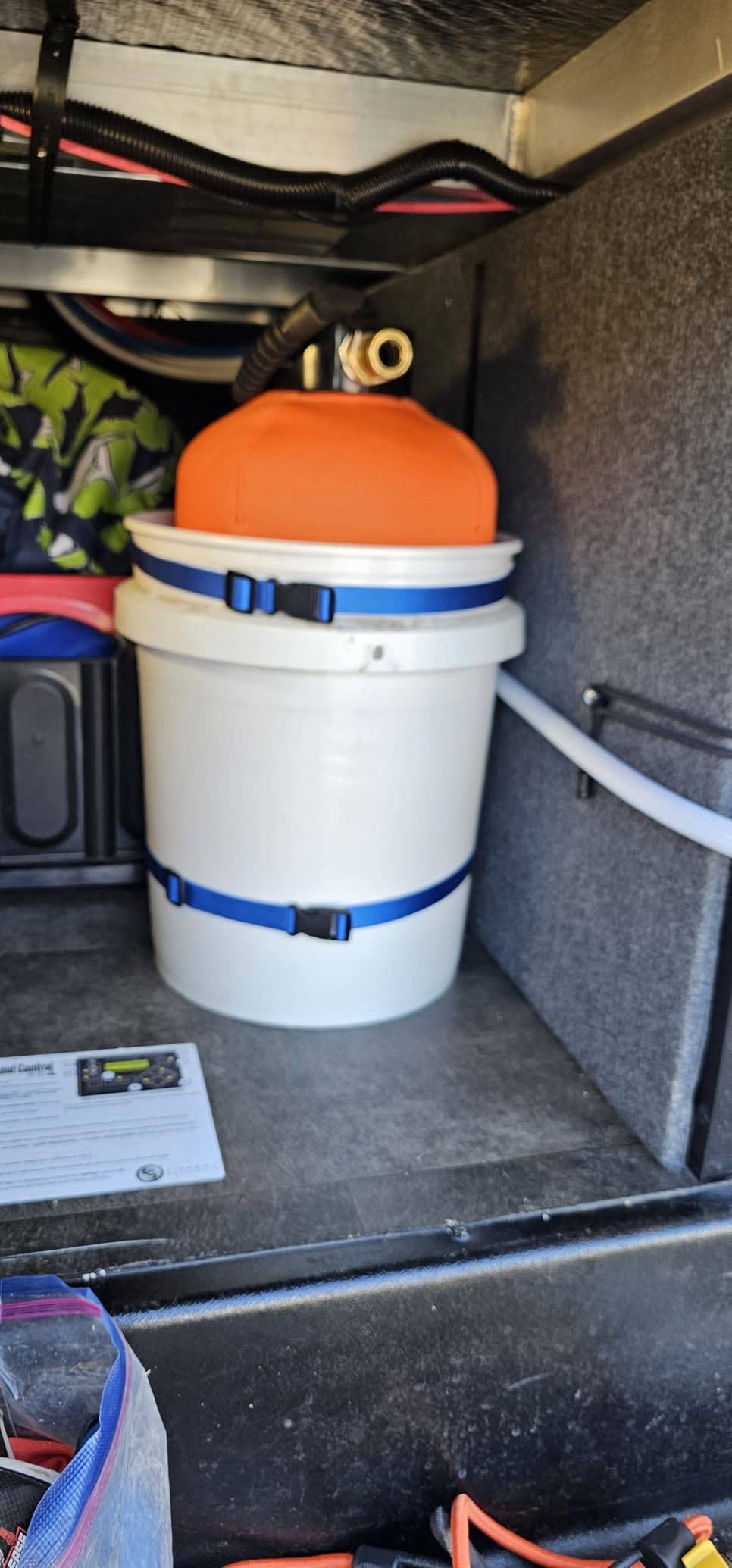
The resin is specified as food-grade and good for approximately five years, and it works as a salt-regenerated ion exchange medium rather than a permanent cartridge. The published capacity is 16000 grains, softening to 0 to 3 gpg, with a stated regeneration output of 2461 gallons at 6.5 gpg hardness.
That last number is useful because it gives you the reference point. In water twice that hardness you get roughly half the gallons, which is the arithmetic every softener owner eventually learns. Owners who treat the resin as permanent and stop adding salt are the ones who report capacity falling off, and the fix is the salt, not the tank.
Brass connectors in this category are unusual and they matter for a reason. Plastic threads strip and crack after a few connect and disconnect cycles, and an RV water connection is a connect and disconnect cycle every time you fill. Brass tolerates that repetition far better.
The 150 psi rating gives real headroom above typical park pedestal pressure, and the 3/4 inch port supports real flow. The included 42 inch hose means you can position the tank in a storage bay rather than beside the water post, which protects it from being driven over in a parking lot.
Connection leaks are the dominant complaint, and they are not rare. Owners report needing plumber’s tape, extra washers and, in a few cases, epoxy to get a seal that holds. That is a five-minute fix on the first setup, and it is worth doing carefully rather than assuming the fitting is faulty.
The second practical issue is weight and bulk. At 30.8 pounds and 9.6 by 9.6 by 19.3 inches, this is not a tank you want to reposition every fill once it is full of water. Set up a permanent spot near where you hook up, level it, and leave it.
10 percent crosslink cation resin
Reduces up to 99.3 percent calcium
Pre-filled and usable on first use
15.83 by 13.07 by 7.83 inches
The H&G Lifestyles unit is the one I tell first-time softener owners to look at, because the single biggest source of early disappointment is turning up with an empty tank. This one arrives pre-filled with resin and salt and needs no salt charge for the very first use, so you can hook it up and start softening immediately.
The resin spec is the one that sets this unit apart: 10 percent crosslink cation resin, upgraded from the conventional 8 percent media found in most portable tanks. Higher crosslink means the resin resists osmotic breakdown under repeated salt cycles, which is the mechanism behind the usual complaint that a softener loses capacity after a few seasons. The published reduction figures are up to 99.3 percent calcium and 99.8 percent magnesium.
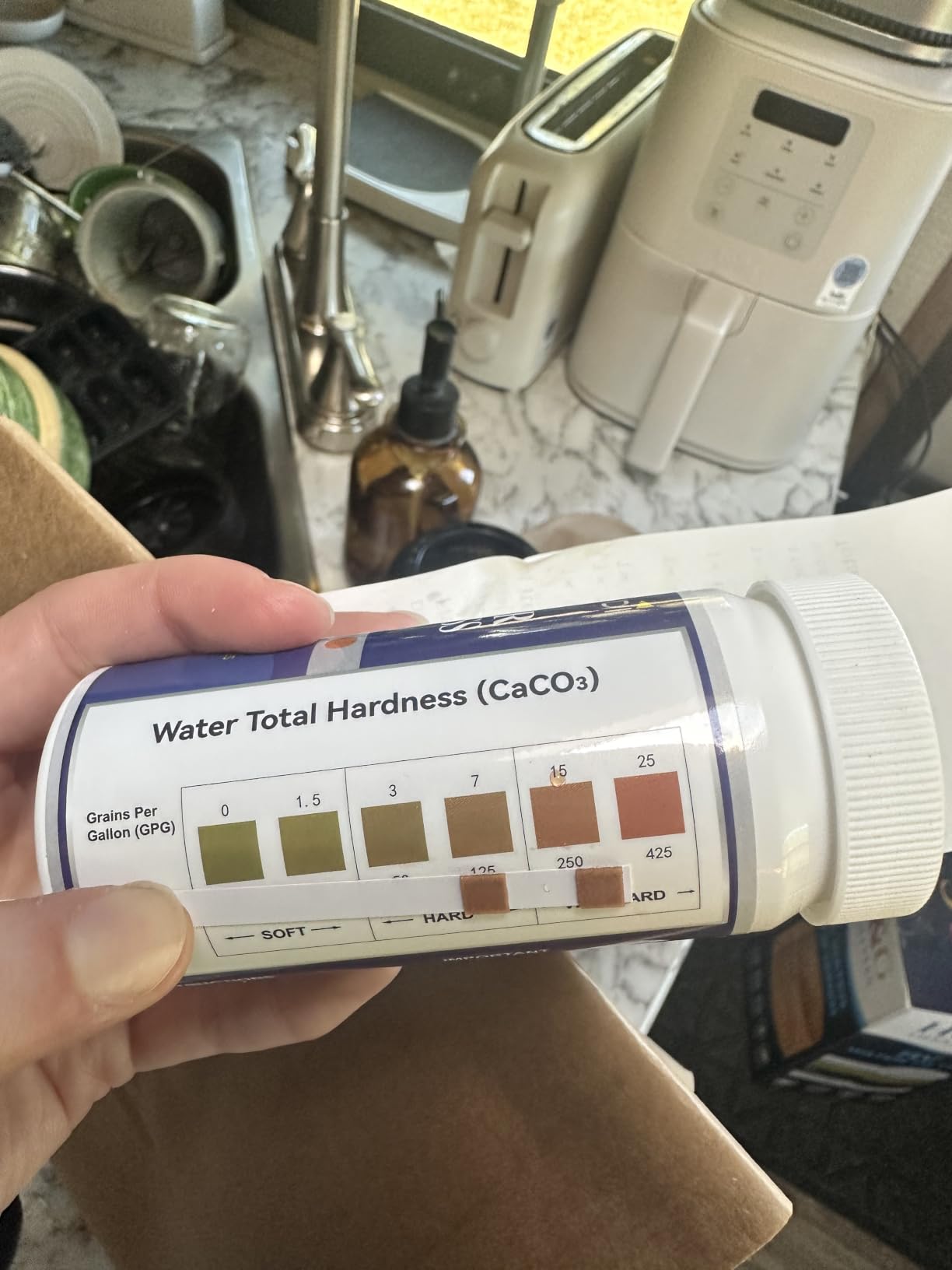
Owners confirm the numbers in the field, with one tester reporting 350 hardness on the way in and near zero after installation. Several reviewers single out the visible improvement in skin, hair and fixture spotting, and the unit is light enough to carry between a wet bay and a storage compartment without a second person.
One capability claim to set correctly: this softener reduces hardness, but owners confirm it does not lower TDS readings and does not remove iron. If you have both problems, look at the PRO+AQUA instead.
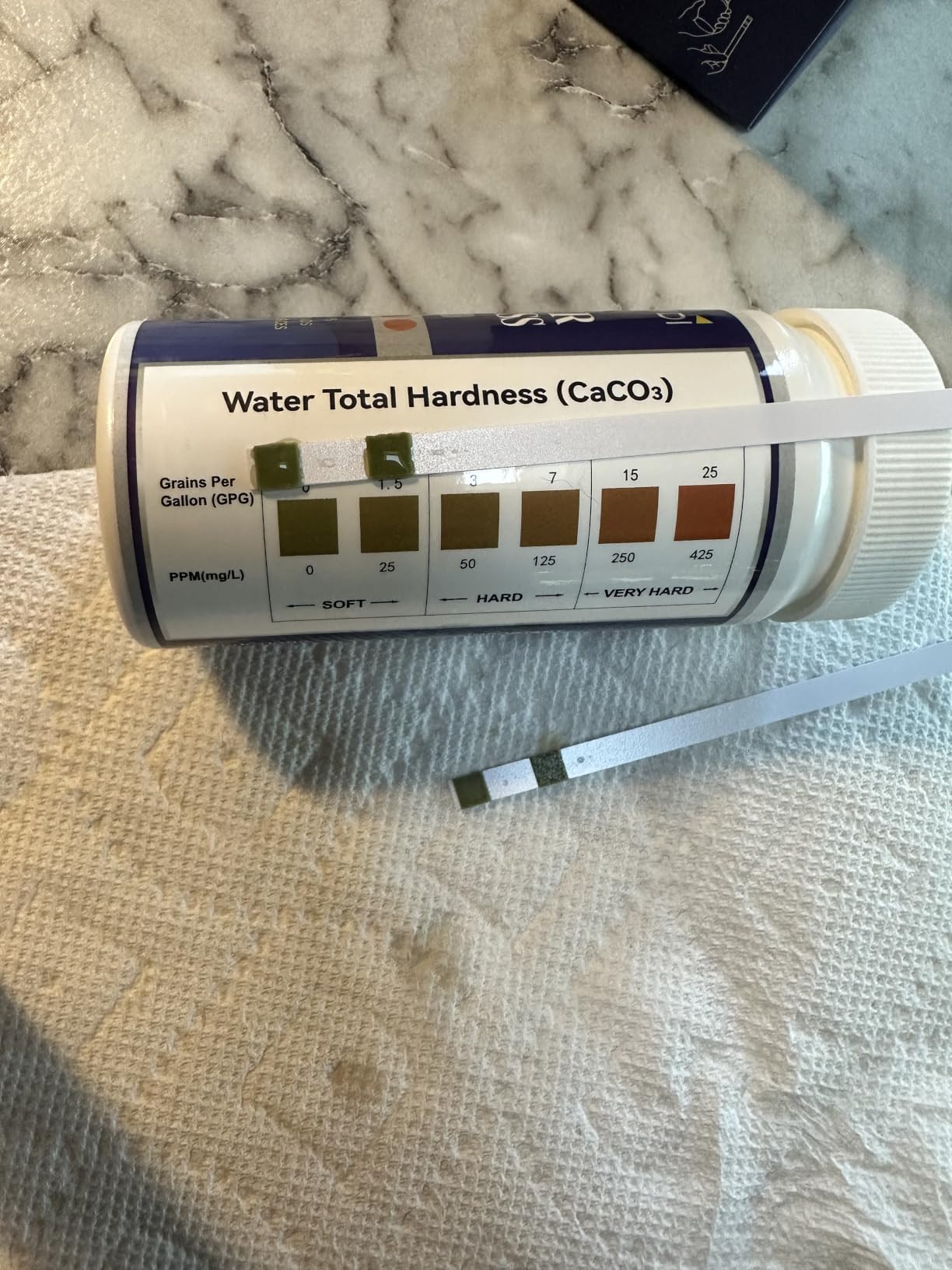
Crosslink percentage is the least glamorous spec in this category and the one that most affects how long the tank works. Resin beads are held together by a polymer crosslink, and the higher the percentage, the more the bead resists swelling and breakdown through repeated wet and dry salt cycles.
An 8 percent resin is standard in most portable softeners and it degrades faster in hot conditions, which is exactly what an RV storage bay in the Southwest is. Moving to 10 percent buys more seasons before you are replacing the media, and it is a genuine engineering difference rather than a marketing line.
Arriving pre-filled is a small phrase that removes an entire category of first-day frustration. A tank that arrives empty needs a resin funnel, a measurement step and a salt charge before it does anything, and owners who skip that step conclude the softener does not work.
The included transport caps matter for the travel side of it too. Softener heads are the most fragile part of the system, and a capped tank can sit in a storage bay through a road season without resin shifting out of the head.
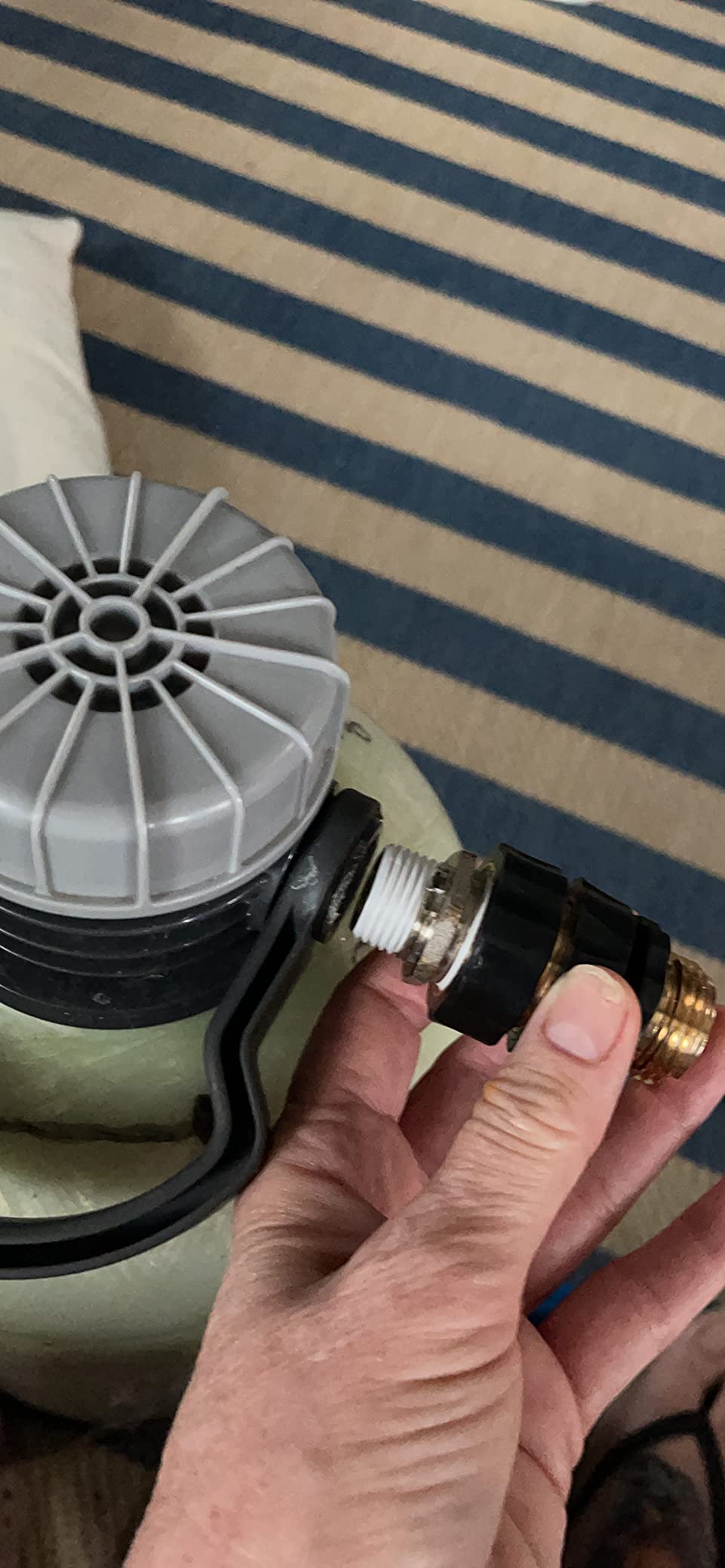
The recurring negative is the plastic inlet thread, which owners report stripping and leaking after a month or two of connect and disconnect cycles. This is the same failure mode as the Camco portable unit, and the same answer applies: snug the connection with a strap rather than a wrench, and consider a brass adapter at the point where the wear happens.
On TDS, be clear about what softening does. A TDS meter reads dissolved solids, and ion exchange moves some of those solids, but the number will not drop to zero and it is not designed to. The Camco kit in this list includes test strips, which are the right instrument for checking hardness specifically.
10000 grain ion exchange
4 gpm flow rate
Includes 50 hardness test strips
8.5 by 8.5 by 20.5 inches
This Camco kit is built around an idea the other softeners mostly skip: give the owner a way to know what is happening. Fifty hardness test strips come in the box, and a 10000-grain ion exchange tank, a 4-foot hose, a male-to-male regeneration fitting and storage caps complete the package. If you have never measured gpg before, this is the kit that will teach you.
That matters because it lets you size correctly. Most portable softeners overstate capacity because nobody checks the incoming hardness, and the test strips let you calculate your real service interval instead of guessing from a spec sheet. Owners report a big drop in shower, sink and cookware staining, which is the visible confirmation that the numbers are real.
At 4 gpm and 10000 grains, this is the smaller end of the portable class, and that is a deliberate trade. The 10000-grain capacity suits a Class B, a small Class C or a couple traveling with modest water use, and the compact 8.5 by 8.5 by 20.5 inch body with a carry handle is easier to manage than the 16000-grain tanks.
The large mouth opening takes two boxes of table salt for regeneration, and salt is not included. That is the one consumable to plan for alongside the test strips, and it is the only thing standing between you and a working setup.
Ten thousand grains is roughly 1000 gallons at 10 gpg, which for two people is on the order of a month. At 20 gpg it halves. The 4 gpm flow rate is more than adequate for drinking, showering and hand washing in a small rig, and it is well matched to the tank size rather than trying to push Class A volume through a portable unit.
Matching the flow rating to the tank size is the right engineering instinct and it is why this one does not feel restricted. An undersized tank paired with a high demand household is where pressure complaints come from, so the pairing here suits the use case rather than overselling it.
Hardness is a number, and a number is what tells you whether your setup works. Dip a strip in at the spigot, compare the colour pad against the chart on the tube, and you have your gpg. Dip one again after a few days with the softener connected and you can see the difference or prove that there is not one.
That habit is exactly what experienced owners on RV forums describe. Checking status with a strip rather than waiting for a symptom is the difference between servicing a softener on a schedule and reacting to hard water that has already etched the shower stall.
The most common problems are mechanical. The cap seal is fiddly to seat correctly, and a unit that leaks at the cap will not hold a brine level long enough to regenerate properly. Read the regeneration sequence twice and check the seal every time you close it.
Owners also report some units cracking at the top after a couple of months and a small number that never recovered initial performance even after cleaning. Treat the tank as a consumable with a service life, and buy the test strips as a long-term habit rather than a one-time check.
1 micron sediment stage
Coconut shell CTO carbon stage
3/4 inch GHT 304 stainless adapter
9.81 by 5.79 by 14.65 inches
The Nasibey is a wall-mountable external dual stage filter, and it is the right tool for a specific job: cleaning up sediment, rust and chlorine before anything else sees the water. Stage one is a 1 micron sediment cartridge for sand, dirt, silt and rust particles. Stage two is a coconut shell CTO carbon cartridge that reduces up to 99 percent of chlorine, VOCs, fine sediment and chemicals.
In hard water regions that ordering matters. Rust and sediment particles will blind an ion exchange resin bed, so putting a sediment stage ahead of a softener is not optional, it is how you keep the softener working. This unit is a good front stage for the setups in this roundup, especially on well or high-iron supply.
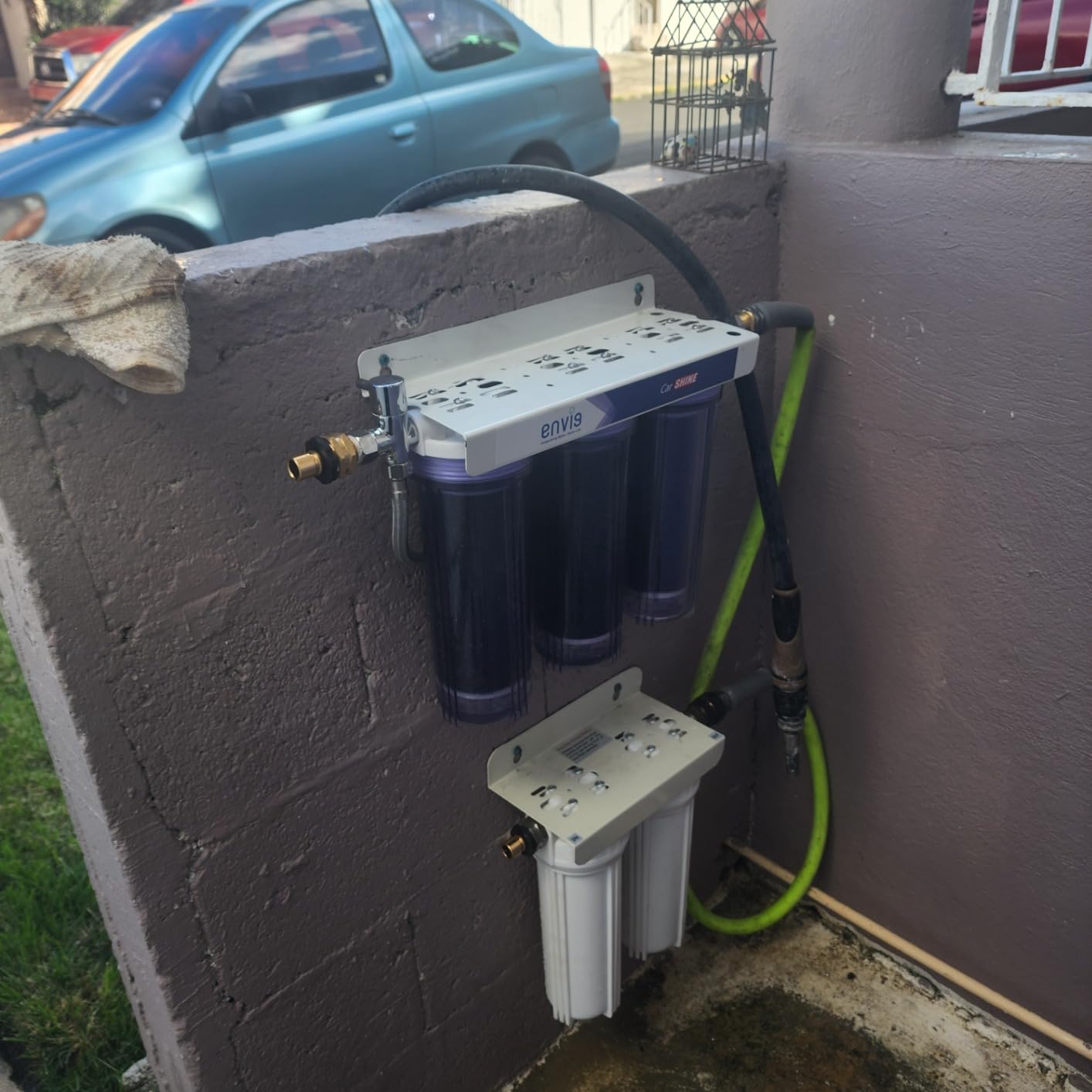
Owners report steady flow, no noticeable pressure restriction and clear chlorine taste reduction, with one long-term reviewer reporting 20 months of solid service. The cartridges are inexpensive and change on a 4 to 6 month interval, which keeps the running outlay of a hard water setup lower than most people expect.
The mount matters in an RV. The included heavy duty bracket and 3/4 inch GHT 304 stainless steel adapter let you fix the unit to a compartment wall out of the way of the fill hose, rather than leaving a canister in the aisle where someone can kick it.
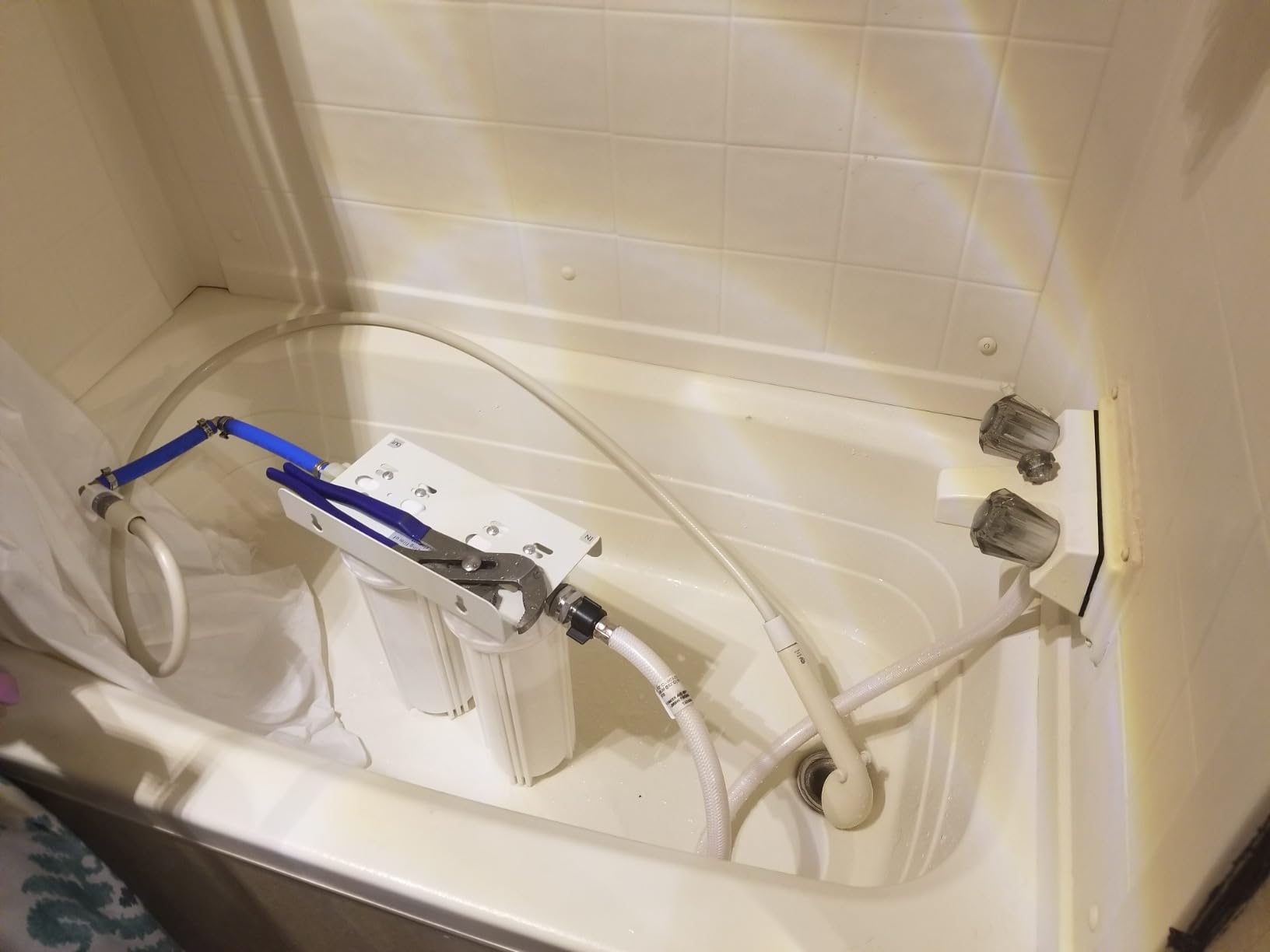
Two micron ratings, two jobs. The 1 micron sediment stage is fine enough to catch fine silt and rust flecks that would otherwise circulate through the fresh tank and end up in the aerators, and it is the stage that protects every downstream component from abrasion.
The coconut shell CTO carbon block is a taste and odor stage. CTO means chlorine taste and odor, which is the phrase on the cartridge and an accurate description of what it does. Reduce up to 99 percent of chlorine and VOCs is a meaningful improvement on park water, and it costs very little to keep fed.
The 3/4 inch GHT 304 stainless steel adapter is a better material choice than the plastic fittings common in this category, and stainless does not corrode in hard water the way cheaper plated parts can. The heavy duty mounting bracket keeps the housing fixed, which is the difference between a filter that stays put for a season and one that ends up on the ground.
One quirk to plan around: the internal filter threads are 1/2 inch NPT while the housing ports are 3/4 inch GHT. That mismatch is normal for this design but it means the replacement cartridge thread is not interchangeable with a 3/4 inch inline cartridge, so check the thread size when you reorder rather than assuming a universal fit.
To be direct, because it is the most common misunderstanding in this category: this filter reduces sediment and scale particles and chlorine taste, but it does not soften water. Any scale particle already dissolved in the water stays dissolved and passes straight through, so hardness readings will not move.
Use it as stage one in front of a softener, or on its own if your supply is only moderately hard and your problem is taste. Pair it with one of the 16000-grain tanks in this list and you have a setup that measurably lowers hardness and still tastes clean.
16000 grain ion exchange
Full accessory kit included
Pre-filled resin and salt
Carry handle and fabric cover
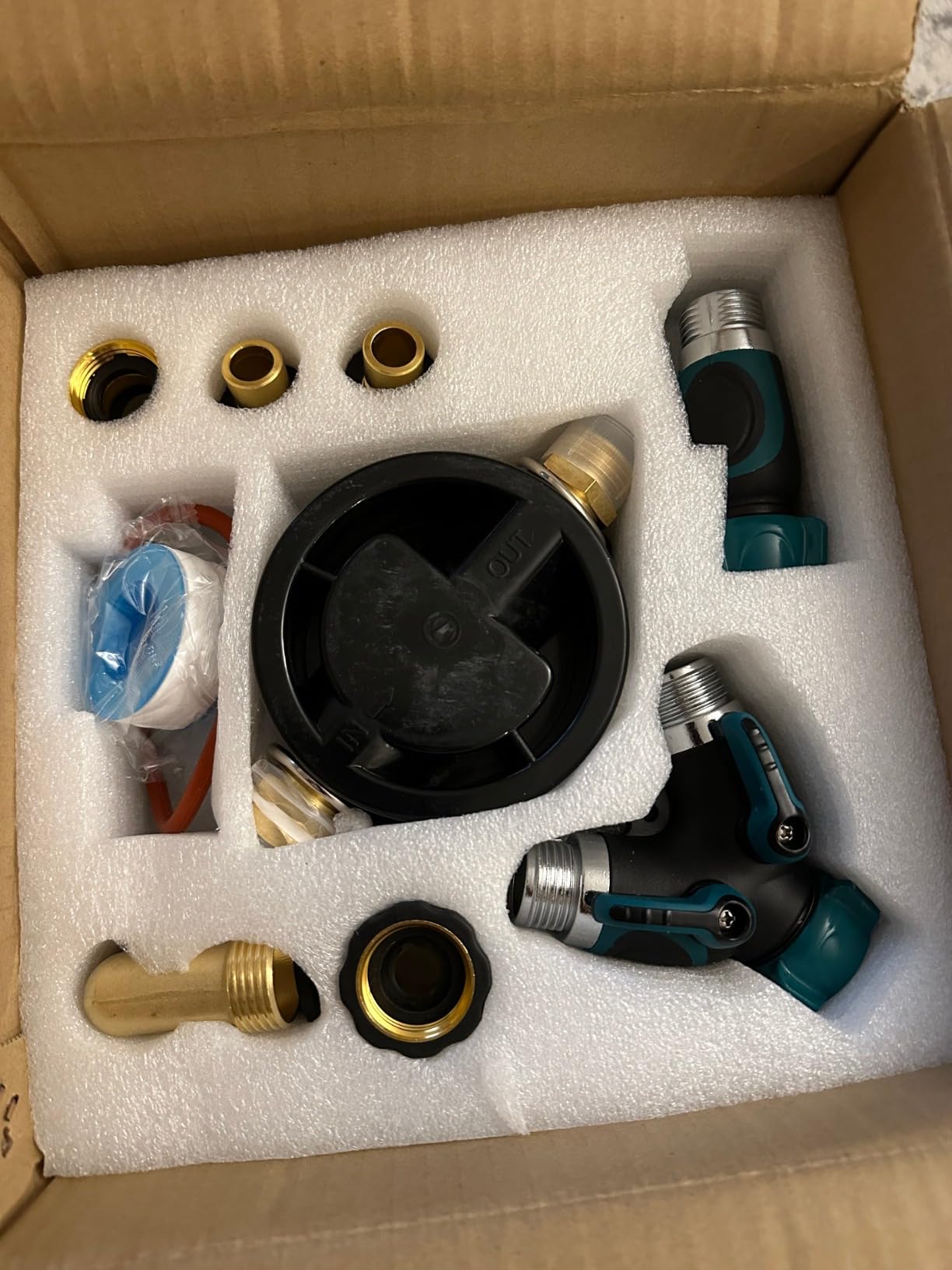
The RVGUARD is the softener to buy if you want a full 16000-grain class unit without a second hardware order. The box includes the portable softener, a fabric cover, a water hose, two hose adapters, an F-F connector, a quick connector, a Y-splitter, a shut-off valve and a 90 degree elbow connector, plus PTFE tape and four O-rings. That is the entire installation, in one package.
Reviewers confirm soft water within two weeks by both feel and hardness test strips, and specifically call out the disappearance of white staining on black faucets, which is the marker most RV owners notice first. The 4.6 average here is among the strongest in the roundup, and owners consistently describe it as the best value among 16000-grain units.
The tank arrives pre-filled with resin and salt, so like the H&G unit it is usable immediately with no first salt charge. That removes the single most common reason a new softener gets abandoned in month one.
Full-time owners report recharging roughly once a month at typical household water use, which lines up with the capacity math and keeps the maintenance expectation realistic rather than optimistic.
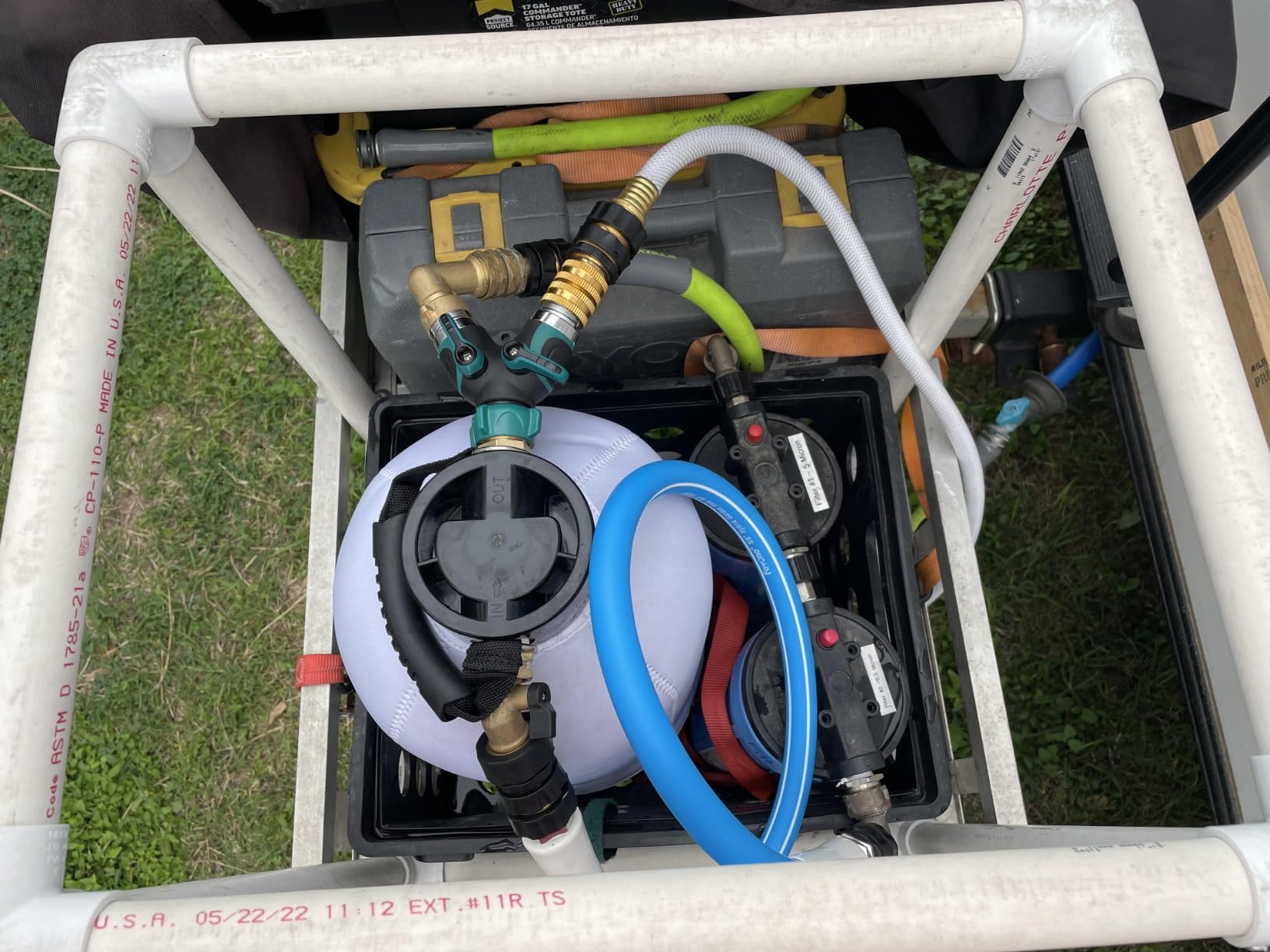
The Y-splitter is the item most worth noting. It lets you tee the softener into the fill line so you keep a plain unsoftened feed available, which is what you want for flushing the tank, for winterizing and for any task where softened water is not helpful. The shut-off valve means you can isolate the tank without dismantling the hose.
Having the shut-off valve and the elbow in the box is what separates a kit from a bare tank. Most softener owners end up at a hardware store within an hour of unboxing a bare unit, and in a park at dusk that is a real inconvenience.
After regeneration this tank needs about five minutes before the water is fully softened, and that is a genuine planning consideration. It is longer than the fastest tanks here, so if you regenerate and immediately run a shower you may get partially hard water for the first few minutes.
Give it time. Most owners salt it in the evening, let it work overnight and start the next day on soft water, and the interval becomes a non-issue once it is a habit.
Prefilled tanks are extremely heavy and reviewers specifically recommend a hand cart to move them. Measure your install space before you buy, because this one needs a permanent home near the fill connection.
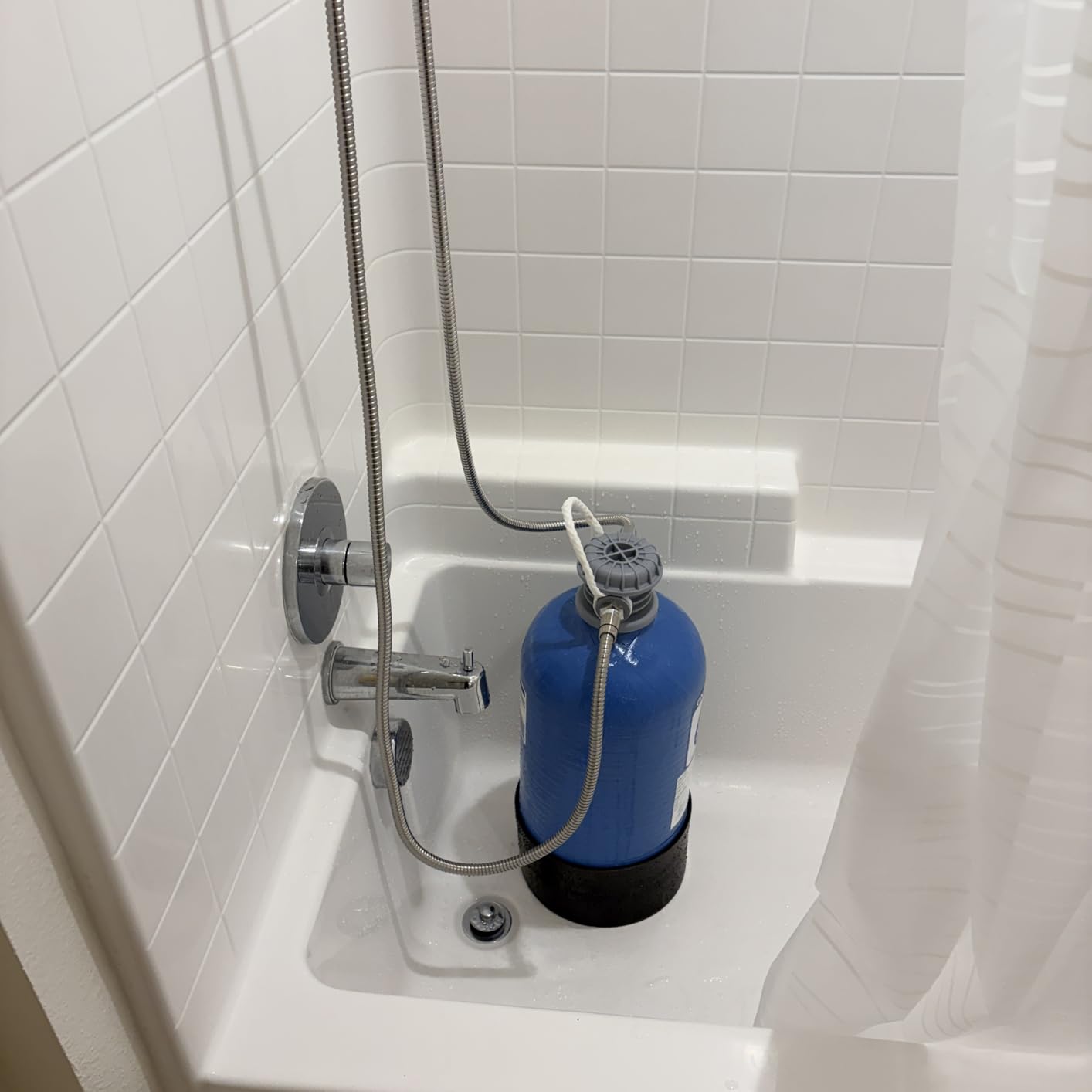
There is one placement warning worth heeding. If you plumb this into a shower line, owners report it makes changing water temperature nearly impossible, because the water has to travel through the tank before reaching the valve. Soften at the fill point, not at the shower, and the problem disappears.
500 ppm maximum supported TDS
16000 grain capacity
3/4 inch brass connector
16 by 11 by 10 inch tank
The Filterelated is the softener to choose when your source water is mineral-heavy beyond what a 350 ppm rated tank likes. The published maximum supported TDS level of 500 ppm is the highest in this roundup, and it is the spec that makes it relevant for boondockers filling from brackish coastal sources, high-mineral springs or untreated supply.
Performance data in reviews is strong where it counts. One tester measured 700 ppm and above coming out of a test strip and under 40 ppm after the tank charged, and other owners report effective action on iron and rust staining at campgrounds. The connect-and-use design sets up in 5 to 10 minutes with the included Teflon tape.
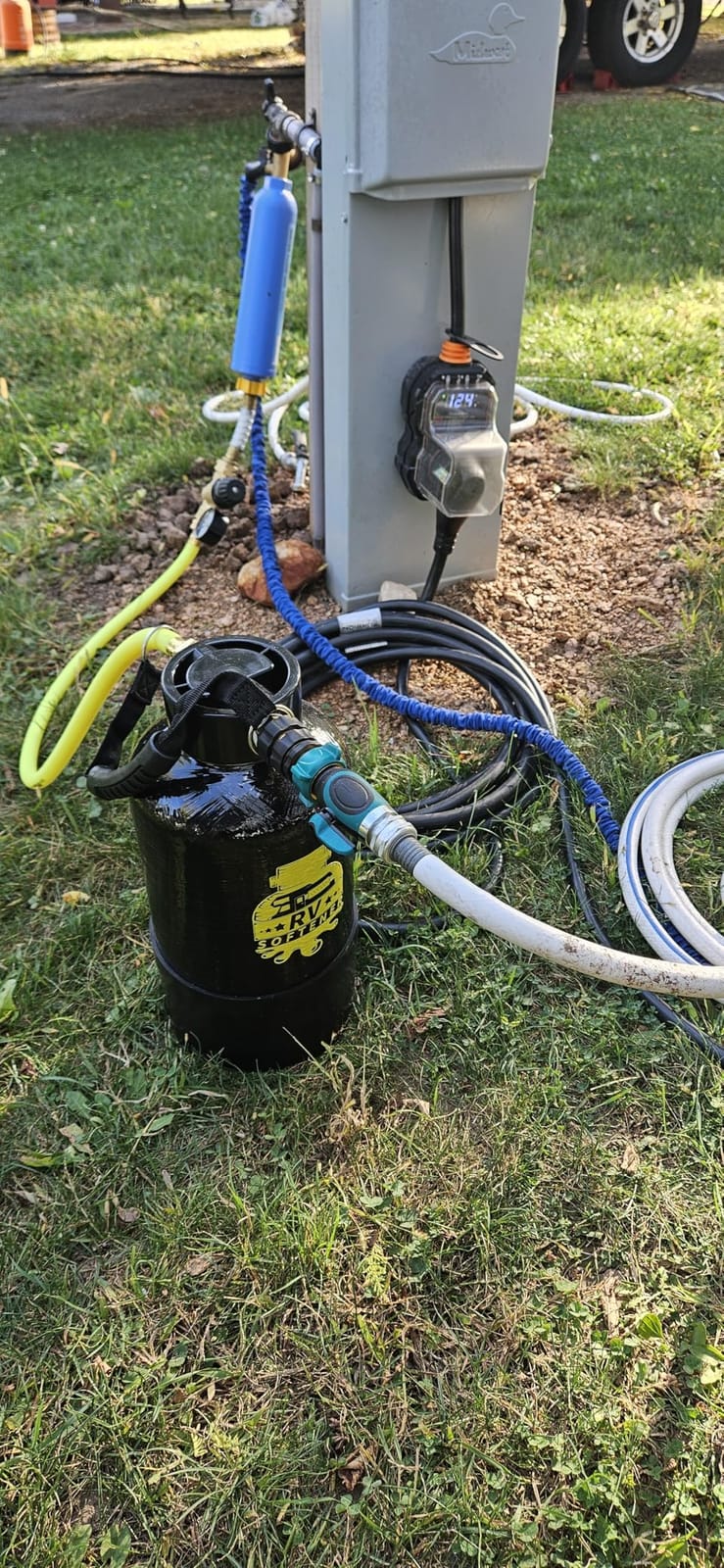
Capacity is quoted at up to 2000 gallons or 60 days, resin is renewable food-grade rated for about five years, and the 3/4 inch brass connector suits an RV, a garden hose or a larger hookup. The package includes a tank, handle, adapters, resin, a custom hose and two water separators.
At roughly 16 pounds dry it is one of the lighter tanks here, which is why it is worth a look for a trailer or a Class B that cannot carry a 30-plus pound softener.
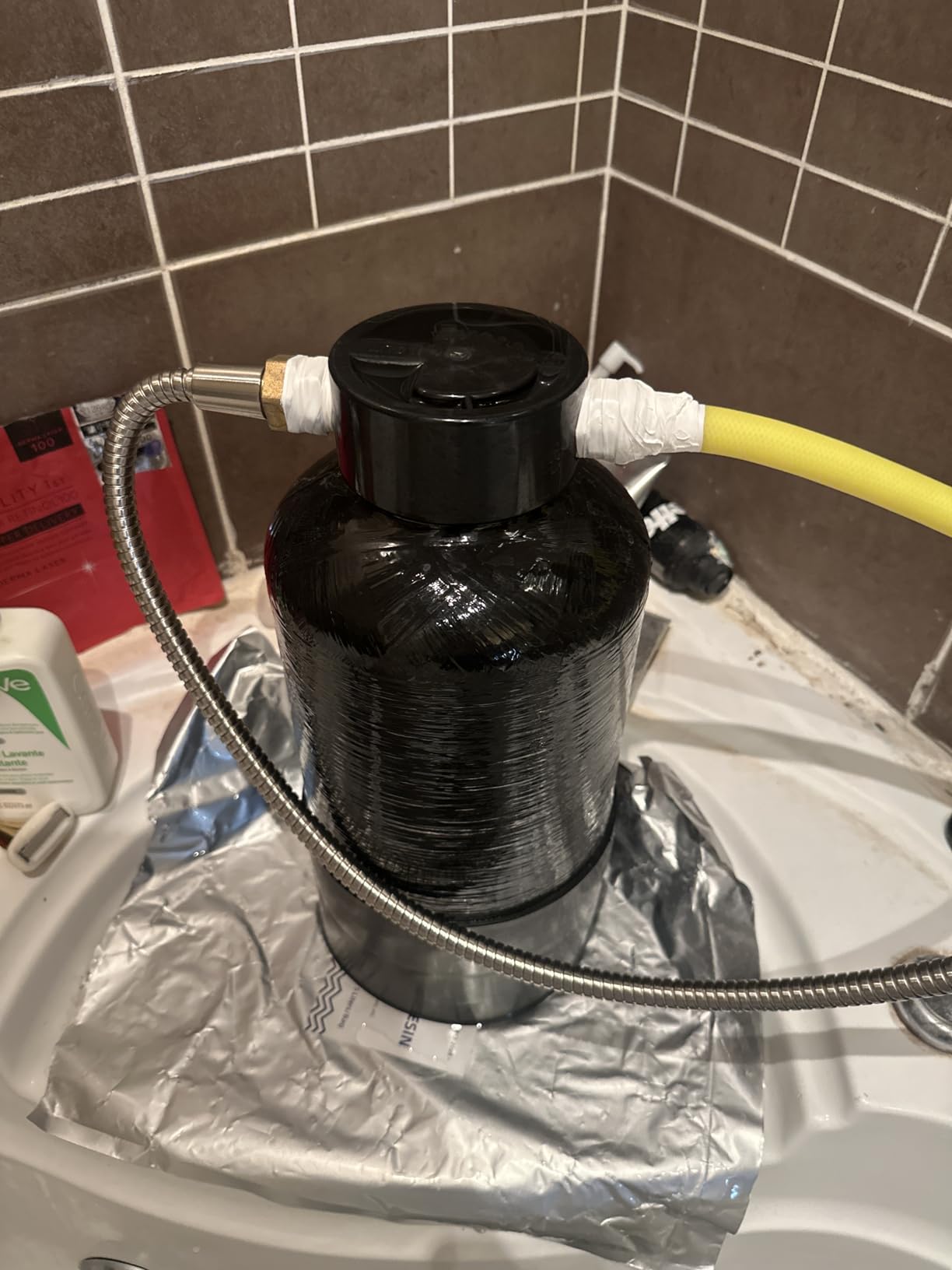
TDS measures everything dissolved in the water, so a higher ceiling means the resin has more mineral load to exchange before it is spent. At 500 ppm this tank tolerates supply that would overwhelm a 300 ppm or 350 ppm rated unit, and that tolerance is the entire reason to pick it.
Measure first. If your TDS meter reads in the low hundreds, the NPGLOBAL or the On The Go tank is the better buy and you get a larger tank for a similar outlay. If it reads in the high hundreds, this is the one in the list rated to handle it.
Here is the honest reality check. One owner running extremely hard water at 25 gpg reported the tank running out after about 200 gallons, which is a fraction of the quoted 2000. That is not a defect, it is arithmetic: 16000 grains divided by 25 gpg is about 640 gallons at best, and real-world efficiency in very hard water is lower than the ideal.
So in extremely hard water, expect to service this tank often or plan to run a larger capacity setup. The lesson generalizes to every softener in this roundup: the published gallon figure assumes moderate hardness, and your test strips are the only way to know your real interval.
The most hardware-specific complaint is about the included aluminum fittings, which owners report corroding and swelling in hard water. Aluminum is a poor choice in a high-mineral environment, and a swelling fitting is a fitting that will not come apart when you need it to.
Replace any aluminum in the accessory kit with brass before first use. The main connector is already 3/4 inch brass, so the fix is confined to the small pieces, and it takes five minutes with a wrench.
Short answer: a filter alone will not fix hard water, and hard water is the one problem in RV water treatment that no carbon or sediment cartridge addresses. If you want hardness numbers to change, you need ion exchange, and if you only want to stop scale forming on fixtures, a descaler or anti-scale cartridge is the cheaper route.
Filters strain particles and adsorb chemicals. That mechanism is a physical barrier and a surface adsorption process, and dissolved calcium and magnesium ions are too small and too stable to be caught by either. Softeners exchange ions, and that is the only mechanism in this list that lowers gpg. Descalers do not remove minerals at all, they change the crystal structure so scale forms in a softer, less adherent form that rinses away.
That is also the direct answer to the most common question on RV water forums, which is whether you need a softener if you already have a whole-RV filter. You need both, doing different jobs, and no amount of filter capacity substitutes for ion exchange. The practical failure of skipping the softener is not a taste problem, it is the water heater, the aerators and the quick connects.
On the objection about bacteria in a brine tank: a softener is not a disinfection device and is not intended to be one. It can reduce some organisms incidentally, but if you are relying on a softener to make questionable water safe, you need a certified filter or disinfection stage in the setup for that job. Softened water itself is safe to drink, since the exchange process exchanges minerals for sodium and potassium rather than introducing anything new.
Where a descaler makes sense is a full-time RVer in hard water who refuses to carry salt and does not mind slightly higher TDS. A polyphosphate anti-scale cartridge is the simplest version, binding trace minerals so they cannot precipitate, with no salt and no regeneration. The risk is that performance is easy to overstate and slow to notice, so verify it with the same test strips rather than with a white shower stall six months later.
Measure before you buy, because grain capacity is meaningless without an incoming hardness figure. The fastest method is a hardness test strip: dip it in the water, hold it for the stated time, wait for the colour pad to settle and compare it against the chart on the tube. Write the number down and measure at three different fill points over a few trips.
The second method is a TDS meter, which reads total dissolved solids in ppm. It is broader than hardness, so it will not separate calcium from everything else, but it is a fast sanity check on whether your supply is unusual. For reference, roughly 180 to 200 ppm corresponds to the 10 gpg hard threshold, and anything much higher points toward a higher-TDS rated unit.
The third is free. Fill a clear glass from the tap, let it sit for a day in bright light and look for white specks on the bottom. That is precipitated calcium carbonate, and if it is there, your water is hard enough to be doing visible damage. The check is imprecise but it takes no equipment and it never lies.
Once you have a softener connected, repeat the test after a week and again after a regeneration cycle. A softener that does not move the number is not working, whatever the brand claims. And run the test at the campground spigot as well as in your own tank, because the park supply and the water sitting in your tank are two different problems.
Take your measured gpg, multiply it by the gallons you expect to use between services, and check the result against the published grain rating. A 16000-grain tank in 10 gpg water is about 1600 gallons. In 20 gpg water it is about 800. Purchase for the worst water you expect to fill from, not the best case at your home park.
Regeneration takes 25 to 45 minutes on the softeners in this list, and you need a place to discharge the flush water. If you fill and move on a 15-minute stop, plan to regenerate between stays rather than at the pump. This is the single most common reason RV owners buy a softener and then stop using it.
Softeners in this roundup weigh from about 14 pounds dry to about 35, and pre-filled tanks are heavier still once charged. A Class B or a small trailer on a weight-sensitive payload rating may want a lighter tank like the Filterelated instead of a 16000-grain unit. Measure the install bay, and check the payload sticker before you order.
Almost every negative review in this category is about a plastic threaded connection. Brass inlet and outlet fittings run higher up front and last the life of the rig. That preference is why the VEVOR and Filterelated rank well on hardware, and it is the first thing to check on any softener you consider.
NSF/ANSI 42 covers aesthetic claims like taste and odor, NSF/ANSI 53 covers health-related claims like lead reduction, and NSF/ANSI 372 covers lead-free compliance. NSF 42 and 60 testing on softener resin refers to material safety. Where a listing shows no certification at all, treat the performance figures as unverified and check them with your own test strips.
The three-stage setup is the most durable arrangement in hard water regions. A sediment and carbon stage first to protect the resin, an ion exchange softener second to do the actual softening, and a dedicated drinking stage third for taste at the sink. One iRV2 owner runs exactly this logic with a metal trap, a 1 micron sediment stage and a 0.5 micron carbon block feeding an under-sink ceramic for drinking, and reports drinking tank water without hesitation.
Start at the fill point. Most owners tee the softener into the fill line with a Y-splitter so the plain feed is still available, then put a sediment pre-filter ahead of the softener so rust and sediment never reach the resin bed. A whole-rig cut-in is the more permanent version of the same idea and takes a few hours, while an inline hose connection takes about five minutes and can travel with you.
Keep the softener out of the water heater inlet. Softening cold supply water before it enters the tank is what protects the tank, and routing softened water through the heater is where owners sometimes get the order wrong. Where a shower is concerned, soften at the fill point rather than at the shower valve, because a softener on a shower line makes temperature control nearly impossible.
Descaling the water heater and the fresh tank is a separate job from filtering, and in a hard water area you do it on a schedule rather than waiting for symptoms. White deposits on the heating element are insulating the element and cutting efficiency, so an annual flush with a descale solution is cheap compared with replacing a tank in a storage bay.
Winterizing takes about 20 minutes for an inline setup: disconnect the hoses, drain the canister, remove the cartridge if it is a disposable type, and store the softener indoors or in a dry compartment. Drain the resin tank if the rig will sit for months, because resin sitting in a partially frozen tank can fracture. iRV2 owners who have been through several seasons treat this as a set checklist rather than a judgement call.
Finally, keep a small maintenance kit on board: PTFE tape, spare O-rings, a spare lid seal for whichever softener you own, a roll of plumber’s tape, and a box of table salt. Every complaint we read about portable softeners in service came down to one of those five items being absent when it was needed.
No, not by themselves. Standard RV filters strain sediment and adsorb chlorine and taste compounds onto activated carbon, but neither mechanism removes dissolved calcium and magnesium. Hardness can only be reduced by ion exchange softening, which swaps those minerals for sodium or potassium, or by anti-scale and descaler devices that stop the minerals from precipitating.
Yes, but it is a filter that works by a different mechanism. Look for a polyphosphate anti-scale cartridge, a crystallizing descaler, an electronic descaler, or reverse osmosis. Of these, only ion exchange softeners actually lower the measured hardness number, and only reverse osmosis removes a large share of the dissolved minerals outright.
You need both, because they do different jobs. A whole-RV filter handles sediment, chlorine taste and odor, and protects the system from particles. A softener handles hardness. Hard water will still scale your water heater, aerators and quick connects with a full filter system in place, so the filter is not a substitute for softening.
Dip a hardness test strip in the water, hold it for the stated time, wait for the colour pad to settle and compare it to the chart on the tube. Test at the campground spigot, then again from your own tank, since they are often different. A TDS meter gives a broader dissolved-solids reading, and a glass left for a day shows white calcium carbonate if the water is hard.
It depends on grain capacity divided by hardness. A 16000-grain tank in 10 gpg water gives roughly 1600 gallons, about 40 days for two people. In 20 gpg water the same tank gives about 800 gallons. Most owners check with a hardness test strip rather than a calendar, and add table salt when the reading starts climbing back up.
A brine tank is a salt solution, and salt brine is hostile to most organisms, so it is not a hospitable environment. It is still not a disinfection device. If you are worried about untreated water, the softener is not what answers that concern, and you want a certified filter or UV stage in the setup for the safety role.
If you are starting from nothing, begin with the Camco TastePure inline filter. It is our editor’s choice because it does the filtration job properly, it is independently certified to NSF 42, 53 and 372, and no other filter in this roundup has a review base anywhere close to it. It is also the honest answer to hard water only if your water is moderately hard and the problem is taste.
If hardness is the real problem, add an ion exchange softener behind it. Full-time RVers who want the longest interval between salt charges should pick the On The Go 16000-grain unit for up to 1600 gallons or 40 days per cycle. Owners working to a tighter budget get the same capacity class from NPGLOBAL with a limited lifetime warranty. Boondockers on high-iron or high-mineral supply want the PRO+AQUA bundle with its pre-filter, or the Filterelated tank with its 500 ppm TDS ceiling.
Small rigs should start with the Camco 10000-grain kit, which weighs in at 25 pounds and comes with 50 test strips so you can size your service interval from real numbers instead of a spec sheet. Anyone who will not carry salt should set expectations honestly: a descaler prevents scale without lowering hardness, and that is a different and less complete answer.
Whichever route you take, measure your water first. Five minutes with a test strip will tell you more than any product page, and it is the difference between buying a softener that works and buying a softener you blame later.