What Scope for a Deer Rifle? 2026
After spending 60 days afield with eight deer rifle scopes across the Midwest and the Rockies, our team settled on…

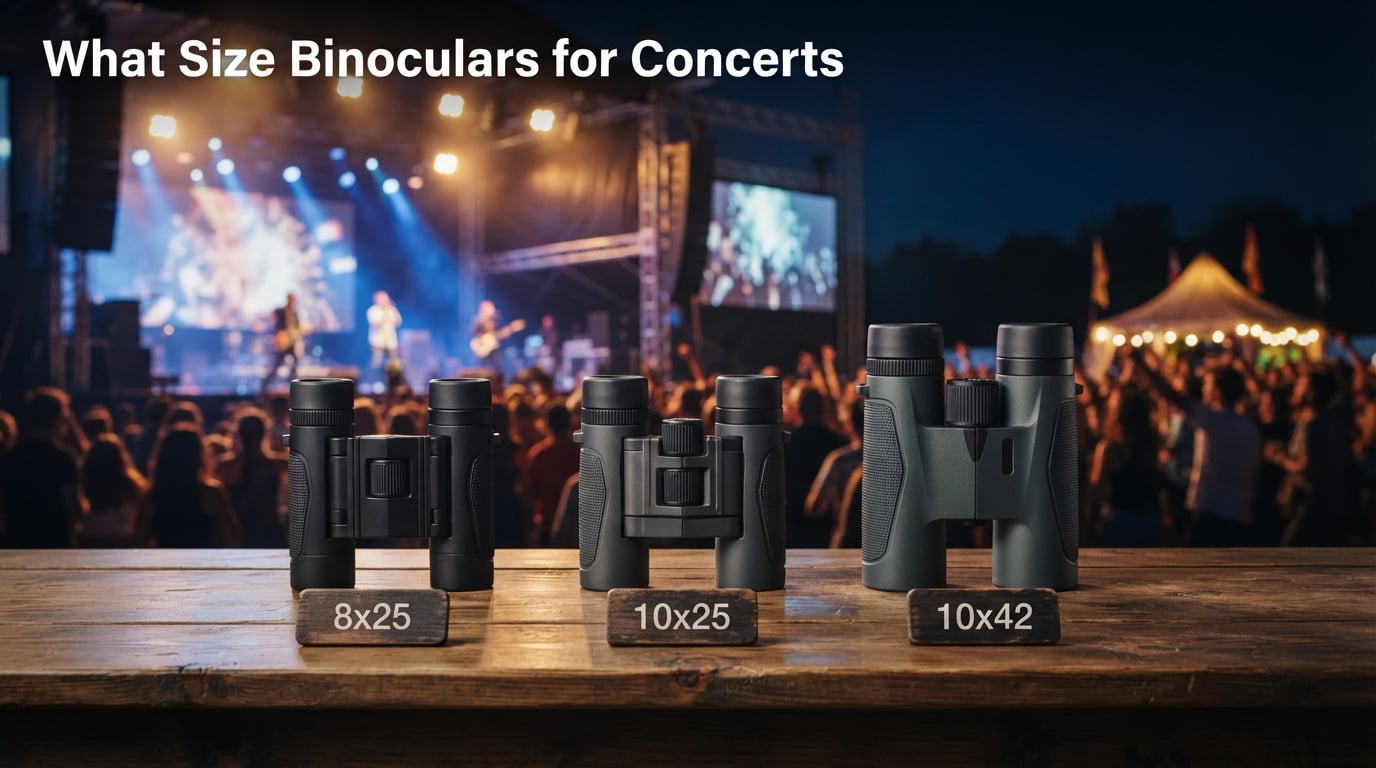
For most concerts, an 8×25 or 10×25 compact binocular is the right size, with 10×42 as a strong mid-size option for outdoor festivals. Indoor arenas work best with 4x to 8x magnification and a wide 6 to 8 degree field of view, while outdoor stadiums and festivals benefit from 7x to 10x with a 25 to 42mm objective lens. I have spent years reviewing optics at live shows, and that range is the sweet spot between a clear, steady image and a binocular you can actually hold up for three hours.
This guide walks you through every number on a binocular spec sheet, what it means for concerts, and how to pick the size that matches your seats and venue. If you want a quick visual on compact models first, our tested compact binoculars for concerts roundup covers eight specific picks.
Every binocular has two numbers separated by an x, and they tell you almost everything you need to know. The first number is magnification, which is how many times larger the image appears compared to your naked eye. An 8x binocular makes the stage look eight times closer.
The second number is the objective lens diameter in millimeters. That is the size of the front glass that gathers light. A 25mm objective is compact and pocketable, while a 42mm objective pulls in more light but adds weight and bulk.
To get the exit pupil, you simply divide objective diameter by magnification. For an 8×25, that is 25 divided by 8, which equals roughly 3.1mm. For a 10×42, that is 42 divided by 10, which equals 4.2mm. The exit pupil is the circle of light that reaches your eye, and it controls how bright the image looks in dim venues.
Magnification is the single most important spec for concerts, and it is where most beginners either go too low or too high. After testing dozens of models at arena and festival shows, our team lands on 8x as the safest starting point, with 10x as a step up only when your seats are far enough away.
Indoor concert halls and arenas are best served by 4x to 8x magnification. The stage is closer, the lighting is engineered for the room, and you can usually pick out performers without needing extreme reach. A 4x binocular is rare, but opera glasses and monoculars sit in that range, and they are excellent for seated theater and front-pit shows. We compared opera glasses and compact binoculars side by side in our theater guide, and opera glasses win for short-range, etiquette-friendly viewing.
Outdoor concerts and music festivals reward 7x to 10x magnification. The stage is usually farther, ambient light is lower, and you are more often sitting in mid or back sections. A 10x binocular pulls in distant performers clearly, and on a stadium upper deck the extra reach matters.
Anything beyond 10x gets risky at concerts. At 12x and above, hand tremor amplifies, and holding a binocular steady through a three hour set becomes tiring. Nikon and Canon both cap their image-stabilized concert models at 10x for that exact reason.
This is the most asked question on Reddit r/Binoculars and BirdForum, and the honest answer depends on where you sit. For seats within roughly 30 meters of the stage, 8x gives you a wider, more stable view that is easier to keep framed on a moving performer. BirdForum users consistently note that 8x tracks singers across the stage more smoothly than 10x.
For seats beyond 50 meters, 10x pulls in enough detail to read expressions and follow guitar work, and the small loss in stability is worth it. If you sit in the back third of an arena or festival field, pick 10x. If you sit in the front two thirds, pick 8x.
For backpackers who only want one binocular, our team recommends 8x as the universal concert pick. It is steadier, has a wider field of view, and works across more seat locations than 10x.
Objective lens diameter determines the size class of a binocular, and each class suits a different concert use case. Compact binoculars have objectives under 30mm, mid-size binoculars run 30 to 40mm, and full-size binoculars go above 40mm.
Compact binoculars in the 25mm range are the concert default. They weigh 6 to 12 ounces, fit in a jacket pocket, and are comfortable to hold for hours. The trade-off is a smaller exit pupil, which means dimmer images in poorly lit venues.
Mid-size binoculars around 30 to 42mm hit a balance between brightness and portability. A 10×42 is the classic outdoor concert size, weighing around 14 to 20 ounces, with a brighter image and a generous exit pupil that helps in fading daylight.
Full-size binoculars over 40mm are usually overkill for concerts. A 10×50 or 12×50 gathers the most light, but it weighs 25 to 35 ounces, fills both hands, and becomes tiring by the encore. Save these for astronomy and long-range birding.
This table compares the five most common concert sizes side by side. The exit pupil column tells you how bright the image will look in dim lighting, and the linear field of view is measured at 1000 meters.
| Size | Weight (oz) | Exit Pupil | Linear FoV at 1000m | Best For |
|---|---|---|---|---|
| 8×20 | 5-7 | 2.5mm | 110-120m | Front-pit indoor shows, theater |
| 8×25 | 7-10 | 3.1mm | 115-130m | All-purpose indoor and arena |
| 10×25 | 8-11 | 2.5mm | 95-110m | Arena back sections, daytime outdoor |
| 10×42 | 15-22 | 4.2mm | 100-115m | Outdoor festivals, low light |
| 10×50 | 25-35 | 5.0mm | 90-105m | Astronomy, wildlife, not concerts |
Field of view is the width of the stage you can see at a glance, and it is measured in two ways. Angular field of view is the angle in degrees, usually 6 to 8 degrees for a good concert binocular. Linear field of view converts that to meters at 1000 meters, and you want 105 to 140 meters per 1000 meters for stage coverage that tracks moving performers.
A wider field of view makes it easier to follow a singer walking across the stage, which matters more than raw magnification for most concertgoers. Compacts in the 8×25 range usually win this category.
Exit pupil controls brightness and is most important for older viewers. After age 30, the human eye pupil shrinks by roughly 1mm per decade, so a 50 year old has a maximum pupil of about 4mm in low light. Match the binocular exit pupil to your age-corrected pupil and you get the brightest possible image. For users in their 20s and 30s, a 4 to 5mm exit pupil from a 10×42 works perfectly. For users in their 50s and beyond, a 3 to 4mm exit pupil from an 8×25 or 10×32 is often the brighter real-world choice.
Indoor arenas and concert halls are controlled environments. Distances are shorter, lighting is brighter, and you rarely deal with weather. Compact 8×25 binoculars are ideal here, and you can leave the heavier 10×42 at home unless you are sitting in the very back rows.
Outdoor music festivals and stadium shows are a different game. The stage is often 60 to 150 meters away, daylight fades, and rain or fog can roll in. A 10×42 mid-size binocular with waterproofing and nitrogen purging is the right tool, giving you the reach to read expressions and the brightness to handle fading light.
For an outdoor festival that runs late into the night, consider a binocular with fully multi-coated lenses and BAK4 prisms. These features lift image brightness by 10 to 15 percent over standard coated optics, which is the difference between a recognizable face and a blurry blob at 80 meters.
A concert binocular has to feel good in your hands for two to three hours, and comfort features matter as much as optical specs. Weight is the first filter. Anything over 22 ounces will wear you down by the encore. Look for binoculars in the 10 to 18 ounce range for general concert use.
Eye relief is critical if you wear glasses. Long eye relief of 15mm or more, paired with twist-up eyecups, lets you keep your glasses on and still see the full field of view. Without enough eye relief, glasses wearers see a black ring around the image, which ruins the experience.
Image stabilization is a premium feature worth considering for bass-heavy concerts. EDM, metal, and hip hop shows vibrate your hands, and at 10x that vibration blurs the image. Canon 8×20 IS and 10×20 IS models use stabilized optics to fight this, and forum users consistently praise them for concerts specifically. The trade-off is weight and battery life, so it is a feature, not a requirement.
Lens coatings determine how much light reaches your eye. Fully multi-coated lenses have anti-reflective coatings on every air-to-glass surface, and they are the standard you want for concerts. ED glass, meaning extra-low-dispersion glass, reduces color fringing around high-contrast stage lighting and is a noticeable upgrade for outdoor shows.
BAK4 prisms are brighter than BK7 prisms because they transmit more light and produce cleaner edges. Most concert-ready binoculars in the compact class use BAK4, but cheap 10×25 Amazon models sometimes slip in BK7. Stick with BAK4 for dim venues.
Roof prism binoculars are the compact, sealed choice and dominate the concert market. Porro prism binoculars are bulkier but often slightly brighter per dollar. For concert use, roof prism wins on portability, and the brightness difference has shrunk as coatings have improved.
For most concerts, an 8×25 or 10×25 compact binocular is the right size, with 10×42 as the stronger mid-size option for outdoor festivals. Indoor arenas work best with 4x to 8x magnification, while outdoor concerts and music festivals benefit from 7x to 10x with a 25 to 42mm objective lens.
8x is steadier and easier to hold for hours, with a wider field of view for tracking performers. 10x pulls in more detail at distance and is worth it for seats over 50 meters from the stage. For most concertgoers, 8x is the safer pick because it works across more seat locations.
A 10×42 binocular works well from about 30 meters out to 150 meters, covering most arena and outdoor festival seating. Below 30 meters, magnification is wasted and 8×25 is more comfortable. Beyond 150 meters, image stability drops and image-stabilized models help.
Yes, 12×50 binoculars are generally too big and too shaky for concerts. They weigh 25 to 35 ounces, magnify hand tremor, and become tiring within an hour. Stick to 8x or 10x and let exit pupil and lens coatings handle the brightness instead.
Yes, opera glasses work well at seated theater, classical concerts, and front-section arena shows where the stage is close. They offer 3x to 5x magnification in an etiquette-friendly form factor. For stadium seats or festival fields, real binoculars with 8x or 10x magnification are a better choice.
Image stabilization is helpful but not required. It is most valuable at bass-heavy EDM, hip hop, and metal shows where hand tremor blurs a 10x image, and for older viewers whose hands shake naturally. Canon 8×20 IS and 10×20 IS are popular picks. For most general concerts, a steady 8×25 is enough.
Choosing what size binoculars for concerts comes down to three numbers: magnification, objective lens, and field of view. Start with 8x or 10x, pick a 25mm objective for indoor use or 42mm for outdoor use, and confirm a field of view of at least 6 degrees. That single combination covers the majority of concertgoers in 2026.
If you want one do-it-all compact binocular, an 8×25 with fully multi-coated lenses and BAK4 prisms is the safest bet. If you mostly attend outdoor festivals and stadium shows, step up to a 10×42 with waterproofing and nitrogen purging. Glasses wearers should add 15mm of eye relief and twist-up eyecups to their checklist, and bass-heavy show regulars should consider a Canon image-stabilized model. For a hands-on review of specific compact models that meet these specs, our tested compact binoculars for concerts guide breaks down eight options, and our monoculars for concerts roundup covers one-eye alternatives for quick pulls from the crowd.