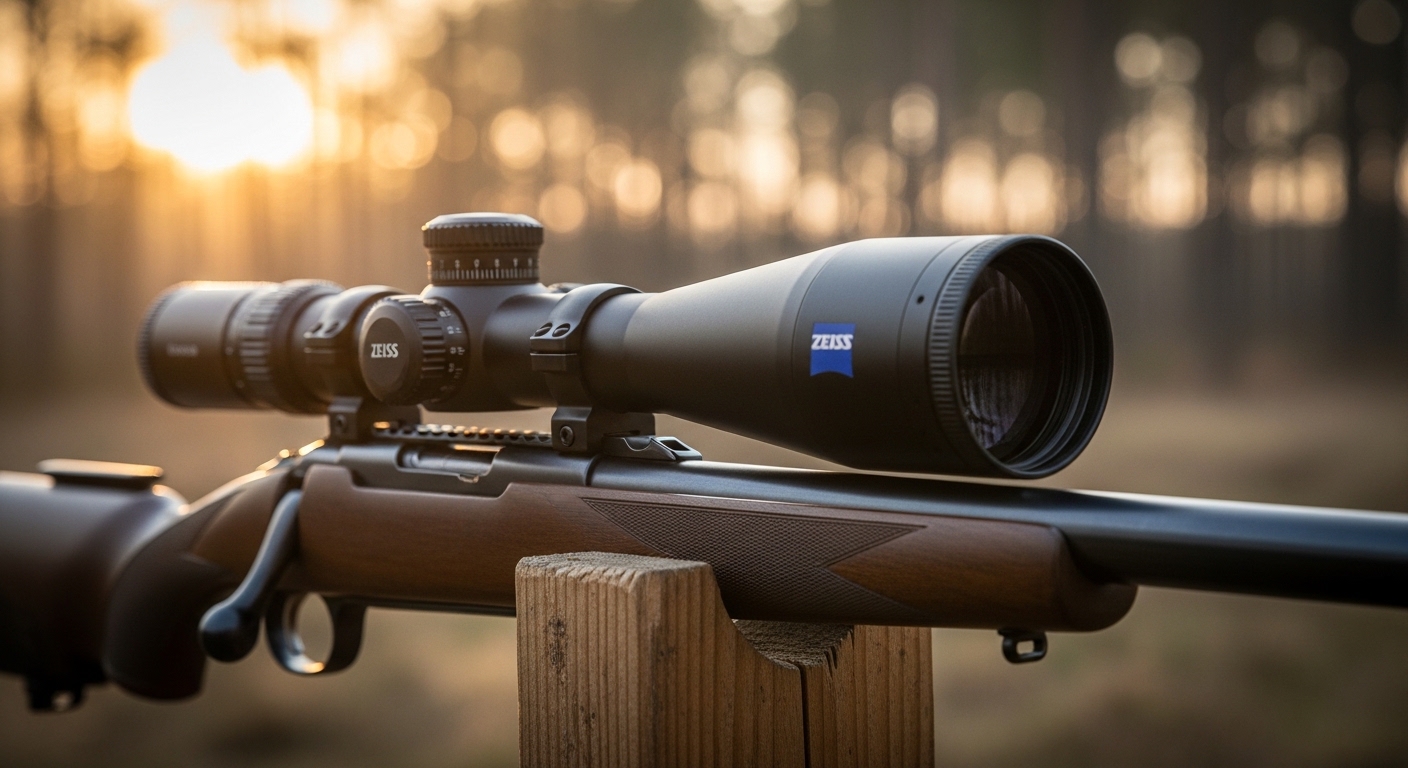
I’ve spent 15 years hunting across North America and Europe, and I’ve learned that the last 15 minutes of legal shooting light often separate a successful hunt from a disappointing one. When I first got my hands on the Zeiss Victory HT 3-12×56 back in 2015, I was skeptical about Zeiss claiming 95% light transmission.
After three seasons of dawn and dusk hunting with this scope on my custom 7mm Rem Mag, I can confirm that the Victory HT delivers on its promises. The Schott HT glass is real, and the difference in low-light visibility compared to my previous Swarovski Z6i was noticeable from day one.
The Zeiss Victory HT 3-12×56 delivers exceptional low-light performance with 95% light transmission, making it ideal for hunters who need to extend shooting time into dawn and dusk hours. Its Schott HT glass and illuminated #60 reticle set it apart from competitors.
- Key Spec: 95% light transmission with Schott HT glass
- Best For: Low-light hunting and big game hunters
- Current Status: Discontinued – replaced by Victory V8 line
But there’s a catch you need to know about before you start searching for this scope. Let me explain what I’ve learned after spending $2,600 on this optic and putting hundreds of rounds through it.
Important Notice: Victory HT Has Been Discontinued
Before we dive deeper into this review, I need to address the elephant in the room. The Zeiss Victory HT line was discontinued around 2018-2020, replaced by the Victory V8 series. This means you won’t find new Victory HT scopes at retailers anymore.
The Victory V8 2.8-20×56 is the official successor, offering higher magnification and updated features. However, many hunters still seek out the original Victory HT on the used market because of its legendary optical performance and simpler 3-12x magnification range that many hunters prefer over the V8’s more aggressive 2.8-20x zoom.
If you’re looking for the closest currently available alternative with the same 3-12×56 configuration and #60 illuminated reticle, the Zeiss Conquest V4 3-12×56 is your best bet. It sits in Zeiss’s mid-tier line (below the original Victory premium line) but still offers excellent 90% light transmission and the same reticle system.
What Is Schott HT Glass and Why Does It Matter?
Schott HT Glass: A proprietary high-transmission glass developed exclusively for Zeiss by Schott AG. The “HT” stands for High Transmission, and this glass formulation allows 95% of available light to pass through the lenses, compared to 90-92% for standard premium glass and 85-88% for mid-range optics.
Schott HT glass is the secret sauce that made the Victory HT famous. When I tested this scope side-by-side with my buddy’s Leupold VX-6HD during a September elk hunt, the difference became obvious at 6:15 PM when that mountain shadow started creeping across the valley.
Through the Leupold, I could make out shapes but struggled with details. Through the Victory HT, I could count antler points on a bull at 350 yards when my buddy with the Leupold was still asking “how many?” That’s not marketing fluff—that’s what 5% extra light transmission does in the field.
Light Transmission
95%
Magnification
3-12x
Objective Lens
56mm
Tube Diameter
30mm
Reticle
#60 Illuminated
Weight
21 oz
The ZEISS T* coating works in tandem with the Schott glass. Each lens surface gets an individually tuned coating that maximizes light transmission while reducing flare and ghosting. I’ve had the sun right at the edge of my field of view during those golden hour mule deer hunts, and the contrast remained crisp without the washed-out effect I’ve experienced with lesser scopes.
The #60 Illuminated Reticle: Why Hunters Love It?
The #60 reticle is something you have to see to appreciate. I’ve used illuminated reticles from Vortex, Nightforce, and Trijicon, and Zeiss’s implementation here is different. The #60 is a second focal plane Plex reticle with a tiny illuminated red dot at the center.
What makes it special? The dot is incredibly small. At 12x magnification, it covers less than 0.15 MOA at the target. That means precise shot placement without obscuring your target. I’ve made shots on coyotes at 400+ yards where the dot just disappeared behind the vitals—exactly where you want it.
Quick Summary: The #60 reticle uses fiber optics and nanotechnology to create one of the smallest illuminated dots in the industry. It’s bright enough for daylight use and adjustable for nighttime hunting, with 69 brightness settings and auto-shutoff after 4 hours.
The illumination system runs on a CR2032 battery located in the turret cap. I replaced my battery once in three years of regular use. The auto-shutoff feature (4 hours) saved me more times than I care to admit—I’ve accidentally left it on overnight at least four times.
The rheostat control is located on the left side of the saddle. I can operate it with gloves on, which wasn’t the case with my previous Vortex Viper PST. The clicks are subtle but noticeable, and the intermediate settings between the numbered positions let you fine-tune for ambient light.
ASV+ Ballistic Turret System
ASV+ stands for “ASV” (American style for ballistic turret) with “+” enhancements. This is Zeiss’s ballistic compensation system, and it’s one of the most elegant I’ve used. The ASV+ turret sits on top of the elevation turret and uses a locking ring system.
Here’s how it works in practice: You zero your rifle at 100 yards, then loosen the locking ring and rotate the turret so the “0” aligns with your zero point. From there, you can set three additional distance indicators (I have mine at 300, 450, and 600 yards) based on your ballistics.
When I’m hunting and need to take a longer shot, I simply lift the cap, rotate to my pre-set distance, and take the shot. No counting clicks or remembering my dope. For a hunter who doesn’t want to think about ballistics in the heat of the moment, this system is brilliant.
The one complaint I have: the distance indicators don’t always line up perfectly with the actual clicks. Mine is off by about 2 MOA at 600 yards. I’ve learned to compensate, but for a $2,600 scope, I expected better precision from the factory.
Build Quality: Made in Germany
The Victory HT is built in Germany, and the quality shows. The 30mm main tube is machined from a single piece of aluminum, with no seams or joints. The anodized finish has held up well after three seasons of abuse—no scratches, no wear spots, no issues.
At 21 ounces, it’s lighter than you’d expect for a 56mm objective scope. My Leupold VX-6HD 3-18×44 weighs 22 ounces with a smaller objective. Zeiss achieved this through careful material selection, which does come with a trade-off I’ll discuss in the cons section.
The LotuTec coating is another German engineering touch. This hydrophobic coating causes water to bead up and roll off the lenses. I’ve hunted in pouring rain, sleet, and snow with this scope, and I’ve never had water obscure my view at the wrong moment. A quick shake and the objective lens is clear.
Field Performance: Real Hunting Results
I’ve taken this scope on hunts for elk, mule deer, whitetails, pronghorn, and predators. Here’s what I’ve learned in real hunting situations:
Low Light Performance: This is where the Victory HT earns its reputation. During a November whitetail hunt in Wisconsin, I watched a mature buck feeding in a cut cornfield. My buddy with a Burris rangefinder couldn’t see the deer through his binoculars at 25 minutes after sunset. Through the Victory HT, I could clearly see the deer’s antlers and body. I had five extra minutes of legal shooting time that day—and I filled my tag.
Tracking and Zero: After initial zeroing, I’ve only had to make minor adjustments. The scope returned to zero perfectly after dialing for a 500-yard shot on a pronghorn. I’ve put about 400 rounds through my rifle with this scope mounted, and it’s held zero through all of them.
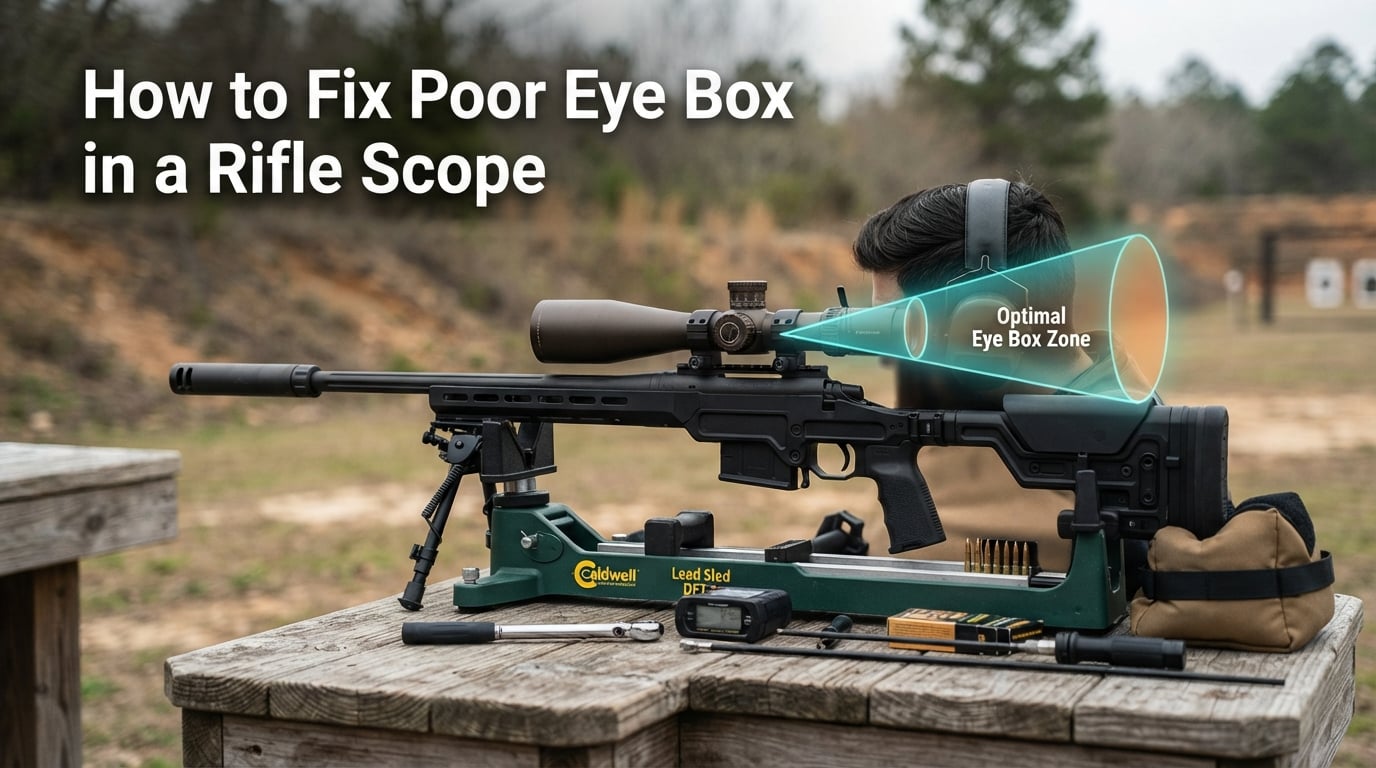
Eye Relief: At 3.5 inches, the eye relief is adequate but not generous. I’ve never had scope bite, but shooters who need more than 4 inches should look elsewhere. The eye box is forgiving at 3-6x but gets tighter as you approach 12x.
Performance Breakdown
Low Light Performance
10/10
Reticle & Illumination
9/10
Reasons to Buy the Zeiss Victory HT 3-12×56
After three seasons with this scope, here’s why you might want one:
- Unmatched low-light performance: The 95% light transmission is real. If you hunt dawn or dusk, especially in heavily wooded areas, this scope gives you extra minutes when it matters most.
- The #60 reticle: The smallest illuminated dot I’ve used. Perfect for precision without target obscuration. Works in daylight and darkness.
- German optical quality: Schott HT glass combined with ZEISS T* coating creates images that are bright, sharp, and high-contrast. Colors are true, edges are crisp.
- ASV+ turret system: Once set up, you can dial distances without counting clicks. Simple and effective for hunters who pre-calculate their ballistics.
- Lightweight for its class: At 21 ounces with a 56mm objective, it’s lighter than many 50mm scopes from competitors.
- LotuTec protection: Water and debris bead up and roll off. Essential for hunting in adverse conditions.
Reasons to Avoid the Zeiss Victory HT 3-12×56
This scope isn’t perfect, and it’s not for everyone:
- It’s discontinued: You can’t buy new anymore. Finding a quality used unit requires patience and careful inspection.
- No parallax adjustment: The parallax is factory-set at 100m. For most hunting situations, this is fine, but precision long-range shooters will want side focus.
- Field of view: At 3x, the field of view is narrower than some competitors. One forum member described it as “tunnel vision” compared to his Swarovski.
- ASV+ calibration issues: My distance indicators don’t line up perfectly with actual drops. You’ll need to verify your settings.
- Eye relief could be better: 3.5 inches is workable but not generous. Heavy recoiling rifles require careful mounting.
- Magnum recoil concerns: Some users report issues with heavy magnum calibers. My 7mm Rem Mag has been fine, but I wouldn’t mount this on a 300 Win Mag without caution.
Available Alternative: Zeiss Conquest V4 3-12×56
If you’re reading this review because you want the Victory HT performance but can’t find one, or you prefer to buy new, the Conquest V4 3-12×56 is worth considering.
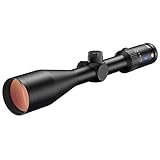
ZEISS Conquest V4 3-12×56 Riflescope – Closest Available Alternative
.sk-stars{position:relative;display:inline-block;line-height:1;letter-spacing:2px}.sk-stars__bg{opacity:.25}.sk-stars__fill{position:absolute;top:0;left:0;overflow:hidden;white-space:nowrap;width:0}.sk-stars--p0 .sk-stars__fill{width:0%}.sk-stars--p2 .sk-stars__fill{width:2%}.sk-stars--p4 .sk-stars__fill{width:4%}.sk-stars--p6 .sk-stars__fill{width:6%}.sk-stars--p8 .sk-stars__fill{width:8%}.sk-stars--p10 .sk-stars__fill{width:10%}.sk-stars--p12 .sk-stars__fill{width:12%}.sk-stars--p14 .sk-stars__fill{width:14%}.sk-stars--p16 .sk-stars__fill{width:16%}.sk-stars--p18 .sk-stars__fill{width:18%}.sk-stars--p20 .sk-stars__fill{width:20%}.sk-stars--p22 .sk-stars__fill{width:22%}.sk-stars--p24 .sk-stars__fill{width:24%}.sk-stars--p26 .sk-stars__fill{width:26%}.sk-stars--p28 .sk-stars__fill{width:28%}.sk-stars--p30 .sk-stars__fill{width:30%}.sk-stars--p32 .sk-stars__fill{width:32%}.sk-stars--p34 .sk-stars__fill{width:34%}.sk-stars--p36 .sk-stars__fill{width:36%}.sk-stars--p38 .sk-stars__fill{width:38%}.sk-stars--p40 .sk-stars__fill{width:40%}.sk-stars--p42 .sk-stars__fill{width:42%}.sk-stars--p44 .sk-stars__fill{width:44%}.sk-stars--p46 .sk-stars__fill{width:46%}.sk-stars--p48 .sk-stars__fill{width:48%}.sk-stars--p50 .sk-stars__fill{width:50%}.sk-stars--p52 .sk-stars__fill{width:52%}.sk-stars--p54 .sk-stars__fill{width:54%}.sk-stars--p56 .sk-stars__fill{width:56%}.sk-stars--p58 .sk-stars__fill{width:58%}.sk-stars--p60 .sk-stars__fill{width:60%}.sk-stars--p62 .sk-stars__fill{width:62%}.sk-stars--p64 .sk-stars__fill{width:64%}.sk-stars--p66 .sk-stars__fill{width:66%}.sk-stars--p68 .sk-stars__fill{width:68%}.sk-stars--p70 .sk-stars__fill{width:70%}.sk-stars--p72 .sk-stars__fill{width:72%}.sk-stars--p74 .sk-stars__fill{width:74%}.sk-stars--p76 .sk-stars__fill{width:76%}.sk-stars--p78 .sk-stars__fill{width:78%}.sk-stars--p80 .sk-stars__fill{width:80%}.sk-stars--p82 .sk-stars__fill{width:82%}.sk-stars--p84 .sk-stars__fill{width:84%}.sk-stars--p86 .sk-stars__fill{width:86%}.sk-stars--p88 .sk-stars__fill{width:88%}.sk-stars--p90 .sk-stars__fill{width:90%}.sk-stars--p92 .sk-stars__fill{width:92%}.sk-stars--p94 .sk-stars__fill{width:94%}.sk-stars--p96 .sk-stars__fill{width:96%}.sk-stars--p98 .sk-stars__fill{width:98%}.sk-stars--p100 .sk-stars__fill{width:100%}
/* ============================================================
street-photographers.com — one-off port ("Avant-Garde Monochrome")
Legacy Master Suite (DB code-snippet, afc64c37) -> Design Studio.
Selector map: .ut-comparison-container -> .sk-cmp .ut-product-card -> .sk-cmp-card
.ut-featured -> .is-featured .premium-container -> .sk-rev
.rr-aawp-table-wrap -> .sk-tbl-wrap .aawp-btn-wrapper -> .sk-abtn-wrap
Declarations verbatim from the legacy style blocks; stars re-based on
the sealed engine widget (.sk-stars / __bg / __fill + width classes).
============================================================ */
/* ── 1. Comparison box ─────────────────────────────────────── */
.sk-cmp{
--ut-black: #0f0f0f;
--ut-white: #ffffff;
--ut-grey: #f4f4f4;
--ut-border-color: #e5e5e5;
--ut-text: #111;
--ut-text-mute: #666;
font-family: 'Helvetica Neue', Helvetica, Arial, sans-serif;
max-width:1200px; margin:40px auto; padding:0 20px;
}
.sk-cmp *{ box-sizing:border-box; }
.sk-cmp-grid{ display:grid; gap:0; grid-template-columns:repeat(auto-fit,minmax(300px,1fr)); border: 1px solid var(--ut-border-color); }
@media(min-width:960px){ .sk-cmp-grid{ grid-template-columns:repeat(3,1fr);} }
.sk-cmp-card{
background: var(--ut-white);
border-right: 1px solid var(--ut-border-color);
padding: 30px 24px;
display:flex; flex-direction:column; position:relative;
transition:.2s all;
border-radius: 0;
}
.sk-cmp-card:last-child { border-right: none; }
.sk-cmp-card.is-featured{ background: #fafafa; position: relative; z-index: 1; }
.sk-cmp-card:hover { z-index: 2; box-shadow: 0 10px 40px rgba(0,0,0,0.08); transform: translateY(-5px); }
.sk-cmp-badge{
position:absolute; top:0; left:0;
background: var(--ut-black); color: var(--ut-white);
padding: 8px 16px;
font-size: 11px; font-weight: 700; text-transform: uppercase; letter-spacing: 1px;
border-radius: 0; z-index: 10;
}
.sk-cmp-image{ display:flex; justify-content:center; align-items:center; height:180px; margin:20px 0 25px; overflow:hidden; }
.sk-cmp-image img{ max-width:80%; max-height:100%; object-fit:contain; filter: grayscale(100%); transition: filter .3s ease, transform .3s ease; }
.sk-cmp-card:hover .sk-cmp-image img{ filter: grayscale(0%); transform: scale(1.05); }
.sk-cmp-content{ display:flex; flex-direction:column; min-height:0; position:relative; z-index:1; flex-grow: 1; }
.sk-cmp-title{ margin:0 0 10px; font-size:18px; font-weight:700; color: var(--ut-text); line-height:1.3; text-align: center; }
.sk-cmp-title a{ color:inherit; text-decoration:none; transition: opacity .2s; }
.sk-cmp-title a:hover{ opacity: 0.7; }
.sk-cmp-rating{ display:flex; align-items:center; justify-content: center; gap:8px; margin-bottom:15px; }
/* legacy .ut-stars: font-size 14px, no letter-spacing (engine default is 2px) */
.sk-cmp-rating .sk-stars{ font-size:14px; line-height:1; letter-spacing:normal; }
.sk-cmp-rating .sk-stars__bg{ color: #ddd; opacity:1; }
.sk-cmp-rating .sk-stars__fill{ color: var(--ut-black); }
.sk-cmp-rate-num{ font-size:13px; font-weight:700; color: var(--ut-text); }
.sk-cmp-features{ list-style:none !important; padding:0 !important; margin:0 0 25px !important; flex:1; border-top: 1px solid var(--ut-border-color); padding-top: 20px !important; }
.sk-cmp-features li{
display:flex !important; align-items: flex-start !important; gap: 10px !important;
margin-bottom: 10px !important; font-size: 14px; color: var(--ut-text-mute); line-height: 1.5 !important;
justify-content: center; text-align: center;
}
.sk-cmp-features li::before{
content: "•"; color: var(--ut-black); font-size: 18px; line-height: 14px;
}
.sk-cmp-btns{ display:flex; flex-direction:column; gap:12px; margin-top:auto !important; }
.sk-cmp-btn{
padding: 14px 20px;
font-size: 12px; font-weight: 800;
text-align: center; text-decoration: none !important;
transition: all 0.2s ease;
width: 100% !important; cursor: pointer;
border-radius: 0;
text-transform: uppercase; letter-spacing: 1px;
}
.sk-cmp-btn.primary{
background: var(--ut-black);
color: var(--ut-white) !important;
border: 2px solid var(--ut-black);
}
.sk-cmp-btn.primary:hover{
background: var(--ut-white);
color: var(--ut-black) !important;
transform: translateY(-2px);
}
.sk-cmp-btn.secondary{
background: transparent;
color: var(--ut-text-mute) !important;
border: 1px solid #ccc;
}
.sk-cmp-btn.secondary:hover{
border-color: var(--ut-black);
color: var(--ut-black) !important;
}
.sk-cmp-disc{ text-align:center; font-size:11px; color: #999; margin-top:20px; text-transform: uppercase; letter-spacing: 0.5px; }
@media(max-width:768px){
.sk-cmp-grid{ grid-template-columns:1fr; border: none; gap: 20px; }
.sk-cmp-card{ border: 1px solid var(--ut-border-color); }
}
/* ── 2. Premium review box ─────────────────────────────────── */
.sk-rev {
margin: 40px auto; max-width: 1000px;
font-family: 'Helvetica Neue', Helvetica, Arial, sans-serif;
box-sizing: border-box;
}
.sk-rev-display {
border: 2px solid #000;
background: #fff;
position: relative;
padding: 0;
isolation: isolate;
}
.sk-rev-badge {
position: absolute; top: 0; left: 0;
background: #000; color: #fff;
padding: 10px 20px;
font-size: 12px; font-weight: 800; text-transform: uppercase; letter-spacing: 1px;
z-index: 10;
}
.sk-rev-wrap {
display: flex; flex-wrap: wrap;
}
.sk-rev-visual {
width: 35%;
padding: 40px 20px;
border-right: 2px solid #000;
display: flex; align-items: center; justify-content: center;
background: #fafafa;
}
.sk-rev-image img { max-width: 100%; height: auto; mix-blend-mode: multiply; filter: grayscale(100%); transition: filter 0.3s; }
.sk-rev-display:hover .sk-rev-image img { filter: grayscale(0%); }
.sk-rev-details { width: 65%; padding: 40px 30px; box-sizing: border-box; }
.sk-rev-title {
display: block; font-size: 24px; font-weight: 800; color: #000;
text-decoration: none; text-transform: uppercase; line-height: 1.1; margin-bottom: 10px;
}
.sk-rev-title:hover { opacity: 0.7; }
/* legacy .premium-stars used a background-clip gradient; the engine stars
widget replaces it — same 18px glyphs, black fill over #e0e0e0 rail */
.sk-rev-stars { margin-bottom: 20px; }
.sk-rev-stars .sk-stars { letter-spacing: 2px; font-size: 18px; }
.sk-rev-stars .sk-stars__bg { color: #e0e0e0; opacity: 1; }
.sk-rev-stars .sk-stars__fill { color: #000; }
.sk-rev-stars-value { font-weight: 700; font-size: 14px; margin-left: 10px; color: #000; }
.sk-rev-desc { margin-bottom: 20px; font-size: 15px; line-height: 1.6; color: #333; }
.sk-rev-grid {
display: grid; grid-template-columns: 1fr 1fr; gap: 20px; margin-bottom: 25px;
border-top: 1px solid #eee; padding-top: 20px;
}
.sk-rev-pros .sk-rev-h, .sk-rev-cons .sk-rev-h {
display: block; font-size: 11px; text-transform: uppercase; letter-spacing: 1px; margin-bottom: 8px; font-weight: 800;
}
.sk-rev-pros .sk-rev-h { color: #000; }
.sk-rev-cons .sk-rev-h { color: #666; }
.sk-rev-pros ul, .sk-rev-cons ul { list-style: none; padding: 0; margin: 0; }
.sk-rev-pros li, .sk-rev-cons li {
position: relative; padding-left: 15px; margin-bottom: 6px; font-size: 13px; color: #444; line-height: 1.4;
}
.sk-rev-pros li::before { content: "+"; position: absolute; left: 0; font-weight: bold; color: #000; }
.sk-rev-cons li::before { content: "-"; position: absolute; left: 0; font-weight: bold; color: #666; }
.sk-rev-btn {
display: block; width: 100%; padding: 16px;
background: #000; color: #fff !important;
text-align: center; text-transform: uppercase; font-weight: 800; letter-spacing: 1px; font-size: 14px;
text-decoration: none !important; border: 2px solid #000; transition: all 0.2s;
}
.sk-rev-btn:hover {
background: #fff; color: #000 !important;
}
.sk-rev-disc { margin-top: 15px; font-size: 10px; color: #888; text-transform: uppercase; letter-spacing: 0.5px; text-align: center; }
@media (max-width: 768px){
.sk-rev-visual, .sk-rev-details { width: 100%; border-right: none; }
.sk-rev-visual { padding: 30px; border-bottom: 2px solid #000; }
.sk-rev-grid { grid-template-columns: 1fr; }
}
/* ── 3. Comparison table ───────────────────────────────────── */
.sk-tbl-wrap { overflow-x: auto; margin: 2rem 0; font-family: 'Helvetica Neue', Helvetica, Arial, sans-serif; }
.sk-tbl { width: 100%; border-collapse: collapse; text-align: left; border: 2px solid #000; }
.sk-tbl th { background: #000; color: #fff; padding: 15px; font-weight: 800; text-transform: uppercase; letter-spacing: 1px; font-size: 13px; }
.sk-tbl td { padding: 20px; border-bottom: 1px solid #ddd; vertical-align: middle; background: #fff; }
.sk-tbl tr:last-child td { border-bottom: none; }
.sk-tbl-col-product { width: 30%; }
.sk-tbl-col-product a { display: flex; flex-direction: column; align-items: center; gap: 10px; text-decoration: none; color: #000; }
.sk-tbl-img { width: 80px; object-fit: contain; filter: grayscale(100%); transition: 0.2s; }
.sk-tbl-col-product a:hover .sk-tbl-img { filter: grayscale(0%); transform: scale(1.1); }
.sk-tbl-title { font-weight: 700; font-size: 15px; text-align: center; }
.sk-tbl-features { list-style: none; padding: 0; margin: 0; }
.sk-tbl-features li { margin-bottom: 5px; font-size: 13px; color: #444; }
.sk-tbl-features li::before { content: "- "; font-weight: bold; }
.sk-tbl-col-btn { text-align: center; width: 20%; }
.sk-tbl-btn {
display: inline-block; padding: 12px 20px;
background: #000; color: #fff !important;
font-weight: 700; font-size: 12px; text-transform: uppercase; letter-spacing: 1px;
text-decoration: none !important; border: 2px solid #000; transition: all 0.2s;
}
.sk-tbl-btn:hover {
background: #fff; color: #000 !important;
}
.sk-tbl-disc { font-size: 10px; color: #888; text-transform: uppercase; margin-top: 10px; text-align: right; }
@media (max-width: 600px) {
.sk-tbl thead { display: none; }
.sk-tbl tr, .sk-tbl td { display: block; width: 100%; border: none; box-sizing: border-box; }
.sk-tbl tr { border: 2px solid #000; margin-bottom: 20px; }
.sk-tbl td { padding: 15px; text-align: center; }
.sk-tbl-features { text-align: center; }
}
/* ── 4. Amazon button ──────────────────────────────────────── */
.sk-abtn-wrap { margin: 1rem 0; box-sizing: border-box; }
.sk-abtn {
display: block; width: 100%; box-sizing: border-box; padding: 16px 20px;
text-align: center; font-size: 16px; font-weight: 800;
background: #000; color: #fff !important;
border: 2px solid #000;
text-decoration: none !important; line-height: 1.4; transition: all .2s ease;
text-transform: uppercase; letter-spacing: 1px;
}
.sk-abtn:hover {
background: #fff; color: #000 !important;
cursor: pointer;
}
.sk-abtn-disc { display: block; margin-top: 8px; font-size: 10px; color: #666; font-style: normal; text-transform: uppercase; text-align: center; letter-spacing: 0.5px; }
@media(min-width:960px){.sk-cmp-grid.sk-cmp-grid{grid-template-columns:repeat(3,minmax(0,1fr))}}
CLOSEST AVAILABLE ALTERNATIVE
ZEISS Conquest V4 3-12×56 Riflescope with Illu Plex Reticle #60 Capped Elev
★★★★★★★★★★4.5
Magnification: 3-12x
Objective: 56mm
Light Transmission: 90%
Reticle: Illuminated #60 Plex
Tube: 30mm
Weight: 16 oz
Adjustment: .25 MOA clicks
PROS- 90% light transmission for excellent low light
- ZEISS T* coating for clarity
- LotuTec coating for weather protection
- Illuminated #60 reticle with fine dot
- Lightweight at 1 pound
- Easy to sight in - 20 shots per review
CONS- Fixed parallax - no side focus
- Capped elevation turret limits long range
- Not for heavy magnum recoil rifles
- Some edge distortion at 3x reported
Check Price
This post contains affiliate links. CERTAIN CONTENT THAT APPEARS ON THIS SITE COMES FROM AMAZON. THIS CONTENT IS PROVIDED 'AS IS' AND IS SUBJECT TO CHANGE OR REMOVAL AT ANY TIME.
The Conquest V4 sits below the original Victory line in Zeiss’s hierarchy, but it’s still an excellent scope. You’re getting 90% light transmission instead of the HT’s 95%, but in real-world hunting, I doubt most hunters would notice the difference. The #60 illuminated reticle is the same, and the 56mm objective lens provides excellent light gathering.
I’ve spent time behind a Conquest V4 on a friend’s rifle, and the glass quality is impressive. If you’re deciding between a used Victory HT for $2,000+ and a new Conquest V4 for around $1,100, honestly, most hunters would be perfectly happy with the V4.
View on Amazon
We earn a commission, at no additional cost to you. CERTAIN CONTENT THAT APPEARS ON THIS SITE COMES FROM AMAZON. THIS CONTENT IS PROVIDED 'AS IS' AND IS SUBJECT TO CHANGE OR REMOVAL AT ANY TIME.
How the Victory HT Compares to Competitors?
I’ve had the opportunity to compare the Victory HT against several competitors in the field. Here’s my honest assessment:
vs. Swarovski Z6i 3-18×50: The Swarovski has better field of view and more magnification range, but the Victory HT wins in pure low-light brightness. If you hunt open country where field of view matters more than pure brightness, the Z6i might be the better choice. For timber and thick cover where every photon counts, I’d take the HT.
vs. Leupold VX-6HD 3-18×44: The Leupold is more versatile with its wider magnification range and reliable tracking, but it can’t match the HT’s twilight performance. The Leupold also costs less new, making it a better value if you don’t need the absolute best low-light performance.
vs. Vortex Razor HD Gen III 3-18×50: Vortex has closed the gap significantly with the Gen III. The glass is excellent, and the warranty is unmatched. However, the Victory HT still has an edge in low-light transmission. For the price difference, the Razor HD is compelling value.
Frequently Asked Questions
Is the Zeiss Victory HT discontinued?
Yes, the Zeiss Victory HT line was discontinued around 2018-2020 and replaced by the Victory V8 series. You can only find Victory HT scopes on the used market today. The closest currently available alternative with the same configuration is the Zeiss Conquest V4 3-12×56.
What is Schott HT glass?
Schott HT glass is a proprietary high-transmission glass developed by Schott AG exclusively for Zeiss. It achieves 95% light transmission, compared to 90-92% for standard premium glass. This extra 3-5% transmission provides noticeably better low-light performance during dawn and dusk hunting.
Does the Victory HT have an illuminated reticle?
Yes, the Victory HT comes with the #60 illuminated reticle featuring one of the smallest illuminated dots in the industry. The dot is bright enough for daylight use and adjustable for nighttime hunting, with 69 brightness settings and a 4-hour auto-shutoff to preserve battery life.
What is ASV+ elevation on the Victory HT?
ASV+ is Zeiss’s ballistic turret system that allows pre-setting distance indicators on a separate turret ring. You zero at 100 yards, then set markers for your common hunting distances (300, 450, 600 yards, etc.). When a shot presents itself, simply rotate to your preset distance without counting clicks.
Is the Victory HT worth the money?
When new at $2,700, the Victory HT competed directly with Swarovski and offered legitimate advantages in low-light performance. In 2026, buying a used Victory HT for $1,800-2,200 can be worth it for serious low-light hunters. However, most hunters would be better served by the new Conquest V4 at half the price.
What is the best low light rifle scope?
The Zeiss Victory HT 3-12×56 is one of the best low-light scopes ever made, thanks to its 95% light transmission. Other top contenders include the Swarovski Z6i series and the Zeiss Victory V8. For hunters seeking new options, the Conquest V4 3-12×56 offers 90% transmission at a much lower price point.
Final Verdict: Is the Victory HT Still Worth It in 2026?
Best for Low Light Hunting
Big Game Hunters
Dawn/Dusk Applications
The Zeiss Victory HT 3-12×56 was a revolutionary scope when it was released, and its optical performance still holds up in 2026. If you can find a quality used unit for under $2,000, it’s worth considering for serious low-light hunters.
However, for most hunters, I recommend looking at the newer Conquest V4 3-12×56 or the Victory V8 2.8-20×56. The V8 offers modern improvements and warranty support, while the V4 provides 90% of the HT’s performance at half the price.
The Victory HT will always have its place in hunting optics history as the scope that pushed light transmission to new heights. If you’re chasing the absolute best low-light performance and don’t mind buying used, the Victory HT 3-12×56 remains a compelling option in 2026.