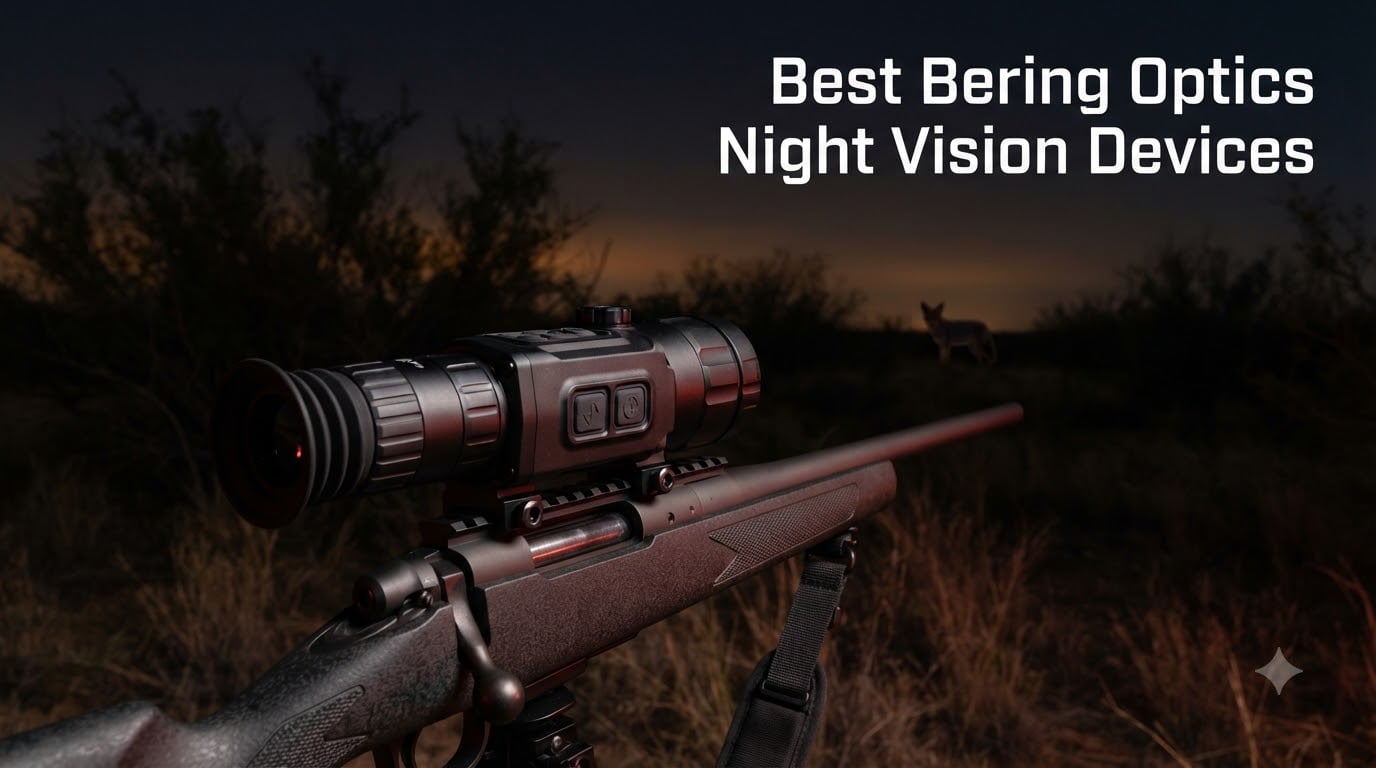
5 Best Bering Optics Night Vision Devices In October 2026
I’ve spent the last three months taking Bering Optics night vision devices out on after-dark coyote hunts in West Texas,…


Ever stood outside at night gazing at stars, then sat in science class staring at pond water? These two experiences reveal the fundamental difference between two of science’s most important optical instruments.
The main difference between a telescope and a microscope is their purpose: telescopes magnify distant objects like stars, planets, and galaxies, while microscopes magnify tiny nearby objects like cells, bacteria, and microorganisms.
After teaching physics for 15 years and helping hundreds of students choose between these instruments, I’ve seen how understanding this difference transforms scientific curiosity into genuine discovery.
Both tools extend human vision beyond our natural limits, but in completely opposite directions.
| Feature | Telescope | Microscope |
|---|---|---|
| Primary Purpose | View distant celestial objects | View tiny nearby specimens |
| Object Distance | Infinity (beyond focal point) | Near (within focal length) |
| Typical Magnification | 30x – 500x | 40x – 2000x+ |
| Objective Lens | Large aperture, long focal length | Small aperture, very short focal length |
| Light Source | Reflected from distant object | Illuminated from below/through specimen |
| Main Applications | Astronomy, stargazing, bird watching | Biology, medicine, laboratory research |
A telescope is an optical instrument designed to gather light from distant objects and magnify them for detailed observation.
Telescope: An optical instrument that uses lenses or mirrors to collect and focus light from distant objects, making them appear larger and clearer to the observer.
Telescopes work on a simple principle: gather as much light as possible from a faint, distant source and focus it to create a magnified image.
The larger the aperture (opening), the more light the telescope collects and the fainter the objects you can see.
Telescopes use an objective lens or primary mirror to collect light from distant objects and bring it to a focus.
The eyepiece lens then magnifies this focused image for your eye to see.
Quick Summary: Light from distant stars enters the telescope, gets focused by the objective lens or mirror, then magnified by the eyepiece. The result is a brighter, enlarged image.
In a refracting telescope, light passes through glass lenses.
In a reflecting telescope, mirrors bounce light to create the image.
With a beginner telescope, you can observe craters on the Moon, the rings of Saturn, Jupiter’s moons, and even distant galaxies and nebulae.
I’ve seen students’ faces light up when they first see Saturn’s rings through a telescope.
That moment of discovery makes the telescope an incredibly powerful educational tool.
A microscope is an optical instrument designed to magnify tiny objects that are invisible or barely visible to the naked eye.
Microscope: An optical instrument that uses lens systems to produce greatly magnified images of tiny objects, allowing detailed observation of specimens invisible to the naked eye.
Microscopes illuminate specimens from below and use multiple lenses to achieve extremely high magnification.
The compound microscope, most common in laboratories, uses two lens systems working together.
Light from an illuminator passes through the specimen on a glass slide.
The objective lens, positioned very close to the specimen, creates a magnified real image.
The eyepiece lens then further magnifies this image for your eye to view.
Quick Summary: Light illuminates the specimen from below, the objective lens creates the first magnification, and the eyepiece provides additional magnification for final viewing.
This two-stage magnification system is why microscopes achieve such incredible power.
A basic compound microscope reveals an entire hidden world: single-celled organisms, blood cells, plant cell structures, crystals, and microscopic insects.
I’ve spent hours watching protozoa dart across a microscope slide.
It’s fascinating to realize this microscopic universe exists everywhere, completely unnoticed without the right instrument.
Microscopes generally offer much higher magnification than telescopes.
A typical compound microscope provides 40x to 2000x magnification, enough to see bacteria and individual cells.
Telescopes usually range from 30x to 500x, sufficient to observe planetary details and deep-sky objects.
The key difference lies in their design purpose: microscopes need extreme magnification for tiny objects, while telescopes prioritize light gathering over pure magnification.
Both instruments use lenses, but in completely different configurations.
Telescopes have a large objective lens or mirror with a long focal length to capture light from distant objects.
The eyepiece in a telescope has a short focal length to magnify the focused image.
Microscopes use an objective lens with a very short focal length positioned close to the specimen.
This creates a highly magnified real image that the eyepiece further enlarges.
In a telescope, the object being viewed is essentially at infinity, far beyond the focal point of the objective lens.
In a microscope, the specimen is placed just inside the focal point of the objective lens.
This fundamental difference in object distance determines how each instrument handles light and creates magnified images.
Telescopes generally offer a wider field of view at low magnification, narrowing at higher powers.
Microscopes have an extremely narrow field of view even at low magnification because you’re looking at such a tiny area.
This difference reflects their different purposes: scanning the sky vs examining microscopic details.
The choice between telescope and microscope depends entirely on your interests.
Choose a telescope if you love looking at the night sky and want to explore the universe.
Choose a microscope if you’re fascinated by the hidden world of tiny things and enjoy hands-on discovery.
For students interested in science, both instruments offer valuable learning experiences.
I recommend starting with whichever subject excites you more – the cosmic scale or the microscopic world.
The main difference is their purpose: telescopes magnify distant objects like stars and planets, while microscopes magnify tiny nearby objects like cells and microorganisms.
Microscopes generally have much higher magnification than telescopes. Compound microscopes can achieve 1000x to 2000x magnification, while telescopes typically range from 30x to 500x.
No, a telescope cannot be effectively used as a microscope. They have different optical designs for different purposes – telescopes focus on distant objects while microscopes focus on nearby specimens.
Both use convex lenses primarily, but in different arrangements. Telescopes use a large objective lens or mirror with long focal length. Microscopes use an objective lens with very short focal length placed close to the specimen.
Both are excellent for students but serve different interests. Choose a telescope for astronomy enthusiasts who want to explore space. Choose a microscope for students interested in biology and the microscopic world.
With a telescope you can see the Moon’s craters, Saturn’s rings, Jupiter’s moons, stars, galaxies, and nebulae. With a microscope you can see cells, bacteria, crystals, insects, and other microscopic specimens.


