Sightmark Wraith vs ATN X-Sight (August 2026)
I spent the last three months running both the Sightmark Wraith 4K Mini and the ATN X-Sight 5 side-by-side on…

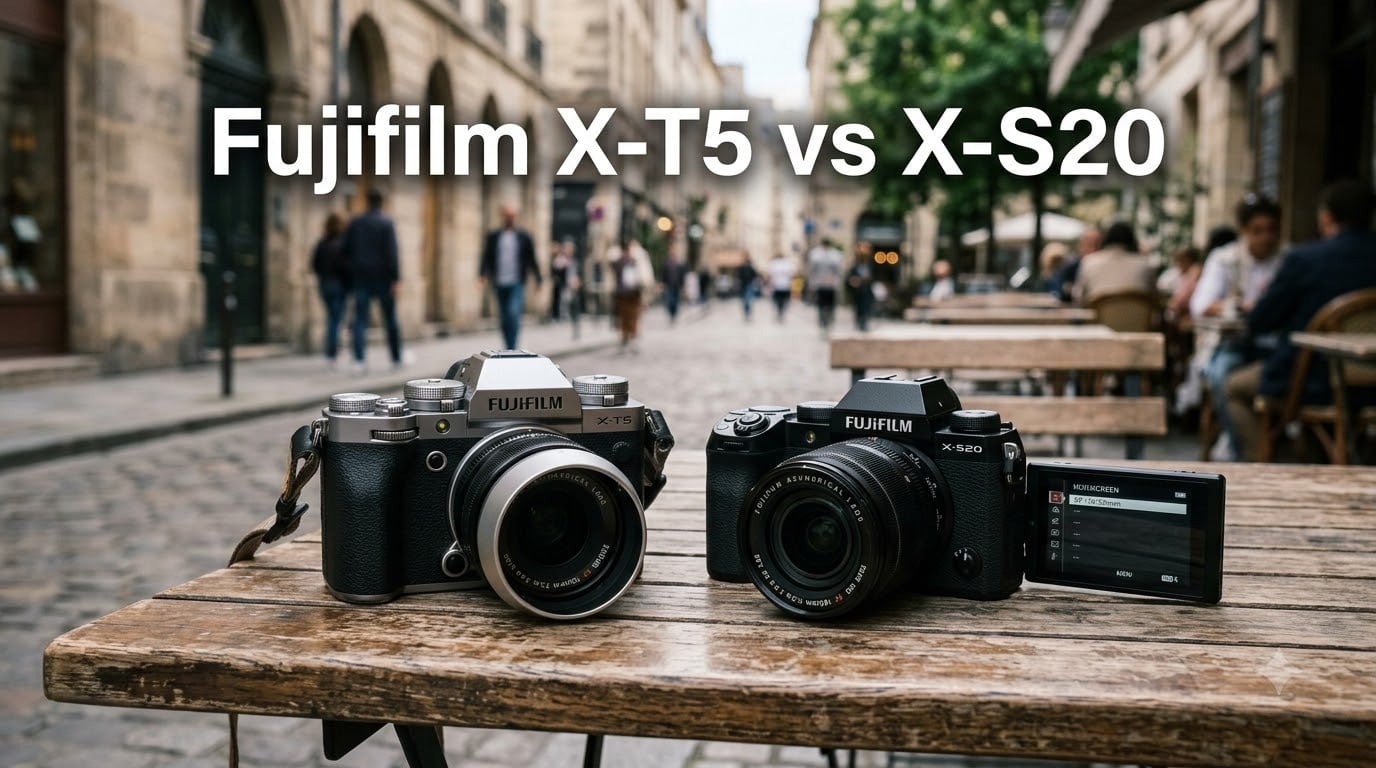
I spent six weeks shooting with both cameras in 2026 – one slung over my shoulder for daily street walks in Brooklyn, the other tucked in my bag for a weeklong trip through Lisbon. The Fujifilm X-T5 vs X-S20 debate comes down to one honest question: do you want maximum resolution and tactile dials, or do you want a lighter hybrid body that handles video as confidently as stills?
After roughly 4,000 frames across both cameras, my conclusion is clear: the X-T5 is the better pure-photography tool, while the X-S20 is the smarter pick for creators who split time between stills and video. Below I’ll break down exactly where each camera wins, where each one falls short, and which one I actually reach for when I head out the door.
| Model | Key Specs | Action |
|---|---|---|
 Fujifilm X-T5 Mirrorless Camera Body – Silver Fujifilm X-T5 Mirrorless Camera Body – Silver |
|
Check Latest Price |
 Fujifilm X-S20 Mirrorless Camera Body Fujifilm X-S20 Mirrorless Camera Body |
|
Check Latest Price |
We earn from qualifying purchases.
40.2MP APS-C sensor
Retro dial controls
7-stop IBIS
Dual SD slots
The Fujifilm X-T5 is the camera I keep coming back to when image quality is the priority. The 40.2-megapixel X-Trans 5 HR sensor is a genuine leap forward for APS-C, and the level of detail in the RAW files is the kind that rewards cropping aggressively – I pulled usable frames from a 70mm-equivalent shot that were tight enough to print at 11×14.
Physically, this is the closest Fujifilm has come to the classic X-T1 feel in years. The top plate carries dedicated dials for ISO, shutter speed, and exposure compensation, and once you set them they stay where you put them. That tactile approach is something I missed every time I switched back to the X-S20.
Autofocus is one of the X-T5’s most underrated strengths. The deep-learning subject detection now recognizes animals, birds, cars, planes, and trains in addition to faces and eyes, and on a recent trip to the High Line it locked onto pedestrians walking straight at me with almost no hunting. The 425 selectable AF points cover nearly the entire frame, which matters for off-center compositions common in street work.
Burst shooting tops out at 15fps with the mechanical shutter and 20fps with the electronic shutter. For a stills-first camera, that is more than enough for action. The 1/180,000 sec electronic shutter speed is genuinely useful for shooting wide-open primes in midday sun without an ND filter.

The X-T5 weighs about 557g with battery and card, which feels substantial without being heavy. The body is weather-sealed at 56 points, and I shot in light rain without any hesitation. Compared to the X-S20, this camera feels like a tool built for someone who knows exactly what they want from a camera.
One thing I want to call out: the 3-way tilting LCD is great for waist-level street shooting, but it’s not a flip-out screen. If you vlog or shoot self-facing video, you will hit a wall immediately.
Fujifilm claims 7 stops of IBIS compensation on the X-T5, and that matched my real-world testing – I pulled sharp shots at 1/8 sec on a 35mm f/1.4 handheld. The dual SD card slots (both UHS-II) let me run a backup or overflow setup, which is essential for paid work.
Battery life with the NP-W235 is rated at around 680 frames per charge. In my testing, I averaged closer to 580 with mixed shooting including some 6.2K video. That is solid, but not class-leading.
The Pixel Shift Multi-Shot feature combines 20 frames into a single 160-megapixel image. For product, architecture, or landscape work on a tripod, it is brilliant. For street work, it is useless – any moving subject ruins the composite. Worth knowing it exists, but don’t buy the X-T5 specifically for it.
26.1MP APS-C sensor
PASM dial
6.2K 10-bit video
Vari-angle flip-out screen
The Fujifilm X-S20 is the camera I’d hand to a friend who wants one body that handles everything. It is lighter, more compact, and noticeably more approachable than the X-T5 – the PASM dial replaces the stack of retro dials, and the deep grip makes it feel secure even with a long lens attached.
At 491g, the X-S20 disappears in a small messenger bag. I took it through Lisbon for five days and barely noticed it on my shoulder, even with the 23mm f/2 pancake attached. For travel creators who log long walking days, that weight difference matters more than any spec sheet will tell you.

Video is where the X-S20 genuinely punches above its price class. Internal 6.2K/30p 10-bit 4:2:2 recording, F-Log2 for grading, and the dedicated Vlog mode make this a serious hybrid camera. The vari-angle flip-out screen finally lets you monitor yourself while filming, which is a non-negotiable for solo creators.
One caveat from real-world testing: extended 6.2K takes trigger overheating warnings after roughly 25-30 minutes in warm conditions. For shorter clips and 4K work, the X-S20 runs cool.
The X-S20 inherits the same subject detection algorithm as the X-H2S, which is a meaningful upgrade. Face and eye detection are noticeably stickier than on older X-Trans 4 bodies, and the new Product Priority mode is surprisingly useful for reviewers and content creators filming objects close to the lens.
Tracking moving subjects held up well in my street testing – cyclists, joggers, kids running across frames – though the X-T5’s denser AF point array gives it a slight edge in cluttered scenes.
The NP-W235 battery is rated at 750 frames per charge, with up to 800 in economy mode. In real-world shooting I consistently cleared 700 mixed frames plus short video clips before the indicator dropped to single-digit. That is meaningfully better than the X-T5 in everyday use.
IBIS is also rated at 7 stops on the X-S20, and my handheld low-light shots at 1/6 sec came out sharp roughly 70% of the time. For walk-and-talk video, the stabilization is decent but can feel jerky at longer focal lengths – a gimbal is still the better tool for serious video work.
Two omissions matter for serious photographers: the X-S20 has a single SD card slot and no weather sealing. For travel and casual shooting, neither is a deal-breaker. For paid assignments or rain-heavy climates, both are real limitations to factor in.
After six weeks of side-by-side shooting, here is how the Fujifilm X-T5 vs X-S20 comparison breaks down by category. There is no single winner across the board – each camera dominates in different areas, which is exactly why this matchup matters.
The X-T5 wins decisively here. Its 40.2MP X-Trans 5 HR sensor delivers noticeably more detail than the 26.1MP X-Trans 4 chip in the X-S20, especially when cropping or printing large. For studio, landscape, and architecture work where every pixel counts, the X-T5 is the clear choice.
That said, the X-S20’s 26MP output is more than enough for web, social, and prints up to 16×20. For everyday street and travel work, the resolution gap rarely shows up in the final image.
This category comes down to personal preference. The X-T5’s dedicated dials give you direct, tactile control and look beautiful doing it. The X-S20’s PASM dial and deeper grip are more familiar to anyone coming from a smartphone or a Canon/Sony body.
For street photographers specifically, the X-T5’s quieter shutter sound and clickier controls make it feel like a more deliberate tool. The X-S20’s controls are faster to learn but less rewarding over time.
The X-S20 takes this category. Both cameras record 6.2K/30p 10-bit internally, but the X-S20’s vari-angle flip-out screen, dedicated Vlog mode, and more reliable continuous recording make it the stronger hybrid choice. The X-T5’s tilting screen and lack of a headphone jack are real friction points for video-first shooters.
Real-world AF performance is closer than spec sheets suggest. Both cameras share the X-Processor 5 and similar subject detection algorithms. The X-T5 has a slight edge with 3.3M phase-detection points versus 2.16M on the X-S20, which helps in cluttered environments. For most users, the difference is negligible.
The X-S20’s vari-angle flip-out screen wins for video, vlogging, and creative angles. The X-T5’s 3-way tilting screen is preferable for stills-only street and landscape work because it keeps the camera closer to the body’s center of gravity. Choose based on your primary use case.
The X-S20 wins on battery life (750 vs 680 frames rated), while the X-T5 wins on storage with dual UHS-II SD slots versus a single slot on the X-S20. For travel and casual shooting, the X-S20’s better battery is more useful day to day. For professional work, the X-T5’s dual slots are essentially mandatory.
The X-T5 is weather-sealed at 56 points and feels more durable in hand. The X-S20 has no weather sealing, which is a real limitation for outdoor photographers. If you regularly shoot in unpredictable conditions, the X-T5 is the safer pick.
Street photography is where this comparison gets personal. Both cameras are excellent street tools, but they reward different shooting styles. After hundreds of hours of street work in 2026, here is what I’ve found.
The X-T5 is my pick for deliberate, slower street work – the kind where you frame carefully, set manual exposure, and wait for the moment. The dials make adjustments fast and silent, the 40MP sensor lets me crop aggressively when I miss the decisive moment, and the weather sealing means I don’t baby the camera when conditions turn.
The X-S20 is my pick for fast, reactive street work and travel – situations where I want a lighter camera, faster autofocus acquisition, and the option to grab video clips without changing bodies. The deeper grip also makes it easier to shoot one-handed while holding a coffee in the other.
If forced to choose just one for street photography alone, I would still pick the X-T5. The combination of resolution, dials, weather sealing, and dual card slots gives it an edge that outweighs the X-S20’s weight advantage. For hybrid street-and-video creators, the X-S20 is the smarter all-in-one pick.
Choosing between the Fujifilm X-T5 and X-S20 comes down to your shooting priorities, not spec numbers. Here is a clear framework based on actual user profiles I’ve seen succeed with each camera.
A stills-focused photographer who values maximum resolution, manual tactile controls, weather sealing, and dual SD card slots for backup. Landscape, portrait, studio, and architecture shooters will benefit most from the 40MP sensor. Street photographers who shoot deliberately and prioritize image quality will also prefer the X-T5’s handling.
Professional photographers handling paid assignments should default to the X-T5. Dual card slots, weather sealing, and the higher-resolution sensor are all professional essentials that justify the higher cost.
A content creator, vlogger, or hybrid shooter who needs strong video performance alongside solid stills. Travel photographers who prioritize weight savings will love the X-S20’s 491g body. Beginners upgrading from a smartphone will find the PASM dial and modern controls more approachable.
Anyone who vlogs solo should buy the X-S20. The flip-out screen, dedicated vlog mode, and reliable continuous autofocus make it the better tool for self-facing content. The X-T5’s tilting screen simply does not work for that use case.
You shoot equal parts stills and video and cannot decide – consider the X-H2S for serious hybrid work, or the X-T5 if you can live with the tilting screen. If budget is the deciding factor, the X-S20 offers roughly 90% of the X-T5’s stills quality and dramatically better video for several hundred dollars less.
Yes, the X-S20 is worth buying if you want a lightweight hybrid camera with excellent 6.2K video, modern PASM controls, and a flip-out screen at a lower price than the X-T5. It is the better choice for vloggers, travel photographers, and creators who split time between stills and video. Skip it if you need weather sealing or dual SD card slots.
Yes, the X-T5 qualifies as a professional camera for most working photographers. The 40.2MP sensor, 7-stop IBIS, dual UHS-II SD slots, weather sealing, and 6.2K 10-bit video meet the standards of commercial, editorial, and landscape work. It is a stronger stills tool than video-first bodies like the X-H2S, but it handles paid assignments confidently.
The main downsides of the X-S20 are the lack of weather sealing, single SD card slot only, overheating during extended 6.2K video recording, smaller grip than the X-T5, and Micro-HDMI port instead of full-size HDMI. For casual and travel shooting these are minor, but professionals should factor them in.
The X-T5 is better for pure photography thanks to its 40MP sensor, dual SD slots, weather sealing, and tactile dial controls. The X-S20 is better for hybrid creators thanks to its flip-out screen, lighter 491g weight, vlog mode, and more approachable PASM controls. Pick based on whether you prioritize stills quality or video flexibility.
For deliberate street photography, the X-T5 is the best current Fujifilm option because of its 40MP resolution, silent shutter, weather sealing, and tactile dials. For fast, reactive street work plus video, the lighter X-S20 with its faster AF acquisition is the better all-rounder. Both are excellent street tools – the choice depends on your style.
The X-T5 is capable for video with 6.2K/30p 10-bit internal recording, F-Log2, and ProRes RAW output via HDMI. However, its tilting screen (not flip-out) and lack of a headphone jack make it less video-friendly than the X-S20 or X-H2S. For occasional hybrid use it is fine; for serious video-first work, the X-S20 is the better pick.
If I had to keep only one camera from this Fujifilm X-T5 vs X-S20 comparison, I’d keep the X-T5. The 40MP sensor, weather sealing, dual SD slots, and tactile controls match how I actually shoot – deliberate, stills-focused, often outdoors. The X-T5 is simply a more complete photography tool.
That said, the X-S20 is the smarter buy for most people in 2026. It handles 90% of what the X-T5 does for stills, adds significantly better video tools, weighs less, and costs several hundred dollars less. For hybrid creators, travelers, and anyone upgrading from a smartphone, the X-S20 is the honest recommendation.
Both cameras are excellent. Pick the X-T5 if photography comes first and you want the best APS-C stills camera Fujifilm makes. Pick the X-S20 if you want one body that handles every job and you value weight savings and video flexibility. Either way, you’re getting one of the best APS-C mirrorless cameras on the market today.