
8 Best Lens Pouches and Wraps (September 2026)
Last summer, I watched a fellow wedding photographer fumble through her backpack on a sandy beach while a bride waited.…

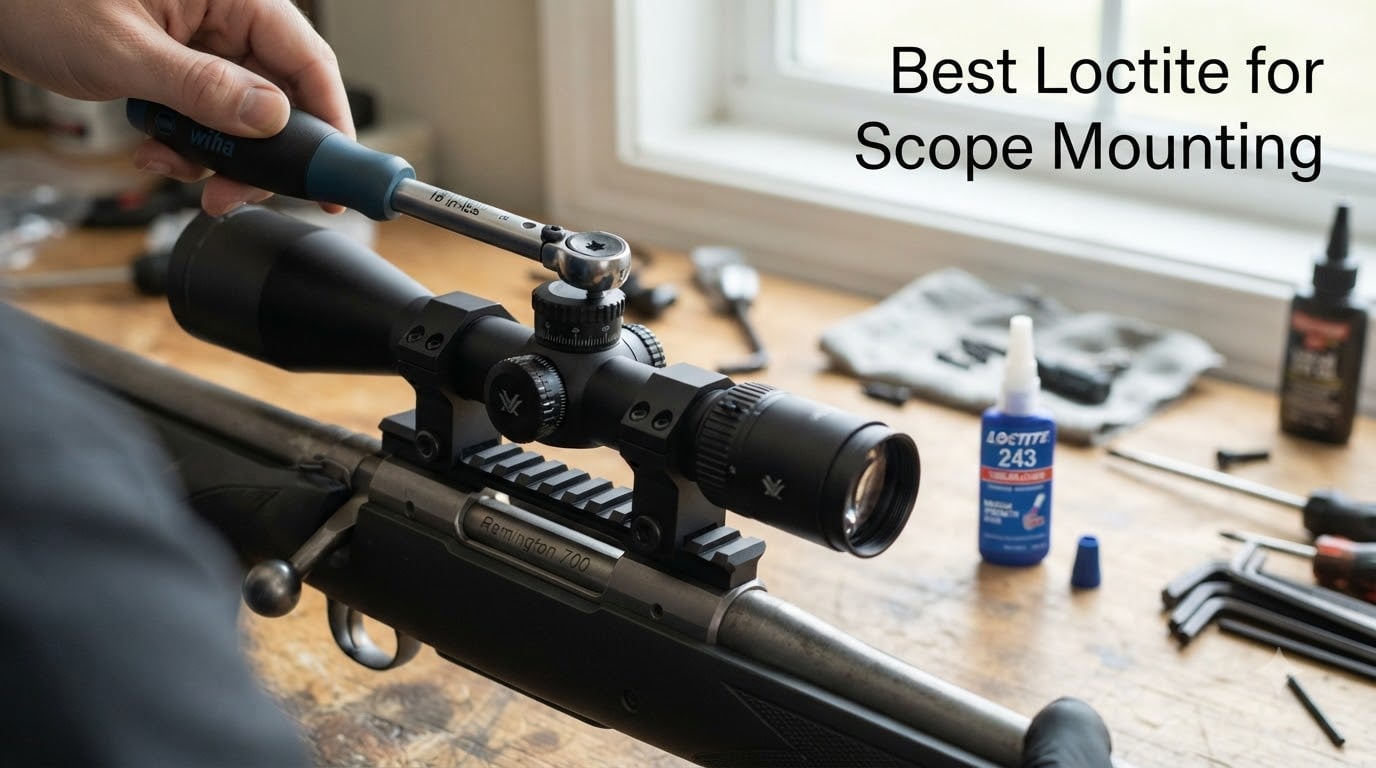
If you have ever watched a rifle group wander open up over a hunting season, or lost zero between range sessions, the culprit is almost always loose scope screws. Choosing the best Loctite for scope mounting is the single cheapest insurance policy you can buy for your optic, but picking the wrong product, or applying it the wrong way, can be just as damaging as using nothing at all. After testing dozens of mounting jobs on bolt-action, AR-platform, and semi-auto rifles, and digging through thousands of forum threads, our team has put together the definitive guide for 2026.
We will walk through the Loctite color system, the exact products professional gunsmiths reach for, the wet-versus-dry torque issue that catches most shooters off guard, and the controversy around what Vortex itself tells customers. By the end, you will know which Loctite to buy, how much torque to use, and when to skip threadlocker entirely.
Loctite is a brand name for a family of anaerobic threadlocker adhesives made by Henkel. When the liquid is trapped between two close-fitting metal surfaces with no air, it cures into a hard thermoset plastic that resists vibration, heat, and chemical attack. That sounds dramatic for a tube that costs less than a fast-food lunch, but the science is exactly why every aerospace mechanic and gunsmith in the country keeps a bottle on the bench.
Scope mount screws live in a brutal environment. Every shot sends a shockwave through the receiver, and on semi-auto rifles that shock happens four to ten times per second. Without threadlocker, the screws slowly back themselves out a few thousandths of an inch at a time, and that micro-movement is enough to shift point of impact by an inch or more at 100 yards. The right threadlocker for scope mounting keeps that from ever happening.
There are three things to understand before you pick a tube. First, threadlocker strength is rated by color and you cannot eyeball it. Second, Loctite acts as a lubricant until it cures, which changes how much torque you actually need. Third, not every manufacturer wants you using it on their scopes, and we will explain why later in this guide.
Loctite color is not marketing. Each color is a different strength rating, and the difference between Purple and Red is roughly a tenfold jump in breakaway torque. Memorizing the system saves you from shearing a screw off or never getting a ring cap off again.
Purple 222 is rated for screws up to a quarter inch in diameter, with a breakaway torque of about 53 inch-pounds. It is designed for small fasteners, adjustment screws, and components you may want to remove often. Cure time on steel is roughly 10 minutes for handling strength and 24 hours for full cure.
For scope work, 222 is the right call on the tiny screws that hold windage caps, reticle illumination batteries, or some set-screw style rings. It is overkill as a primary threadlocker on base screws because the bond is too weak to handle serious recoil.
Blue 242 is the workhorse of the threadlocker world. It is rated for fasteners up to three-quarter inch with a breakaway torque around 110 inch-pounds on steel. Cure time matches Purple at about 10 minutes handling, 24 hours full. Blue 243 is a slightly newer formula with better oil tolerance, meaning it will cure even if the screw threads are not perfectly clean. For most scope mounting jobs, the choice between 242 and 243 comes down to how clean your screws are, not which is stronger.
This is the strength range that 90 percent of shooters should be using on scope base screws and ring screws. It holds through recoil, but it still releases cleanly with a hand tool and applied heat when you need to remove it.
Red 271 is rated for fasteners up to one inch and requires about 230 inch-pounds of breakaway torque to remove once cured. Heat above 500 degrees Fahrenheit is usually needed for disassembly. It is the right product for cylinder head studs, motor mount bolts, and press-fit assemblies that should never come apart.
It is the wrong product for almost every scope mounting scenario, and we will dig into that warning in detail in the next section.
The short answer most shooters want: Loctite 243 (Blue) for scope base screws and ring screws on any rifle, with Loctite 222 (Purple) reserved for small set screws and adjustment hardware. This is also what most professional gunsmiths reach for on the bench, including the consensus we found across r/gunsmithing, Rokslide, Sniper’s Hide, and Accurate Shooter forums.
Here is the breakdown by use case.
Use Loctite 243. The base screws on a Picatinny or Weaver base typically run 8-32 or 10-32 thread, which sits right in the sweet spot for Blue 243. The oil-tolerant formula is forgiving if the screws have any leftover factory oil, and the medium-strength bond holds through thousands of recoil cycles without loosening.
If your screws are spotlessly clean and you want the slightly faster cure of the older formula, Loctite 242 is equally valid. The real-world difference between the two for scope base work is small enough that experienced shooters split roughly 50/50.
Use Loctite 243 or 242. Ring cap screws see a lot of clamping force but smaller thread diameters, and Blue threadlocker handles both well. The medium-strength bond also lets you re-torque or swap rings without needing a heat gun.
Skip the temptation to skip threadlocker on ring screws because they get retorqued anyway. The screws still vibrate loose between range sessions if they are not bonded.
Use Loctite 222. These tiny fasteners are exactly what Purple 222 was designed for, and using a stronger threadlocker risks stripping the small hex heads when you eventually service the optic. If the set screw is on a non-critical part, some gunsmiths even skip the threadlocker in favor of a tiny dab of blue Remington nail polish.
Red Loctite 271 and 262 are permanent threadlockers. Once cured, they require 230 inch-pounds of breakaway torque and usually 500 degrees of heat to release. On a steel scope ring screw going into an aluminum scope body, that is a recipe for stripping threads, rounding hex heads, or damaging the optic tube.
The other problem is operational. Scopes get removed for storage, swapped between rifles, and sent in for warranty service. If you bond the ring screws with Red Loctite, every one of those tasks becomes a repair project instead of a maintenance task.
Save Red 271 for thread-locking a muzzle brake, pinning a gas block, or any fastener you genuinely never want to come apart. For scope mounting, it has no upside and significant downside.
This is the part most scope mounting guides skip, and it is the reason Vortex and other scope manufacturers tell customers to avoid Loctite entirely. Until Loctite cures, it acts as a thread lubricant. That means a screw torqued to spec on dry threads will actually be tightened far beyond spec the moment threadlocker is added.
The industry terms for this are dry torque (no thread lubricant) and wet torque (with thread lubricant or wet threadlocker). Loctite publishes a chart showing that wet torque values are typically 50 to 70 percent of dry torque values for the same fastener. In other words, if you torque a dry screw to 25 inch-pounds and then add Loctite, the effective clamp load after curing is closer to 35 to 40 inch-pounds.
The practical takeaway. If your scope manufacturer specifies a torque value, assume that value is the dry torque rating. Use a torque wrench and reduce the applied torque by roughly 30 percent when using Loctite, then let it cure before final use. Many experienced shooters back the calculated wet-torque value off another 10 percent just to be safe.
This is also the reason cheap beam-type torque wrenches and click-type torque wrenches are non-negotiable tools for scope mounting. You cannot eyeball 15 inch-pounds, and the difference between proper torque and stripped threads is about five inch-pounds of wrench movement.
Application matters as much as product choice. A messy application can wick into places it does not belong, or cure unevenly because the threads were not prepped. Here is the step-by-step process our team uses on every build.
Wipe each screw with a clean rag soaked in isopropyl alcohol or brake cleaner. Factory screws arrive coated in oil, and even fingerprint oils will block Loctite from curing properly. If you are using Loctite 243, light oil contamination is acceptable. For 242 or 222, take the extra five minutes to degrease thoroughly.
Thread each screw in by hand first to confirm the threads mate cleanly. Cross-threaded screws will not cure evenly, and you can damage the receiver this way. If a screw feels gritty going in, stop and chase the threads with a proper tap.
Place one or two drops of Loctite on the threads, roughly the middle two-thirds of engagement length. Do not coat the first two threads, because that is where the screw meets the receiver and excess Loctite will squeeze out into the action.
Thread the screw in until it is hand-snug, then torque to roughly 70 percent of the manufacturer’s dry-torque spec. For most scope base screws that means 15 to 20 inch-pounds instead of the usual 25. If the manufacturer does not list a wet-torque number, our rule of thumb is to start 30 percent low, fire a three-shot group, and confirm zero before final use.
Loctite reaches handling strength in about 10 minutes and full strength in 24 hours. Do not shoot the rifle for at least an hour after mounting, and ideally wait overnight before heading to the range. Heat accelerates cure, so a hair dryer on low can speed the process in cold weather.
Threadlocker is not a one-brand category. A few alternatives show up repeatedly on r/gunsmithing and Sniper’s Hide when shooters want something a little different.
Vibra-TITE VC-3 is a medium-strength threadlocker with a slightly lower breakaway torque than Blue Loctite, which makes it easier to remove with hand tools. It is the most-mentioned alternative in the Accurate Shooter forum threads on scope mounting, and several professional gunsmiths prefer it for that exact reason. It also tolerates oily threads better than 242.
Rocksett is a high-temperature ceramic threadlocker used heavily on muzzle brakes and suppressors. It is overkill for scope mounting, but it works, and some precision rifle shooters use it on the action screws of bedding systems for extra security.
Yes, really. Clear nail polish works as a low-strength threadlocker in a pinch, and several forum regulars use it on windage screws and bubble levels. The bond is weaker than Purple 222 and brittle with age, but for non-critical small fasteners it is a legitimate option when you have no threadlocker on hand.
No. Vortex Optics, one of the largest scope manufacturers in the country, explicitly tells customers not to use Loctite or similar threadlockers on their mounting screws. Their published reasoning is that threadlocker acts as a lubricant and can cause the installer to over-torque the screws, which then damages the scope tube or warps the ring system. That same wet-versus-dry torque issue we covered above is exactly the failure mode they are warning about.
Vortex’s official position is that proper torque without threadlocker is sufficient for their optics, and they will not warranty damage caused by threadlocker use. Other manufacturers fall on both sides of the debate, with Leupold and Nightforce generally silent on the topic and primary arms competitors like Athlon and Primary Arms leaving it to the installer.
The middle path that respects the manufacturer stance is the one we use: torque to a known value on a calibrated wrench, use Blue 243 only on base screws (not ring screws that bear directly on the scope tube), and reduce wet torque by roughly 30 percent from the published dry value.
These are the failure modes we see repeatedly on forums and in our own test bench work.
The single biggest mistake is using Loctite without reducing torque. If the dry spec is 25 inch-pounds and you torque to 25 inch-pounds wet, you have effectively tightened the screw to 35 to 40 inch-pounds once the threadlocker cures. On an aluminum scope body that is enough to compress the tube and shift point of impact, or worse, crack the scope.
Every few months a forum post shows up from a shooter who bonded their rings with Red 271 and now cannot get the optic off for service. Do not be that person. Use Blue for almost everything scope-related.
Loctite cures through contact with metal in an air-free environment. Oil, grease, cosmoline, and even fingerprint oils will stop the cure in patches, leading to a screw that feels tight during installation but loosens over time. Always degrease first.
Once Loctite has cured on a fastener, removing and reinstalling the same screw means scraping off the cured residue and reapplying fresh threadlocker. Old cured Loctite flakes will contaminate the new application and create weak spots.
Hand-tight plus a quarter turn is not a torque spec. If you are going to use Loctite, you need a torque wrench rated for the low inch-pound range that scope work requires. A 1/4 inch drive click-type wrench with inch-pound scale is the standard tool.
Most professional gunsmiths reach for Loctite 243 (Blue) as their default scope mounting threadlocker. It is medium strength, oil tolerant, and holds base screws and ring screws through recoil without making future removal impossible. Purple Loctite 222 is reserved for small set screws on windage caps and bubble levels, while Red Loctite 271 is almost never used on scopes because it is a permanent bond.
Both work for scope base screws. Loctite 242 is the original Blue medium-strength formula and requires very clean threads to cure properly. Loctite 243 is the newer oil-tolerant version that cures reliably even on lightly oiled screws. For most rifles, 243 is the safer pick because factory screws almost always carry trace oil. The strength difference between them is negligible.
Use Blue Loctite 243 on base screws and ring cap screws, and Purple Loctite 222 on small set screws, windage caps, and illumination batteries. Never use Red Loctite 271 or 262 on optics because the permanent bond makes warranty service and optic swaps extremely difficult. Always reduce applied torque by roughly 30 percent when using threadlocker to compensate for its lubricant effect.
No. Vortex Optics explicitly recommends against using Loctite or any threadlocker on their scope mounting screws. Their published reasoning is that threadlocker acts as a lubricant and can cause over-torquing that damages the scope tube. Vortex will not warranty damage caused by threadlocker use. Their recommended mounting method is a calibrated torque wrench without any threadlocker.
No. Red Loctite 271 and 262 are permanent threadlockers that require roughly 230 inch-pounds of breakaway torque and 500 degrees of heat to remove. Using them on scope ring screws risks stripping threads, rounding hex heads, and damaging the optic tube. Blue 242 or 243 is strong enough for any recoil a civilian rifle produces.
Apply localized heat above 500 degrees Fahrenheit with a heat gun or torch to soften cured Red Loctite, or use hand tools and penetrating oil for cured Blue Loctite. For Purple Loctite, hand tools usually release the screw without heat. After removal, clean the threads with isopropyl alcohol and a brass brush before applying fresh threadlocker, since cured residue interferes with the new bond.
For most shooters the answer is simple: buy a tube of Loctite 243 (Blue) for every scope base and ring screw, and keep a tube of Loctite 222 (Purple) on hand for small set screws and windage hardware. Apply the threadlocker to clean threads, torque to roughly 70 percent of the manufacturer’s dry-torque spec using a calibrated inch-pound wrench, and let it cure overnight before heading to the range.
If you are mounting a Vortex optic or any other scope whose manufacturer explicitly forbids threadlocker, follow their guidance and skip the Loctite entirely. Use a quality torque wrench and stick to the published torque values. The wet-versus-dry torque warning we covered earlier is exactly the failure mode Vortex is trying to help you avoid, and their guidance is sound for anyone who is not prepared to back off the torque spec.
If you want a removable alternative that does not carry the lubricant risk, Vibra-TITE VC-3 is the next product to consider. It is the most-mentioned substitute on the Accurate Shooter and Sniper’s Hide forums, and several professional gunsmiths prefer it over Blue Loctite for routine mounting work. Whichever route you take, the best Loctite for scope mounting in 2026 is the one you apply correctly, with a torque wrench, on clean threads. A cheap bottle of threadlocker and a 40 dollar torque wrench will protect a 1,500 dollar optic better than any marketing claim on the shelf.