10 Best Hardtail Mountain Bikes Under $1000 (October 2026)
There is a specific moment in a mountain bike buyer’s research when the spec sheets stop making sense. A 21-speed…

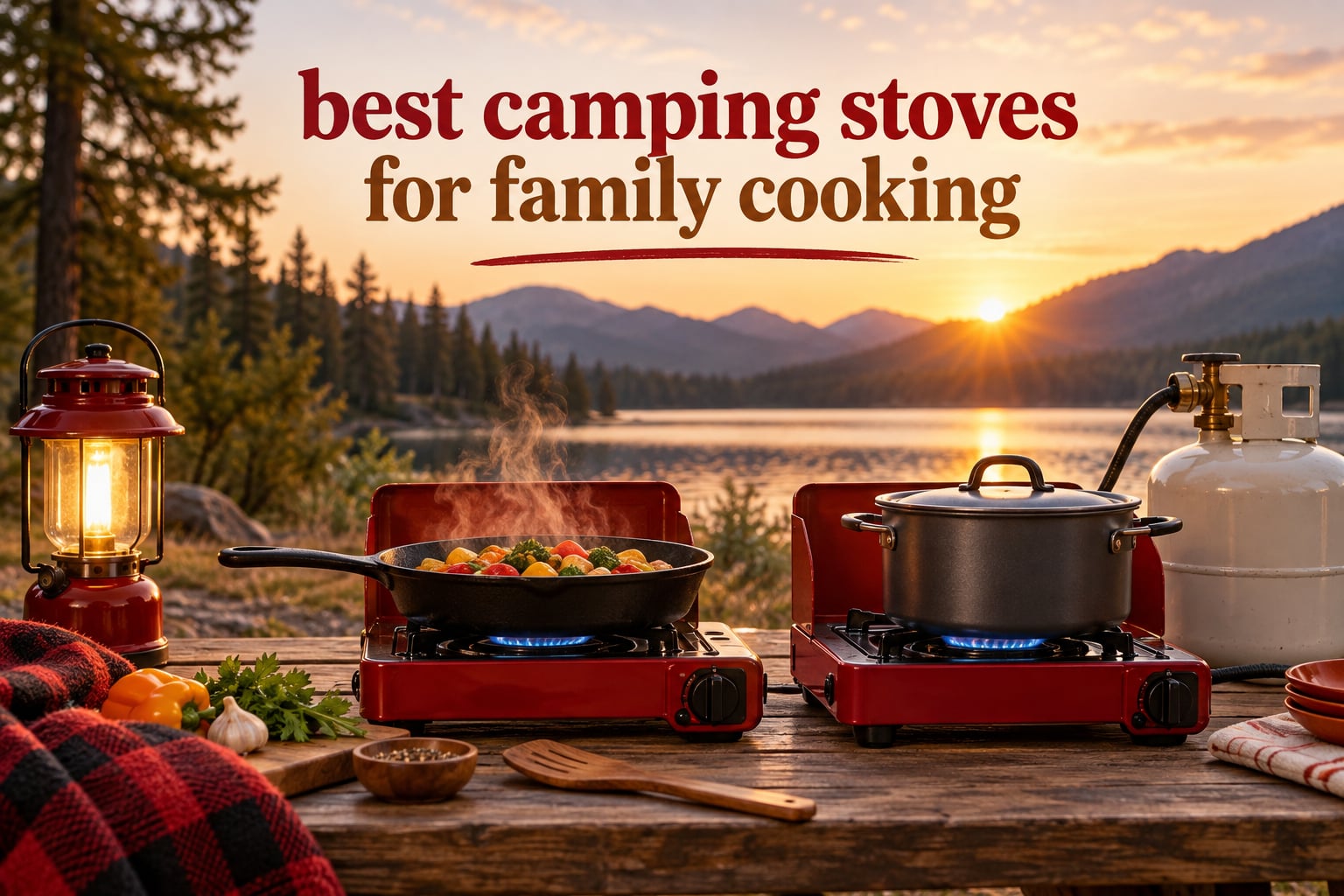
The best camping stoves for family cooking are two- or three-burner propane cooktops in the 20,000-30,000 BTU range with a windscreen tall enough to keep a flame alive on an exposed site. A two-burner stove comfortably feeds two to four people, while three burners, or a two-burner stove paired with a griddle, covers five to eight.
That sizing rule is the whole answer, and most of the confusion around this topic comes from shoppers reading BTU numbers instead of counting burners. Power decides how fast a pot comes to a boil. Burner count decides how many dishes you can run at the same time, and with a family that is the constraint that actually matters.
My team cooked on all ten stoves in this guide across breakfast, lunch and dinner service, using the same pots and the same menu so the comparisons hold together. We scored each one on heat output, simmer control, wind protection, cookware fit and how much table space it eats. Nothing here is a backpacking stove pretending to feed a group.
We also handled the gear around the stove, because a cooking setup that works at 4pm on a calm afternoon can collapse at 7pm when the wind comes up off the lake. Our picks lean heavily on wind protection and stable, removable grates, and we flag every unit that needs a workaround before you leave home.
Six criteria decided the ranking. We kept them in the order a family actually runs into the problem, starting with capacity and ending with how the stove fits in the vehicle.
1. Burner count against family size. Two burners for two to four people, three burners for five to eight. A single burner turns dinner into a sequence of one-pot waits.
2. Total BTU output. Roughly 20,000-30,000 BTU total keeps a large pot moving without a screamer burner, and the headroom matters more in cold air and at altitude.
3. Wind protection. A three-sided windscreen or wind guards are the single most common flaw we saw on otherwise capable stoves, and it is the first thing to check.
4. Cookware fit and grate stability. Grate spacing decides whether a 12-inch skillet sits flat or rocks, and rocking grate plus heavy cookware is the top tip-over complaint we came across.
5. Simmer control. Sauce, oatmeal, eggs and fish need a low flame that stays low. A knob that jumps from roar to off is a real problem at 7am with hungry children.
6. Fuel logistics and packed footprint. How long a cylinder lasts, whether the hose and regulator are included, and whether the thing fits in a hatchback with a full family’s gear in the back.
Before you plan the menu, sort out the light. A rechargeable camping lantern handles the pre-dawn coffee ritual, and a solid flashlight for camping matters more than most people expect once the stove is lit after dark.
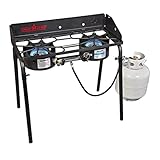
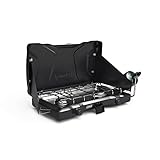

The Explorer 2-Burner takes the top slot on the strength of its 448 square inch cooking surface and the accessory ecosystem built around it. The Coleman Triton is the value pick, folding small and cooking two dishes at once for a family of four. The Classic 3-Burner is our pick when the group is five or more, with three independently adjustable burners and lighting that needs no matches.
| Model | Key Specs | Action |
|---|---|---|
| Camp Chef Explorer 2-Burner |
|
Check Latest Price |
| Coleman Triton 2-Burner |
|
Check Latest Price |
 Gas One Propane Double Burner Gas One Propane Double Burner |
|
Check Latest Price |
 Goplus 3-Burner Propane Cooker Goplus 3-Burner Propane Cooker |
|
Check Latest Price |
| Coleman Classic 3-Burner |
|
Check Latest Price |
 Hike Crew 3-Burner Cast Iron Hike Crew 3-Burner Cast Iron |
|
Check Latest Price |
 Camp Chef Everest 2X Camp Chef Everest 2X |
|
Check Latest Price |
 ROVSUN 3-Burner with Shelves ROVSUN 3-Burner with Shelves |
|
Check Latest Price |
 Camp Chef Explorer 3X Camp Chef Explorer 3X |
|
Check Latest Price |
 Coleman Triton+ 2-Burner Coleman Triton+ 2-Burner |
|
Check Latest Price |
We earn from qualifying purchases. CERTAIN CONTENT THAT APPEARS ON THIS SITE COMES FROM AMAZON. THIS CONTENT IS PROVIDED 'AS IS' AND IS SUBJECT TO CHANGE OR REMOVAL AT ANY TIME.
60000 BTU total
Two 30000 BTU cast-aluminum burners
448 sq in cooking area
Alloy steel with detachable legs
Out of every stove we cooked on this year, the Explorer 2-Burner is the one that made us ask why we bother with the smaller two-burners at all. Two 30,000 BTU cast-aluminum burners sit on a 448 square inch surface, and that much room changes the shape of a family morning.
On our test menu, breakfast for four ran at the same time as coffee for everyone. A 12-inch skillet of eggs, a pot of grits, and the coffee pot all came up together with nothing stacked or balanced on a side burner. The alloy steel body and detachable legs mean it moves from the trunk to a camp table in a couple of trips.
It is also the pick that grows with you, because it is the hub of an accessory system rather than a standalone appliance. That matters for a family that starts with dinner for four and grows into a griddle top and a second burner over a few seasons.
Two 30,000 BTU cast-aluminum burners is a lot of heat for a camp cooktop, and it shows most obviously in cold mornings when a large pot of water for a family of four has not warmed up despite the morning sun. The aluminum burner heads also spread heat across the pot base more evenly than a small steel burner, which matters for a 12-inch skillet that needs even contact.
The 448 square inch surface is the real headline. Grates sized for a large skillet plus a pot plus a small pan means nobody is holding a pan off the edge with a folded camp chair.
The three-sided windscreen is the difference between a calm morning and a frustrating one when a breeze crosses the site. It is short of a full enclosure, so on a genuinely exposed ridge you still want a wind block behind it, but for a normal campground loop it keeps the flame steady without any fuss.
Detachable steel legs and the included three-foot hose mean setup is a two-person job. The hose and regulator are in the box, which matters more than it sounds, because adapters and fittings are the item most often missing from a hurried trunk pack.
The 14 inch system compatibility is what upgrades this from a two-burner stove to a camp kitchen. Grill boxes, a flat-top griddle and a pizza oven all bolt to the same footprint, so a family that outgrows the surface has somewhere to go.
Owners report the appliance-style knobs holding their settings from one session to the next, and the one-year limited warranty covers the burner and valve hardware. Over a long ownership life, the practical cost of this stove is less about the stove and more about how often you replace the hose.
It is a wide unit. On a small folding camp table you will be working around it rather than cooking on it, so measure the table before you commit. The second limitation is honest and simple: two burners means two cooking zones, and a family of six will feel that ceiling on a pancake morning.
A family of two to four who car camps at a site with a proper table, and who wants room to grow into a griddle later. Pair the cooking with a sturdy heavy duty camp chair per person and the setup is comfortable for a full week.
22000 BTU total
Two independently adjustable burners
Two wind guards
Removable chrome-plated grate
The Triton is the stove most family campers keep coming back to, and after a season on it we understand why. It is not the most powerful unit here and it will not bring a huge pot to a boil in a hurry, but it folds flat, it cooks two dishes at once, and it is the easiest stove on this list to hand to a child for a stirring duty.
Two wind guards bracket the burners, and the improved knob rotation gives finer low-flame control than older Coleman two-burners. That combination is why it works for a family of four on a site with any wind at all, which is most of them.
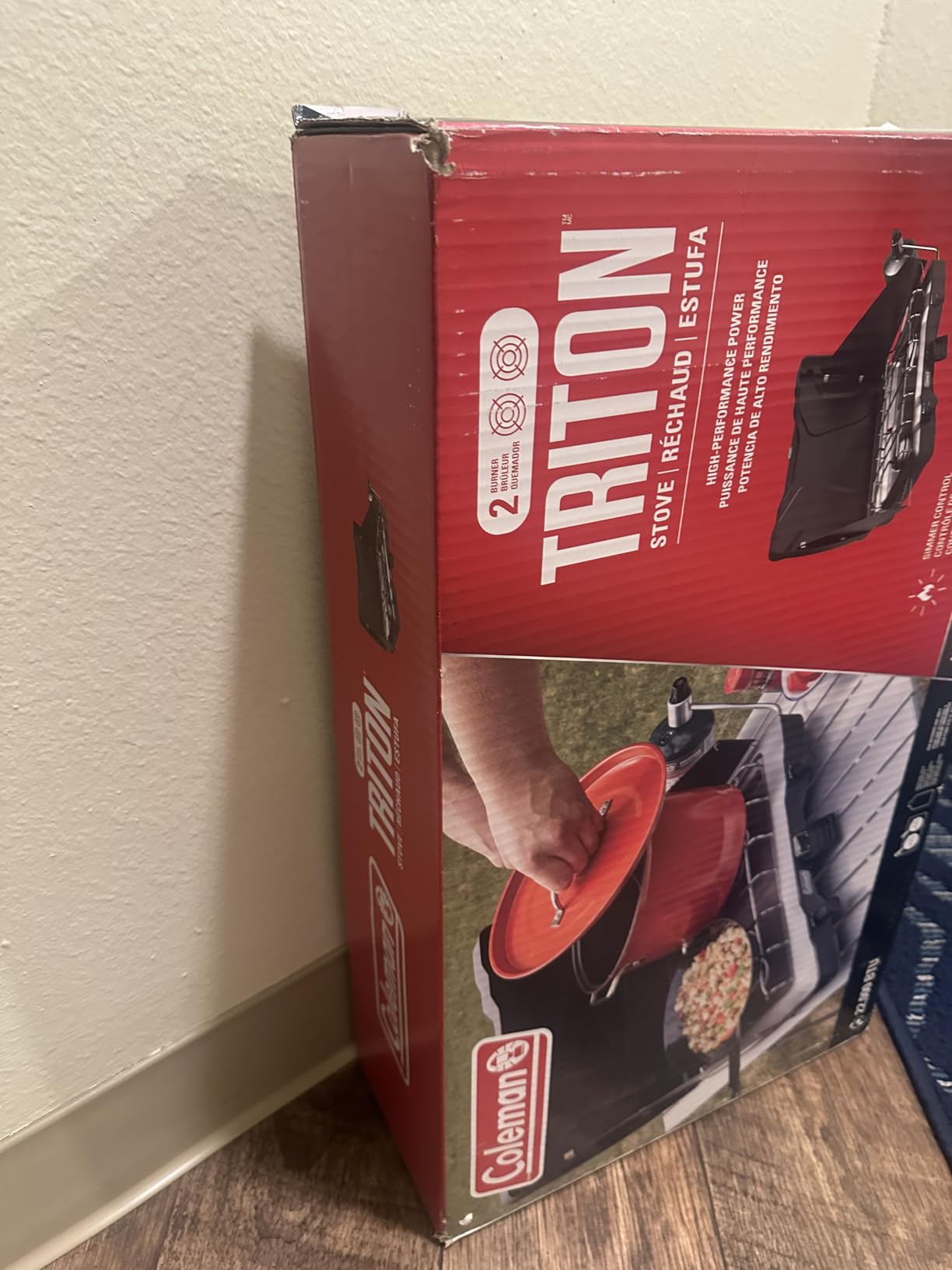
The math that matters most: up to one hour of high-heat burn time per 16 oz cylinder. For three meals a day with a family of four, that is a fuel plan you need to think about rather than react to.
22,000 BTU total is at the lower end of the range we recommend for family cooking, and you can feel it on a big pot of water in cold air. It is not a weakness for most menus. Eggs, pasta water, a soup pot and a griddle of vegetables are all well inside what the burners can do.
The 12-inch and 10-inch pan accommodation is more useful day to day than raw output. A family can run the 12-inch for the main and the 10-inch for a side without improvising a grate extension.
Each burner has its own knob, which is the minimum for family cooking. Sauce on one side, eggs on the other, at different temperatures, without one person hovering over the stove turning things down.
The knob rotation improvement over earlier models shows up most at the low end, where oatmeal and scrambled eggs live. On our run it held a genuine low flame rather than dropping to nothing.
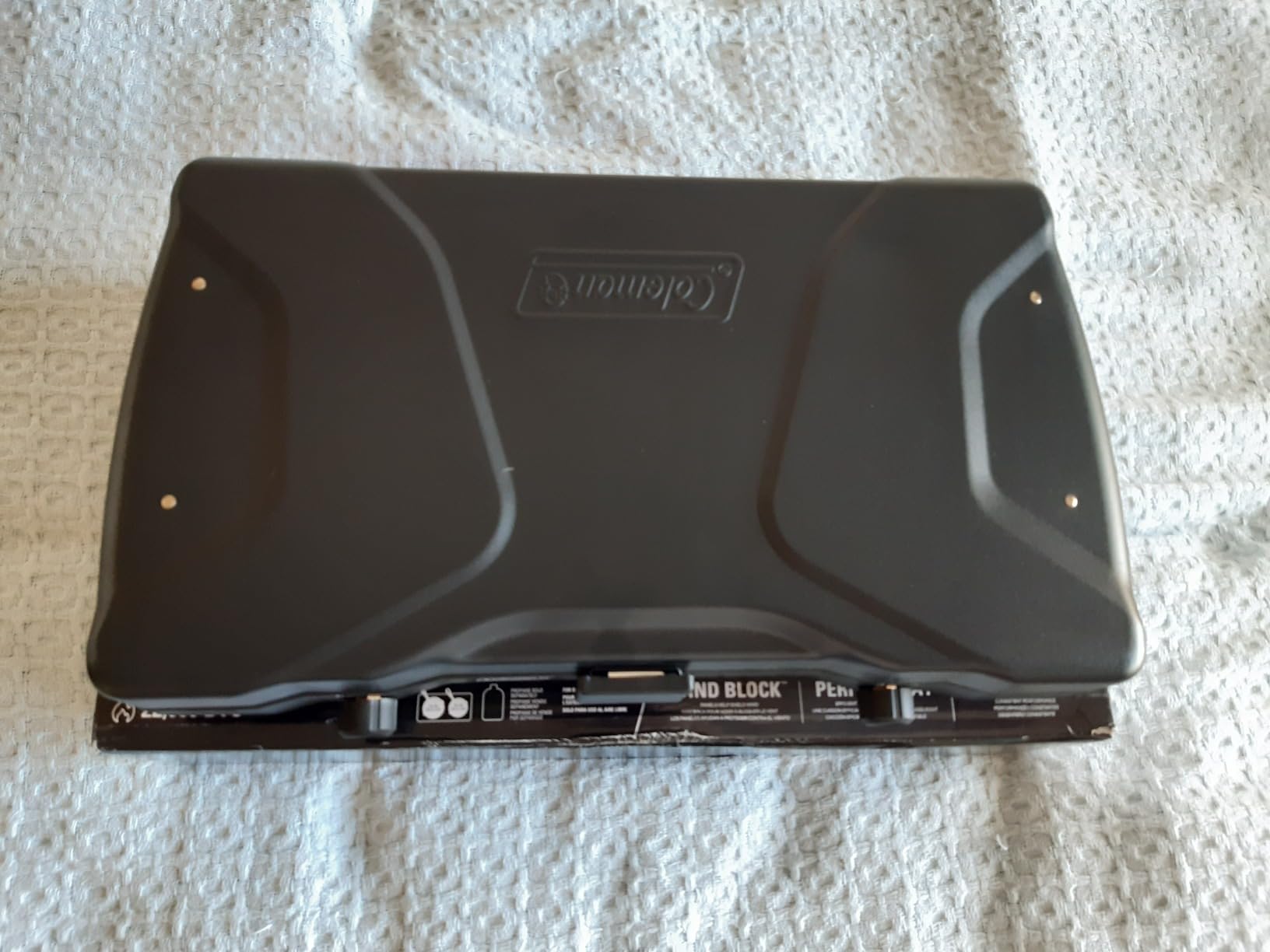
Two wind guards are not a full windscreen, so the flame can still be knocked sideways by a strong gust. They are enough for normal campground and forest-site conditions, which is where most family trips happen.
The chrome-plated grate lifts out for cleaning, and the heavy-duty latch keeps everything secure when the stove is crammed into a duffel. At 5 pounds and 15.9 by 7.8 by 24.8 inches, one person loads it easily.
Carry a spare cylinder and treat the first as a partial day. A family of four cooking three meals a day on a weekend trip will get through more than one 16 oz cylinder, and finding a fresh one mid-trip is the logistics step most people forget.
Regulators and hoses are replaceable parts, and the Coleman three-year limited warranty is one of the longer commitments in this category. That warranty length is a real signal about the steel case and the valve hardware.
Two burner heads
Cast iron frame
0-5 PSI adjustable regulator
4 ft braided steel hose
The Gas One double burner is the one on this list we would trust with a heavy pot of beans or a large pot of water for a big group. The cast iron frame does not flex, and at 27 pounds it is not going anywhere once it is set up on level ground.
What you trade for that stability is refinement. There is no windscreen, no igniter, and it needs an adapter to connect to a standard cylinder. It is a workhorse, not a polished family kitchen, and we think that is a fair trade for the people who cook big.
At 27 pounds and 30.75 by 15.75 by 28.5 inches, this is a stove that stays where you put it. That weight is exactly what you want under a full pot of beans or a pot of water for eight, and exactly what you do not want if the walk from the car is long.
The two burner heads sit on a frame that does not rack. With a wide pot and a heavy soup, that is the difference between cooking and worrying.
Each burner has its own heat dial, running from simmer to boil, so a family can hold a sauce low while water comes to a rolling boil on the other side. The 0-5 PSI adjustable regulator and braided steel hose give a steadier flame than a cheap fixed hose, and the regulator is designed to shut off gas flow if it detects a fault.
Owners running water-bath canning on it report it holding two canners at once, which is the strongest stress test on this list.
There is no windscreen on this configuration, and wind is the number one failure mode we saw across the whole category. A windscreen improvised from a folding camp chair back panel or a sheet of foil-side-out cardboard fixes it in about two minutes, and we recommend doing that before the first night.
There is also no built-in igniter, so a long-neck lighter goes in the same bag as the stove. Slightly annoying, not a problem.
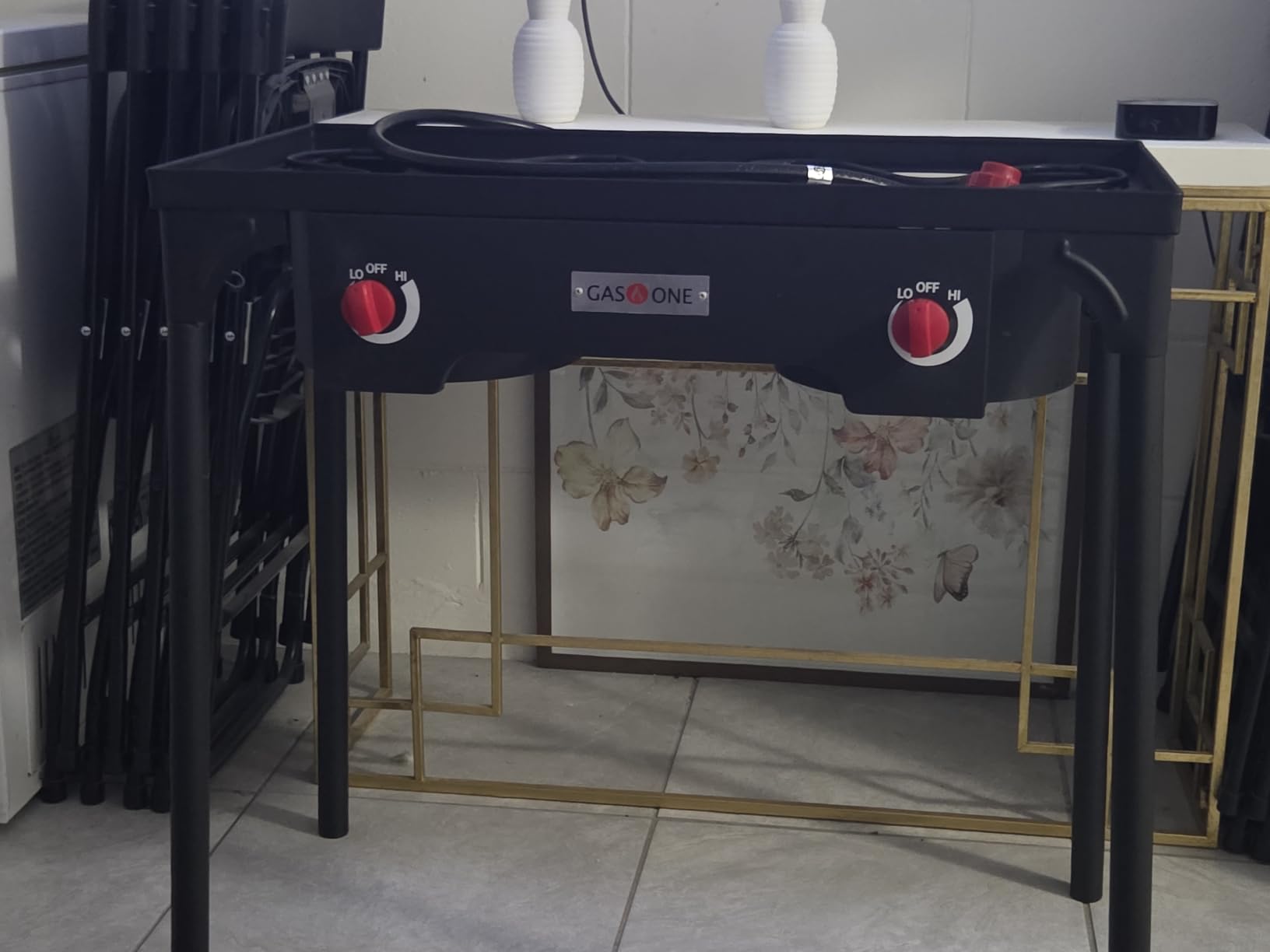
The unit comes with a burner, regulator and hose, and you will need an adapter before it will connect to a standard propane cylinder. That is a small part to buy once and a common trip-stopping surprise if you do not.
The one-year manufacturer warranty is among the shortest in this group. On a cast iron body the mechanical failure risk is low, but budget for a new hose and regulator eventually rather than treating them as forever parts.
225000 BTU total
Three 75000 BTU burners
Cast iron with coating
Legs detach for car loading
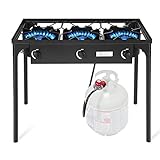
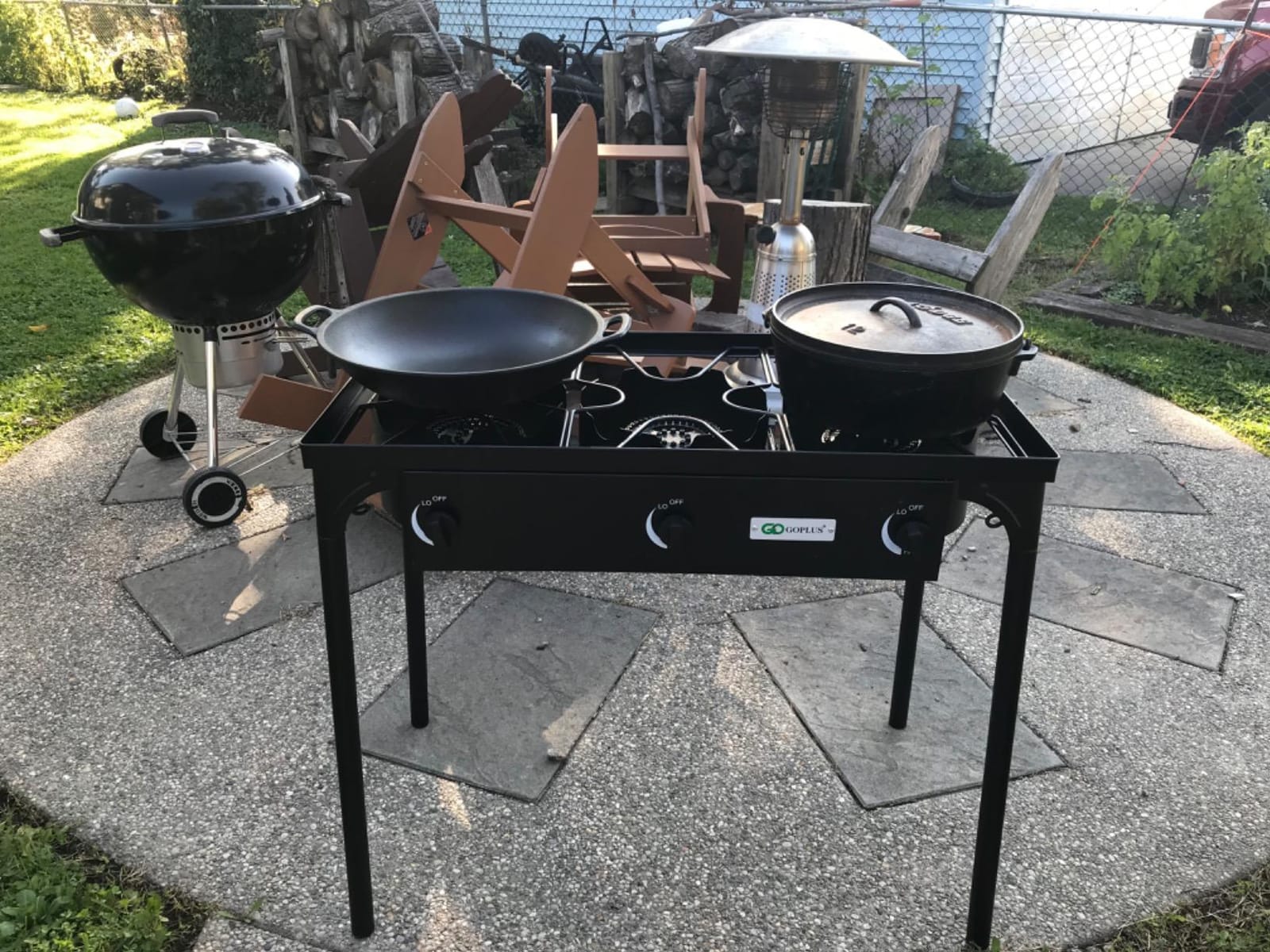
When a family crosses five people, two burners stop being enough and you either move up to three or run a second cooking method. The Goplus is the most direct answer here, with three 75,000 BTU burners that each have their own flame adjustment.
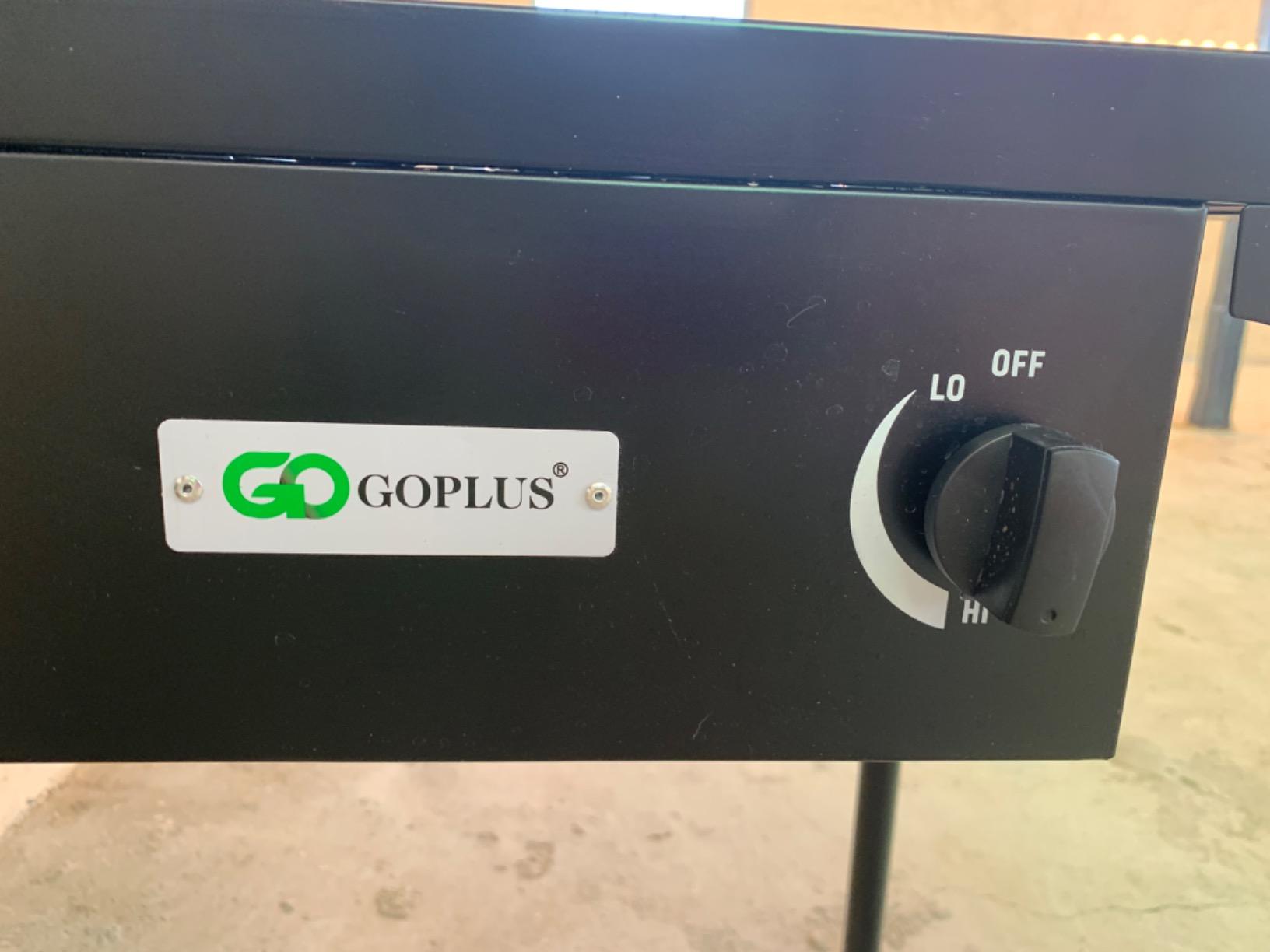
That third burner is not a luxury. On a breakfast for six, it is the difference between eggs, potatoes and coffee happening together and happening in sequence.
225,000 BTU total is genuine high-output territory, and it means a large pot of boiling water for a full group comes to temperature quickly. Cast iron burners with hundreds of small gas orifices produce a hot blue flame that handles a heavy pot without complaint.
Individual flame adjustment on all three burners is what makes it a family stove rather than a catering burner. One side sears, one side simmers, one side boils.
The 33 pound total weight is real, but the detachable legs are the reason that is acceptable. Strip the legs off and two people can load it in a couple of trips, which matters for a family that is already carrying coolers and tents.
It also stands high enough off the ground that you are not crouching over the burners while flipping pancakes, which is a genuine comfort difference on a long morning.
The high-temperature powder coating is what protects the cast iron from rust, and it held up for most owners. One reviewer got caught in rain and later found rust spots, so treat the coating as weather protection you can extend rather than a permanent shield.
The recurring complaint is the control knobs, which several owners report loosening or coming off entirely. Check them after the first few sessions and you will avoid the problem most people describe.
Three burners at 75,000 BTU each will empty a cylinder faster than anything else on this list. A weekend of three meals a day for six people is a multi-cylinder proposition unless you are disciplined about running one burner at a time for most dishes.
A CSA-certified regulator is included, which is one fewer part to source. There is no carry bag in the box, so a simple bag for the legs and hose is worth adding to your packing list.
28000 BTU total
Three Even-Temp burners
Push-button InstaStart
Fits two 12 inch or three 8 inch pans
The Classic 3-Burner is the three-burner answer for a family that does not want to drag a cast iron monster out of the trunk. At 19.1 pounds it is far lighter than the 43 pound Explorer 3X, and the three Even-Temp burners give you a much calmer breakfast than a single big flame under one crowded pan.
Push-button InstaStart ignition also removes a small daily friction. Lighting a stove with a lighter in the dark, in wind, while holding a coffee, is a task nobody needs to repeat six mornings in a row.
The racetrack burner design radiates heat evenly rather than concentrating it in one spot, which is why a griddle of pancakes browns uniformly across the whole surface instead of scorching in the middle. That evenness is a family-serving feature, not a technical nicety.
Two 12-inch pans or three 8-inch pans fit at once. Three 8-inch pans covers eggs, sausage and a pot of grits for four or five people simultaneously.
Two wind guards with WindBlock protection shield the burners from gusts, which makes this one of the better-protected three-burners here despite the open layout. For a campground with trees or a valley site, that is the difference between cooking and fighting.
The three-year limited warranty is among the longest in this group, and Coleman support is widely reported as quick and generous when something does go wrong.
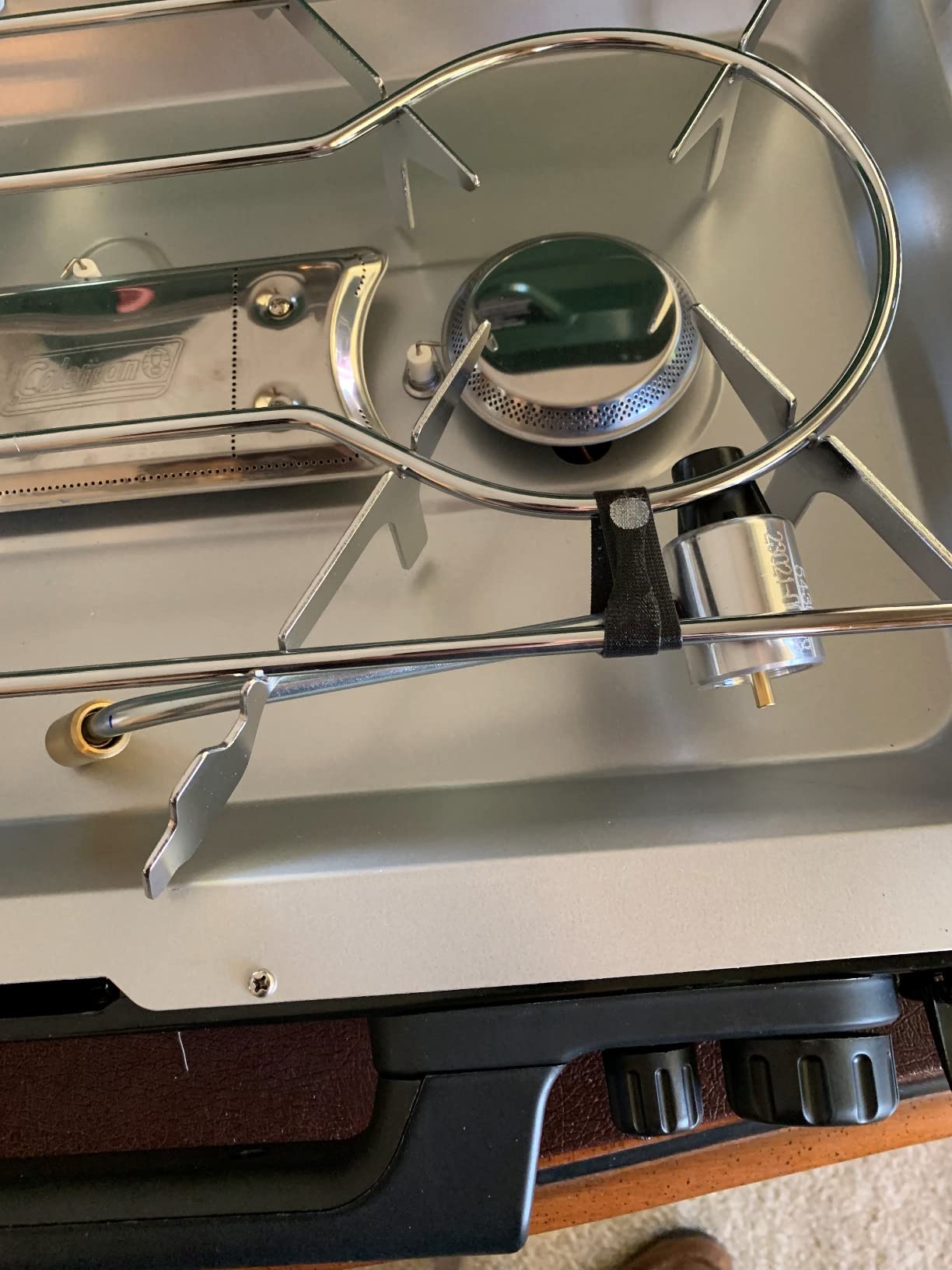
The knobs are the weak point. Owners repeatedly describe them as finicky, with a hard time holding a true low simmer, and the PerfectHeat technology smooths the mid-range more than the bottom of it. If your menu is egg-heavy, budget a little extra attention at the low setting.
Case metal is thin by older Coleman standards, and some units arrive with loose screws that need tightening before first use. Five minutes with a screwdriver on day one prevents a rattle that runs through the whole trip.
Up to one hour on high per 16 oz cylinder is the figure to plan around. With three burners available, the temptation is to run all three at once, which is exactly how a cylinder disappears by day two.
Plan meals around using one or two burners and saving the third for the big pot, and a weekend for a family of five needs more spare cylinders than most shoppers expect.
225000 BTU across three burners
Three-sided wind panel
0-20 PSI regulator and hose included
Protective carry case
The Hike Crew 3-Burner arrives with a carry case, a propane hose and a 0-20 PSI regulator in the box, which is a genuinely convenient package for a family assembling a camp kitchen for the first time. Nothing to buy before the first cookout.
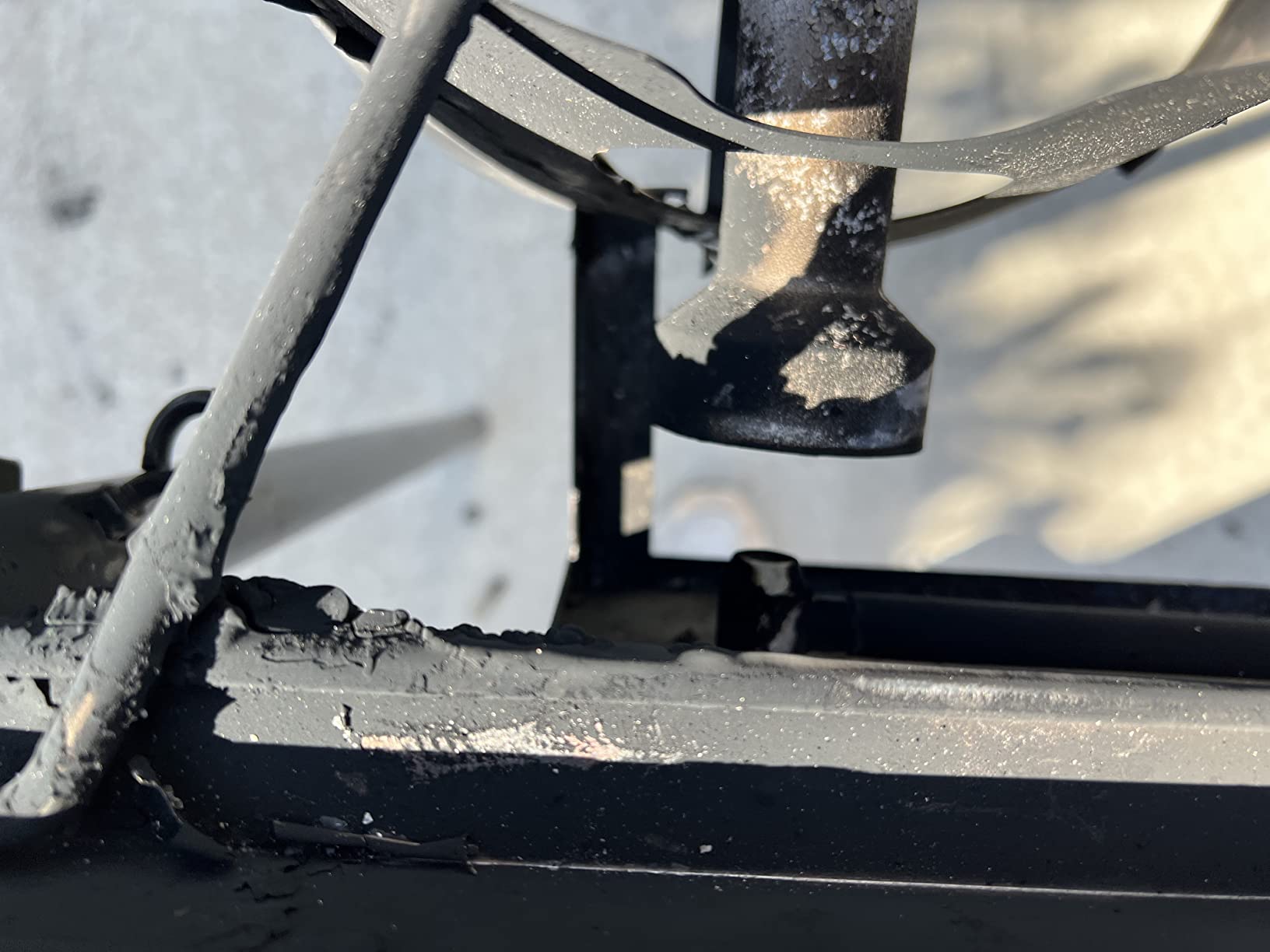
It is also the lowest-rated stove in this roundup at 4.4, and the reason is mostly size. At 36.25 by 20.5 by 35.5 inches it wants a full table and then some.
Three burners covering boiling, simmering, frying and grilling simultaneously is real capacity for a group of six to eight. For a family that cooks a big breakfast and a big dinner, having all three zones available is the entire argument.
Separate temperature control knobs on each burner mean the three zones are genuinely independent rather than one shared flame with two dividers.
Most competing stoves leave the regulator as an extra purchase or bundle a less capable one. Having a 0-20 PSI regulator and hose in the box removes the single most common first-day trip to a hardware store.
The protective carry case is a smaller benefit than it sounds. Cast iron stoves with removable legs produce a handful of loose pieces, and a dedicated bag is the difference between a clean load and a bag of rattling metal.
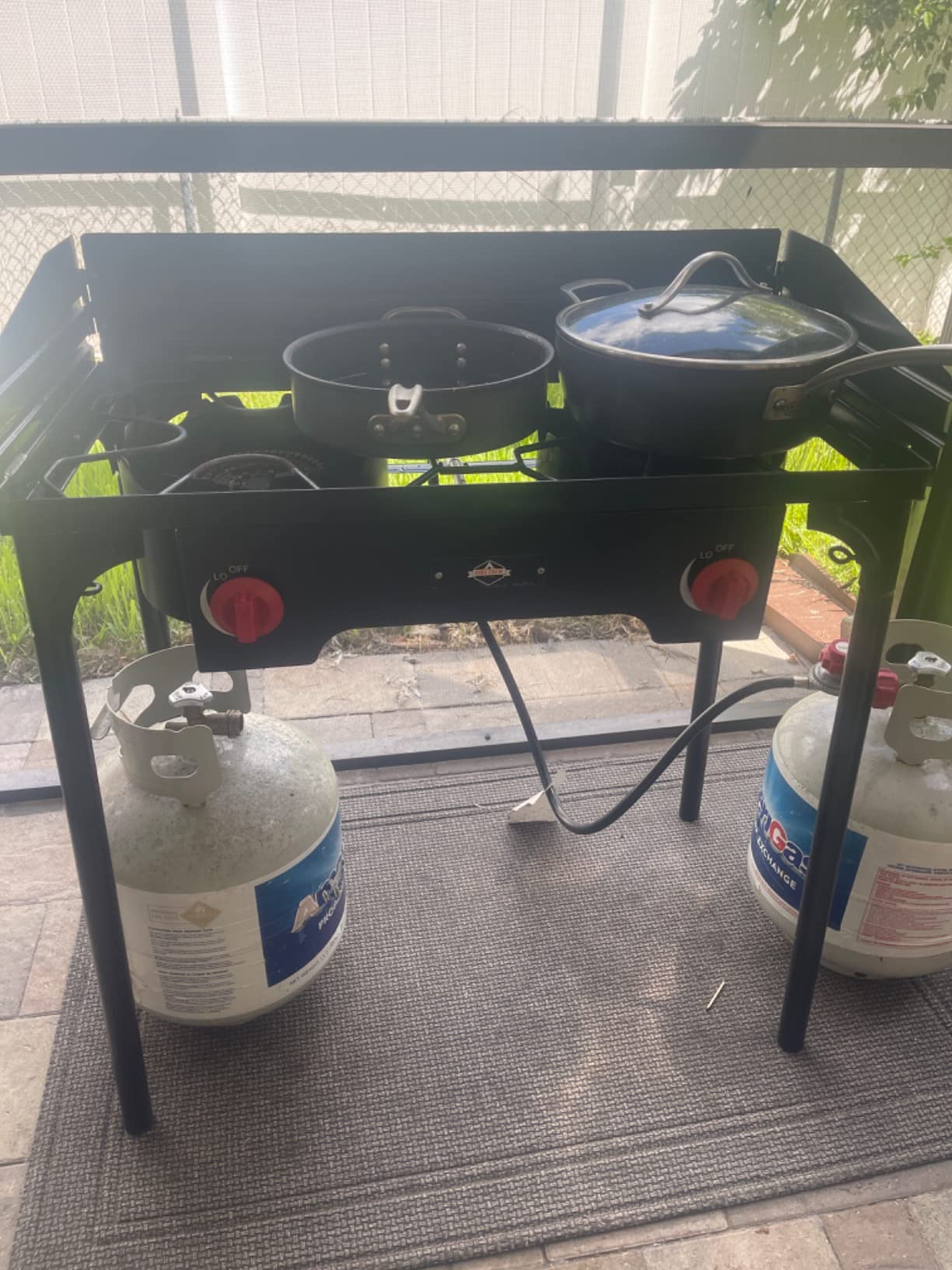
The three-sided wind panel is a genuine advantage over open-frame designs, and the cast iron frame resists warping, rusting and cracking under sustained high heat.
The recurring complaint is fit. Large burner grates leave small pots and pans sitting awkwardly near the edge, so a family that cooks with a 10-inch sauté pan will feel the mismatch more than one that owns 12-inch skillets.
This is where the low rating comes from. The stove is big enough that it defines the packing plan, and a family loading a hatchback for six will be giving up real cargo space for a cooking surface they may not fill every meal.
Measure your table and your vehicle before choosing this one. If both check out, the included kit and raw output make it hard to argue with.
40000 BTU total
Two 20000 BTU cast-aluminum burners
215 sq in cooking area
Folding lid doubles as windscreen
The Everest 2X solves a specific problem: a family of four that wants the heat of a serious stove without the table footprint of one. Two 20,000 BTU cast-aluminum burners give 40,000 BTU total in a body that folds down and carries a handle.
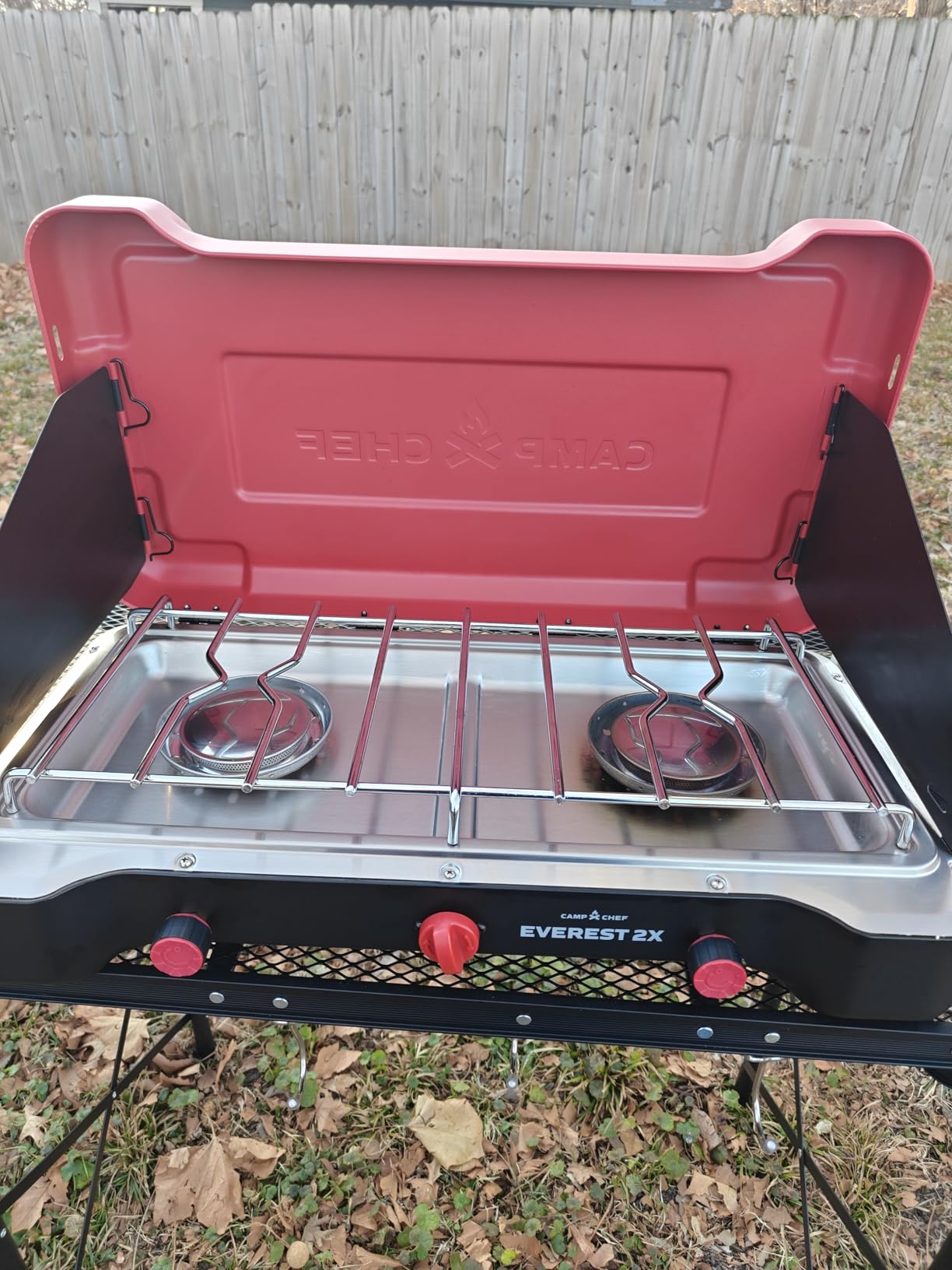
It is also our pick for high-altitude and cold-weather trips, where thin air and low ambient heat eat the performance of a modest burner far faster than most buyers expect.
40,000 BTU is nearly double the output of the entry-level two-burners in this roundup, concentrated into the same burner count. On a cold morning at altitude, the difference is the difference between coffee in five minutes and coffee in fifteen.
At 15 pounds and 27 by 15.5 by 8.25 inches, it is light enough for one person to load and small enough to live on a camp table that would not accept the Explorer.
Matchless ignition is standard on this unit rather than an upgrade, which removes a step from every single cooking session.
The folding lid doubles as a windscreen, a genuinely clever bit of design for a stove this compact. It is not a tall three-sided panel, so an exposed site still deserves a wind block, but it covers the common case.
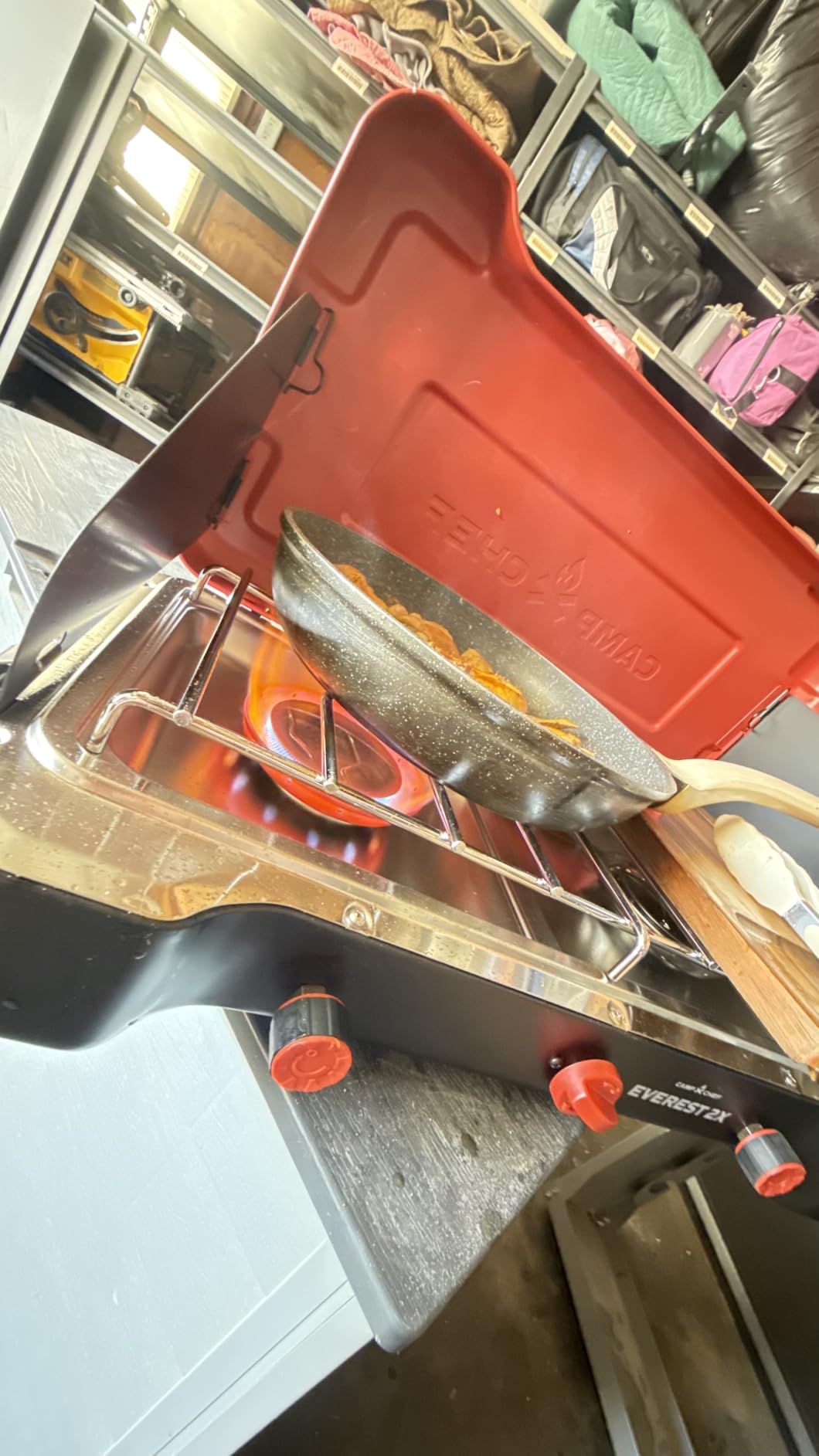
215 square inches fits two pans plus a small accessory, which is exactly enough for a family of four cooking two dishes. It is the smallest surface on this list, and it is the one compromise you will notice first with a 12-inch skillet.
The drip tray underneath catches what drips, and the carry handle makes the move from storage to table a one-person job.
This is the premium option among two-burners, and the cost shows up in the comparison. If you cook at sea level in a sheltered site for a family of two, the extra output is money spent on headroom you will not touch.
If you camp high, in winter, or cook for six on a two-burner budget, it is the most sensible spend on this list.
225000 BTU across three burners
Two fold-out side shelves
Three-sided foldable windscreen
CSA listed regulator
The ROVSUN is the only stove here with side shelves, and that changes the working day more than another burner would. A prep surface on each side of the burners is where chopped vegetables, a cutting board, a plate of raw meat and a phone that somebody keeps walking into the flame actually go.
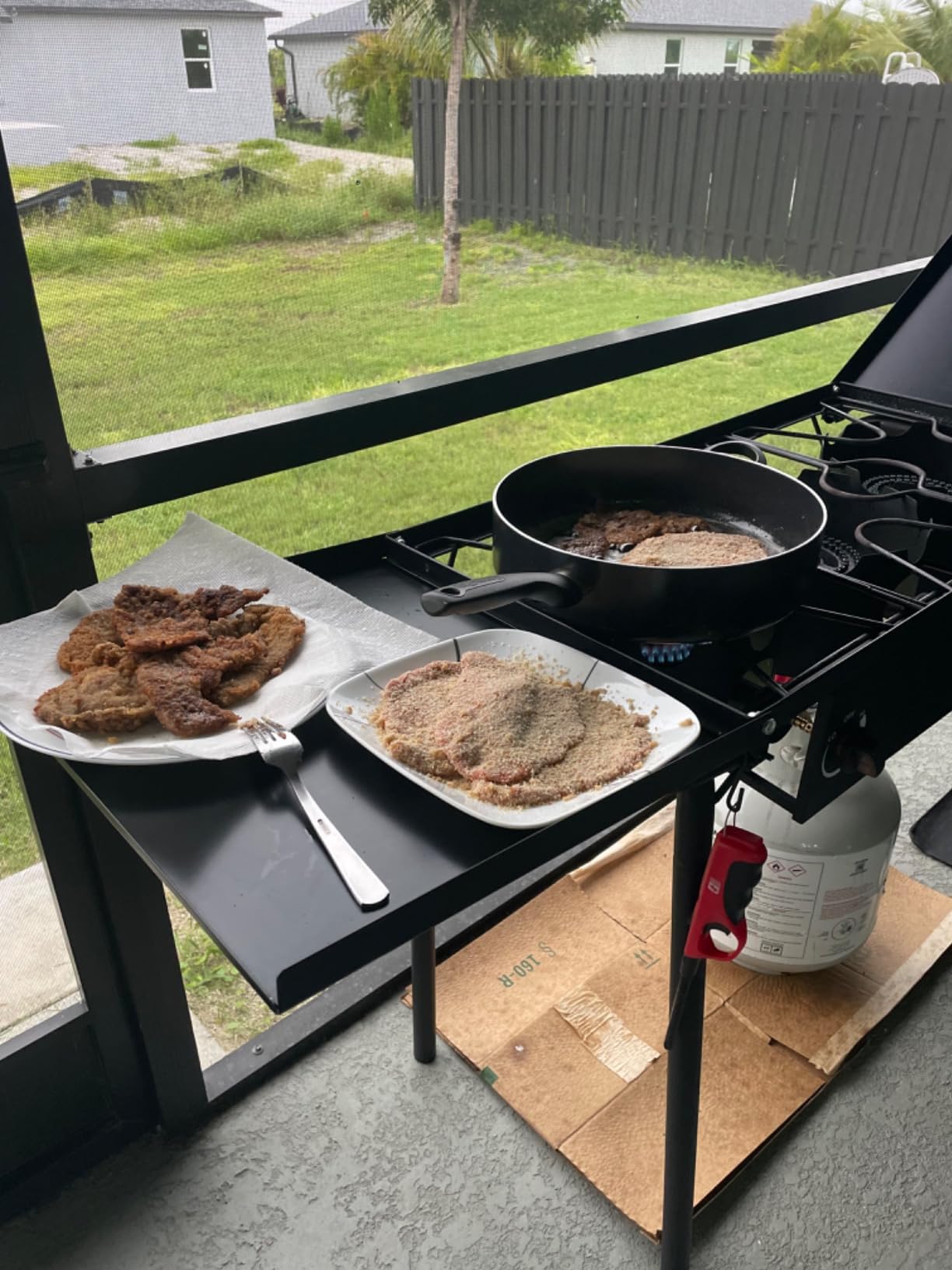
Without shelves you are using a picnic table for prep and a narrow stove surface for everything else, which is how a family camp kitchen turns into a bottleneck at 6pm.
Two fold-out shelves beside the burners turn a stove into a small kitchen station. The prep and the cooking happen in the same footprint, which on a crowded drive-up site is a real gain.
They also stop small items from ending up on the ground beside a burner, which on a campsite with gravel underfoot is a genuine safety and hygiene improvement.
Three burners totalling 225,000 BTU cover boiling, frying and grilling for a group, and owners running it for large numbers report the burner durability holds up under that load.
Heat control through the front knob on the CSA-listed regulator is fine enough for simmering lighter meals without catching the bottom, which is more than some budget three-burners manage.
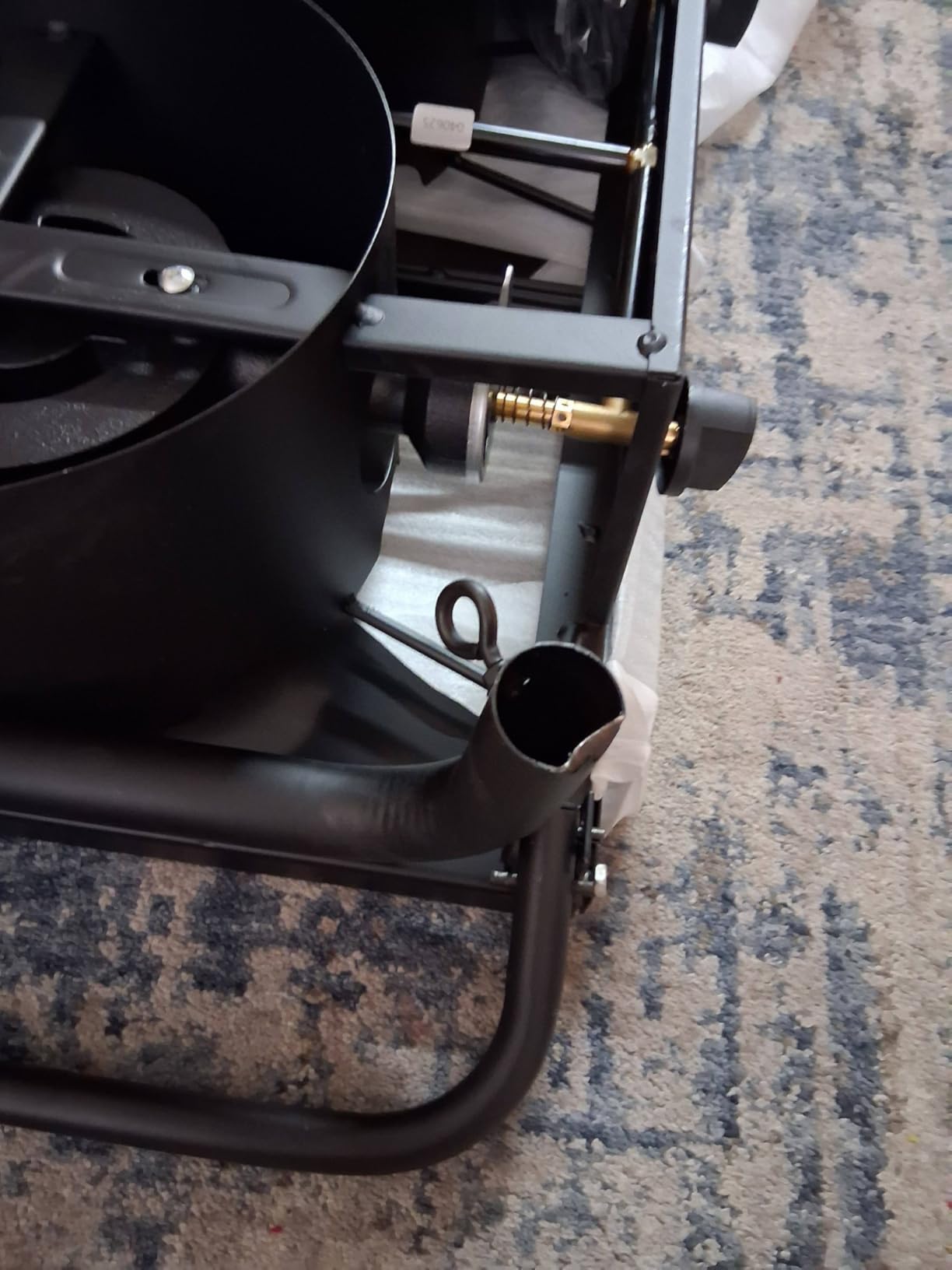
Detachable legs and a three-sided foldable windscreen break the stove down for a carry bag, which matters given the 66 by 18 by 35 inch assembled size.
The foldable windscreen is genuinely useful in wind and folds flat when you are done, a better answer to exposed sites than no protection at all.
There is no built-in igniter, so a long-neck lighter is part of the kit. One owner also reported flames escaping around the temperature control knobs, which is isolated but worth a close look during setup.
The main cost is bulk. This is a basecamp or backyard stove rather than a family car-camping stove, and the large grates mean a 10-inch pan sits awkwardly on the burner edge.
90000 BTU total across three burners
686 sq in cooking area
Three-sided windscreen
Alloy steel with detachable legs
The Explorer 3X is the stove you buy when a camping trip regularly involves more people than a nuclear family. 686 square inches of cooking area across three 30,000 BTU cast-aluminum burners is the largest surface we tested, and it fits three water-bath canners at once, which is the most demanding cooking test we could think of.
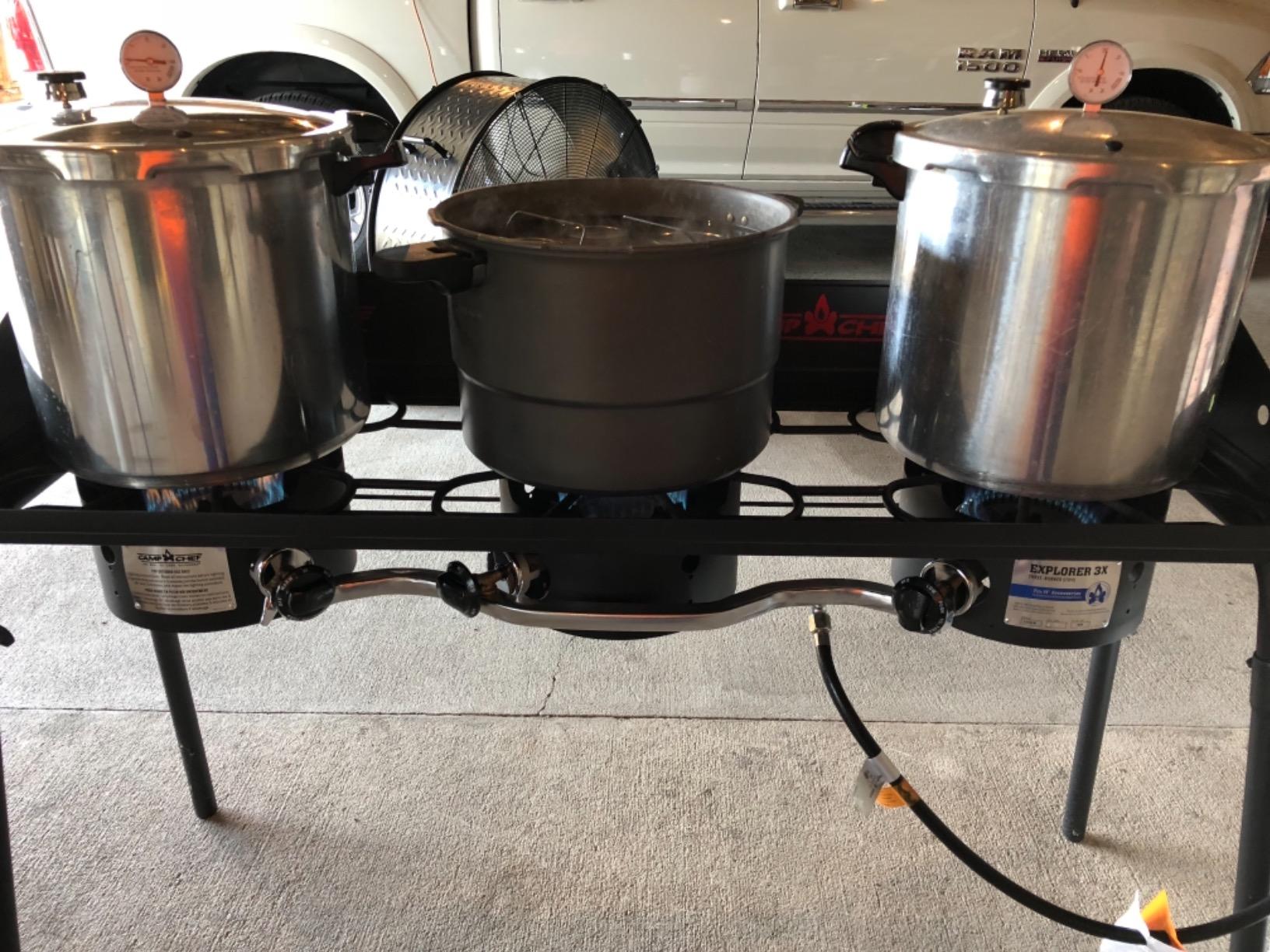
It is also one of the heaviest stoves here at 43 pounds. That is not a flaw, it is the trade, and it only makes sense if you have a vehicle and a reason to need that much surface.
The 30,000 BTU per burner output boils a large pot quickly and still turns down low enough for eggs, which is a combination most stoves in this roundup cannot manage on a single burner.
Blue flame burners run efficiently in cold weather, and the even spread across 686 square inches means a griddle of breakfast for eight cooks uniformly rather than in a hot centre.
Everything in the Camp Chef ecosystem fits: grill boxes, griddles, reversible cast iron grills and a pizza oven. For a family that wants one cooking platform to cover stir-frying, searing and flat-top breakfasts, that flexibility is the reason to own this brand’s larger stoves.
Because the accessory system is shared, buying the 3X now and adding a griddle or a second burner later is a coherent path rather than a replacement.
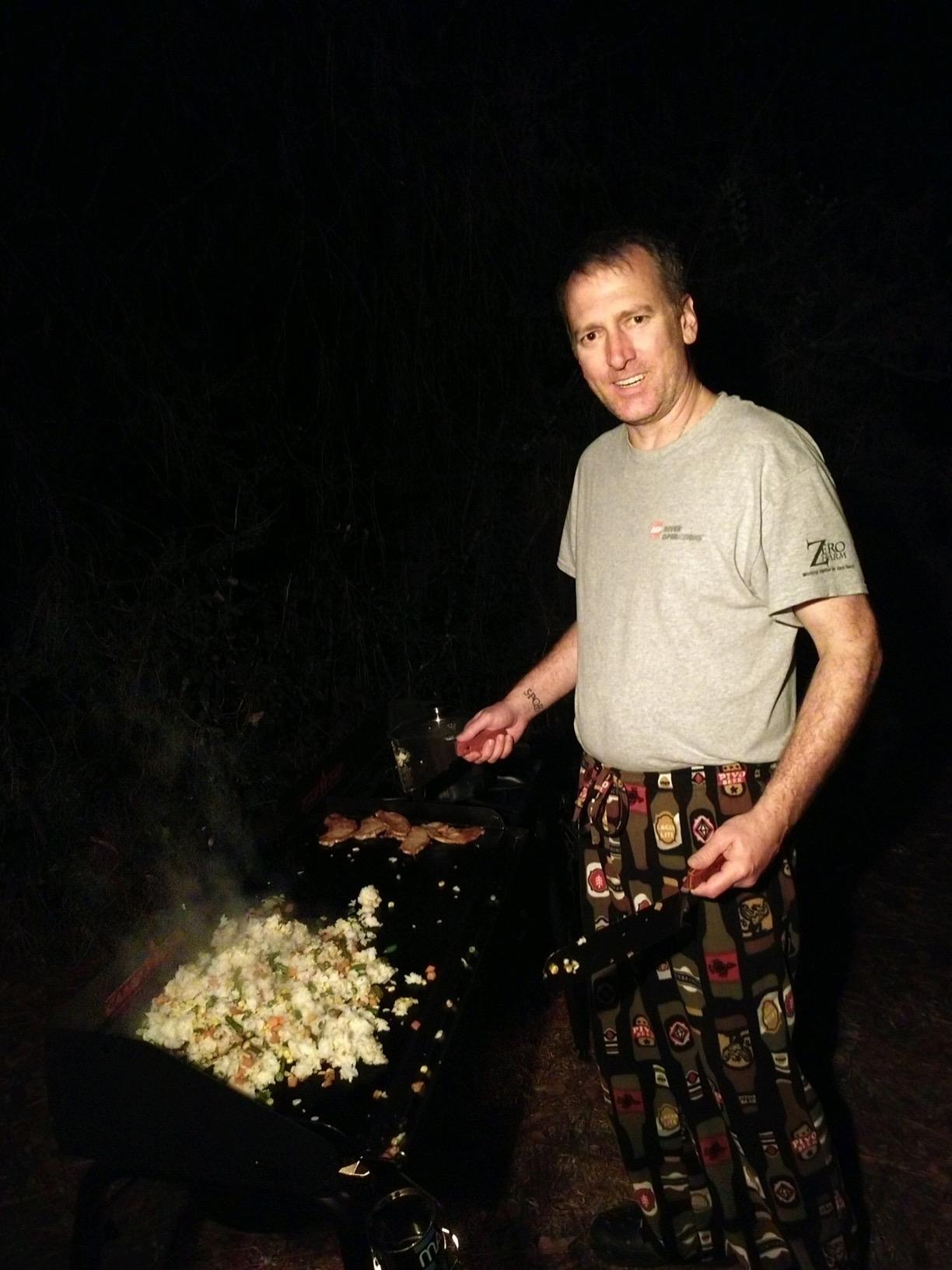
At 43 pounds and 50 by 8.5 by 16 inches, this needs two people and a real plan to load. Detachable steel legs help, and owners report it is light enough for one person to reposition once it is set up.
One owner wished it were slightly taller for standing use, which is worth knowing if you cook upright rather than crouched at the picnic table.
The Explorer series is the entry level of the Camp Chef line, and it shows. Igniters, a griddle and leg levelers are all sold separately, so budget for them if your plan involves a lot of flat-top cooking.
The burners have no built-in ignition, so a lighter or a separate igniter is required. For a stove this large, that is an odd omission, and it is a five-minute fix in a hardware store before the trip.
22000 BTU total
PerfectFlow and PerfectHeat control
Push-button InstaStart
Folds to a 13.7 inch footprint
The Triton+ is our pick when the constraint is the car rather than the menu. It folds to a 13.7 inch footprint, which means a family of four can keep it in the car permanently instead of making it a separate piece of trunk cargo for one trip a season.
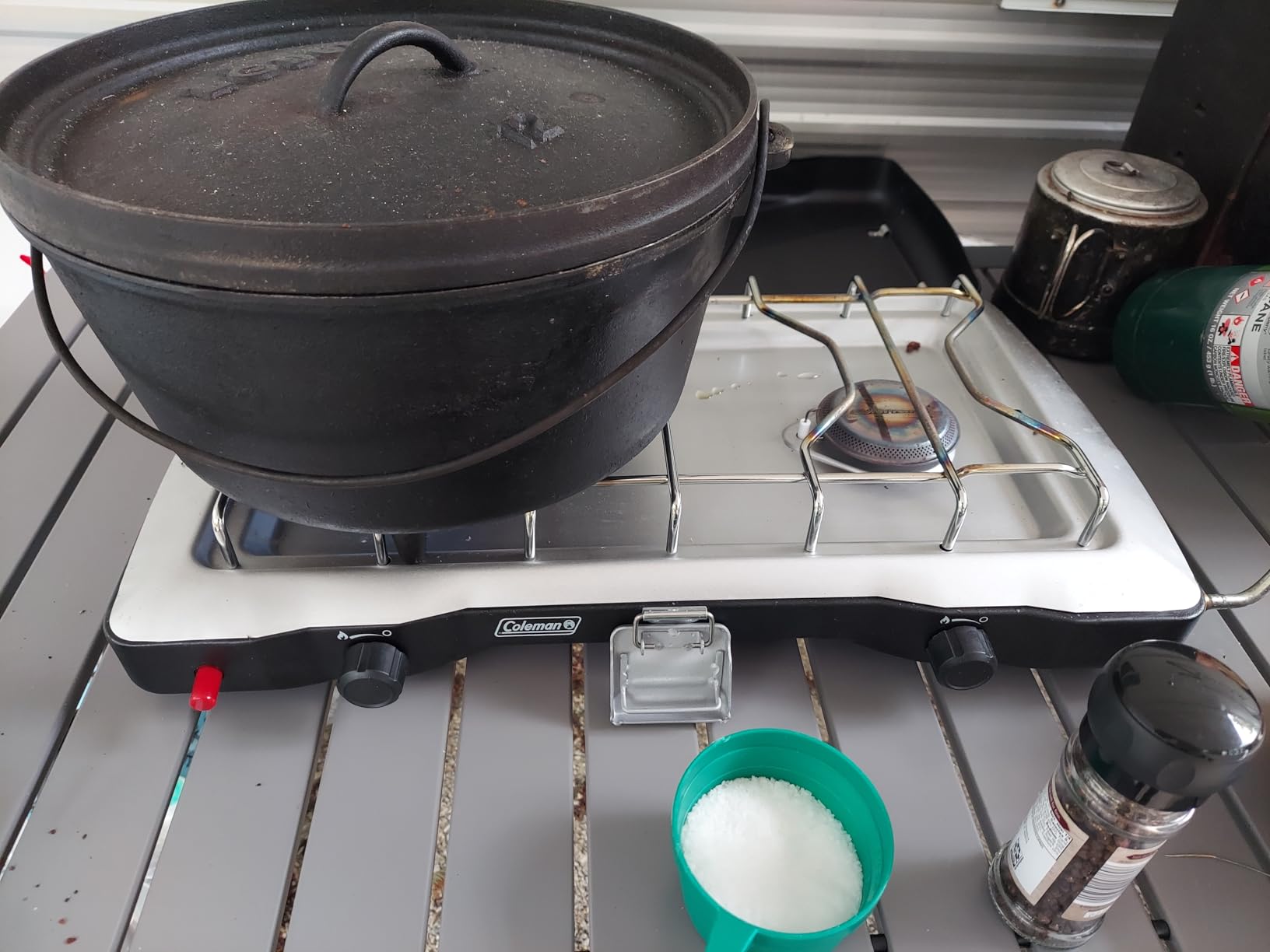
It is also the highest five-star share in this roundup, at 84 percent across 1,280 reviews. That is not a spec, but in a category where budget stoves are often reported as long-lasting, the satisfaction rate matters.
At 13.7 by 5.7 by 22.6 inches folded, this is the stove that lives in the door pocket of a hatchback or behind a seat in a sedan. The built-in handle and heavy-duty latch make it secure in a cargo area.
For a family that camps opportunistically rather than on a schedule, that always-available stove is worth more than raw output you only touch four times a year.
PerfectFlow manages gas pressure and PerfectHeat manages the burner, and together they give independent control on both burners. On our runs the low flame stayed low, which is what makes oatmeal and a low-simmer sauce reliable rather than a guessing game.
Two burners means a family of four can still run coffee and a main dish at the same time, which is the whole point of choosing a two-burner over a single.
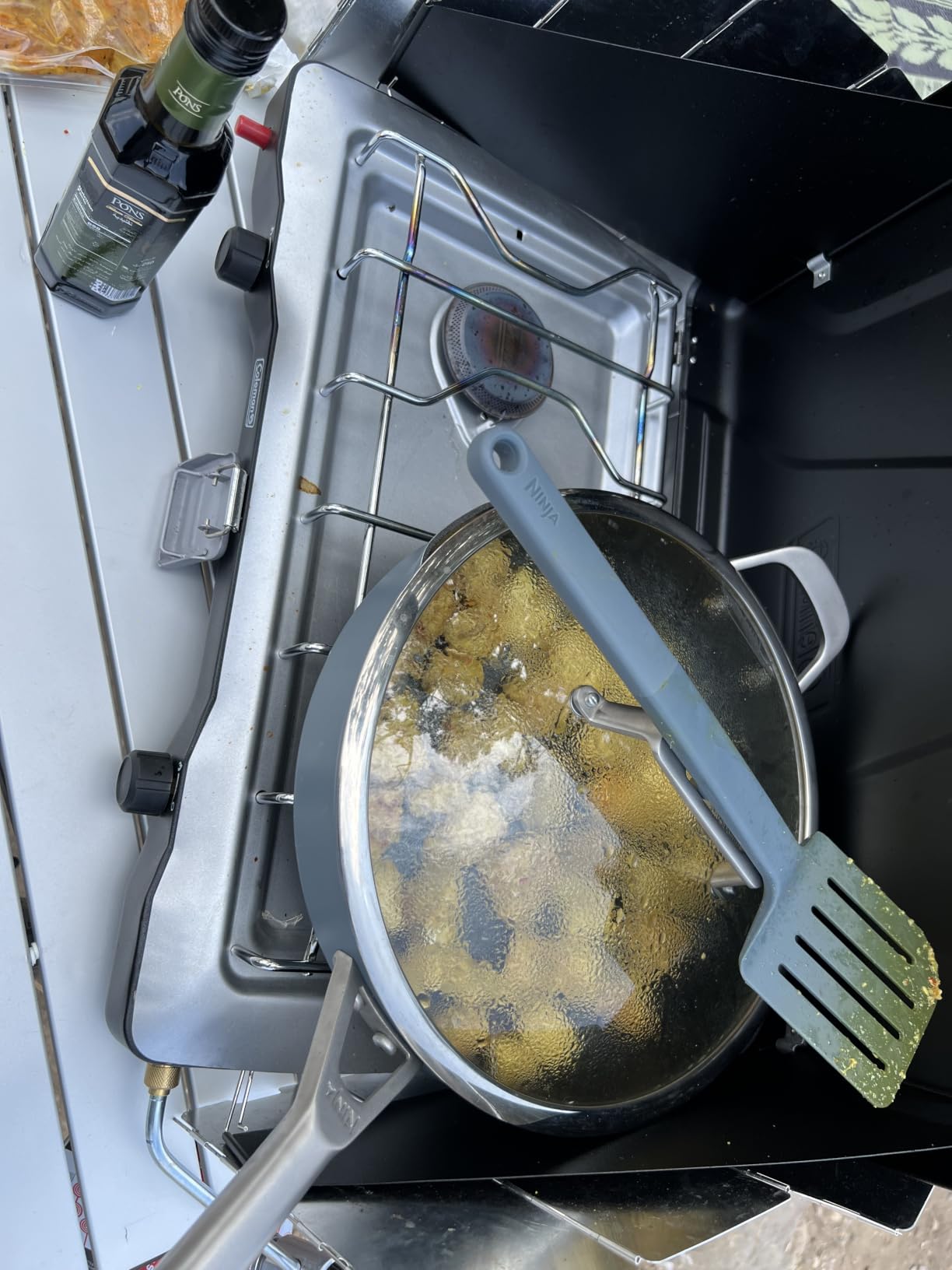
Dual wind guards protect the burners, and the removable chrome-plated grate plus rust-resistant aluminized steel cooktop make cleanup after a messy dinner a two-minute job rather than an evening project.
It accommodates 12-inch and 10-inch pans, and the three-year limited warranty matches the Triton it replaces.
It is the same ceiling as the original Triton. 22,000 BTU total is modest, and a family of five trying to cook a two-pot dinner plus a griddle of sides will feel the queue.
Plan on using it as a family of four or fewer, and it is a genuinely excellent tool. Push past that and you should be looking at a three-burner.
Buy the burner count that matches the number of plates, then judge everything else around that. Here is the reasoning in the order it should happen, with the trade-offs that actually decide it.
Two burners cover two to four people comfortably. Three burners, or a two-burner stove with a griddle, cover five to eight. Beyond eight you are into a full camp kitchen or a fire plus stove combination, which is a different kind of purchase.
The number of dishes you can run at once sets the pace of the whole day. One burner means breakfast takes an hour. Two burners means eggs, a pot and coffee happen together. That difference shows up in how long your children tolerate being at a campsite.
BTU is a measure of heat energy per hour. Higher output boils water faster and holds temperature better in wind or cold, which is why the same stove feels weak in November and fine in July.
For families, 20,000-30,000 BTU total is the working range. A 22,000 BTU two-burner handles a normal menu. A 40,000 BTU two-burner handles altitude and cold. Anything above 100,000 BTU on three burners is built for heavy pots, canning and large groups rather than a family of five.
A windscreen is the single most-cited flaw across this category, and the fix is cheap. A windscreen or wind guards that bracket the burners stop a steady breeze from killing the flame mid-meal.
Where one is missing, use a folding camp chair back panel, a folding privacy screen, or cardboard covered in aluminium foil positioned downwind. Ten seconds of setup protects the whole cook. Wind is the number one reason a family stove gets abandoned on a windy site.
Every stove in this roundup runs on propane, and that is a deliberate choice for family use. Propane is available at hardware stores, grocery stores and most campground supply points, and it performs consistently in cold weather and at altitude.
The planning question is how many cylinders. The Coleman two-burners in this roundup rate up to one hour of high heat per 16 oz cylinder, which sounds generous until you run two burners for three meals a day. A family of four on a weekend trip should carry spares, and finding a fresh cylinder mid-trip should be part of the plan rather than a surprise.
Multi-fuel stoves accept white gas or unleaded as well as propane, which is genuinely convenient for trips far from a fuel source. The trade is weight, cost per hour, and a noisier, sootier flame that is less pleasant for a week of family breakfasts. For car camping, propane is the better buy.
Grate spacing decides whether your 12-inch skillet sits flat or rocks. A rocking grate under a heavy cast iron pan is the most common tip-over complaint in the category, and it matters more in a family context because the pan is usually full and hot.
Check the stated pan accommodation, which ranges from two 12-inch pans to three 8-inch pans. Bigger stoves like the Hike Crew and ROVSUN have large grates that leave smaller pans sitting near the edge, so match your cookware to the unit.
Simmer control is the difference between a low flame that stays low and a knob that jumps from roar to nothing. Sauces, oatmeal, eggs, fish and melted butter all live at the bottom of that range, which is precisely where cheap stoves are weakest.
Look for independent knob adjustment on each burner and for terms like PerfectHeat or improved knob rotation in the spec sheet. Both signal a valve designed for fine control rather than an on-off compromise.
Families of four and up are packing a car, and stove footprint is a selection criterion nobody considers until the trunk is full. Compact two-burners at around 13 to 16 inches folded cost nothing in terms of cargo space. Three-burner cast iron stoves at 33 to 43 pounds need a plan and usually a second pair of hands.
Measure the picnic table too. Several of the three-burners on this list are wider than a standard camp table, which means cooking on the ground or standing at the tailgate, neither of which is comfortable with children around.
A camp stove produces enough radiant heat to burn bare skin, and children bump things. Several habits change that risk more than any product choice.
Set the stove at the far end of the table with the burners pointed inward, never toward the edge where a chair sits. Keep handles of skillets turned inward so a passing arm does not catch one. Keep a water bottle within reach of any adult cooking, and never leave a lit burner unattended, even for the two minutes it takes to grab a lid from the car.
Check the hose and regulator connection before the first light of the trip rather than the second evening. Use stoves outdoors only, and never in a tent, vehicle or enclosed shelter, where carbon monoxide builds without warning. Before you cook, set up the site around the stove: a solar camping lantern and a lantern for camping let you do prep and cleanup after dark without adding a second flame near the stove.
Finally, know your local fire restrictions. Propane stoves are usually permitted where wood fires are banned, which is exactly why a stove is the more reliable cooking method in a dry season or a restricted national forest.
The best camping stove for a family is a two-burner propane cooktop in the 20,000 to 30,000 BTU total range with wind guards or a windscreen. Two burners comfortably feed two to four people because you can run a main dish and a side at the same time. Families of five to eight need three burners or a two-burner stove paired with a griddle. Burner count matters more than raw power for daily usability.
For most families the best all-round option is a two-burner propane stove with a three-sided windscreen and a large cooking surface, because it delivers the strongest heat and surface area in a unit that still folds down for a car. A three-burner model takes over once you regularly cook for five or more, and a high-output two-burner is the choice for cold weather and high-altitude sites.
A two-burner propane stove is the better answer for family cooking. A single-burner boil-water system is built to heat one pot as fast as possible, which is ideal for morning coffee but forces dinner into a one-dish-at-a-time sequence. A two-burner stove lets you simmer sauce while pasta water boils, and its windscreen keeps that going in wind. A stove like the Jetboil still makes sense as a coffee station alongside one.
A multi-fuel stove runs white gas or unleaded as well as propane, which means you can refuel almost anywhere including hardware stores that do not carry cylinders. The trade-off is weight, a higher cost per hour of heat, and a sooty flame that is less pleasant for daily family cooking. For car camping where propane is easy to find, a dedicated propane stove is the simpler and cleaner choice.
Two burners is the right answer for a family of four. That lets you run a 12-inch skillet of protein on one side and a pot of pasta water, rice or soup on the other, plus a small pan for a side. A single burner serialises every meal and roughly doubles breakfast time. If your group regularly reaches six, step up to three burners or add a griddle top to a two-burner unit.
For a family of two to four cooking at a site with a proper table, the Camp Chef Explorer 2-Burner is the buy. Its 448 square inch surface and 60,000 BTU of output leave room for a proper breakfast, and the three-sided windscreen covers the conditions most families actually meet.
If the car is small or the stove needs to live in the vehicle between trips, the Coleman Triton+ folds down to 13.7 inches and delivers the highest satisfaction rate in this roundup. The Coleman Triton is the same idea with a little more surface, and the Triton+ is our pick for tight packing.
For five to eight people, move to three burners. The Coleman Classic 3-Burner is the balanced pick with matchless ignition and even burners. Choose the Goplus for genuine high output and a standing cooking height, the Hike Crew if you want the regulator, hose and case in the box, and the ROVSUN if prep space on side shelves matters more than packed size.
For cold sites, high altitude or cooking for eight or more at once, the Camp Chef Everest 2X and the Camp Chef Explorer 3X are the two ends of the range. The Gas One double burner is the answer when the priority is heavy cookware stability rather than portability.
Whatever you pick, test it at home with a full bottle before the trip, learn where the low flame sits on each knob, and pack a spare cylinder. The best camping stoves for family cooking are the ones you stop thinking about once the pan is on.