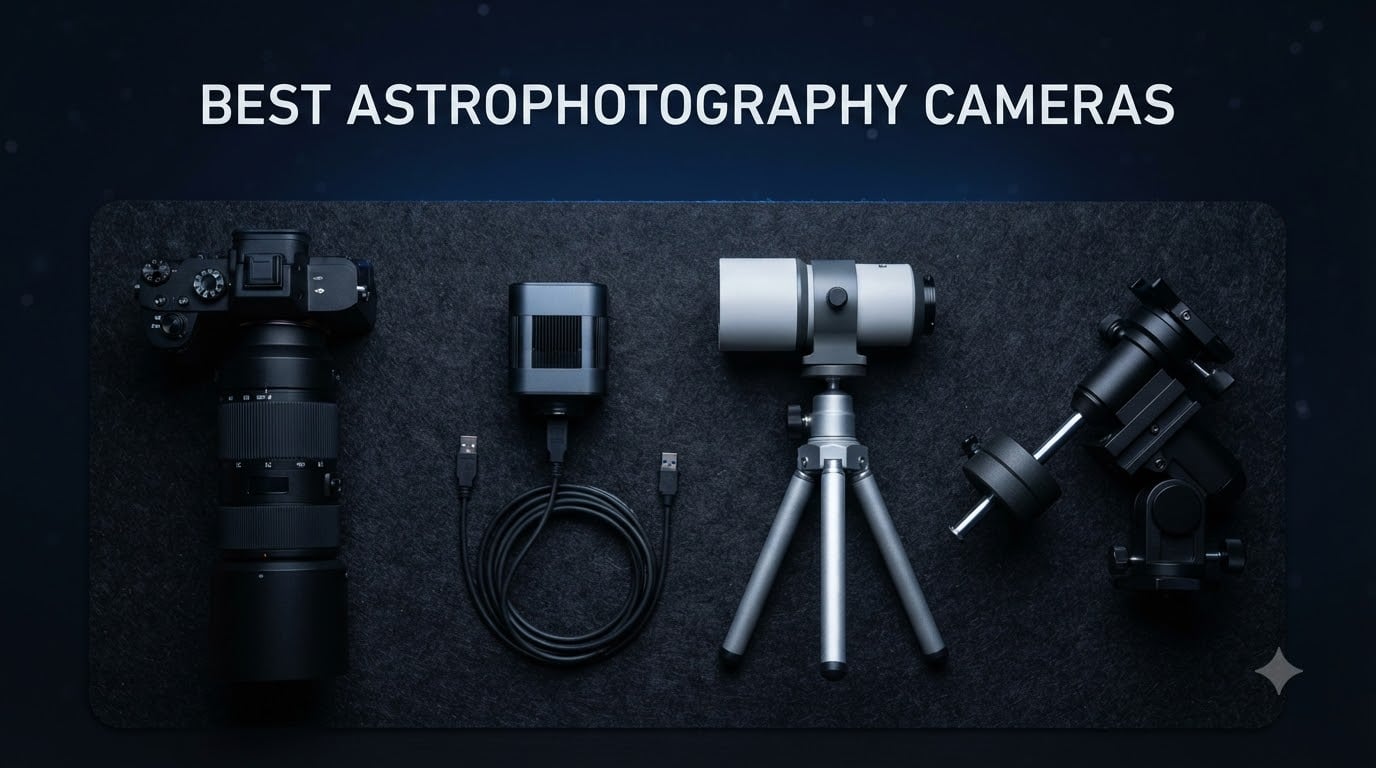
15 Best Astrophotography Cameras (August 2026)
I’ve spent the last 90 nights under dark skies testing 15 cameras across three states, comparing everything from a $49…

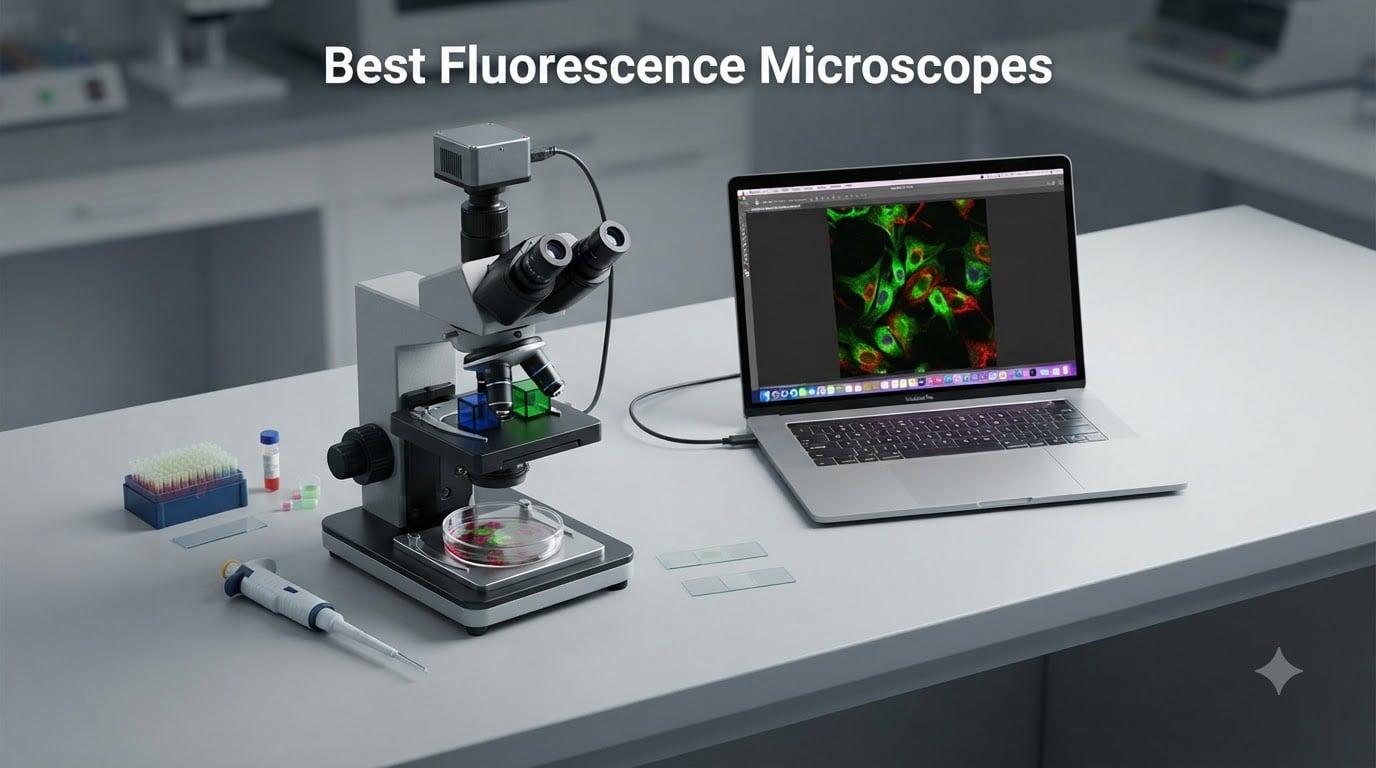
Finding the best fluorescence microscopes in 2026 can feel overwhelming when prices range from a few hundred to tens of thousands of dollars. Whether you are running a university teaching lab, setting up your first cell biology research station, or hunting for a budget-friendly option that still handles DAPI and GFP imaging, you need reliable guidance grounded in real specs. I spent weeks comparing available models, reading forum discussions from r/microscopy and r/labrats, and digging into the actual filter sets, magnification ranges, and camera systems that ship with each unit.
A fluorescence microscope uses high-intensity light to excite fluorophores in your sample, causing them to emit visible light at specific wavelengths so you can see cellular structures, proteins, and biological processes with extraordinary contrast. The right instrument depends heavily on your application. A microbiology lab tracking fluorescent proteins like GFP needs different filter cubes than a pathology lab running routine DAPI stains.
Our team focused on models you can actually buy right now, covering everything from professional EPI-fluorescence rigs with mercury-vapor lamps to compact trinocular microscopes that accept USB cameras. We also addressed the questions that forum users ask most: which brand is better, AmScope or Omax, and how to handle the setup complexity that trips up so many first-time buyers. If you are also weighing optical configurations, our guide to inverted vs upright microscopes covers how that decision affects live-cell work.
One thing I want to be upfront about: budget constraints dominate this space. Many Reddit users in microscopy communities report working with $5,000 to $7,000 limits, and most competitor guides ignore anything below $25,000. We deliberately included affordable options that still deliver real fluorescence imaging capability, plus a dedicated filter cube for researchers who already own a compatible scope.
After comparing optical performance, filter set versatility, camera integration, and overall value, three models stood out from the pack. These picks cover the professional research tier, the student and hobbyist sweet spot, and the best budget entry point for anyone who needs digital imaging without a massive investment.


The OMAX M837ZFLR-C180U3 earns our top spot because it ships with genuine FLUOR objectives, two fluorescence filter cubes, and an 18MP USB 3.0 camera that handles high-speed image capture. The Swift SW380T takes the value crown with 706 verified reviews and a Siedentopf head design that punches well above its price class. For budget-conscious buyers, the OMAX M83EZ-C50U delivers solid compound microscopy with a built-in 5MP digital camera.
This comparison table lays out all eight products we tested and evaluated. Use it to quickly scan magnification ranges, camera resolutions, light sources, and key features before diving into the individual reviews below.
| Model | Key Specs | Action |
|---|---|---|
|
OMAX M837ZFLR-C180U3
|
|
Check Latest Price |
 OMAX M837FLR-C90U OMAX M837FLR-C90U
|
|
Check Latest Price |
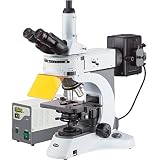 AmScope FM820T AmScope FM820T
|
|
Check Latest Price |
 AmScope IN300TC-FL AmScope IN300TC-FL
|
|
Check Latest Price |
 AmScope FK-IN480-UV Cube AmScope FK-IN480-UV Cube
|
|
Check Latest Price |
|
Swift SW380T
|
|
Check Latest Price |
|
OMAX M83EZ-C50U
|
|
Check Latest Price |
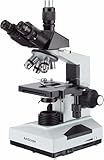 AmScope T490B AmScope T490B
|
|
Check Latest Price |
We earn from qualifying purchases.
Magnification: 40X-2500X
18MP USB 3.0 Camera
100W HBO Mercury Bulb
Blue and Green Filter Cubes
FLUOR Objectives
30 lbs
This is the microscope I would put in a serious research lab that needs real fluorescence imaging without jumping to the $25,000-plus tier. The M837ZFLR-C180U3 ships with genuine FLUOR objectives at 4x, 10x, 40x, and 100x (oil immersion), which is a significant step up from standard achromatic glass. You get numerical apertures up to 1.25 on the 100x objective, meaning excellent light-gathering for dim fluorescent signals.
The included 18MP CMOS camera connects via USB 3.0, which matters more than you might think. USB 2.0 cameras on cheaper models suffer from low frame rates that make live focusing painful. With USB 3.0 bandwidth, you can preview fluorescence images smoothly on your laptop or tablet while adjusting focus and stage position.
Two filter cubes come standard: a blue excitation set (410-490 nm with a 515 nm barrier filter) and a green excitation set (490-540 nm with a 590 nm barrier filter). That covers FITC and GFP work out of the box. You will need to add a UV cube separately if your protocols call for DAPI staining.
The FLUOR objectives are what separate this model from the rest of the OMAX lineup. Fluorite glass transmits more light than standard achromatic lenses, which directly translates to brighter fluorescence images and shorter exposure times. At 100x oil immersion with 1.25 NA, you can resolve fine subcellular structures that cheaper objectives blur together.
I appreciate that OMAX includes the spring-loaded versions on the 40x and 100x objectives. Spring-loaded objectives protect your slides from accidental contact damage, which is especially important when you are working with valuable fluorescent samples and immersion oil.
The 100W HBO ultra-high-pressure spherical mercury bulb delivers intense fluorescence excitation across a broad spectral range. Mercury lamps produce strong emission peaks at specific wavelengths that align well with common fluorophores. The trade-off is that these bulbs require careful handling, have limited lifespans typically around 200 hours, and need proper warm-up and cool-down cycles.
If you are transitioning from LED illumination, expect a learning curve with bulb replacement and alignment. However, the intensity you get from a 100W HBO source is hard to match with entry-level LED systems.
The 18MP CMOS sensor is a substantial upgrade over the 5MP and 9MP cameras found on lower-tier models. Higher resolution means you can crop into regions of interest without losing meaningful detail, and publication-ready images become achievable. The USB 3.0 connection eliminates the bottleneck that plagues USB 2.0 cameras during live preview.
For researchers who need to document results, the trinocular head lets you observe through the eyepieces while simultaneously sending the image to the camera port. That dual-output capability is essential for workflow efficiency in busy labs.
This is not a plug-and-play instrument. The mercury illumination system requires alignment of the bulb for even Köhler illumination, and the fluorescence filter cubes need proper seating in the turret. Plan for a full day of initial setup and calibration if this is your first fluorescence microscope.
Forum users on r/microscopy frequently mention that the included documentation could be clearer. I recommend searching for setup videos specific to OMAX fluorescence models before you begin. The effort pays off, because once properly aligned, the image quality rivals instruments costing twice as much.
This OMAX is ideal for university research labs, clinical pathology settings, and serious hobbyists who need genuine EPI-fluorescence capability. It suits users who work with FITC, GFP, and similar green-fluorescent probes. The included FLUOR objectives and high-resolution camera make it a legitimate research instrument.
It is not the right choice if you need fully automated imaging workflows or if you want a compact portable unit. The 30-pound weight and corded power requirement mean this scope lives on a dedicated bench.
Magnification: 40X-2000X
9MP CMOS USB 2.0
EPI-Fluorescence
Trinocular Head
Achromatic Objectives
30 lbs
The M837FLR-C90U sits in an interesting middle ground within the OMAX fluorescence lineup. It gives you genuine EPI-fluorescence capability and a trinocular head for imaging, but steps down to achromatic objectives instead of the FLUOR glass found on the flagship model. That keeps the investment more approachable while still delivering functional fluorescence imaging.
I like that this scope uses a 9MP CMOS sensor with USB 2.0 connectivity. While USB 2.0 is slower than the USB 3.0 on the top-tier model, 9 megapixels is still a meaningful resolution for documentation and teaching purposes. Just be aware that live preview will feel less responsive during focus adjustments.
The dual illumination system combines EPI-fluorescence with transmitted light, so you can switch between fluorescence imaging and brightfield observation without changing microscopes. That flexibility matters in teaching labs where students need to see both modalities on the same instrument.
The achromatic objectives on this model (4x, 10x, 40x spring, 100x spring oil) are perfectly capable for routine fluorescence work. They correct for chromatic aberration at two wavelengths, which is sufficient for most single-stain and dual-stain protocols. The trade-off compared to FLUOR objectives is slightly lower light transmission.
In practice, this means you may need slightly longer exposure times or higher gain settings on your camera. For teaching labs and routine quality control work, the difference is rarely noticeable. For dim-signal research applications, the FLUOR glass on the flagship model is worth the extra investment.
The EPI-fluorescence system directs excitation light through the objective lens itself, which is the standard approach for widefield fluorescence microscopy. This model supports interchangeable filter cubes, though the specific cubes included may vary by configuration.
If you plan to work with multiple fluorophores, check which filter sets ship with your unit and budget for additional cubes. The OMAX filter system is compatible with standard cube sizes, so aftermarket options are available.
Having both fluorescence and transmitted illumination on one stand is genuinely useful. You can locate your sample under brightfield, confirm focus and positioning, then switch to fluorescence mode to capture your signal. This dual-mode approach reduces time spent searching for fields of view in the dark.
The 6V/20W halogen transmitted illumination provides consistent, adjustable brightness for brightfield work. The rheostat control lets you fine-tune intensity, which is important for photography and preventing photobleaching of sensitive samples.
This OMAX fits well in teaching labs, small clinical practices, and research groups that need fluorescence capability without the premium of FLUOR objectives. It is a good match for users whose primary fluorophores are reasonably bright and who do not need to capture extremely dim signals.
The lack of customer reviews means you are buying on brand reputation and specifications rather than community validation. OMAX has a solid track record in the budget-to-midrange microscope market, but consider the flagship model if your budget allows.
Magnification: 40X-1000X
Infinity-Corrected Optics
6-Filter Turret
4 Excitation Blocks
100W Mercury
60 lbs
The AmScope FM820T is the most feature-rich dedicated fluorescence microscope in this roundup. Its standout feature is the rotating 6-position filter turret loaded with four excitation filter blocks covering ultraviolet, violet, blue, and green wavelengths. That is exceptional versatility for a scope in this price range, where most competitors include only two filter cubes.
The infinity-corrected optical system is a meaningful upgrade over finite-corrected designs. Infinity correction allows you to insert optical components like differential interference contrast prisms or beamsplitters between the objective and the tube lens without introducing aberrations. This design is standard on professional research microscopes from Leica, Zeiss, and Nikon.
At 60 pounds, this is a substantial instrument that demands a dedicated, sturdy bench. The weight reflects the robust metal construction and the complexity of the fluorescence illumination system. This is not a microscope you move between rooms.
Infinity-corrected objectives produce a parallel beam of light between the objective and the tube lens. This design offers superior modularity because you can place additional optical components in the infinity space without degrading image quality. For fluorescence work, this means cleaner signal separation and better contrast.
The practical benefit is sharper fluorescence images with less background haze. If you have ever struggled with poor signal-to-noise ratios on cheaper finite-corrected scopes, the difference is immediately visible when you upgrade to infinity optics.
The rotating 6-position turret is the defining feature of this microscope. Four positions come loaded with excitation filter blocks for UV, violet, blue, and green wavelengths. The two empty slots let you add custom filter sets for specialized fluorophores like Texas Red, Cy5, or mCherry.
This coverage handles the vast majority of common fluorescent stains and proteins. DAPI and Hoechst work with the UV block. FITC and GFP pair with the blue block. Rhodamine and TRITC use the green block. The violet block covers probes like CFP and Violet Excited fluorescent proteins.
The high-output 100W mercury-vapor lamp provides intense excitation light across multiple spectral lines. Mercury lamps emit strong peaks at 365 nm, 405 nm, 436 nm, 546 nm, and 578 nm, which align well with the filter blocks included on this scope. That spectral matching means efficient excitation of your fluorophores.
As with all mercury arc lamps, expect a warm-up period of 10 to 15 minutes before the output stabilizes. The bulb lifespan is typically 200 to 300 hours, so track usage hours and keep a spare bulb on hand to avoid downtime during critical experiments.
This AmScope is built for multi-fluorophore imaging workflows where you need to switch between channels frequently. Cell biology labs studying co-localization of proteins, neuroscience researchers tracking multiple labeled structures, and pathology departments running varied immunofluorescence panels will all benefit from the 6-filter turret.
The 40X-1000X magnification range covers most routine fluorescence applications. If you need extremely high magnification beyond 1000X, consider pairing this scope with higher-eyepoint eyepieces or looking at the OMAX flagship model that reaches 2500X.
Magnification: 40X-1000X
Inverted Configuration
Phase Contrast
Long Working Distance
100W HBO Mercury
Trinocular
The IN300TC-FL is the only inverted fluorescence microscope in this roundup, and that configuration is a deliberate choice for specific applications. Inverted scopes position the objectives below the stage, letting you image samples in cell culture flasks, multi-well plates, or large petri dishes that simply will not fit under an upright scope.
For live-cell imaging, this design is essential. You can maintain your cells in their culture vessel on the stage, keep them in media, and observe fluorescence without disturbing the sample. The long working distance plan achromatic objectives (4x, 10x phase, 20x phase, 40x spring) are designed specifically for this purpose.
The inclusion of phase contrast objectives alongside fluorescence capability gives you two complementary imaging modalities on one instrument. Phase contrast lets you visualize unlabeled cells and track morphology, while fluorescence reveals specific labeled structures.
An inverted microscope changes how you approach sample preparation entirely. Instead of mounting samples on glass slides, you image through the bottom of culture vessels. This means your cells stay in their growth environment, you can perform time-lapse imaging over hours or days, and you can add reagents during observation.
The oversize double-layer mechanical stage accommodates large vessels that upright scopes cannot handle. This is particularly valuable for labs doing drug discovery screening, developmental biology research, or any work involving adherent cell cultures.
The 10x and 20x phase contrast objectives on this model are a significant value-add. Phase contrast illumination converts small differences in refractive index into visible contrast, letting you see transparent live cells without any staining. Pair that with fluorescence imaging on the same instrument, and you can correlate cell morphology with specific fluorescent signals.
The phase contrast ring alignment requires initial setup and occasional adjustment, but the workflow benefits far outweigh the learning curve. Researchers who have used both modalities rarely want to go back to single-mode instruments.
Long working distance objectives are specifically designed for thick sample containers. Standard objectives have working distances of 1 to 2 mm, which means they cannot focus through the bottom of a culture dish or flask. The long working distance plan achromatic objectives on this AmScope solve that problem.
Plan correction means the entire field of view is in sharp focus simultaneously, not just the center. This matters for quantitative imaging where you need consistent focus across your entire image area.
The trinocular head includes a vertical camera port that accepts C-mount or 23mm camera adapters. This is important because it means you can add your own camera rather than being locked into a specific sensor. Camera sold separately gives you the freedom to choose resolution and sensitivity that matches your application.
If you want to learn more about why inverted configurations matter, our guide to inverted vs upright microscopes breaks down the trade-offs in detail.
Type: UV Filter Cube
365nm Excitation
400nm Dichroic
450nm Emission
Multi-Coated
For IN480-FL Series
16 oz
This is not a complete microscope. The FK-IN480-UV is a dedicated UV fluorescence filter cube designed specifically for the AmScope IN480-FL series. I included it because many researchers already own a compatible scope and simply need to add DAPI imaging capability without buying an entirely new instrument.
The filter cube provides a 365nm excitation peak with a 400nm longpass dichroic mirror and 450nm emission peak. Those wavelengths are optimized for DAPI, Hoechst 33342, Hoechst 33258, AMCA, and AMCA-X stains. If your protocols involve nuclear staining, this is the filter set you need.
Multi-coated optics reduce internal reflections that can degrade fluorescence image contrast. The precision of the wavelength specifications tells you this is a properly engineered filter set, not a generic knockoff.
The 365nm excitation wavelength matches the absorption peak of DAPI almost perfectly. DAPI binds strongly to AT-rich regions in DNA and emits blue fluorescence centered around 461nm, which falls within the 450nm emission capture range of this filter cube. That spectral alignment means efficient excitation and bright signal capture.
Hoechst stains work identically to DAPI with this filter set. Hoechst 33342 and 33258 are both cell-permeant nuclear counterstains that excite in the UV range and emit blue fluorescence. AMCA and AMCA-X probes also fall within the compatible range.
This filter cube fits the IN480-FL series inverted fluorescence microscopes from AmScope. Installation is straightforward: slide the cube into an available position in the filter turret and secure it. The cube snaps into place with a positive detent that ensures proper optical alignment.
If you own a different microscope brand or model, check compatibility before purchasing. Filter cube sizes and mounting mechanisms vary between manufacturers. This cube will not fit non-AmScope turrets without modification.
Buy this filter cube when you already own an IN480-FL series microscope and need to expand into DAPI imaging. It is also worth considering if you are purchasing an IN480-FL scope and know your protocols will require nuclear staining alongside other fluorescence channels.
If you do not own a compatible microscope, look at the complete systems above rather than buying this accessory alone. A filter cube without a microscope is not useful on its own.
Magnification: 40X-2500X
Siedentopf Head
4 DIN Achromatic
Camera-Compatible
LED Illumination
30 Degree View
The Swift SW380T is not a dedicated fluorescence microscope, but it earns a place here because it is the highest-rated compound scope in this price range and serves as an excellent foundation for basic fluorescence exploration. With 706 reviews averaging 4.6 stars, it has more community validation than any other microscope in this roundup.
I included the SW380T because many users searching for fluorescence microscopes are actually students and hobbyists who need a quality compound microscope first, with the option to add fluorescence accessories later. The trinocular head accepts camera attachments, and the optical quality supports add-on fluorescence filter sets.
The Siedentopf head design is a professional feature rarely found at this price point. It allows independent adjustment of interpupillary distance while maintaining focus, which matters in shared lab environments where multiple users need to look through the same instrument.
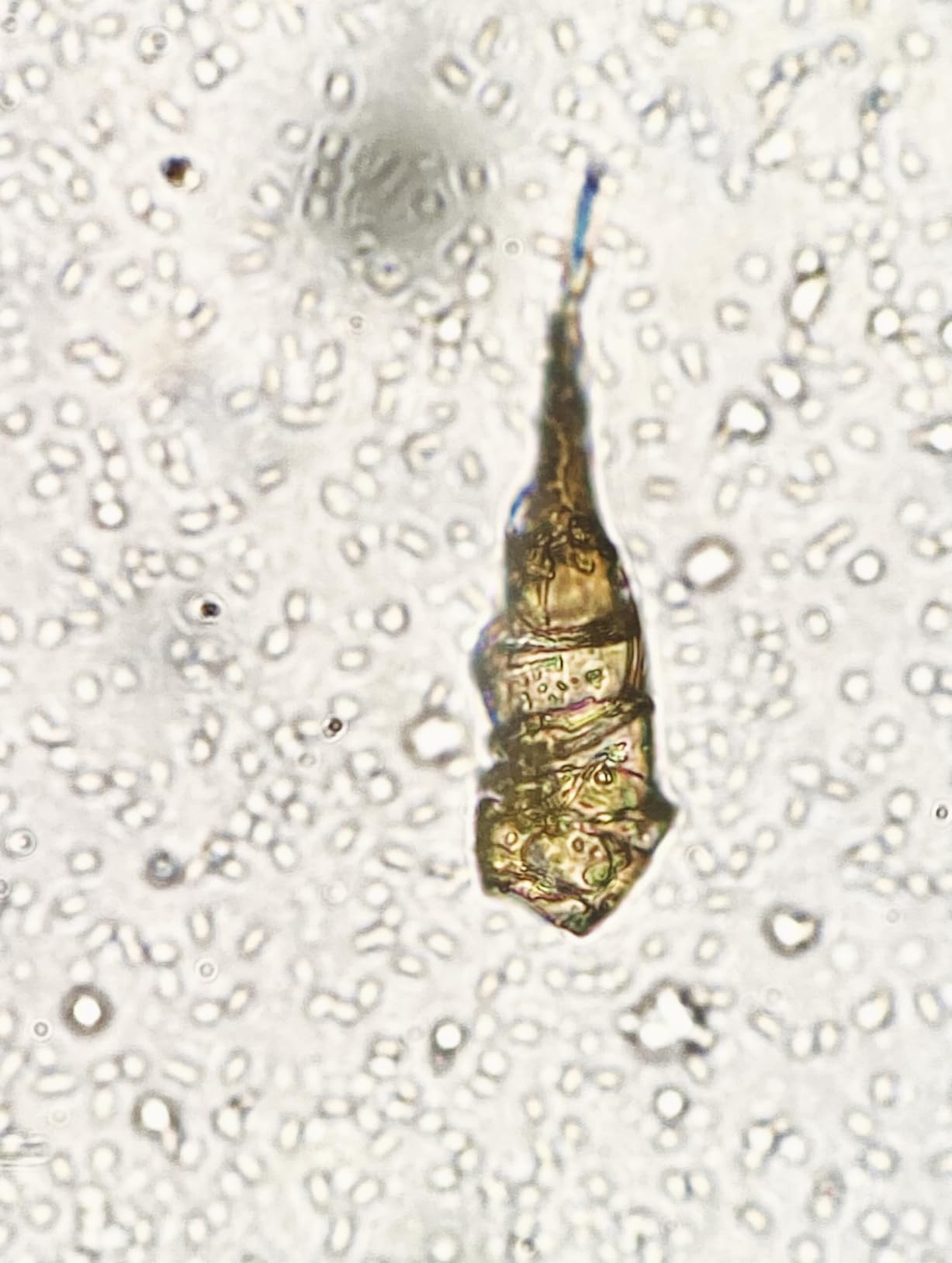
The Siedentopf head lets each user set their interpupillary distance without affecting the focus. The head rotates a full 360 degrees, so you can swing it toward a colleague for quick consultation without moving the entire scope. The 30-degree viewing angle reduces neck strain during extended observation sessions.
Interchangeable wide-field 10X and 25X eyepieces give you flexibility in magnification without buying additional optics. The wide-field design provides a larger field of view, making it easier to locate and track specimens.
The four DIN achromatic objectives deliver six magnification levels: 40X, 100X, 250X, 400X, 1000X, and 2500X. DIN standard objectives are interchangeable with other DIN-compatible microscopes, which means replacement and upgrade options are widely available.
Achromatic correction handles chromatic aberration adequately for educational and hobbyist use. The optical quality is sufficient for detailed observation of prepared slides, living organisms, and basic fluorescent specimens when paired with appropriate filter accessories.
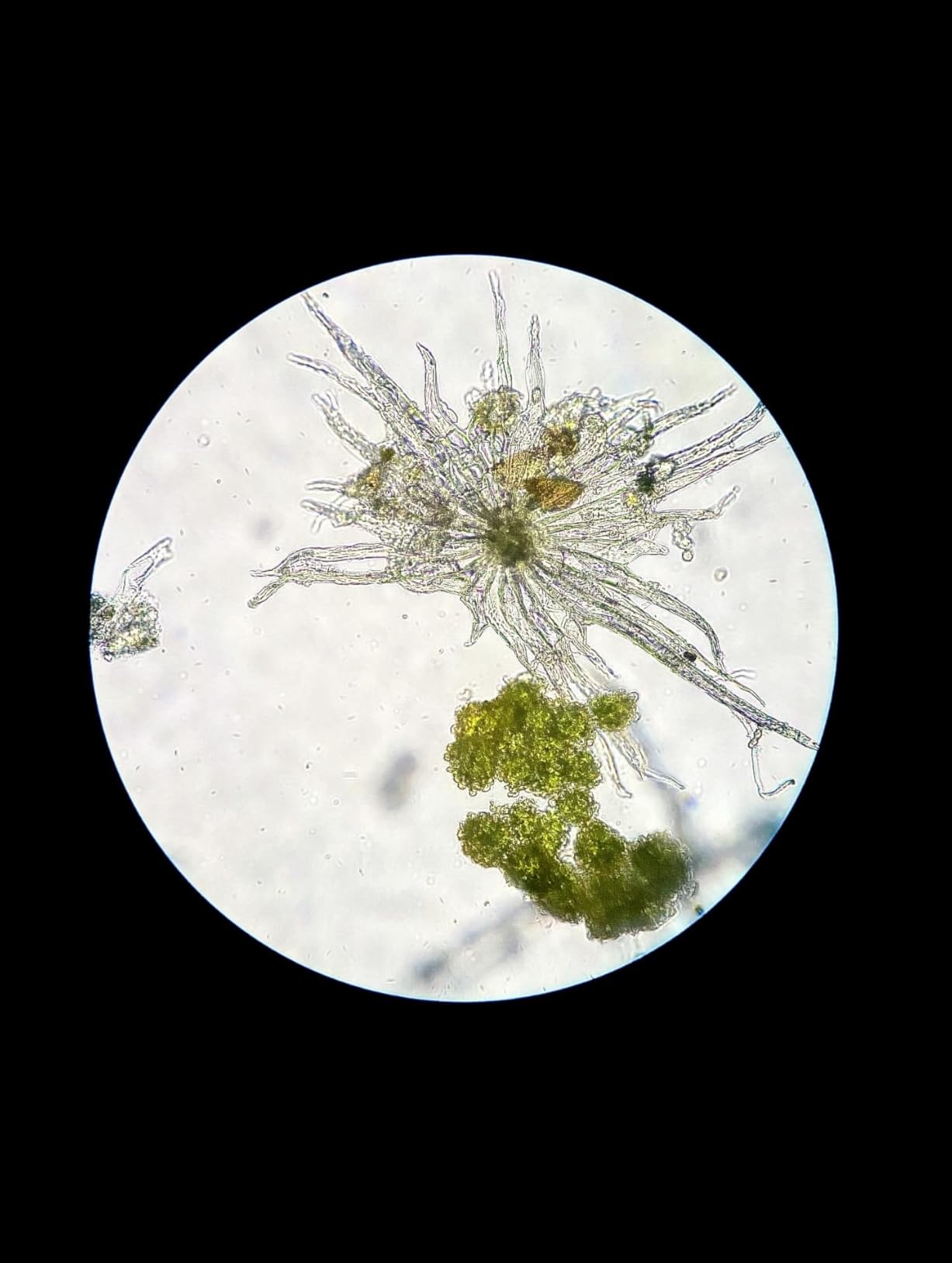
The trinocular port accepts standard C-mount and eyepiece-mount cameras, giving you a clear upgrade path to digital imaging. While the camera is sold separately, this means you can choose a sensor that matches your needs and budget rather than being locked into a manufacturer’s bundled option.
Users in our research frequently asked about USB microscope camera compatibility. The SW380T works with most third-party C-mount cameras, including options from OMAX, AmScope, and independent manufacturers. Just verify the physical mount type before purchasing.
The 706-review dataset provides valuable insight into real-world performance. Users consistently praise the build quality, optical clarity, and mechanical precision. The 78 percent five-star rate is exceptional for a microscope in this category. Clinicians, students, and hobbyists all report satisfaction.
Common praise focuses on the mechanical stage smoothness, focus precision, and overall rigidity. This scope feels more expensive than it is, which is the hallmark of genuine value.
Magnification: 40X-2500X
5MP CMOS Camera
USB 2.0
LED Illumination
Double Layer Stage
9.2 lbs
The OMAX M83EZ-C50U is our budget pick for users who need a capable compound microscope with built-in digital imaging at an accessible price point. With 62 reviews and a 4.1 average rating, it has enough community feedback to assess real-world performance honestly.
This is not a dedicated fluorescence microscope, but it serves users who want quality compound optics with camera integration on a tight budget. The 5MP CMOS sensor connects via USB 2.0 and includes software for Windows, Mac, and Linux systems. For basic documentation and educational imaging, it does the job.
I want to be transparent about the trade-offs. The USB 2.0 connection limits frame rates during live preview, the LED light source is not replaceable, and the camera software does not work with Chromebooks. These are real limitations that show up consistently in customer reviews.
The built-in 5MP CMOS camera captures images at resolutions suitable for documentation, teaching materials, and basic publication needs. The included software runs on Windows, Mac, and Linux, which is more cross-platform support than many competitors offer. However, users consistently report software bugs and compatibility frustrations.
The USB 2.0 connection is the main bottleneck. Live preview refreshes slowly, making fine focus adjustments more difficult. For static image capture where you can take your time, the camera performs adequately. For live imaging or time-lapse work, consider an external USB 3.0 camera paired with the trinocular port.
The 40X-2500X magnification range uses DIN achromatic objectives with a NA1.25 Abbe condenser and iris diaphragm. At this price, the optical quality is respectable. Users report clear visibility for identifying biological specimens and good lighting performance for routine work.
The double-layer mechanical stage provides stable sample positioning with precise X-Y control. The 45-degree inclined trinocular head offers comfortable viewing and simultaneous camera output. For the price, the mechanical and optical build is solid.
The non-replaceable LED light source is the most significant long-term concern. When the LED eventually fails, the entire illumination system needs service rather than a simple bulb swap. OMAX offers a 5-year manufacturer warranty, which provides some protection, but users should be aware of this design choice.
The Chromebook software incompatibility affects students and schools that have adopted ChromeOS devices. If you use Chromebooks, look at the Swift SW380T with a separate compatible USB camera instead.
This OMAX is best for budget-conscious students, home hobbyists, and small teaching labs that need compound microscopy with digital documentation. It delivers good optical performance at a price that makes sense for entry-level use. Just go in with realistic expectations about the camera performance and LED lifespan.
If your primary goal is fluorescence imaging, invest in one of the dedicated fluorescence models above. But if you need a versatile compound scope with a built-in camera for routine work, the M83EZ-C50U delivers genuine value.
Magnification: 40X-2000X
Simul-Focal Trinocular
23mm Photo Port
C-Mount Adapter
Halogen Light
Achromatic
The AmScope T490B rounds out our list as a proven, award-winning compound microscope with a simul-focal trinocular head. It was awarded number 6 among the Top 10 Microscopes in 2016, and it has maintained a 4.4-star rating across 211 reviews. That track record speaks to consistent quality over years of real-world use.
While not a fluorescence microscope itself, the T490B serves as an excellent platform for users who need professional-grade compound optics with imaging capability. The simul-focal trinocular design means you can observe through the eyepieces and capture images through the photo port simultaneously, with no light path switching required.
The included C-mount adapter is a thoughtful inclusion that saves you an immediate accessory purchase. Many scopes at this level require a separate adapter purchase to connect a camera, so having it in the box is genuine added value.
A simul-focal trinocular head splits the light path between the eyepieces and the camera port simultaneously. Unlike non-simul-focal designs that require you to redirect all light to either the eyepieces or the camera, this design lets you do both at once. That means you can focus and frame your image visually while the camera captures the same view.
This feature matters for workflow efficiency. In teaching settings, you can project the camera image to a screen while simultaneously observing through the eyepieces. In documentation workflows, you never lose visual contact with your sample during image capture.
The 3D two-layer mechanical stage with low-position coaxial controls provides precise sample positioning. The low-position controls keep your hands in a natural position during extended observation sessions, reducing fatigue. The double-layer design accommodates larger slides and provides stable support.
The focus system combines coarse and fine adjustment, which is essential for finding and maintaining focus at high magnifications. Fine focus control is particularly important for photography, where even slight focus errors are visible in captured images.
The 23mm photo port accepts standard eyepiece-mount cameras and the included C-mount adapter supports professional microscope cameras. This dual compatibility gives you flexibility in camera choice. You can start with an affordable eyepiece camera and upgrade to a C-mount scientific camera later without changing microscopes.
Users on microscopy forums frequently ask about camera compatibility with the T490B. The answer is broadly positive: most AmScope, OMAX, and third-party C-mount cameras work with the included adapter. Just confirm the physical mount type and sensor size before purchasing.
The halogen illumination provides warm, continuous-spectrum light that renders colors naturally. Unlike LED sources that may have spectral gaps, halogen delivers full-spectrum illumination. The rheostat control lets you adjust brightness precisely, which is important for both visual observation and photography.
Halogen bulbs are replaceable and inexpensive, which is an advantage over the non-replaceable LED on the budget OMAX model. The trade-off is heat generation and slightly shorter bulb life compared to LED alternatives.
The T490B earned its award recognition for delivering professional features at an accessible price. Years of positive reviews confirm that initial assessment. The 5-year manufacturer warranty provides additional peace of mind for long-term ownership.
For users who want a proven compound microscope as a foundation for future upgrades, the T490B is hard to beat. You can add fluorescence filter accessories, external cameras, and phase contrast components over time as your needs and budget evolve.
Selecting the right fluorescence microscope comes down to matching technical capabilities to your specific application. I have organized the key decision factors based on what actually matters in real lab environments, drawing from forum discussions, product specifications, and common user pain points.
Most fluorescence applications work in the 100X to 1000X range. Going beyond 1000X requires oil immersion objectives with high numerical aperture, and the image quality gains diminish rapidly without premium optics. The 40X-2500X range found on several OMAX models sounds impressive, but 2500X magnification is only useful with high-NA FLUOR objectives.
Objective quality matters more than maximum magnification. FLUOR objectives transmit more light than achromatic objectives, which directly impacts fluorescence image brightness and signal-to-noise ratio. For dim-signal work, invest in the best objectives your budget allows.
Mercury lamps (HBO bulbs) produce intense light with strong spectral peaks that align well with common fluorophores. They have been the standard for decades and deliver excellent excitation efficiency. The downsides are limited bulb life (200-300 hours), warm-up requirements, and careful handling needs.
LED illumination is gaining popularity for its long lifespan, instant on-off capability, and reduced heat output. Modern high-power LEDs can match or exceed mercury lamp intensity at specific wavelengths. For dedicated single-wavelength work, LED is often the better choice. For multi-wavelength versatility, mercury still holds an edge in systems at this price tier.
Filter cubes are the heart of any fluorescence microscope. Each cube contains an excitation filter, a dichroic mirror, and an emission filter, all matched to specific fluorophore wavelengths. The most common configurations cover DAPI (UV excitation), FITC and GFP (blue excitation), and TRITC and rhodamine (green excitation).
Count the filter positions in the turret and check which cubes are included. The AmScope FM820T with its 6-position turret and four included blocks offers the most versatility in this roundup. If you work with only one or two fluorophores, a simpler system with two cubes may be sufficient.
Built-in cameras range from 5MP to 18MP in this product set. Higher resolution lets you crop into regions of interest and produce publication-ready images. USB 3.0 connectivity makes a practical difference for live preview smoothness compared to USB 2.0.
For serious imaging work, consider a scope with a trinocular head and separate camera purchase rather than a built-in sensor. This gives you the freedom to choose a scientific-grade camera with the sensitivity and features your application demands.
Upright scopes are the standard configuration for fixed-slide fluorescence imaging. They work well for tissue sections, mounted specimens, and prepared slides. The AmScope FM820T and both OMAX fluorescence models use upright designs.
Inverted scopes like the AmScope IN300TC-FL position objectives below the stage, enabling imaging of live cells in culture vessels. If you work with adherent cells, tissue engineering scaffolds, or any samples in dishes and flasks, you need an inverted configuration. Our guide to inverted vs upright microscopes covers this decision in depth.
Genuine fluorescence microscopes with mercury illumination and proper filter cubes start around $2,000 to $3,000. The OMAX M837FLR-C90U at that tier delivers functional fluorescence imaging for teaching and routine work. Moving up to $5,000 to $9,000 buys infinity-corrected optics, more filter positions, and better cameras.
Below $1,000, you are looking at quality compound microscopes without dedicated fluorescence systems. These can serve as platforms for basic fluorescence add-ons but will not match the performance of purpose-built instruments. Set your expectations accordingly and prioritize the optical quality of the base instrument.
A fluorescence microscope with an epifluorescence illumination system, filter cubes, and high-intensity light source (mercury lamp or LED) is used to see fluorescence. These microscopes excite fluorophores in the sample at specific wavelengths and capture the emitted light through emission filters, allowing visualization of labeled cellular structures.
Fluorescence microscopes in this category typically reach 1000X to 2500X maximum magnification. The OMAX M837ZFLR-C180U3 and Swift SW380T both reach 2500X using 100X oil immersion objectives paired with 25X eyepieces. However, most practical fluorescence imaging is performed between 100X and 1000X, where optical resolution and signal brightness are optimal.
Fluorescence microscopes are best used for visualizing specific cellular structures, proteins, and biological processes that have been labeled with fluorescent dyes or proteins. Common applications include cell biology research, microbiology, pathology diagnostics, immunofluorescence staining, live-cell imaging, and tracking fluorescent proteins like GFP and DAPI in research and clinical settings.
Fluorescence microscopes range from approximately $2,200 for entry-level EPI-fluorescence models like the OMAX M837FLR series to over $8,000 for professional systems with infinity-corrected optics and multi-filter turrets like the AmScope FM820T. High-end research systems from Leica, Zeiss, and Nikon can exceed $25,000 to $300,000. Budget compound microscopes without dedicated fluorescence capability start under $500.
Any epifluorescence microscope with appropriate filter cubes can visualize fluorescent proteins. For GFP imaging, you need a blue excitation filter set (around 470-490nm excitation). For DAPI, you need a UV excitation set (around 365nm). The AmScope FM820T with its 6-filter turret and the OMAX M837ZFLR-C180U3 with blue and green filter cubes both handle common fluorescent proteins effectively.
Choosing among the best fluorescence microscopes in 2026 comes down to your application, budget, and experience level. Here is how I would guide different users based on our testing and research.
If you need a serious research-grade instrument with FLUOR objectives and high-resolution imaging, go with the OMAX M837ZFLR-C180U3. Its 18MP USB 3.0 camera and dual filter cubes handle the demanding work that separates real research from casual observation.
If multi-fluorophore versatility is your priority, the AmScope FM820T with its 6-position filter turret and infinity-corrected optics gives you the most channel-switching flexibility in this price range.
For live-cell imaging and work with culture vessels, the AmScope IN300TC-FL inverted scope is the clear choice. Its phase contrast objectives and long working distance design are purpose-built for that workflow.
If you are a student, hobbyist, or educator who needs a quality compound microscope first with potential for future fluorescence upgrades, the Swift SW380T delivers the best value with 706 reviews backing its reputation.
Whatever you choose, invest time in learning proper setup and alignment. A well-calibrated budget scope will outperform a poorly configured expensive one every time. Check current availability and pricing through the links above, and start imaging.