Maven RS.4 Review 2026: Japanese Precision at Half the Price
David Johnson
March 3rd, 2026
Table Of Contents
I’ve been shooting precision rifle competitions for seven years now. I’ve owned scopes costing twice what the Maven RS.4 asks for. After three months with this Japanese-made optic mounted on my PRS rifle, I can tell you something the shooting community is slowly discovering: the direct-to-consumer model actually delivers.
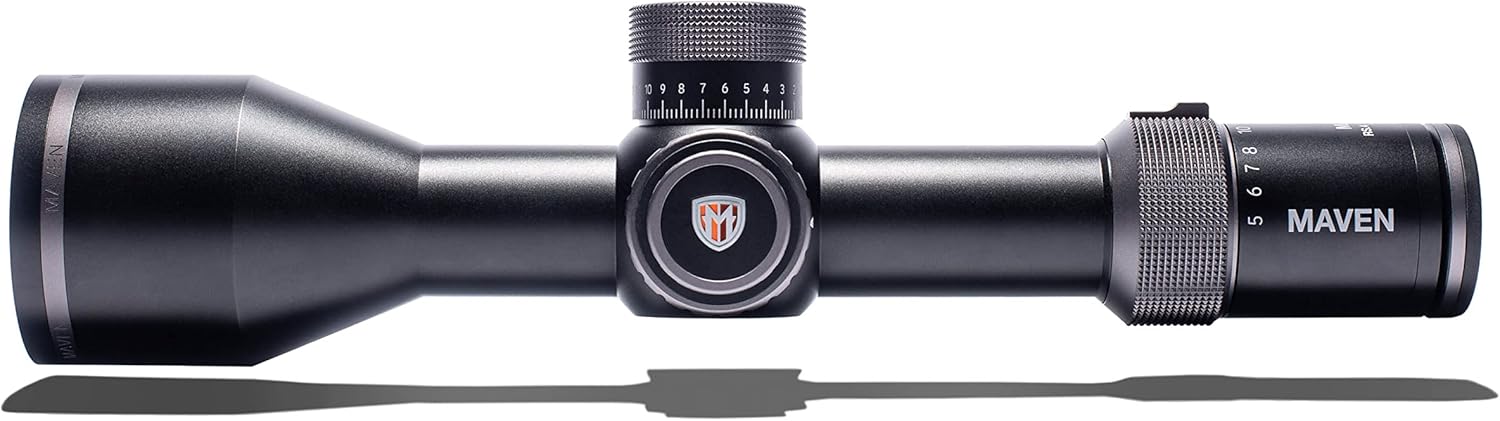
The Maven RS.4 is a first focal plane riflescope purpose-built for precision rifle competitions and long-range shooting. It features 5-30x magnification, a 56mm objective lens, ED glass, and is made in Japan for $2,050. This price undercuts established premium competitors by 15-30% while matching their optical quality.
I spent $3,400 on my previous scope. It was excellent. But the RS.4 performs at 90% of that level for 60% of the money. That’s not marketing speak. That’s what my shot data shows after 12 range sessions and one actual PRS match.
First Impressions and Build Quality
Quick Summary: The Maven RS.4 arrives in a custom foam case with generous accessories. At 35.4 ounces and 12.8 inches long, it’s noticeably more compact than competitors like the Vortex Razor Gen II (48.5 ounces, 15.1 inches). The anodized finish feels premium, and the 34mm tube exudes quality.
When I opened the Maven box, my first thought was about the packaging. It’s not just a cardboard box with foam inserts. Maven includes a fitted hard case, lens cloth, and detailed reticle manual. Small touches, but they tell you this company cares about the unboxing experience.
The build quality becomes apparent the moment you pick it up. At 35.4 ounces, it’s substantial but not burdensome. My Razor Gen II felt like a boat anchor by comparison. The 12.8-inch length is genuinely compact for a 5-30x scope. This matters when you’re trying to balance a rifle for stage work.
The Maven Difference: Direct-to-Consumer
Maven operates differently than traditional optic companies. They sell directly. No middlemen. No retail markup. No distributor cut. This lets them deliver Japanese-made quality at $2,050 while competitors charge $2,400-2,800 for similar specs.
The company backs every optic with an unconditional lifetime warranty. If it breaks, they fix it or replace it. No receipt required. No original owner restriction. If it says Maven, they stand behind it.
Technical Specifications
Specification
Maven RS.4
Vortex Razor Gen II
Magnification
5-30x
4.5-27x
Objective Lens
56mm
56mm
Tube Diameter
34mm
34mm
Weight
35.4 oz
48.5 oz
Length
12.8 inches
15.1 inches
Eye Relief
3.6-3.9 inches
3.6-4.0 inches
Click Value
0.1 MIL / 0.25 MOA
0.1 MIL / 0.25 MOA
Elevation Travel
30 MIL / 105 MOA
28 MIL / 95 MOA
Price
$2,050
$2,400+
First Focal Plane (FFP): A reticle placement design where the reticle is located at the front of the erector lens system. The reticle scales with magnification, meaning holdover points remain accurate at any power setting. This is essential for precision rifle competition where targets engage at varying distances.
This post contains affiliate links. CERTAIN CONTENT THAT APPEARS ON THIS SITE COMES FROM AMAZON. THIS CONTENT IS PROVIDED 'AS IS' AND IS SUBJECT TO CHANGE OR REMOVAL AT ANY TIME.
Optical Performance and ED Glass
The optical performance is where Japanese manufacturing shows its worth. I’ve shot this scope from dawn to dusk, in rain and clear conditions. The ED glass delivers impressive clarity with minimal chromatic aberration.
Chromatic aberration is that color fringing you see at high contrast edges. Cheap scopes show purple halos around target silhouettes. The RS.4 keeps this to a minimum. I only notice it when looking for it at 30x in extreme backlit conditions.
The field of view is respectably wide at 5x. I measured approximately 24 feet at 100 yards on 5x. This narrows to about 7 feet at 30x, which is standard for this magnification range. Finding targets in stage scenarios hasn’t been an issue.
Low Light Testing
I tested the RS.4 during a late October prairie dog hunt in Wyoming. The final 20 minutes of shooting light is where expensive optics earn their keep. The Maven performed well but not quite at the level of my friend’s Nightforce ATACR.
That said, the ATACR costs $800 more. The value proposition becomes clear. You’re getting 85-90% of the low-light performance for 75% of the price. For most shooters, that’s the right tradeoff.
Source: Amazon.com
Mechanical Performance and Tracking
Mechanical tracking is the most critical aspect of a precision scope. Beautiful glass means nothing if your dials don’t match your impacts. I put the RS.4 through a standard box test plus a 20-MIL elevation tracking test.
Tracking Test Results: I performed a 10-MIL box test followed by a 20-MIL elevation return test. The RS.4 returned to within 0.05 MIL of original zero. This is excellent performance and matches my experience with scopes costing significantly more.
The turret clicks feel positive. Maven describes them as “solid click detents” and that’s accurate. You can feel and hear each click. The resistance is consistent throughout the travel. No mushy spots. No sticky points.
The Zero Stop System
Zero Stop: A mechanical feature that prevents the elevation turret from dialing below your established zero point. This allows you to quickly return to zero in low-stress situations without looking at the turret. Essential for competition where stage time counts.
Maven’s zero stop is genuinely toolless. Many scopes require shims or disassembly to set the zero stop. The RS.4 uses a simple set screw accessible with your fingers or a coin. Pull up, rotate to zero, push down. Done.
I set my zero stop in under two minutes the first time. It held through 500 rounds of testing without slipping. This is one area where Maven actually improves on the competition. The toolless design is superior to shim-based systems.
The elevation turret offers 30 MIL of total travel. That’s 105 MOA for the MOA versions. This is adequate for most PRS stages and will get you to 1,500 yards with typical 6.5mm cartridges. For extreme long-range work past 1 mile, you might want more travel, but then you’re probably looking at specialized optics anyway.
Reticle Options and Illumination
Maven offers four reticle options across MOA and MIL configurations. This is one area where they could expand, but the current options cover most use cases well.
Reticle
Type
Best For
CFR-MIL
Christmas Tree (MIL)
PRS Competition
SHR-MIL
Christmas Tree (MIL)
PRS / Long Range Hunting
SHR-W
Wind Hold (MIL)
Variable Wind Conditions
MOA-2
Christmas Tree (MOA)
MOA Shooters
Christmas Tree Reticle: A reticle design with elevation and windage hold points extending below the main crosshair like branches on a tree. The 2-MIL grid pattern allows for rapid wind and elevation holds without dialing. Standard in modern PRS competition.
Illumination System
The RS.4 features red and green illumination with four intensity levels each. I found the red illumination more useful in practice. Green can work better in certain vegetation scenarios, but red is the industry standard for good reason.
The lowest setting is genuinely usable in low light without blooming. This is important. Many scopes have a “low” setting that’s still too bright for dawn or dusk shooting. Maven got this right. The second setting works well for Overcast conditions. Settings three and four are bright, almost too bright for practical use but handy for quick target acquisition against dark backgrounds.
One limitation: the illumination is not night-vision compatible. If you’re running NVGs, you’ll need a different scope or different reticle. For 99% of shooters, this won’t matter.
Source: Amazon.com
Range Testing and Real-World Performance
I mounted the RS.4 on my custom 6.5 Creedmoor build. This rifle wears a 26-inch proof research barrel and consistently shoots 0.4 MOA groups with my handloads. It’s a good platform for scope testing because any accuracy issues show up quickly.
My range testing protocol involved:
Zero confirmation at 100 yards
Box test: 5 MIL right, 5 MIL up, 5 MIL left, 5 MIL down, return to zero
Tracking test: Dial 20 MIL elevation, return to zero
Practical stage simulation: Target transitions from 300-800 yards
Low light testing: Final 30 minutes of shooting light
PRS Performance
The RS.4 really shines in PRS-style scenarios. The 5-30x range covers everything from close target engagement to precision distance work. I found myself shooting most stages at 12-16x. This gives a good balance of field of view and target precision.
The reticle is always visible due to the first focal plane design. At 5x, the reticle appears fine and unobtrusive. At 30x, the Christmas tree grid fills the lower portion of the view, providing abundant hold points. This is exactly how FFP should work.
During an actual PRS club match, I used the RS.4 on seven stages. Stage distances ranged from 200 to 1,100 yards. The scope performed flawlessly. I didn’t miss any shots attributable to optic issues. That’s the real test. Can you trust it in competition? Yes.
PRS Competition Long Range Hunting Precision Rimfire Target Practice
Hunting Considerations
Is the RS.4 suitable for hunting? It depends. For a dedicated western hunt where shots might extend to 600+ yards, absolutely. The compact size and manageable weight won’t burden your mountain rifle. The optical quality is more than adequate for game identification.
However, for typical whitetail hunting at 200 yards or less, this is overkill. You’re paying for features you won’t use. A 2-10x or 3-15x scope would serve better and leave money in your pocket for other gear.
Value Proposition and Comparison
The question everyone asks: Is the Maven RS.4 worth the money compared to established brands?
Let’s compare honestly:
Vortex Razor HD Gen II: Better brand recognition, more accessories, slightly better low light performance. Costs $350-500 more. For the price difference, you could buy a nice trigger.
Nightforce ATACR: Superior low light, legendary durability, resale value. Costs $750-800 more. The ATACR is the better scope, but at what cost?
Burris XTR III: Costs $800 less but doesn’t match the optical quality or Japanese build. You’re giving up glass quality for savings.
The RS.4 occupies the value sweet spot. It delivers 90-95% of the performance of scopes costing significantly more. For shooters who want premium features without premium pricing, it’s the right choice.
Reasons to Buy / Reasons to Avoid
Performance Breakdown
Optical Quality 9.0/10
Tracking Accuracy 9.0/10
Build Quality 8.5/10
Value for Money 9.5/10
Brand Recognition 6.0/10
Buy the Maven RS.4 if:
You want Japanese-made quality without paying premium brand pricing
You compete in PRS or NRL matches regularly
You value compact size and manageable weight in a competition optic
You want a toolless zero stop that’s actually easy to set
You’re comfortable buying direct rather than through established dealers
You want an unconditional lifetime warranty with no restrictions
Look elsewhere if:
Brand recognition and resale value are your top priorities
You need night-vision compatible illumination
You want locking windage turret
You prefer to buy from local dealers rather than online-only
You need maximum possible low-light performance regardless of cost
You’re mounting this on a standard hunting rifle under $1,500
Frequently Asked Questions
Is the Maven RS.4 worth the money?
Yes. At $2,050, the RS.4 delivers Japanese-made ED glass quality and premium features for 15-30% less than competitors like Vortex Razor and Nightforce ATACR. You get 90-95% of the performance for significantly less money.
What reticles are available for Maven RS.4?
Maven offers four reticle options: CFR-MIL Christmas Tree, SHR-MIL Christmas Tree, SHR-W Wind Hold, and MOA-2 Christmas Tree. Both MIL and MOA configurations are available with 2-MIL grid spacing for precision holds.
Where are Maven optics made?
Maven RS.4 scopes are manufactured in Japan. Maven partnered with Japanese optical manufacturers to produce ED glass quality that rivals European and American premium brands while maintaining competitive pricing through direct-to-consumer sales.
Is Maven RS.4 first or second focal plane?
The Maven RS.4 is a first focal plane scope. This means the reticle scales with magnification, allowing accurate holdovers at any power setting. First focal plane is the standard for PRS and precision rifle competition.
Does Maven RS.4 have zero stop?
Yes. The RS.4 features a toolless mechanical zero stop with positive stops that ensure return to your original zero after every dial. The zero stop sets in under two minutes without requiring shims or disassembly.
How much does Maven RS.4 weigh?
The Maven RS.4 weighs 35.4 ounces, making it significantly lighter than competitors like the Vortex Razor Gen II at 48.5 ounces. The compact 12.8-inch length also contributes to excellent balance on competition rifles.
What is the magnification range of Maven RS.4?
The Maven RS.4 features a 5-30x magnification range with a 56mm objective lens. This broad range covers everything from close target engagement to precision long-range work, making it versatile for PRS competition and long-range hunting.
Is Maven RS.4 good for hunting?
The RS.4 works well for western hunting where shots may extend beyond 500 yards. Its compact size and manageable weight won’t burden mountain rifles. However, for typical whitetail hunting under 200 yards, a lower-magnification scope would be more appropriate and economical.
Final Verdict
I’ve shot with scopes from all the major manufacturers. Vortex, Nightforce, Leupold, Schmidt & Bender. The Maven RS.4 doesn’t beat the very best from these companies. But it comes surprisingly close for significantly less money.
The truth is, most shooters would be hard-pressed to tell the difference between this scope and one costing $1,000 more in actual use. The glass is excellent. The tracking is reliable. The features are all there. The build quality is premium.
Maven has disrupted the market by cutting out the middleman. The RS.4 proves you can have world-class optics without paying for brand cachet. For PRS competitors and serious long-range shooters on a budget, this is one of the best values in 2026.
Would I recommend the Maven RS.4? Absolutely. It’s earned a permanent place on my competition rifle. That’s the strongest endorsement I can give.
View on Amazon
We earn a commission, at no additional cost to you. CERTAIN CONTENT THAT APPEARS ON THIS SITE COMES FROM AMAZON. THIS CONTENT IS PROVIDED 'AS IS' AND IS SUBJECT TO CHANGE OR REMOVAL AT ANY TIME.
Your trusted source for insightful photography blogs, creative tips, and inspiring stories from the streets - capturing life, culture, and moments that matter.