8 Best Quivers for Hunting (September 2026)
I learned the hard way how much a quiver matters. On a cold November morning in Montana, my cheap plastic…

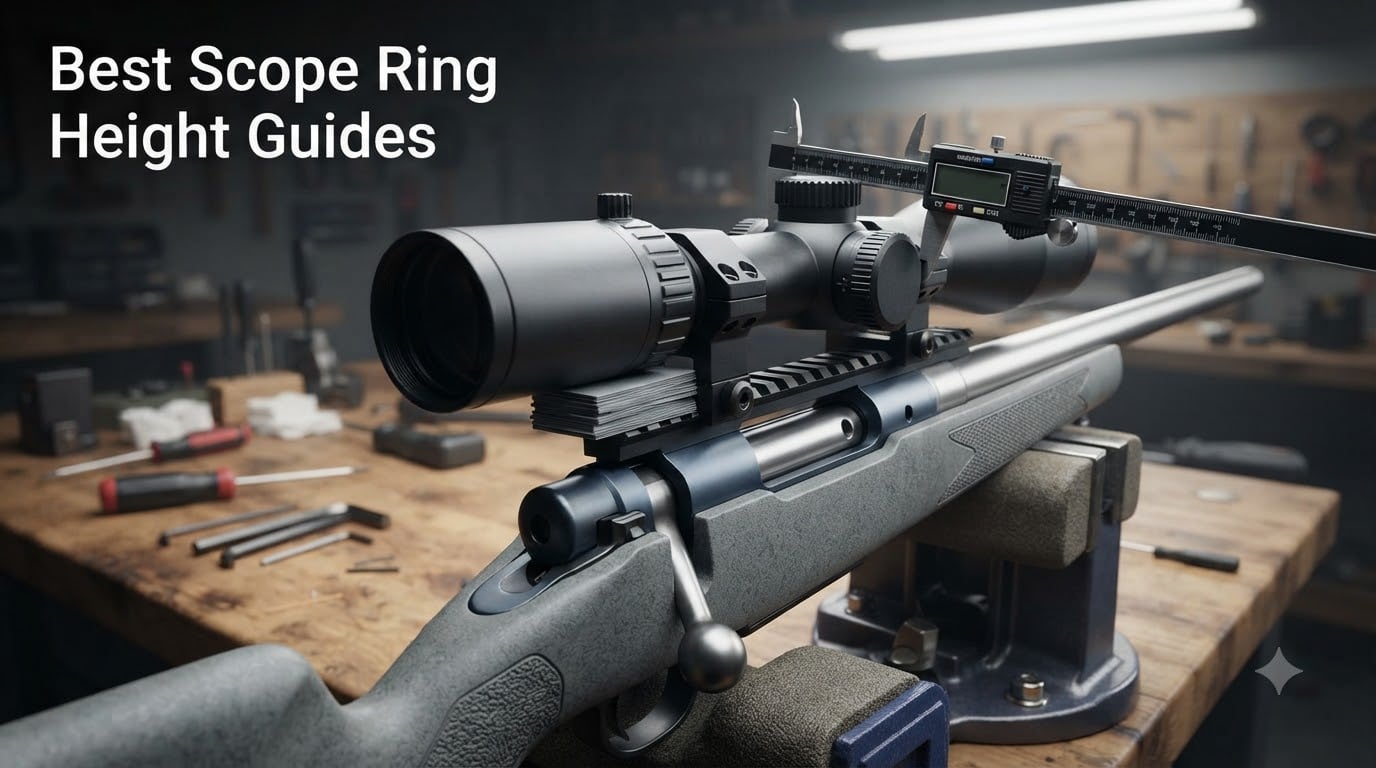
Choosing the right scope ring height is one of those small details that decides whether your rifle feels natural in the shoulder or forces you into an awkward head position every time you mount up. After helping dozens of shooters dial in their optics over the last few years, our team has seen more accuracy problems traced back to wrong ring height than to bad glass. This scope ring height guide walks you through the math, the measurement methods, and the comfort trade-offs so you can mount your optic once and forget it.
Below you will find a comprehensive scope ring height chart covering 1-inch, 30mm, and 34mm tubes, the exact formula to calculate your ideal height, and practical examples for AR-15s, bolt actions, and hunting rifles.
Scope ring height is the vertical distance from the top of your rifle’s mounting rail (Picatinny or Weaver) to the center of your riflescope tube. It is the single number that determines how high your optic sits above the bore, and it directly controls three things: clearance between the objective bell and the barrel, your natural head position behind the scope, and the safety margin around the recoil path.
When ring height is wrong, every shot becomes a compromise. Rings too low force the objective bell into the barrel, or push your head so far forward that eye relief collapses and you risk scope-bite on recoil. Rings too high stretch your neck, break your cheek weld, and turn a precision rifle into a wobbly mess.
The right scope ring height comes from three inputs: objective lens diameter, tube diameter (1 inch, 30mm, or 34mm), and your body’s geometry. The first two are fixed numbers you can measure with calipers. The third is the one most guides skip, and it is the one that matters most once you are behind the gun.
Ring height is sold in four standard categories. Each one is a height range measured from the rail top to the tube centerline, and each suits a different objective size.
Low rings (0.77 to 0.87 inch): Designed for traditional bolt action rifles with slim objective bells. Low rings work with objectives up to about 40mm and keep the scope tucked close to the barrel for a classic European-style mount.
Medium rings (0.90 to 1.10 inch): The workhorse of the category. Medium scope rings handle objectives from 40mm up to roughly 50mm on a 1-inch tube and 44mm on a 30mm tube. Most factory hunting setups and traditional bolt guns fit medium rings perfectly.
High rings (1.20 to 1.45 inch): Built for 50mm-plus objectives on 30mm tubes and 56mm-plus objectives on 1-inch tubes. High rings also provide clearance for AR-15 front sights when the rear sight is removed but the front post stays in place.
Extra-high rings (1.50 inch and up): Reserved for specialized setups. You will see them on long-range rigs with 56mm objectives on 34mm tubes, AR-15 builds that must clear fixed front sights, and some precision chassis systems.
The key insight here is that ring height is not about picking the lowest option. It is about picking the shortest ring that still gives the objective bell safe clearance and your head a natural position.
This chart combines objective diameter, tube size, and recommended ring height in one place. Use it as your first stop before calculating exact measurements.
| Objective Diameter | 1-Inch Tube Ring Height | 30mm Tube Ring Height | 34mm Tube Ring Height |
|---|---|---|---|
| 40mm | Low (0.77 to 0.87 in) | Low to Medium (0.85 to 0.95 in) | N/A (rare combination) |
| 42mm | Low to Medium (0.87 to 0.97 in) | Medium (0.95 to 1.05 in) | Medium (1.00 to 1.10 in) |
| 44mm | Medium (0.97 to 1.05 in) | Medium (1.00 to 1.10 in) | Medium (1.05 to 1.15 in) |
| 50mm | Medium to High (1.10 to 1.20 in) | High (1.20 to 1.35 in) | High (1.30 to 1.45 in) |
| 56mm | High (1.35 to 1.50 in) | High to Extra-High (1.45 to 1.60 in) | Extra-High (1.55 to 1.70 in) |
For a 50mm objective, you almost always need medium rings at a minimum on a 1-inch tube and high rings on a 30mm tube. Going lower than the chart suggests usually forces the objective bell into the barrel or crams your eye against the ocular lens.
Tube diameter affects how much vertical space your scope ring has to work with, because the ring has to wrap around a wider or narrower tube. A 30mm tube adds about 0.04 inch of internal diameter over a 1-inch tube, and a 34mm tube adds another 0.08 inch on top of that.
For the same objective lens, a 30mm scope needs taller rings than a 1-inch scope, and a 34mm scope needs taller rings still. That is why a 50mm objective on a 30mm tube calls for high rings, while the same 50mm objective on a 1-inch tube often fits in a medium ring.
If you are switching between tube sizes on the same rifle, plan on adjusting ring height by roughly 0.10 to 0.15 inch per step up in tube diameter. Many shooters who own both 1-inch and 30mm versions of similar scopes are surprised by how much that difference matters.
Will 30mm scope rings fit a 1-inch scope? No, they will not. The internal diameter of a 30mm ring is too small for a 1-inch tube. You need 1-inch rings for 1-inch scopes. The reverse also fails: 1-inch rings leave a 30mm tube rattling around. Always match ring internal diameter to tube diameter exactly.
Charts get you close. The formula gets you exact. Our team uses this same method on every precision build, and it works for any rifle, any scope, any rail height.
The scope ring height formula is:
Required Ring Height = (Objective Outer Diameter / 2) + Barrel-to-Rail Clearance + Mounting Base Thickness
Here is how each piece is measured.
Example for a 50mm objective on a 30mm tube on a standard Picatinny base: Objective radius (1.05) + clearance (0.15) + base thickness (0.25) – tube radius (0.59) = 0.86 inch minimum ring height. Add 0.10 inch of comfort margin and you land at roughly 0.96 inch, which sits in the high end of medium rings.
For an AR-15 build with a 56mm objective on a 30mm tube, you must also clear the front sight post. Add 0.30 inch for the front sight tower to your clearance number, and you end up needing rings in the 1.40 to 1.55 inch range, which is firmly in extra-high territory.
The math gives you a minimum safe ring height. Comfort usually demands a bit more. After running our team through dozens of builds, the pattern is clear: shooters who mount as low as the math allows often come back a year later asking how to add height because their cheek weld never felt right.
Cheek weld is the consistent contact between your cheekbone and the stock comb when the rifle is shouldered. A good cheek weld lines up your dominant eye directly behind the ocular lens with full field of view and the correct eye relief. A bad cheek weld forces your head to cant, your eye to wander, or your neck to crane.
Eye relief is the distance from your eye to the ocular lens, and most scopes want 3 to 4 inches. If rings are too low and your head naturally settles closer to the stock, eye relief collapses and you risk scope-bite from the eyepiece recoiling into your brow. If rings are too high and your head lifts to reach the ocular, you lose the cheek weld and your groups open up at distance.
Our recommendation: stack playing cards or poker chips under the scope at the bench until your cheek naturally lands on the stock with full field of view. Measure that stack. That stack height is your real number, and it is usually 0.10 to 0.20 inch taller than the math suggests.
If you want to see how ring height interacts with stock comb height and cheek piece design, our article on how to choose scope rings by height goes deeper into the fit process.
Theory is useful, but rifles are concrete. Here are three common setups with the ring height that works in real life.
Traditional bolt action with 40mm to 44mm objective on 1-inch tube: A Remington 700, Winchester Model 70, or Savage 110 with a hunting scope like a 3-9x40mm fits perfectly on low to medium rings (0.87 to 0.97 inch). This is the classic European mount, with the scope tucked tight against the barrel and the comb of the stock.
AR-15 with 50mm to 56mm objective on 30mm tube: An AR with a free-float handguard needs rings that clear both the barrel and, often, a fixed front sight. With the front sight removed, high rings (1.30 to 1.45 inch) work for most 50mm objectives. With the front sight post still in place, you need extra-high rings (1.50 to 1.60 inch) to clear the tower.
Long-range precision rifle with 56mm objective on 34mm tube: A custom bolt action in 6.5 Creedmoor or .28 Nosler with a 5-25x56mm scope on a 20 MOA base needs extra-high rings (1.55 to 1.70 inch). At this level you are usually buying a one-piece Picatinny mount rather than separate ring-and-base sets because the precision and rigidity are worth it.
For builds where the rings leave any micro-marring on the scope tube, our write-up on the best scope ring lapping kits shows how to bed rings perfectly to your specific tube.
Even with the right chart and the right formula, real-world setups sometimes miss. Here is how to recognize and fix the two most common problems.
Symptoms of rings too low: The objective bell contacts the barrel (you can feel it when you cycle the bolt or rotate the barrel). Your eye relief feels short and the field of view looks like you are looking through a keyhole. You get scope-bite on the eyebrow after recoil.
Fix for rings too low: Step up one ring height category. If you have low rings in 0.85 inch, move to medium in 1.00 inch. If you are already in medium, jump to high. Do not try to shim or spacer-stack low rings into medium range, because the geometry will be off and your scope will not return to zero.
Symptoms of rings too high: You have to lift your head off the stock to find the ocular lens. Your cheek weld slips during follow-up shots. The scope feels tippy and the rifle wobbles when you transition between targets.
Fix for rings too high: Step down one ring height category, or lower your stock comb with a different cheek piece configuration. Many precision shooters use an adjustable cheek riser specifically to match scope ring height without changing the rings themselves.
If bolt clearance is the issue on a bolt action with a 50mm-plus objective, you may also need to look at the bolt handle geometry. Some aftermarket handles throw lower and let you drop back down a ring height category without losing clearance.
The best scope ring height is the shortest ring that gives your objective bell safe clearance (at least 0.10 inch above the barrel) and lets your cheek weld naturally on the stock with full field of view and 3 to 4 inches of eye relief. For most traditional bolt actions with a 40mm to 44mm objective, that is medium rings (0.90 to 1.10 inch). For 50mm-plus objectives on 30mm tubes, it is high rings (1.20 to 1.45 inch).
For a 50mm objective on a 1-inch tube, you typically need medium to high rings in the 1.10 to 1.20 inch range. For a 50mm objective on a 30mm tube, plan on high rings in the 1.20 to 1.35 inch range. For a 50mm objective on a 34mm tube, high rings in the 1.30 to 1.45 inch range are the safe starting point.
A 56mm objective needs high rings at minimum on most setups. On a 1-inch tube, plan on 1.35 to 1.50 inch. On a 30mm tube, expect 1.45 to 1.60 inch. On a 34mm tube, you will usually need extra-high rings at 1.55 to 1.70 inch. AR-15 platforms with a fixed front sight post will need to add another 0.30 inch of clearance on top of these numbers.
A 42mm objective fits low to medium rings on a 1-inch tube (0.87 to 0.97 inch), medium rings on a 30mm tube (0.95 to 1.05 inch), and medium rings on a 34mm tube (1.00 to 1.10 inch). This is one of the most versatile objective sizes and works well on traditional hunting setups without forcing extra height into the rig.
If your rings are too low, step up one ring height category (low to medium, medium to high). Do not try to shim or spacer-stack to gain height because the scope will not return to zero. Confirm the new rings with the math formula: objective radius plus 0.10 to 0.15 inch clearance plus base thickness minus tube radius. If your eye relief still collapses after stepping up, consider a different stock comb height instead.
Picking the right scope ring height comes down to two questions: what does the math say is the safe minimum, and what does your cheek tell you is comfortable. Start with the scope ring height chart and formula in this guide to find your minimum, then add 0.10 to 0.20 inch for the comfort margin your body wants.
For a traditional hunting bolt action with a 40mm to 44mm objective, choose medium rings around 1.00 inch and call it done. For an AR-15 with a 50mm-plus objective on a 30mm tube, go with high rings around 1.35 inch and check that you clear the front sight post. For a long-range precision rifle with a 56mm objective on a 34mm tube, plan on extra-high rings in the 1.55 to 1.70 inch range, ideally in a one-piece mount.
Take 15 minutes with your actual rifle and scope, stack some cards or chips under the optic, and confirm your eye relief and cheek weld before you buy. That hands-on test will tell you more than any chart. For a deeper dive into the fit process, revisit our how to choose scope rings by height walkthrough any time you are starting a new build in 2026.